
Summarize and analyze this article with:
- What Are Client Accounting Services (CAS)?
- What's Driving the Demand for CAS in 2026?
- Capacity Has Become a Strategic Priority
- Client Expectations Have Expanded Beyond Compliance
- Growing Demand for Advisory & Virtual CFO Services
- Recurring Revenue Is Reshaping Firm Economics
- Technology Is Lowering Barriers to Scale
- Automation & Integrated Technology Adoption
- CAS Is Becoming a Core Service Line
- Need additional capacity to grow your practice?
- How CPA Firms Scale Using CAS Without Increasing Overhead
- Outsourced Accounting for CPA Firms: Building Capacity Without Adding Overhead
- Why CPA Firms Across the USA Choose Unison Globus for Offshore CAS Support
- Building scalable accounting services is easier with the right CAS outsourcing partner by your side.
- Frequently Asked Questions About Client Accounting Services (CAS) for CPA Firms
- When should a CPA firm consider adopting Client Accounting Services (CAS)?
- What is the biggest challenge in scaling CAS for CPA firms?
- How can CPA firms manage increasing CAS workload efficiently?
- Why are CPA firms shifting toward outsourced accounting models?
- How can Unison Globus support CPA firms in scaling CAS?
What if you could spend less time managing day-to-day accounting tasks and more time growing your firm?
According to the 2024 CPA.com and AICPA CAS Benchmark Survey, CPA firms with Client Accounting Services (CAS) practices reported a median growth rate of 17%, making CAS one of the fastest-growing service areas in public accounting.
For many CPA firms, growth is often limited not by demand but by capacity. Teams are buried under outsourced bookkeeping for CPA firms, reconciliations, reporting deadlines, and other recurring tasks that leave little room for strategic planning, advisory services, or client acquisition.
This is where Client Accounting Services (CAS) is changing the game.
In 2026, client accounting services for CPA firms have evolved from an additional service offering into a scalable growth model. By combining recurring accounting services, automation, AI in client accounting services, and outsourced accounting for CPA firms, practices can expand their client base, increase revenue, and deliver higher-value advisory services without proportionally increasing headcount.
For firms looking to build scalable accounting services, CAS provides a framework for predictable revenue, stronger client relationships, and sustainable growth.
In this article, we’ll explore how CPA firms scale using CAS, the role of CAS outsourcing services for CPAs and AI, and the strategies firms are using to build a client accounting services practice that supports long-term success.
What Are Client Accounting Services (CAS)?
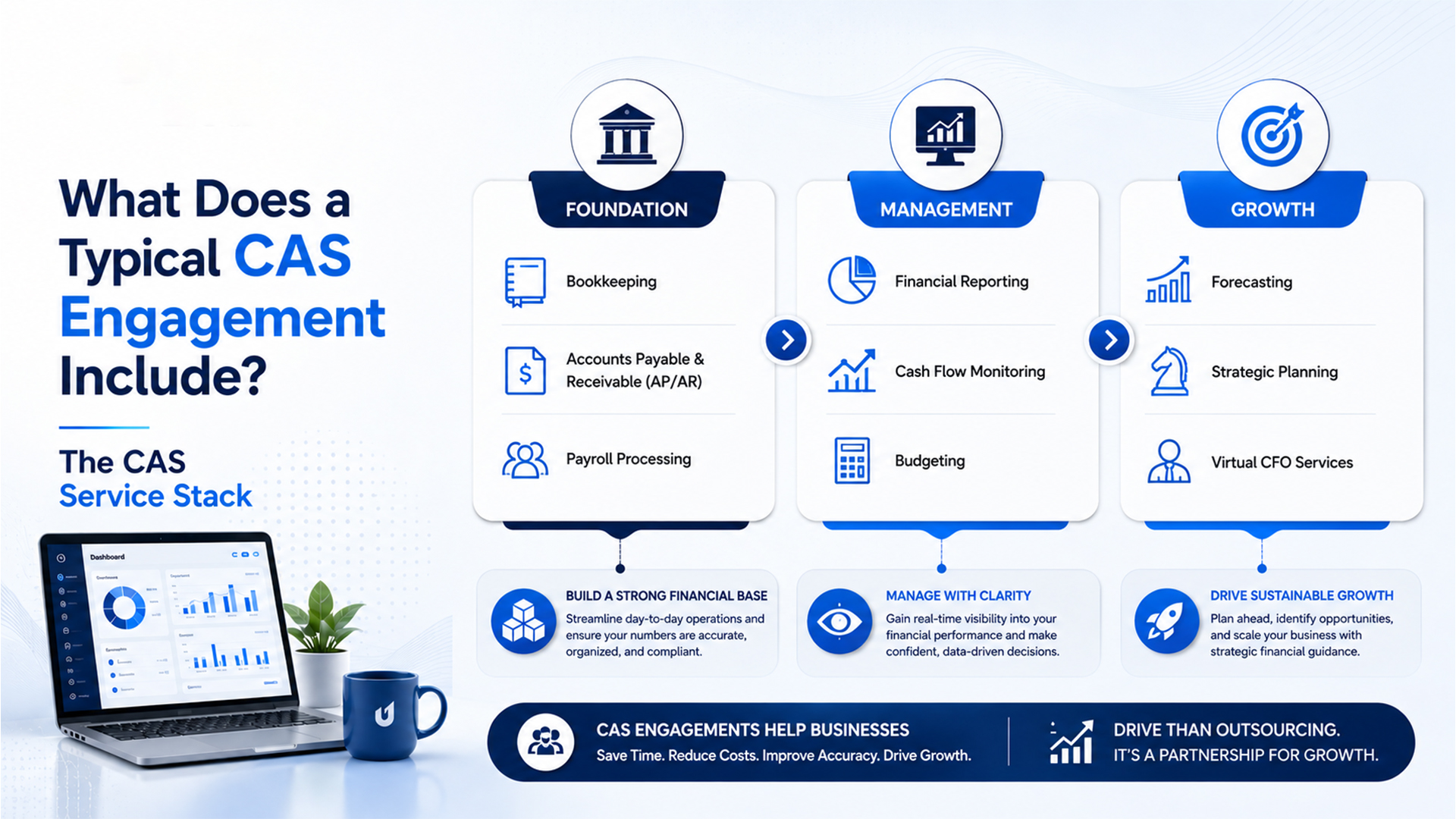
Client Accounting Services (CAS) are a suite of accounting, financial management, and advisory services delivered to clients on an ongoing basis. Instead of engaging a CPA firm for individual tasks or seasonal requirements, businesses receive continuous support for their day-to-day financial operations through a single service model.
The exact mix of services varies by client. Some businesses may only require bookkeeping and reporting support, while others may engage a CPA firm for advanced planning, forecasting, and CFO-level guidance.
Together, these services provide a centralized approach to managing a company’s financial operations.
What's Driving the Demand for CAS in 2026?
The growth of Client Accounting Services (CAS) reflects several changes taking place across the accounting profession. While CAS was once viewed as an additional service offering, it is increasingly being adopted as firms respond to capacity constraints, evolving client expectations, and new opportunities created by technology.
Capacity Has Become a Strategic Priority
For many CPA firms, the challenge is no longer generating demand for services. It is creating the capacity to deliver them efficiently and profitably.The profession continues to face talent-related pressures, including a shrinking pipeline of accounting graduates and ongoing recruitment challenges. According to the AICPA Trends Report, accounting degree completions have declined significantly over the past decade, prompting concerns about the long-term availability of accounting talent.
As a result, firms are placing greater emphasis on service models that improve operational efficiency and allow teams to support growth without a proportional increase in headcount. This shift has contributed to the growing adoption of CAS for CPA firms, particularly among firms looking to scale their service offerings while maintaining quality.
Client Expectations Have Expanded Beyond Compliance
Businesses today expect more from their accounting partners than accurate records and timely filings.Increasingly, they are looking for support with budgeting, forecasting, cash flow management, profitability analysis, and strategic planning. They want financial information that not only explains past performance but also helps guide future decisions.
This shift is changing the role accounting firms play within their clients’ businesses. Services that were once considered value-added offerings are becoming an expected part of the client experience, driving greater demand for ongoing accounting and advisory support.
Growing Demand for Advisory & Virtual CFO Services
Across the profession, firms are expanding advisory and virtual CFO services as clients seek more frequent financial insights, strategic guidance, and decision-making support.
Recurring Revenue Is Reshaping Firm Economics
One of the most significant advantages of client accounting services for CPA firms is the recurring revenue model.Unlike traditional compliance engagements that are often concentrated around specific deadlines, CAS engagements are typically structured as ongoing monthly relationships. This creates more predictable revenue streams while encouraging deeper, year-round client engagement.
Industry data reflects the growing importance of this model. According to the 2024 CPA.com and AICPA CAS Benchmark Survey, participating firms reported a median growth rate of 17%, while median CAS revenue increased by 61% compared to the previous benchmark survey.
As firms continue to expand their advisory capabilities, many industry leaders view CAS as an increasingly important pillar of long-term growth.
CAS is becoming the third leg of the stool.
Technology Is Lowering Barriers to Scale
Technology has made CAS significantly easier to deliver and manage at scale.Cloud accounting platforms, workflow automation tools, and AI in client accounting services are helping firms reduce manual effort, improve consistency, and increase access to real-time financial information. Tasks that once required extensive administrative work can now be completed more efficiently, allowing professionals to focus on analysis, planning, and client advisory services.
Automation & Integrated Technology Adoption
Leading CAS practices continue to invest in automation, workflow standardization, and integrated technology ecosystems to improve operational efficiency and support scalable growth.
CAS Is Becoming a Core Service Line
Perhaps the clearest indicator of market direction is how firms now position CAS within their practices.Rather than viewing CAS as a supplementary offering, many firms are integrating it into their long-term growth strategies. Discussions have shifted from whether firms should offer CAS to how they can standardize delivery, expand advisory capabilities, and increase profitability.
As client expectations continue to evolve and operational pressures persist, CAS is increasingly being recognized as a practical framework for delivering higher-value services while supporting sustainable growth.
Need additional capacity to grow your practice?
How CPA Firms Scale Using CAS Without Increasing Overhead
As demand for Client Accounting Services (CAS) continues to grow, firms are looking for ways to expand their client base and service offerings without increasing costs at the same pace. While every firm takes a different approach, successful CAS for CPA firm practices often share a common characteristic: they are designed to support growth through repeatable processes, recurring engagements, advisory services, and efficient resource allocation.
-
Building Scalable Accounting Services Through Standardization
One of the most effective ways to build scalable accounting services is through standardization.
Consider two bookkeeping clients. One receives reports on the 5th of every month, while the other receives them on the 15th. One has a custom reporting package, while the other follows a completely different process.
Now multiply that across 50 clients.
As the number of exceptions increases, so does the complexity of delivering services efficiently. This is why many firms standardize onboarding procedures, reporting schedules, service packages, and workflows as their CAS practice grows.
Standardization reduces administrative effort, improves consistency, and makes it easier for teams to manage a larger client portfolio without compromising service quality. It is also a common characteristic of mature CAS practices, with industry benchmarking consistently highlighting documented processes and standardized service delivery as key drivers of scalability.
-
Using Recurring CAS Engagements to Support Sustainable Growth
Unlike traditional compliance work, which is often tied to specific deadlines and filing periods, client accounting services for CPA firms are typically delivered through recurring monthly engagements.
Services such as bookkeeping, payroll processing, financial reporting, and cash flow monitoring create regular touchpoints with clients throughout the year. This recurring model provides greater revenue predictability while helping firms build stronger, longer-term client relationships.
It also gives firms better visibility into workloads and resource requirements, making growth easier to plan and manage over time.
The shift toward recurring revenue is one of the reasons CAS continues to attract investment from firms looking to reduce dependence on seasonal compliance work and build more stable growth models.
-
Expanding From Transaction Processing to Advisory Services
Many firms begin their CAS journey by providing bookkeeping, payroll, and financial reporting support. As those relationships mature, opportunities often emerge to deliver higher-value services.
With access to timely financial data and a deeper understanding of a client’s business, firms are better positioned to support budgeting, forecasting, profitability analysis, cash flow planning, and strategic decision-making.
Across the profession, advisory services are increasingly viewed as the natural progression of CAS. Once firms have access to accurate and timely financial information, they are in a stronger position to help clients interpret that information and act on it.
This evolution from transaction processing to advisory support is one of the key benefits of CAS for CPA firms. It increases the value of each client relationship while strengthening the firm’s role as a trusted business advisor.
-
Using Outsourced Accounting for CPA Firms to Increase Capacity
Even the most efficient processes have limits.
As client demand increases, many firms reach a point where existing teams can no longer absorb additional work without affecting turnaround times or service quality.
To address this challenge, firms are increasingly using outsourced accounting for CPA firms to support functions such as bookkeeping, reconciliations, payroll processing, accounts payable, and financial reporting.
The growing adoption of outsourced support reflects a broader shift in how firms approach capacity planning. Rather than hiring ahead of demand, many are building flexible staffing models that can scale alongside client growth.
By shifting routine and time-intensive tasks to dedicated support teams, firms can free up internal resources for client communication, advisory services, and business development. This approach enables firms to increase capacity while maintaining operational efficiency.
-
Creating a CAS Growth Model That Scales
The firms that scale CAS successfully tend to focus less on adding services and more on creating systems that can be repeated, measured, and improved over time.
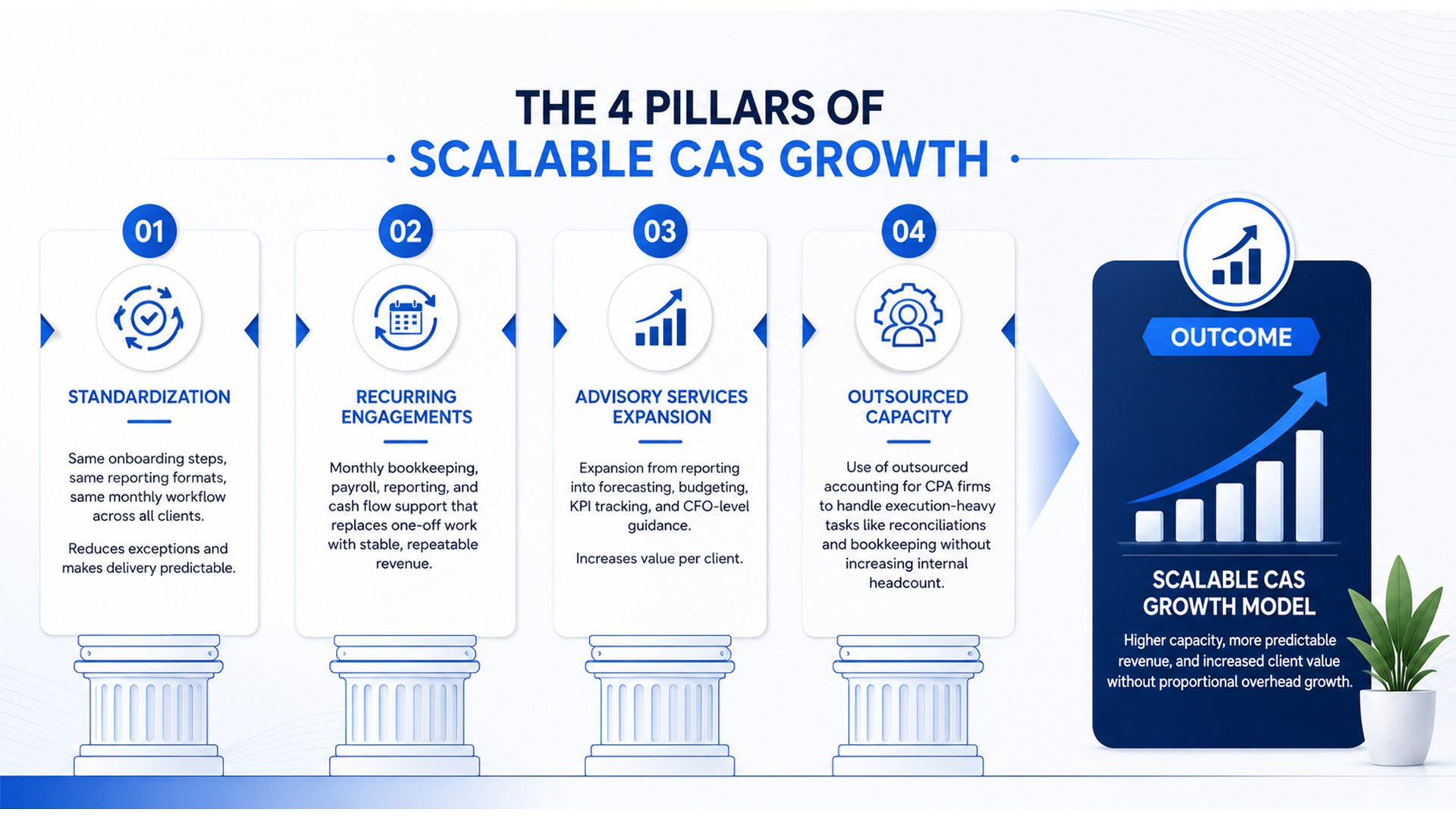
Standardized processes reduce complexity. Recurring engagements create predictable revenue. Advisory services deepen client relationships. Strategic staffing solutions help firms expand capacity.
Together, these elements form the foundation of scalable accounting services and demonstrate how CPA firms scale using CAS without increasing overhead at the same rate as growth.
Outsourced Accounting for CPA Firms: Building Capacity Without
Adding Overhead
Growth in CAS for CPA firms eventually comes down to one constraint: people.
Recruiting qualified accounting staff is competitive and slow. Hiring ahead of demand is a financial risk. And stretching existing teams across outsourced bookkeeping for CPA firms, reconciliations, payroll, and reporting leaves little room for the advisory work that drives the most client value.
CPA outsourcing services USA firms rely on resolve this without the overhead of headcount expansion. Rather than hiring generalists to handle execution-heavy tasks, high-performing CAS practices separate transactional work from advisory work and staff each accordingly.
The functions best suited to outsourced support are high-volume and rules-based: bookkeeping, AP/AR management, payroll processing, month-end close preparation, and management reporting. Shifting these to dedicated external teams frees internal staff for client communication, financial analysis, and strategic advisory, which is the work that deepens relationships and grows revenue.
This is not a temporary workaround. As stated above, the 2024 CPA.com and AICPA CAS Benchmark Survey consistently shows that faster-growing CAS outsourcing services for CPAs invest more heavily in operational infrastructure as a deliberate part of their growth model. The result is a practice that absorbs more clients, maintains service quality, and delivers scalable accounting solutions for CPA firms without a proportional increase in fixed costs.
As your CAS practice grows, capacity often becomes the biggest constraint. Firms looking to scale are increasingly turning to outsourced accounting for CPA firms to manage execution-heavy work efficiently. In addition, choosing to hire offshore accountants for CPA firms allows practices to expand capacity without the risks of local hiring.
Why CPA Firms Across the USA Choose Unison Globus for Offshore
CAS Support
Not all outsourcing partners are built for client accounting services for CPA firms workflows.
Unison Globus provides offshore CAS support for CPA firms looking to expand capacity without local hiring constraints. Their teams are trained in the cadence of month-end close, multi-client bookkeeping standards, and the quality benchmarks that firm partners rely on, which means less onboarding friction and faster time to productivity.
Unlike shared staffing models, firms that want to hire offshore accountants for CPA firms work with dedicated professionals assigned to their practice. Over time, those teams develop familiarity with client-specific charts of accounts, reporting formats, and business context, functioning as a true extension of the firm rather than a transactional vendor.
Support spans the full CAS stack: bookkeeping, AP/AR, payroll, month-end close, and management reporting. Teams work directly within the firm’s existing platforms, including QuickBooks Online, Xero, and Karbon, so no parallel workflows or documentation bridges are needed.
Engagement scales alongside client growth, adding capacity incrementally rather than requiring firms to commit to fixed arrangements ahead of revenue. For practices already built on standardization and recurring engagements, Unison globus delivers the scalable accounting services and accounting outsourcing USA firms need to keep growing without the overhead. With 48-hour onboarding, dedicated offshore teams, and ISO 27001-certified data security frameworks, we enables CPA firms to scale their CAS operations efficiently while reducing costs by up to 70% compared to traditional hiring models.
Growing CPA practice is hard enough without worrying about capacity. Let us handle the execution so your team can focus on what they do best. Get in touch with us today, and let’s build something great together.
Building scalable accounting services is easier
with the right CAS outsourcing partner by your side.
Frequently Asked Questions About Client Accounting Services (CAS) for CPA Firms
CPA firms should adopt CAS when they want to move beyond seasonal compliance work and build consistent, recurring revenue through ongoing client engagement.
The biggest challenge is managing capacity, as growing client demand often puts pressure on internal teams and delivery timelines.
Firms can manage workload by standardizing processes, using automation, and leveraging outsourced accounting support to handle routine tasks.
Outsourced accounting helps firms handle execution-heavy work more efficiently, allowing internal teams to focus on advisory services and client relationships.
Unison Globus supports CPA firms by providing dedicated offshore teams trained in CAS workflows, helping manage execution-heavy tasks like bookkeeping, payroll, and reporting. This allows firms to increase capacity, maintain consistency, and focus more on advisory services and client growth.

[gtranslate]