
Categories
BAS Home Aus

BAS Compliance Review: Common Errors Australian Accounting Firms Should Address Before Year-End

A BAS Compliance Review helps Australian accounting firms identify GST, PAYG and reconciliation issues before year-end. For firms handling high BAS volumes, identifying recurring errors early can reduce review bottlenecks and improve compliance outcomes.

Consider a Melbourne practice reviewing BAS compliance for 180 quarterly clients. As the firm prepares for the FY2027 year-end cycle, a GST coding inconsistency across several construction clients has survived three routine review cycles and now surfaces during year-end reconciliation.

The team can correct the issue. However, doing so requires senior review time, additional client queries and a review of earlier BAS periods. For firms considering outsourced BAS services, the more useful question is where defined support can strengthen checking without replacing professional judgement.

BAS preparation creates the reported figures. BAS reviews whether those figures make sense against client records, prior periods and underlying transactions. When deadlines are compressed, firms can protect preparation output while reducing time for deeper exception checking. A robust workflow connects preparation, reconciliation, exception identification, professional review and lodgement. 

What Is a BAS Compliance Review?

A BAS compliance review is the process of checking GST, PAYG withholding, PAYG instalments, reconciliations, supporting documentation and reporting accuracy before BAS lodgement.

Year-End BAS Review Starts Where Small Errors Become Review Problems

A BAS review becomes more demanding when small issues sit across different parts of the file. GST coding, reconciliations, payroll records and supporting documents may look manageable in isolation, but together they can consume significant senior review time.


A controlled BAS workflow should move through:

  • Preparation: Compile transactions, payroll information, adjustments and supporting records.
  • Reconciliation: Compare BAS figures with the general ledger, bank activity and relevant sub-ledgers.
  • Exception identification: Isolate unusual movements, missing documentation and unresolved items.
  • Professional review: Apply judgement to material or technically complex matters.
  • Lodgement: Finalize the BAS after the practice resolves outstanding review points.

The objective is not to check every transaction manually. It is to ensure the workflow consistently identifies the items that require deeper review. Many Australian accounting firms use dedicated offshore BAS review support from Unison Globus Australia to strengthen reconciliation and exception checking processes while retaining full professional oversight.

Struggling with BAS review bottlenecks during peak periods? Explore how dedicated offshore BAS support can help your firm improve review capacity and turnaround time.

Why BAS Errors Survive the Review Process

Compressed review cycles change what reviewers can realistically investigate. A senior accountant checking twelve BAS files in two hours may confirm totals and obvious movements but have little time to trace an unusual transaction back to its source document.


The difference matters because arithmetic checks and exception checks require different levels of attention.


Preparation capacity and review capacity also solve different problems. Adding another preparer can increase throughput, but it does not automatically create more senior time to investigate unusual transactions, challenge assumptions or resolve reconciling items.


When a firm expands preparation without strengthening review capacity, senior staff can end up reconstructing work instead of reviewing it. That creates more rework and leaves less time for genuinely unusual issues.


Recurring errors expose the same weakness more clearly. If a GST coding problem reaches the BAS once and the workflow never introduces a control around that transaction type, the same issue can return in the next reporting period.

Insight:

A recurring BAS error often tells a firm more about its control points than its staff knowledge. The useful question becomes: which review step should I identify the issue earlier?

What the ATO Data Says About GST Compliance Risk

The ATO’s GST administration data provides useful context for firms reviewing their controls. For 2022–23, the ATO estimated a gross GST gap of 12.6% of theoretical GST and a net gap of $7.9 billion, or 9.0%. The GST gap measures the difference between GST collected and the amount the ATO estimates it would collect if taxpayers fully complied with the law.


For an accounting firm, the more useful application of that context is to examine where routine BAS workflows can allow GST issues to pass through preparation and into review.


Which recurring control gaps could allow an incorrect BAS figure to pass through preparation and review?

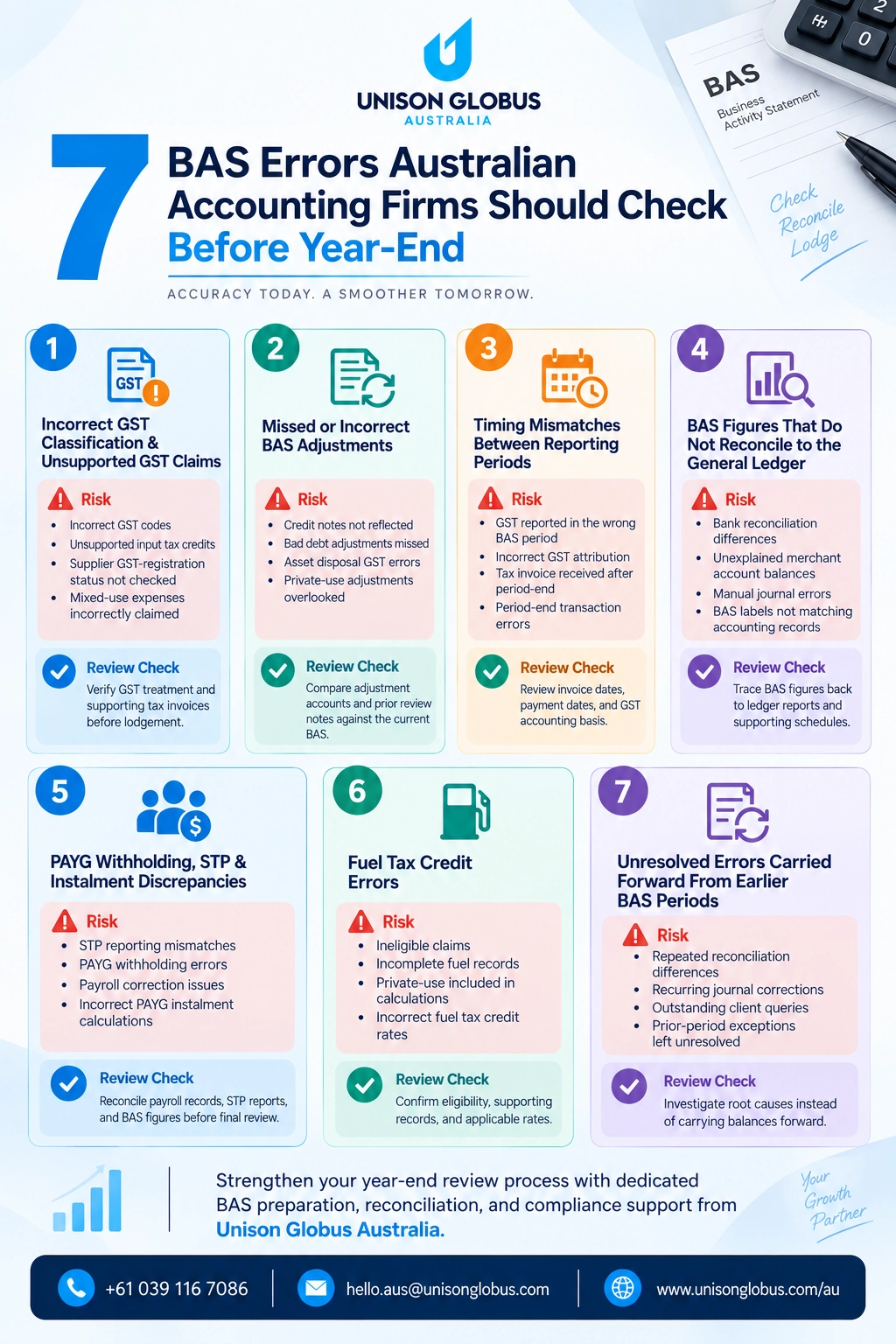
7 BAS Errors to Check Before Year-End

The following checks focus on errors that can survive routine processing when firms rely heavily on recurring workflows or compressed review cycles.

1. Incorrect GST Classification and Unsupported GST Claims

A GST error can start with an incorrect tax code and continue through BAS preparation when the team does not verify the underlying transaction.

Where the risk appears:

  • GST classification: Check whether the tax code correctly reflects taxable, GST-free or input-taxed treatment, and whether the acquisition supports an input tax credit.
  • Unsupported claims: The practice cannot substantiate an input tax credit because it does not hold sufficient supporting documentation. For purchases of more than $82.50 including GST, the practice generally needs to hold a valid tax invoice before claiming the GST credit.
  • Supplier status: The supplier does not hold GST registration where registration affects the claim.
  • Mixed-use expenses: The bookkeeping process claims the full GST amount even though the expense has a private component.

Example: A client purchases equipment partly for business and partly for private use. The bookkeeping file claims the full input tax credit without documenting the business-use proportion. During the year-end BAS review, the firm needs to verify the claim against the underlying evidence and applicable GST treatment.

✓ What to do

Include unusual tax codes, high-value purchases, new suppliers and mixed-use expenses in the year-end BAS review and verify the supporting evidence before finalising the BAS.


2. Missed or Incorrect BAS Adjustments

Adjustments can arise from credit notes, private-use changes, asset disposals and GST bad-debt adjustments. Each situation requires the practice to confirm the relevant GST treatment before finalising the BAS.


Where the risk appears:

  • Credit notes: Previous GST treatment no longer reflects the revised transaction.
  • Bad debts: For clients that account for GST on a non-cash basis, confirm that the client attributed GST on the taxable supply and that the debt remains unpaid because the client has written it off as bad or the debt has remained overdue for 12 months or more. The ATO’s GST adjustment guidance sets out these conditions and excludes the Division 21 bad-debt adjustment for entities that account for GST on a cash basis.
  • Asset disposals: The GST treatment of a business asset disposal does not flow correctly into the BAS.
  • Private use: Business expenses or assets also have a private component.

Review focus: Compare adjustment accounts, credit notes, asset disposals, private-use entries and prior-period review notes with the current BAS. Escalate items that require technical judgement before finalising the activity statement.


3. Timing Mismatches Between Reporting Periods

Timing errors can move GST into the wrong BAS period even when the transaction itself contains the correct amount.


Where the risk appears:

  • GST attribution: Check whether the team applied the client’s cash or non-cash GST accounting basis correctly when determining the relevant BAS period.
  • Tax invoice timing: Confirm that the practice holds the required tax invoice when it claims an input tax credit on the BAS, particularly where invoice timing crosses a reporting period.
  • Period-end transactions: Review transactions close to the reporting-period boundary where payment, invoice issuance or tax-invoice availability could affect GST attribution.
  • Manual journals: Period-end entries affect GST balances without adequate supporting documentation.

Example: A supplier issues an invoice before quarter-end, but the practice receives the supporting tax invoice after the reporting period closes. The reviewer checks the client’s GST accounting basis, the applicable attribution period and whether the practice held the tax invoice when lodging the BAS before deciding which period should include the input tax credit.

✓ What to do

Include GST attribution in the BAS preparation and review support process. Check significant period-end transactions against the client's GST accounting basis, payment and invoice dates, tax-invoice availability and BAS period before escalating unexpected timing differences.


4. BAS Figures That Do Not Reconcile to the General Ledger

A BAS can balance internally while still failing a broader reconciliation with the accounting records. BAS reconciliation and compliance services should therefore trace reported figures back to the general ledger, control accounts and supporting schedules. Poor reconciliations often originate from underlying bookkeeping issues that were not addressed earlier in the reporting cycle.


Where the risk appears:

  • Bank accounts: GST-related transactions do not agree with reconciled bank activity.
  • Merchant facilities: Clearing balances or transaction fees remain unexplained.
  • GST-relevant loan entries: Check fees, charges and other loan-related transactions for the correct GST treatment rather than treating the loan balance itself as a GST item.
  • Manual journals: Entries bypass normal transaction workflows.
  • BAS labels: Reported figures do not trace cleanly to ledger reports.

Example: The BAS reports the expected GST amount, but the GST control account carries a recurring unexplained balance. The team clears the difference with a journal each quarter instead of investigating its source.

✓ What to do

Trace significant BAS labels back to the general ledger and supporting schedules. Investigate recurring differences rather than repeatedly correcting them.


5. PAYG Withholding, STP or Instalment Discrepancies

Payroll information can create BAS exceptions when STP reporting, payroll records and activity statement figures do not align. Payroll compliance and STP accuracy play an important role in reducing BAS review exceptions.


Where the risk appears:

  • STP reporting: Payroll totals differ from information reported through STP.
  • PAYG withholding: Withholding amounts do not reconcile with payroll records.
  • Payroll adjustments: Corrections or unusual pay runs create unexplained differences.
  • PAYG instalments: The instalment position no longer reflects the client’s expected business or investment income.

Example: A payroll correction changes PAYG withholding after the team prepares the BAS. The correction reaches the payroll records but does not flow into the figures used for BAS preparation.

What to do: Reconcile payroll, STP and PAYG withholding before final review. Check the client’s PAYG instalment calculation against expected liability and confirm whether the 2026–27 5% GDP adjustment applies to the method the client uses.

✓ What to do

Reconcile payroll, STP and PAYG withholding before final review. Check the client’s PAYG instalment calculation against expected liability and confirm whether the 2026–27 5% GDP adjustment applies to the method the client uses.


6. Fuel Tax Credit Errors Where Applicable

Fuel tax credits create an additional review point for eligible clients. Errors can arise from eligibility, fuel records, business use or rate application.


Where the risk appears:

  • Eligibility: The client’s activities do not meet the relevant requirements.
  • Fuel records: Quantities or supporting records do not adequately support the claim.
  • Business use: The calculation includes ineligible or private use.
  • Rates: The team applies an incorrect rate for the relevant period.

Review focus:

Treat fuel tax credits as an exception-based check. Confirm eligibility, fuel records, business use and the applicable rates before including the claim.

✓ What to do

Where the BAS includes a fuel tax credit claim, verify the supporting documentation, assess the calculation and confirm that the team applied the correct rate for the relevant claim period. Escalate any unusual or material claims for further review.


7. Unresolved Errors the Team Carries Forward from Earlier BAS Periods

A recurring unresolved BAS difference can indicate a control issue when the team repeatedly clears or carries it forward without identifying the underlying cause or determining the appropriate correction. A routine bookkeeping adjustment resolves a known transaction-level issue; a recurring unexplained difference requires investigation, ownership and escalation.


Where the risk appears:

  • Prior-period differences: Reconciliation items remain open.
  • Recurring journals: The same account requires repeated corrective entries.
  • Client queries: The practice continues requesting the same missing information.
  • Review notes: Previous exceptions remain unresolved.
  • Corrections: The team carries an earlier error forward instead of determining the appropriate correction.

Example: A GST control account has carried a small difference for three consecutive BAS periods. Each quarter, the preparation team posts a journal to clear the balance without identifying the original transaction causing the difference.

✓ What to do

Maintain an exception trail, assign ownership and determine the appropriate correction before the next BAS cycle. Where an earlier GST error requires correction, assess the applicable ATO correction rules rather than repeatedly clearing the difference.
What Year-End Workload Does to BAS Review Capacity

Year-end pressure can reduce the amount of time senior staff have available for BAS review. When senior staff receive a large group of BAS files together, they may spend more time locating missing information and resolving basic preparation issues. Many firms use outsourced accounting support to manage seasonal workload spikes without increasing permanent headcount.


That leaves less time for:

  • Trend analysis: Investigating unusual GST movements.
  • Reconciliation: Following differences across multiple accounts.
  • Exception review: Assessing unusual or technically complex transactions.
  • Client communication: Resolving questions before the lodgement deadline.
  • Professional judgement: Considering matters that require senior oversight.

The issue therefore concerns whether the practice has enough review capacity to assess BAS files after preparation, reconciliation and exception handling.

How Outsourced BAS Review Can Close These Checking Gaps

Outsourced BAS services can provide defined BAS preparation and review support within the firm’s existing preparation, reconciliation and checking workflow. Firms looking for broader support may also combine BAS processes with outsourced accounting and bookkeeping functions.


A controlled model can follow this sequence:

Preparation → Checking → Exception escalation → Internal professional review → Lodgement


The external team can support tasks such as:

  • Reconciliations: Compare BAS figures with ledger and supporting records.
  • Exception identification: Flag unusual GST treatment, missing documents and unexplained differences.
  • Adjustment checks: Identify potential BAS adjustments for internal assessment.
  • Payroll reconciliation: Compare payroll, STP and PAYG withholding information.
  • Prior-period review: Highlight recurring unresolved items.
  • Workpaper preparation: Organise supporting schedules and review notes for the firm’s team.

The handoff should give the firm a clear set of exceptions, reconciliations and supporting schedules to assess during professional review.

What Firms Should Check Before Outsourcing BAS Review & Finalisation

Outsourcing BAS review & finalisation requires more than checking whether a provider can process BAS files. Firms should assess the operating model itself.

Professional Responsibility and Supervision

The practice should establish:

  • Defined responsibilities: Document which tasks the provider performs and which decisions remain with the practice.
  • Escalation rules: Identify matters that require registered practitioner involvement.
  • Review controls: Set expectations for sampling, exception handling and feedback.
  • Auditability: Maintain a clear record of preparation, review comments and changes.

The practice should define where BAS preparation and review support ends and where its own professional review and decision-making begin. Before engaging a provider, the firm should also confirm whether the provider’s activities constitute a BAS service that requires TPB registration or fall within an applicable exemption. The TPB’s guidance on supervision, competency and quality management provides expectations for supervision arrangements, workflow oversight, review processes, file management, escalation pathways and quality controls. The TPB’s guidance on outsourcing and offshoring focuses on the additional considerations that arise when engaging external providers, including competency, supervision, client disclosure obligations and compliance with the Code of Professional Conduct.


Data Security and Offshore Processing

If the arrangement involves offshore processing, firms should assess:

  • Access controls: Limit system and file access according to role.
  • Data transfer: Establish secure methods for sharing client information.
  • Contractual controls: Set enforceable requirements for information handling, subcontracting and breach notification.
  • Audit trails: Maintain visibility over file access and changes.
  • Incident procedures: Confirm how the provider handles security incidents.

The OAIC’s APP 8 guidance on cross-border disclosure requires APP entities to take reasonable steps before disclosing personal information to overseas recipients and can hold the Australian entity accountable for certain overseas handling.

Client Disclosure and Engagement Terms

The firm should also confirm:
  • Client information: Confirm whether the arrangement requires client permission to disclose information to an external provider and whether any privacy or cross-border disclosure obligations apply.
  • Engagement terms: Address third-party and offshore processing where relevant.
  • Client communication: Define who requests outstanding information and manages client communication.
  • Professional decisions: Keep technical judgement and engagement decisions within the firm’s defined responsibility structure.
 

Commercial Fit

The commercial model should support the firm’s existing workflow without creating another layer of review or administration. Firms should assess:

  • Defined scope: Confirm exactly which preparation, reconciliation and checking activities the provider performs and where the firm’s review begins.
  • Workflow integration: Check whether the provider can work within the firm’s existing systems, documentation standards and handoff process.
  • Review burden: Assess whether external checking produces clear exceptions and review-ready files rather than creating additional reconstruction work.
  • Service structure: Confirm how the arrangement handles recurring work, peak-period requirements, escalation and changes in workload.
  • Commercial terms: Examine pricing, minimum commitments and scope boundaries against the firm’s intended use of the service.

When Outsourcing Does Not Solve the Problem

BAS preparation and review support can strengthen a defined workflow, but the practice should address underlying control gaps before adding external support. Review the process first when:
  • Client records: Address recurring gaps where incomplete records delay preparation and exception review.
  • GST coding: Standardise coding rules where bookkeeping and BAS services rely on workflows that repeatedly apply inconsistent GST treatment.
  • Exception ownership: Assign responsibility for unresolved items so issues do not remain open across BAS cycles.
  • Escalation criteria: Define the points that require senior or registered practitioner review.
  • Professional review: Establish the firm’s review responsibilities before assigning preparation or checking activities externally.

When Outsourced BAS Review Makes Operational Sense

The model may fit when the practice has a recurring, clearly defined group of preparation or checking activities that compete with higher-value review work.


Typical indicators include:

  • Seasonal workload spikes: BAS volumes increase faster than available review capacity.
  • Senior bottlenecks: Experienced accountants spend review time on routine reconciliations.
  • Recurring exceptions: Teams repeatedly investigate the same preparation issues.
  • Backlog risk: Completed BAS files wait for review close to lodgement deadlines.

The practical test is whether the firm can isolate repeatable activities without weakening its internal review controls.

Looking to strengthen reconciliation, exception identification, and year-end BAS review processes? Talk to our team about a tailored support model.

Return to the Year-End BAS Review Question

A year-end BAS review should answer more than whether the activity statement balances. It should confirm correct GST treatment, trace significant figures to supporting records, resolve unexplained differences and align payroll and PAYG information.


When earlier exceptions remain unresolved, the issue may sit within the workflow rather than a single BAS. The core question is straightforward: can the practice identify and escalate exceptions before professional review and lodgement? Where the answer remains unclear, strengthen the process before the next BAS cycle.

How Unison Globus Australia Supports BAS Review and Reconciliation

Unison Globus Australia provides BAS Review & Lodgement Support for Australian Businesses, covering defined preparation, reconciliation, exception identification and review support activities, with the firm’s professional team applying the relevant judgement and approval controls.

  • BAS preparation: Prepare activity statement figures and supporting workpapers.
  • GST reconciliation: Compare reported figures with accounting records.
  • Exception identification: Flag unusual treatment, missing evidence and unexplained differences.
  • Review support: Organise schedules and review points for the firm’s professional team.
  • PAYG and prior-period checks: Reconcile payroll information and recurring exceptions.

The firm defines the provider’s role and applies the appropriate professional judgement, review, supervision and engagement controls for the arrangement. While Australian firms focus on BAS, GST and ATO compliance obligations, accounting firms globally face similar review-capacity challenges during peak workloads and reporting periods. 

Compliance Review Challenges Extend Beyond Australia

While BAS compliance reviews are unique to Australia’s GST and ATO reporting framework, the underlying challenge is often the same across accounting firms globally: maintaining review quality during periods of increasing workload. Whether firms are managing BAS reviews, year-end accounts, tax compliance, or reconciliation processes, capacity constraints can place additional pressure on senior review teams.


For example, many firms in the United States use outsourced bookkeeping and accounting support for CPA firms to improve workflow efficiency, strengthen reconciliations, and manage peak workload periods without increasing permanent headcount.


Similarly, accounting practices in the United Kingdom often rely on year-end accounts and bookkeeping support for UK accounting firms to maintain reporting accuracy and meet compliance deadlines during busy reporting cycles.


Canadian accounting firms face comparable challenges around reconciliations, financial reporting, and resource planning, leading many practices to adopt accounting support for Canadian firms as part of their broader operational strategy.


Regardless of jurisdiction, the common objective remains the same: ensuring routine preparation and reconciliation activities are completed efficiently so senior professionals can focus on review, advisory, and compliance oversight.
Frequently Asked Questions

Focus on GST classification, unsupported claims, adjustments, timing differences, ledger reconciliation, PAYG discrepancies, fuel tax credits where relevant and unresolved prior-period errors.
A year-end review can expose recurring exceptions, weak reconciliation points and unresolved prior-period issues before they enter another BAS cycle.
Outsourced BAS services can support preparation, reconciliation, exception identification, workpaper preparation and defined checking activities before the firm’s professional review.
Yes, where the arrangement meets applicable professional, confidentiality, supervision and control requirements. Firms should also confirm whether the provider must hold TPB registration or qualifies for an applicable exemption.
Review the provider’s Australian tax capability, TPB registration or applicable exemption, supervision model, data-security controls, access arrangements, escalation process, audit trails and client disclosure requirements.
It can make sense when recurring BAS volumes create a gap between preparation capacity and senior review capacity, particularly during concentrated workload periods.
A BAS Compliance Review typically involves verifying GST classifications, reviewing PAYG withholding and instalment amounts, reconciling BAS figures to the general ledger, checking supporting documentation, reviewing adjustments, and identifying unresolved exceptions before lodgement. For Australian accounting firms, the objective is to improve accuracy, strengthen compliance controls, and ensure BAS figures align with underlying business records and ATO requirements.
The frequency depends on client size, transaction volume, and reporting obligations. However, many Australian accounting firms perform a BAS Compliance Review before each BAS lodgement cycle, with additional year-end reviews for higher-risk or complex clients. Regular reviews can help identify recurring GST, PAYG, reconciliation, and documentation issues before they accumulate across multiple reporting periods.
Yes. Outsourced BAS support can help accounting firms manage preparation, reconciliations, workpaper preparation, exception identification, and documentation checks during peak workload periods. By reducing time spent on routine review activities, firms can allocate more senior resources to technical review, client advisory, compliance oversight, and lodgement approvals while maintaining professional control over the engagement.
Categories
SMSF

Why Australian Accounting Firms Outsource SMSF Preparation During Peak Workloads

For Australian accounting firms managing sizeable SMSF books, peak workloads can put significant pressure on preparation teams. Reconciliations, financial statements, supporting schedules and documentation must progress alongside other accounting and compliance work.

As preparation queues build, experienced accountants can become increasingly involved in routine preparation instead of focusing on review, exceptions and matters requiring professional judgement. Adding permanent headcount is not always practical when demand fluctuates throughout the year.

This is where Outsourced SMSF Preparation Australia can offer a practical capacity option. Defined preparation activities can be supported by an external team while the firm retains responsibility for review, professional judgement and client relationships. The right model should fit the firm’s existing processes, technology, quality controls and responsibility boundaries.

TL;DR

  • Peak SMSF workloads can create a capacity bottleneck, particularly when preparation volumes compete with other compliance work for the same resources.
  • Adding overtime, hiring or reallocating staff may increase preparation capacity without increasing senior review capacity, creating downstream bottlenecks.
  • Outsourcing defined SMSF preparation activities can add controlled capacity while partners and senior accountants retain technical review, professional judgement and client responsibility.
  • A successful outsourced model depends on clear workflows, documented procedures, exception management, secure data handling and defined responsibility boundaries.
  • Preparation, internal review and independent SMSF audit must remain clearly separated, with the accounting firm retaining appropriate professional responsibilities.
  • The best time to evaluate outsourcing is before peak workload builds, allowing firms to assess providers, test workflows and establish controls before pressure intensifies.

The Instinct to “Just Push Through Peak Season” and Why It Underperforms

Most firms initially absorb SMSF workload internally through overtime, staff reallocation or recruitment. These responses can provide short-term relief, but they do not necessarily resolve the underlying workflow constraint.


Adding preparation hours can increase the number of completed files entering review. However, it does not automatically increase the number of partners, managers or senior accountants available to review those files.


Recruitment has a similar limitation during a concentrated workload period. New staff need time to understand the firm’s SMSF procedures, software environment, workpaper standards and review expectations before contributing independently.


Staff reallocation can create another bottleneck. Moving experienced accountants into SMSF preparation may push other compliance, advisory or client responsibilities further down the workflow.


There is also a quality implication. When preparation is completed under sustained pressure, incomplete information, unresolved exceptions or inconsistent workpapers can generate additional review queries. Those queries return to the same senior professionals already facing constrained availability.

Internal response Immediate benefit What remains unresolved
Overtime Increases short-term preparation capacity Senior review and approval capacity does not increase
Reactive hiring Adds potential preparation capacity New staff require onboarding, supervision and process familiarisation
Staff reallocation Directs existing resources toward urgent SMSF files Capacity is reduced elsewhere in the practice
Batching or deferring files Allows the team to focus on selected files first Work accumulates and creates a larger downstream queue
Increasing review effort Provides additional scrutiny to compressed files Senior staff spend more time correcting preparation issues

Expert Insight:

The important distinction is between preparation capacity and reviewer capacity. A firm can increase production effort while leaving senior review capacity unchanged.

That distinction is critical during peak workloads. Internal responses may increase preparation activity, but they do not necessarily resolve the constraint created by limited senior review capacity. The objective is therefore to create enough review-ready preparation capacity without adding unnecessary work back into the senior review queue.

Is your SMSF preparation bottleneck a staffing problem or a capacity-design problem?

The Stakes: What a Compressed SMSF Season Means for Practice Capacity

The SMSF sector is substantial, which makes preparation and review capacity a legitimate practice-management consideration for firms with sizeable SMSF books.


The ATO publishes quarterly and annual SMSF statistics.. Its March 2025 quarterly report recorded 646,168 SMSFs, 1,197,293 members and approximately $1.01 trillion in estimated assets.


While national SMSF growth does not translate directly into increased workload for every accounting firm, it highlights the scale of the sector and the volume of annual reporting, preparation and audit activity involved.


The question is therefore not how large the national SMSF market is. It is how much preparation and review work reaches a firm’s finite internal team at the same time.


For an accounting practice, the more relevant issue is concentration. A substantial SMSF client base can bring significant reconciliation, financial statement, annual return and review work into periods when other compliance engagements are also progressing.


This is where SMSF compliance obligations intersect with workflow design. The compliance obligations remain with the relevant professionals, but firms can assess whether every production task needs to remain with the same internal resources.


Effective ATO SMSF Compliance also depends on accurate preparation, complete documentation and appropriate professional review throughout the workflow.

Where the SMSF Preparation Bottleneck Actually Shows Up

SMSF preparation capacity is typically consumed across a series of connected production activities. The pressure becomes more visible when routine processing, reconciliations, documentation and exception handling accumulate before senior review.

The preparation points that commonly create pressure

  • Transaction processing: Bank, investment and other transaction data must be captured and classified consistently before reconciliations and financial statements can progress. Incomplete or incorrectly coded transactions can create downstream rework.
  • Bank and investment reconciliations: Multiple accounts, investment transactions, securities and property holdings can increase reconciliation effort, particularly where supporting evidence or transaction classifications require follow-up.
  • Asset registers and supporting schedules: Investment and asset information often needs to be reflected consistently across the relevant registers, financial statements and supporting schedules. Gaps between source records and working papers can create additional review queries.
  • Financial statement preparation: Preparing the first-pass financial statements and associated workpapers can consume substantial production capacity before a senior professional reviews the file. This is often where SMSF Financial Statement Preparation becomes a significant workflow component.
  • Contribution and pension checks: Contribution and pension data should be reconciled to member records and supporting evidence, with exceptions identified before the file reaches senior review.
  • Document follow-up: Missing bank statements, investment documentation, contribution evidence or other supporting records can prevent a file from progressing. Repeated follow-up can also draw internal accountants away from preparation and review activities.
  • Exception identification and escalation: Unusual, incomplete or uncertain items should be identified during preparation, assigned to an appropriate owner and escalated when technical judgement is required. The objective is to resolve and document exceptions before they reach the senior review queue, rather than leave the reviewer to reconstruct the issue.
  • Auditor query turnaround: Preparation gaps or unresolved exceptions can generate additional exchanges with the independent SMSF auditor. Each query can return work to the accounting team and consume further preparation or review capacity.
  • Senior review queues: Even well-prepared files can remain incomplete when partner or manager review capacity is constrained. At this stage, senior review becomes the rate-limiting point in the workflow.

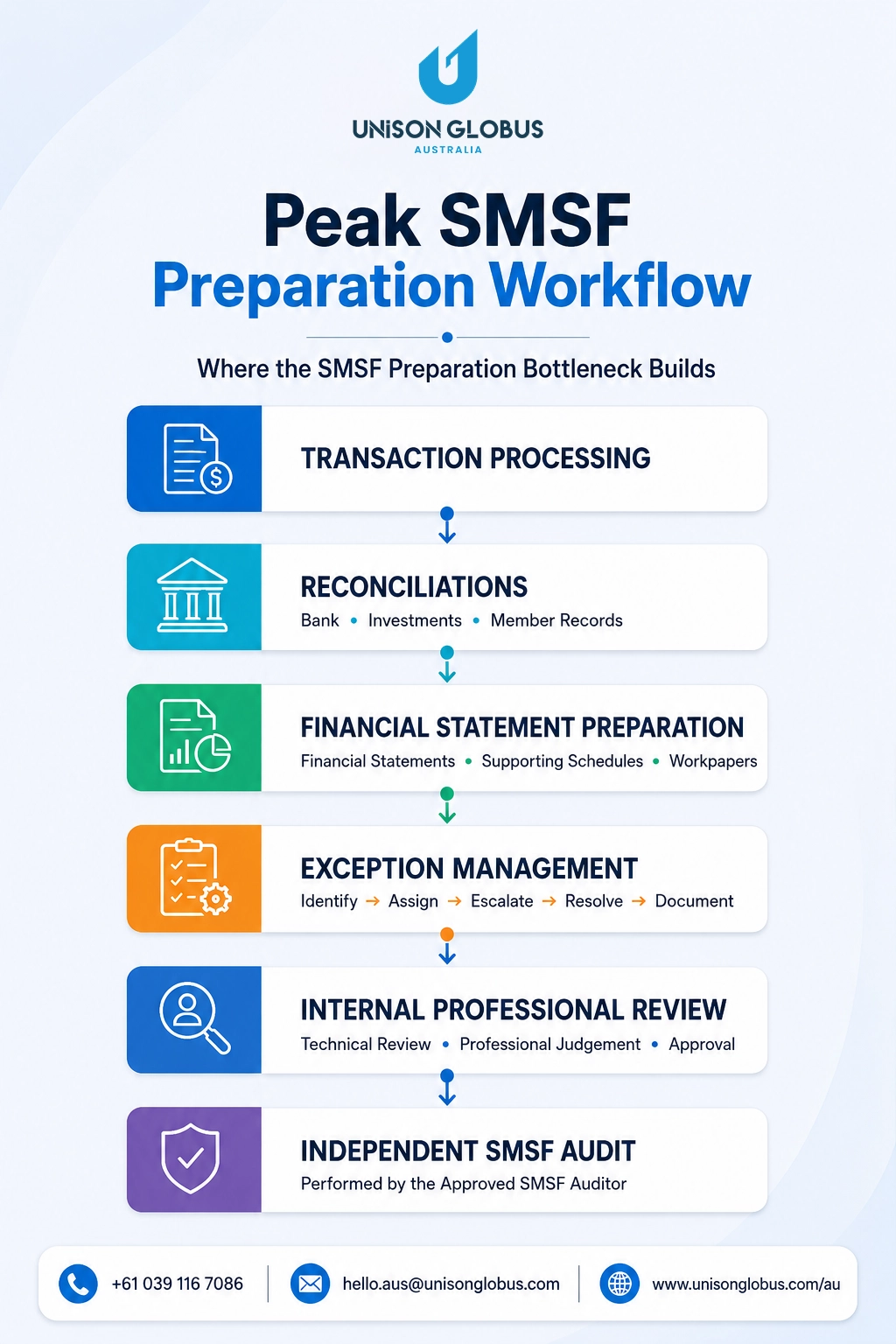
These activities form a connected workflow that moves the file from initial processing through preparation, exception resolution, professional review and independent audit:

Transaction processing → Reconciliation → Financial statement preparation → Supporting schedules and documentation → Exception identification → Exception resolution → Internal professional review → Independent SMSF audit


A dedicated SMSF preparation team Australia model can potentially address the production side of these constraints by absorbing defined preparation activities. It does not remove internal review, professional judgement, client ownership or the accounting firm’s applicable professional responsibilities.

The Talent Supply Problem Behind the Seasonal Squeeze

Recruitment can strengthen permanent capability, but it is not always an efficient response to workload that rises and falls around recurring SMSF preparation periods. Many firms also explore outsourced accounting and bookkeeping support to add flexible capacity without increasing permanent headcount.


Australian accounting firms operate within a broader professional labour market where experienced accounting and tax capability can take time to recruit and develop. That does not establish a universal SMSF-specific talent shortage, but it does make permanent recruitment only one part of capacity planning.

Recruitment and seasonal capacity solve different problems

Permanent recruitment makes sense when workload supports sustained additional headcount. External preparation support can be considered when the requirement is more closely connected to recurring volume fluctuations.


This is where SMSF preparation outsourcing Australia, including SMSF administration, accounting, and year-end finalisation support, becomes an operational consideration.


For firms considering whether to hire offshore SMSF specialists, the important question is not simply whether specialists are available. It is whether the arrangement can operate within Australian requirements, firm-specific procedures, appropriate supervision and secure information-handling controls.

How Outsourced SMSF Preparation Addresses Each Bottleneck

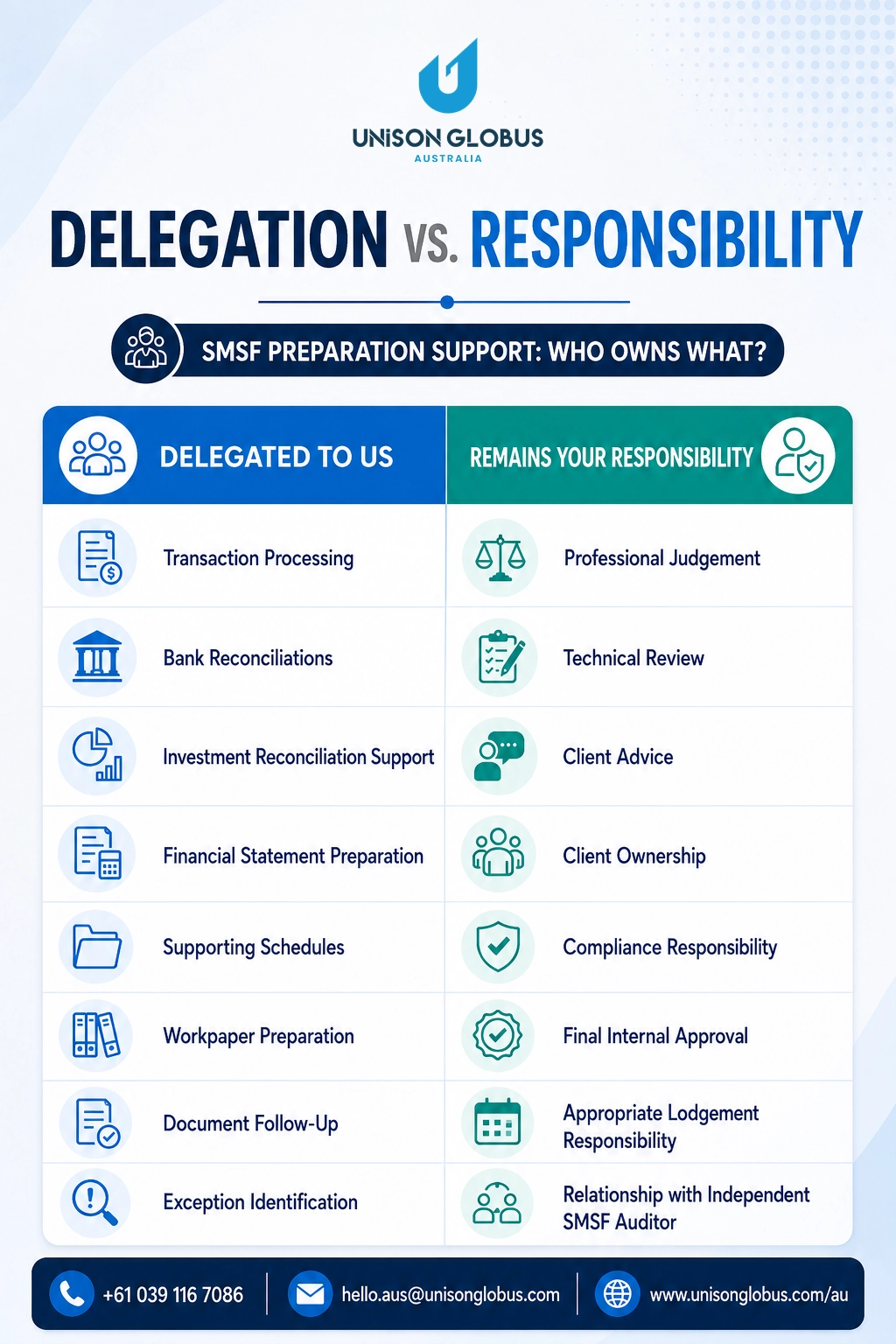
A structured model begins by separating defined preparation activities from responsibilities that require internal professional judgement. The external workflow should align with the firm’s procedures, documentation standards, review checkpoints and escalation requirements.


This approach allows outsourced SMSF preparation services for accounting firms to function as an extension of defined preparation capacity rather than a replacement for internal professional oversight.

Match the external workflow to the internal bottleneck

  • Reconciliation capacity: External preparation support can absorb defined reconciliation and processing activities during higher-volume periods, allowing internal staff to focus on exceptions and review.
  • First-pass financial statements: Financial statements and supporting workpapers can be prepared against firm-specific templates, procedures and documentation expectations within the agreed scope.
  • Structured compliance checks: Standardised checklists and documented review points can help identify missing information or exceptions before senior review. They do not replace professional judgement.
  • Audit-ready handoff: A complete supporting file can create a more orderly handoff to the independent SMSF auditor.
  • Review rather than re-preparation: Senior professionals can focus on reviewing prepared work, investigating exceptions and applying judgement rather than repeatedly rebuilding incomplete files.


The workflow can therefore move from:


  • Internal-only: Intake → Reconciliation → Preparation → Exception management → Rework → Internal review → Audit handoff
  • Supported model: Intake → Reconciliation → Defined external preparation → Exception identification and resolution → Internal review → Audit handoff

The supported model changes where defined preparation activities are performed while keeping technical judgement, approval and audit responsibilities within the appropriate roles.


A review-ready file should contain completed reconciliations, supporting evidence, prepared financial statements, documented exceptions and clear escalation notes, allowing the senior reviewer to focus on validation rather than reconstruction.

Separating SMSF Preparation, Review and Audit Responsibilities

The distinction between preparation, professional review and independent audit should remain clear throughout the workflow. Defined production activities can be supported externally, while the accounting firm retains appropriate review and professional responsibilities and the independent auditor remains separate.

Stage External preparation support Australian accounting firm Independent SMSF auditor
Transaction processing Performs defined processing activities Provides procedures, oversight and review —
Reconciliation Supports bank, investment and other defined reconciliations Reviews results and resolves matters requiring professional judgement —
Financial statements Prepares first-pass financial statements and supporting workpapers Performs technical review and appropriate approval Considers financial information as part of the independent audit
Exceptions Identifies, documents and escalates exceptions Determines treatment and resolves matters requiring professional judgement Considers relevant matters independently during the audit
Compliance judgement Escalates matters requiring technical assessment Determines appropriate treatment within its professional responsibilities Independently assesses matters relevant to the audit
Independent audit Does not perform the independent audit Provides required information and responds to auditor queries Performs the independent SMSF audit

This structure keeps defined preparation activities within the external production workflow while the accounting firm retains professional judgement, review and client responsibility. The independent SMSF auditor remains separate from the preparation process.


That is the practical role of an SMSF outsourcing partner: supporting defined preparation activities within the firm’s established review structure.


For firms assessing SMSF outsourcing solutions for accountants, the critical question is whether preparation responsibilities can be clearly separated from professional decisions and review responsibilities.

Technology integration matters

Technology compatibility should support the firm’s existing workflow, not create another process to manage. Before implementation, firms should confirm system access, document exchange, reconciliation workflows, task tracking and review handoffs. Automated feeds can reduce manual data entry, but reconciliation, exception investigation and professional review remain essential.

What Firms Should Consider Before Outsourcing SMSF Preparation

Outsourcing SMSF preparation raises legitimate questions about independence, professional responsibility, confidentiality, offshore processing, and cost. Assess these before implementation, not after the arrangement is operational.

Independent audit requirements

Under section 35C of the Superannuation Industry (Supervision) Act 1993, each SMSF trustee must ensure that an approved SMSF auditor is appointed for each year of income.


Preparation and audit should therefore remain clearly separated, with defined responsibility boundaries between outsourced preparation, the accounting firm’s internal review and the independent SMSF audit. Preparation support does not make the external provider the independent auditor or transfer the auditor’s separate responsibilities. Approved SMSF auditors must meet ASIC registration requirements and comply with applicable ongoing obligations.


Firms should maintain clear boundaries between preparation, internal review and SMSF audit coordination support activities to preserve independence and ensure compliance responsibilities remain appropriately allocated.

Professional responsibility and supervision

Similar to an STP compliance health check, regular reviews of SMSF workflows and reporting processes can help firms identify operational and compliance risks before peak periods.


The TPB’s current outsourcing and offshoring guidance states that registered tax practitioners must ensure tax agent services provided on their behalf are provided competently. Where an unregistered third party performs such services, appropriate supervision and control may be required depending on the nature of the arrangement.


The precise supervision and control requirements depend on the arrangement and whether the external party is a registered tax practitioner or another third party. The accounting firm’s professional responsibilities therefore do not simply move to the external provider. Responsibility boundaries, review procedures and applicable supervision should be established before work begins.


Firms using offshore SMSF preparation support for CPA firms should establish these controls before client work is transferred, with clear expectations for supervision, review and escalation.

Data security and confidentiality

Firms should assess how client information will be accessed, transferred, stored and protected before engaging an external provider.


The TPB specifically identifies controls such as confidentiality arrangements, secure connections, access controls, audit trails, segregation of duties and approval processes as considerations for outsourcing and offshoring arrangements.

Client disclosure and offshore processing

Where client information is disclosed to an offshore third party, firms need to consider applicable professional and privacy obligations.


Under Code item 6, a tax practitioner must generally obtain client permission before disclosing information relating to the client’s affairs to a third party, unless a legal duty to disclose applies, as outlined in the TPB’s confidentiality guidance.


Where the Privacy Act applies, APP 8 also establishes requirements for cross-border disclosure of personal information and can leave an Australian entity accountable for certain acts or practices of an overseas recipient.

Cost structure

Outsourced preparation and permanent recruitment have different cost structures. External capacity can be aligned more closely with workload volume, while permanent headcount carries ongoing employment and development costs.


That does not make outsourcing automatically cheaper. Firms should assess workload, utilisation, recruitment costs, management requirements and provider fees against their own operating model.


Before moving from consideration to implementation, firms should also assess whether a prospective provider can operate effectively within their existing SMSF workflow and control environment.

When Outsourcing SMSF Preparation Makes Operational Sense

Outsourcing makes the strongest operational case when a firm has a recurring preparation bottleneck that can be separated from professional judgement.


For Australian firms considering whether to outsource SMSF work, the decision should begin with workload patterns, workflow maturity, review capacity and the ability to define responsibilities clearly.

Conditions that support the model

  • Recurring peak volume: Workload increases follow a recognisable pattern rather than representing a one-off event.
  • Senior production involvement: Partners or senior accountants spend substantial time preparing files instead of reviewing completed work.
  • Limited recruitment flexibility: Permanent recruitment does not align with short-term workload fluctuations.
  • Documented procedures: SMSF processes, workpaper standards and escalation points are sufficiently clear for another team to follow.
  • Defined responsibilities: Preparation, review, client communication and audit responsibilities have clear ownership.
  • Controlled technology: Secure file access, document exchange and task tracking can support the required handoffs.

Conditions that suggest fixing the workflow first

  • Unclear ownership: Staff do not have consistent responsibility for preparation and review stages.
  • Inconsistent files: Similar SMSF engagements are prepared using materially different structures or procedures.
  • Undocumented processes: The firm cannot clearly explain how a standard file should move from intake to review.
  • Existing quality problems: Preparation errors have not been diagnosed or addressed at their source.

Outsourcing does not compensate for a fundamentally inconsistent workflow. If the process cannot be explained internally, it will be difficult to transfer effectively to an external team.

What Happens When Firms Wait Until the Next Peak

Recurring workload patterns can be planned for before preparation queues have formed. Waiting until a bottleneck is already developing leaves little time to assess providers, map workflows, establish controls or test file handoffs.


The key is to avoid implementing a new operating model in the middle of the bottleneck.

Before the peak

The firm can document preparation responsibilities, establish review checkpoints, assess providers, confirm information-handling arrangements and test sample file handoffs. A defined workload can then be piloted to measure exceptions, rework, turnaround between handoffs and reviewer effort before broader implementation.

During the peak

Once the process is established, the external team can work within the agreed workflow while internal professionals focus on review, exceptions, client communication and matters requiring professional judgement.

The value of preparing early is not simply speed. It gives the firm an opportunity to test and refine the operating model before peak workload pressure makes changes more difficult.

What Australian Accounting Firms Should Evaluate in an SMSF Preparation Provider

Before engaging a provider, firms should assess the following operational, technical and control criteria to determine whether the model fits their existing SMSF workflow:

Evaluation area What to verify
SMSF capability Experience with Australian SMSF preparation, reconciliations, financial statements and supporting workpapers.
Workflow fit Ability to work within the firm’s procedures, templates, file structures and review checkpoints.
Exception management Defined processes for identifying, assigning, escalating, resolving and documenting exceptions, with clear ownership at each stage.
Quality controls Documented QA procedures, review controls, correction workflows and escalation protocols before work reaches the firm’s senior reviewer.
Software compatibility Compatibility with the firm’s existing SMSF, accounting, document-management and workflow platforms.
Data security Access controls, secure data transfer, storage arrangements, confidentiality controls and incident procedures.
Scalability Ability to absorb defined workload increases while maintaining agreed procedures and responsibility boundaries.
Audit handoff Consistent workpapers, supporting documentation and clear escalation notes for handoff to the independent SMSF auditor.
Communication Defined communication channels, response expectations, status reporting and escalation contacts.

Provider evaluation should focus on how the external team fits within the firm’s existing workflow and control environment. Firms should verify who performs each preparation activity, how exceptions are managed and escalated, what documentation standards apply, and how completed work moves into internal review and audit handoff. Representative workpapers, supporting schedules and exception notes can help assess whether the provider’s output meets the firm’s expectations.


Before broader implementation, firms can test the model using a defined group of files and measure preparation quality, exceptions, rework, turnaround between handoffs and reviewer effort. A structured pilot provides practical evidence of whether the provider can operate consistently within the firm’s procedures and whether the arrangement improves preparation capacity without weakening review controls or responsibility boundaries.

What a Supported SMSF Peak Season Looks Like

SMSF files are entering preparation while other compliance engagements are still progressing through the practice.


In a supported model, defined preparation activities can move through an external team before reaching senior reviewers. Reconciliations are completed against documented procedures, first-pass financial statements and supporting workpapers are prepared, and exceptions are identified for escalation.


The file then moves into the firm’s internal review process.


The partner or senior accountant remains involved. Their role becomes more focused on reviewing prepared work, resolving exceptions, applying professional judgement and managing client and audit interactions.


For firms that need additional support around this stage, SMSF review services for accounting firms can complement preparation capacity while keeping appropriate professional oversight within the practice.


The result is not a pressure-free peak season. It is a different allocation of professional capacity. This approach creates additional controlled preparation capacity while keeping technical judgement, internal review and professional responsibility within the firm’s established workflow.

How Unison Globus Australia Supports a Structured SMSF Preparation Model

For accounting firms considering outsourced SMSF preparation, Unison Globus Australia supports defined preparation activities within the firm’s existing workflow. The focus is on adding controlled preparation capacity while working within established procedures, documentation standards and review checkpoints. This approach can also complement broader SMSF Audit & Compliance Solutions for Australian Businesses where preparation, review and audit-related workflows need clearly defined boundaries.


What the preparation model can support:

  • SMSF preparation: Defined preparation activities, including reconciliations, financial statements, supporting schedules and workpapers, based on the firm’s procedures and agreed scope.
  • Processing support: SMSF Processing Support for Bookkeeping Firms can assist with transaction processing, reconciliations and related preparation activities where inputs, outputs and responsibilities are clearly defined.
  • Exception and workflow support: Preparation teams can identify missing information, document exceptions and escalate matters requiring professional assessment before files move into internal review.

The accounting firm remains responsible for appropriate professional review, judgement, client relationships and applicable compliance responsibilities. External preparation support operates within that structure, giving senior professionals a more organised body of work to review rather than transferring those responsibilities to the provider.


For firms evaluating SMSF Preparation Services for CPA Firms, the decision should ultimately be based on preparation volume, workflow fit, documented procedures, review capacity and appropriate controls.

Need more SMSF preparation capacity without expanding your internal team?

Peak SMSF Workloads Require More Than Additional Hands

Peak SMSF preparation pressure is fundamentally a capacity and workflow-design issue, not simply a staffing shortfall.


When senior review capacity is constrained, defined preparation support can help create additional controlled capacity while allowing professionals to focus on judgement, exceptions and review.


The objective is not to transfer responsibility. It is to structure preparation work so the right tasks are handled by the right resources, with appropriate oversight and clear accountability.


Unison Globus Australia can support accounting firms evaluating a structured B2B SMSF preparation model. If your firm is facing recurring SMSF preparation capacity pressures, contact Unison Globus Australia to discuss a suitable support model.

Frequently Asked Questions

Outsourced SMSF Preparation Australia can support defined production tasks such as reconciliations and financial statement preparation while internal professionals retain review responsibility.

Preparation may occur before independent audit, but the approved SMSF auditor must remain independent and perform the audit under applicable statutory and professional requirements.

No. The TPB requires tax practitioners to ensure outsourced tax agent services are provided competently, with appropriate supervision and control where applicable.

Review confidentiality, access controls, security, data storage, client permission and applicable privacy obligations. Offshore disclosures can also trigger APP 8 requirements where the Privacy Act applies.

They can, where the provider’s systems and access arrangements support the firm’s workflow. Software compatibility should be confirmed before implementation rather than assumed.

Ideally, before preparation queues form. This gives the firm time to document procedures, assess providers, establish controls and test workflow handoffs.

Categories
BAS Home Aus

Avoid BAS Lodgement Errors in Q1 FY2027: A Compliance Guide for Australian Accounting Firms

For Australian accounting firms, Q1 FY2027 is more than the first reporting period of a new financial year. It is an opportunity to reset BAS processes, strengthen review controls and prevent recurring compliance issues before they become costly problems.

BAS lodgement errors Australia-wide can stem from surprisingly ordinary issues: an incorrectly coded transaction, a missing tax invoice, a GST adjustment that was not reviewed, or figures that do not reconcile with the underlying accounting records. Individually, these may appear minor. However, when they pass through the review process, they can affect GST liabilities, input tax credits, PAYG reporting and the overall accuracy of a client’s activity statement.

The scale of GST compliance makes accuracy particularly important. The Australian Taxation Office (ATO) estimated the net GST tax gap at $7.9 billion in 2022–23, equivalent to 9% of theoretical GST. The ATO also reported that the gross GST gap was $11.2 billion for the same year. These figures do not mean every discrepancy represents deliberate non-compliance; however, they demonstrate why accurate GST reporting remains a significant compliance priority. 

For CPA firms, therefore, the goal should not simply be to lodge before the deadline. It should be to lodge accurately, consistently and with sufficient evidence to support every material figure.

This BAS lodgement guide Australia-focused firms can use for Q1 FY2027 explains where errors commonly occur, how to strengthen review processes and when additional capacity can help protect quality during busy reporting periods.

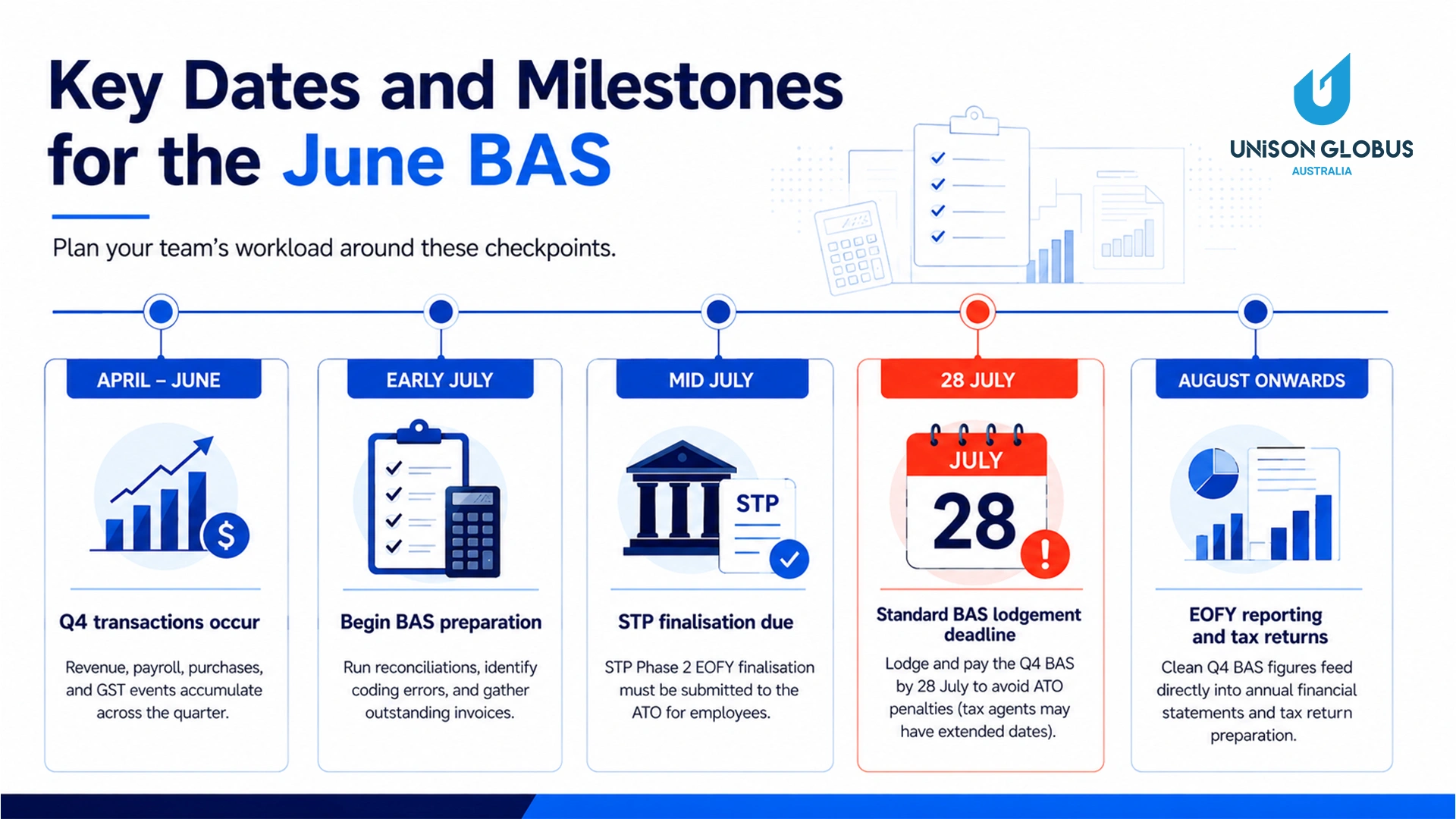
Q1 FY2027 Starts with the Right BAS Calendar

Before reviewing a single transaction, accounting firms should establish which clients have quarterly, monthly or annual GST reporting obligations. The ATO states that businesses generally report GST quarterly when their GST turnover is below $20 million, unless they have been directed to report monthly. Businesses with GST turnover of $20 million or more generally report monthly.

Source: (Australian Taxation Office)


For quarterly BAS clients, the standard reporting dates are:

Reporting period Standard BAS due date
July–September 2026 28 October 2026
October–December 2026 28 February 2027
January–March 2027 28 April 2027
April–June 2027 28 July 2027

If a due date falls on a weekend or public holiday, the ATO states that businesses generally have until the next business day to lodge and pay. Eligible businesses lodging electronically may also receive a two-week concession, while registered agents may have additional lodgement arrangements. Firms should nevertheless confirm the applicable date for each client rather than assuming that every client receives the same concession. 


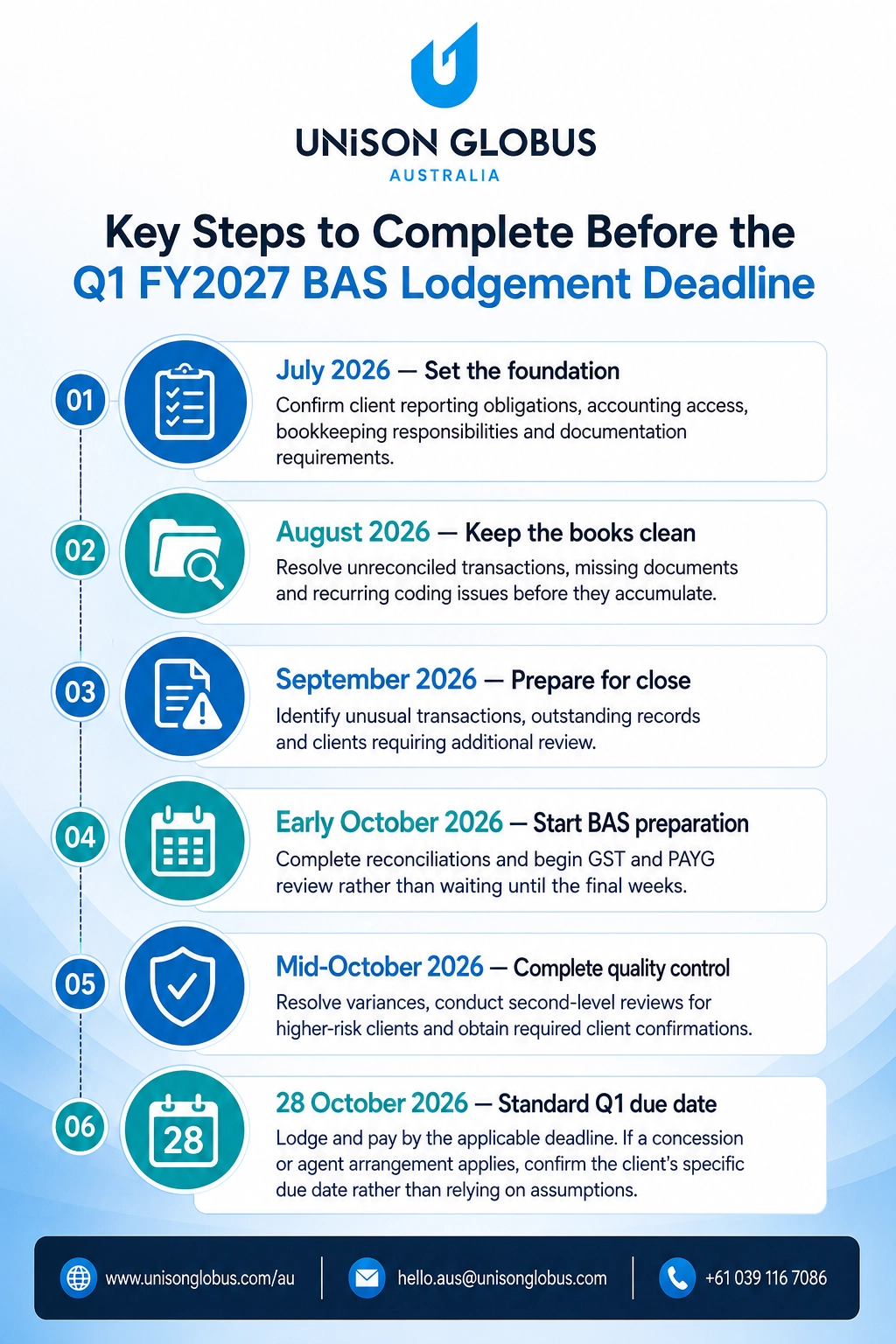
28 October 2026 is the key standard due date for the July–September 2026 quarter. However, firms should not build their workflow around the final lodgement date. Instead, establish earlier internal deadlines for document collection, bookkeeping completion, reconciliation, review and client approval.


A practical internal sequence could be:

Client records complete → Bookkeeping finalised → GST reconciliation → BAS review → Senior review → Client approval → Lodgement


That approach creates a buffer rather than turning the final day into a quality-control exercise.

The Real Source of BAS Errors? The Records Behind the BAS

A business activity statement is only as reliable as the accounting information used to prepare it. Consequently, bookkeeping for BAS accuracy Australia-wide should be treated as part of the compliance process rather than a separate administrative task.


When transactions remain unreconciled, invoices are missing or expenses have been incorrectly coded, the BAS preparer may spend valuable time identifying whether an apparent goods and services tax (GST) variance is a genuine issue or simply a bookkeeping error.


The ATO requires businesses to maintain records that allow their GST liabilities and entitlements to be readily determined. In general, relevant GST records must be retained for at least five years, with specific circumstances potentially requiring longer retention. (Australian Taxation Office)

What should firms review before BAS preparation?

At a minimum, firms should consider:

  • Bank and credit-card reconciliations
  • Sales and purchase transactions
  • Tax invoices
  • Expense classifications
  • GST codes
  • Credit notes and refunds
  • Private-use transactions
  • Asset purchases
  • Overseas transactions
  • GST adjustments
  • Payroll and PAYG information
  • Unusual or high-value transactions

The objective is simply not to ask the business activity statement (BAS) to reveal bookkeeping problems that should have been resolved beforehand.

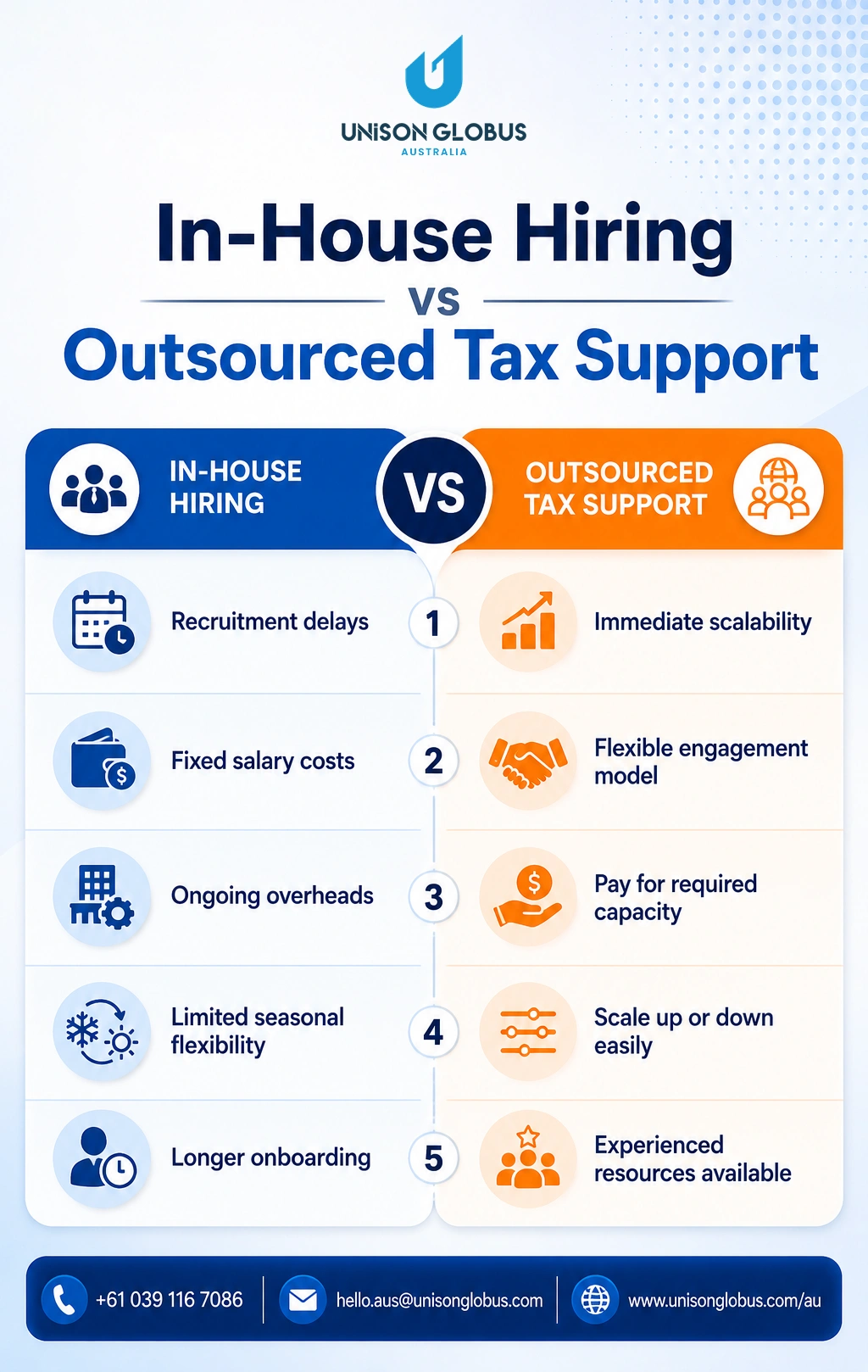
Why Traditional Hiring Models Fall Short During Peak Tax Season?

Recruitment has traditionally been the default response to increasing tax workloads.


However, the Australian accounting profession continues to experience ongoing talent shortages, rising employment costs and increased competition for experienced tax professionals.


Temporary hiring may increase capacity, but it also introduces additional challenges:

  • Recruitment and onboarding costs
  • Training time during peak periods
  • Inconsistent preparation quality
  • Limited seasonal utilization
  • Reduced profitability once tax season concludes

Adding more staff without improving operational processes often shifts workload rather than eliminating inefficiencies.


High-performing firms are increasingly recognizing that sustainable growth depends on building scalable operating models rather than adding full-time staff every tax season.


Capacity is created through workflow optimization, process standardization and access to specialist support, not solely through recruitment. Increasingly, firms are investing in Tax Preparation & Compliance Solutions for Australian Businesses that improve operational consistency, strengthen compliance, and provide the flexibility to manage seasonal demand without continuously expanding internal teams.

Get GST Coding Right Before It Changes Your BAS

Incorrect GST treatment remains one of the most common BAS mistakes Australia-based businesses encounter.


A transaction may be legitimate, recorded on time and supported by documentation, yet still be reported incorrectly because it was assigned the wrong GST code.


Businesses need to distinguish between taxable supplies, GST-free supplies and input-taxed supplies. Similarly, not every business expense automatically creates an entitlement to GST credit. The transaction, documentation and creditable purpose all matter.


This becomes particularly important when clients operate across multiple revenue streams or purchase assets, professional services, subscriptions, vehicles or mixed-use items.

A stronger GST review asks better questions

Rather than simply checking whether the accounting software has calculated the GST correctly, the reviewer should ask:

  1. Does the transaction belong in this GST category?
  2. Is the GST treatment supported by the available documentation?
  3. Does the client have an entitlement to claim the input tax credit?
  4. Does the treatment remain consistent with previous periods?

The ATO notes that GST is generally charged at 10% on most goods and services sold or consumed in Australia, while GST-registered businesses generally claim credits for GST included in eligible business purchases. 


Therefore, accurate coding remains a fundamental part of GST compliance Australia 2026 and should receive particular attention during the first quarter of FY2027.

Reconciliation: The BAS Review Step That Should Never Be Rushed

A completed BAS does not automatically mean a correct BAS. Before lodgement, firms should reconcile reported GST figures against the underlying accounting records and investigate material differences.


This is where a structured BAS review and finalisation services workflow can add significant value. Instead of treating the BAS as a form to complete, firms can treat it as the final output of a controlled review process.

The reconciliation should connect the dots

A robust review can compare:

General Ledger

GST Accounts

Sales

Purchases

BAS Labels

Supporting Documentation

If those numbers do not align, the difference should not simply be adjusted to make the BAS balance. The reviewer should identify why the difference exists.


For instance, a variance could result from:

  • An incorrectly coded transaction
  • A duplicated entry
  • A missing invoice
  • A credit note recorded in the wrong period
  • An incorrect GST adjustment
  • A transaction posted after the reporting period
  • A reconciliation error
  • A manual journal entry

This distinction matters because reconciliation is not about making numbers agree. It is about understanding why they agree or why they do not.

BAS Compliance Is More Than GST, Don't Miss PAYG

Although GST often dominates BAS discussions, accounting firms should also review other obligations reported through the activity statement. Depending on the client’s circumstances, these may include PAYG withholding and PAYG instalments.


PAYG errors can arise when payroll information does not align with the figures carried into the BAS. Consequently, firms should compare payroll records, accounting software and relevant reporting information before finalisation.


This is particularly important for businesses with frequent payroll changes, bonuses, contractors, employee reimbursements or adjustments.


A useful Q1 control? 


Introduce a specific PAYG cross-check into the BAS review workflow:

Payroll Records

PAYG Figures

Accounting Ledger

BAS

This simple control can help prevent a GST-focused review from overlooking another important component of the activity statement.

Facing Q1 BAS Capacity Challenges?

Improve review accuracy, strengthen GST controls, and manage peak-period workloads with dedicated BAS support from Unison Globus Australia.

GST Reporting Errors and Corrections: What Happens When Something Slips Through?

Even a strong review process cannot guarantee that an error will never occur. Therefore, Australian accounting firms should have a clear process for identifying and correcting GST reporting errors.


The first question should be whether the issue can be corrected in a later BAS under the applicable rules or whether an amendment is required. The treatment depends on the nature and circumstances of the error, so firms should assess the relevant ATO requirements rather than applying a one-size-fits-all approach.


Documentation is equally important. When correcting GST reporting errors and corrections, the firm should record what went wrong, how the error was identified, what correction was made and what evidence supports the treatment.


A recurring error should never remain a recurring error.


If the same client repeatedly misclassifies vehicle expenses, for example, the answer is not simply to correct the transactions every quarter. Instead, the firm can introduce a client-specific review rule, update the bookkeeping instructions or educate the client about the required documentation.


That approach shifts BAS compliance from error correction to error prevention.

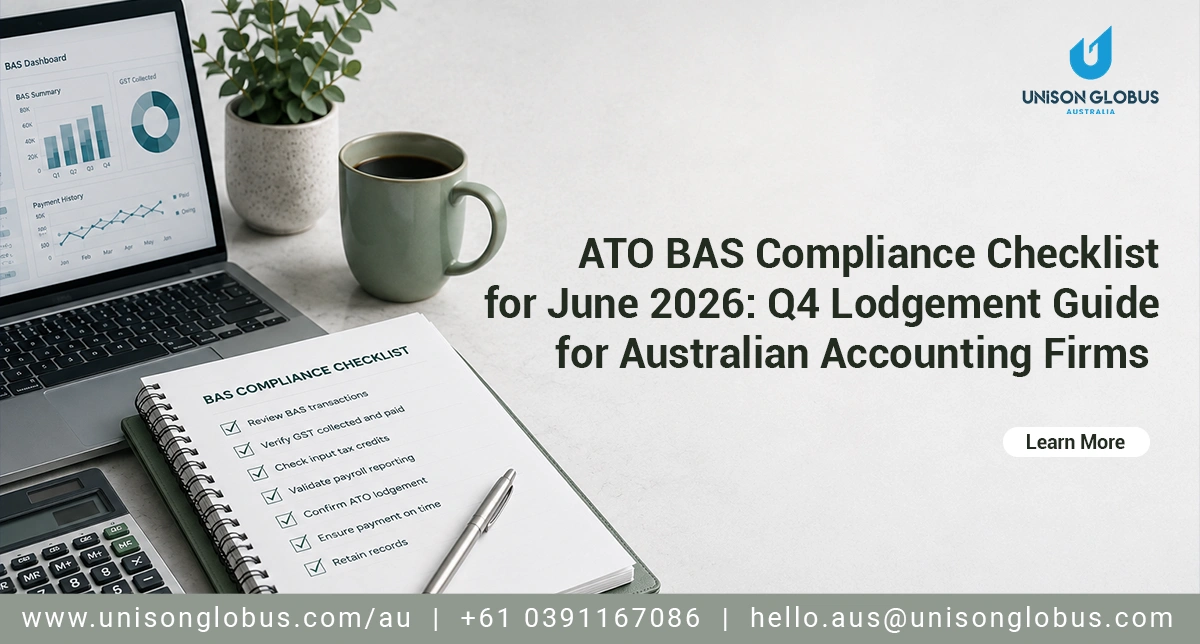
The ATO BAS Compliance Checklist Every Firm Should Actually Use

A checklist becomes valuable when it controls the workflow rather than simply sitting in a folder.


For Q1 FY2027, firms can build an ATO BAS compliance checklist around the following review points:


Records

  • Confirm all relevant bank accounts are reconciled.
  • Confirm sales and purchase records are complete.
  • Identify missing tax invoices.
  • Review unusual or high-value transactions.

GST

  • Review GST coding.
  • Check taxable, GST-free and input-taxed transactions.
  • Review input tax credit claims.
  • Check GST adjustments.
  • Investigate unusual movements against prior quarters.

PAYG

  • Reconcile PAYG withholding figures.
  • Cross-check payroll information.
  • Review PAYG instalment amounts where applicable.

Finalisation

  • Reconcile BAS figures with accounting records.
  • Resolve outstanding variances.
  • Obtain client approval where required.
  • Confirm lodgement details.
  • Retain supporting documentation.

The value of this process is consistency. Whether the firm handles 20 BAS clients or 2,000, the same critical controls should remain visible.

Q1 FY2027 Could Expose the Gaps in Your BAS Capacity

BAS preparation Australia CPA firms manage is rarely limited to preparing the statement itself. Teams must chase records, answer client questions, reconcile accounts, investigate exceptions, review GST treatment, communicate adjustments and complete final checks.


Consequently, BAS periods can quickly expose capacity problems.


A firm may have technically capable staff but still experience delays because senior accountants spend too much time on repetitive preparation work. Meanwhile, complex compliance matters compete for the same review capacity.


This is where firms can consider outsource BAS services Australia as an operational strategy not simply as a cost-cutting measure.


The objective should be controlled scalability


The right support model can help firms distribute workload across:

  • Data and bookkeeping preparation
  • Transaction review
  • GST reconciliation
  • BAS preparation
  • Exception identification
  • Finalisation support
  • Quality-control review

With BAS Preparation & Lodgement Services, firms can create additional capacity while retaining appropriate oversight and client ownership.


Likewise, outsourced bas review & finalisation services can help firms manage repetitive review workloads while allowing internal professionals to focus on complex client matters and advisory work.

Choosing Outsourced BAS Support Without Compromising Quality

Outsourcing should never mean transferring responsibility without transferring controls.


Before engaging a provider, an Australian accounting firm should assess whether the provider understands Australian GST requirements, follows documented review procedures and can work within the firm’s existing accounting systems and workflows.


The provider should also be able to identify exceptions rather than simply process transactions.


A capable outsourcing partner should support:

  • Consistent BAS workflows
  • GST reconciliation
  • Exception reporting
  • Documentation checks
  • Review notes
  • Quality-control procedures
  • Secure information handling
  • Clear turnaround expectations
  • Escalation of unusual transactions

For firms supporting multiple clients, BAS Review & Lodgement Support for Australian Businesses can provide additional operational capacity while maintaining a structured review framework.


The strongest model is therefore not “send the BAS work offshore and forget about it.” It is integrating additional capacity into a controlled compliance workflow.


This approach is not unique to Australia. Accounting firms in the USA face similar challenges across bookkeeping, tax preparation, payroll and other back-office functions, although the underlying compliance requirements differ. The same principle applies that outsourced support should fit the firm’s systems, workflows and regulatory environment.

Comprehensive BAS Compliance Should Go Beyond the Lodgement Date

A BAS should not be viewed as an isolated quarterly obligation. Instead, it should form part of a broader compliance and advisory process.


That means reviewing recurring discrepancies, identifying inefficient bookkeeping practices, monitoring changes in client circumstances and improving documentation standards throughout the year.


Comprehensive BAS Compliance & Advisory Services can support this broader approach by connecting preparation, review, compliance controls and advisory insight.


For example, repeated GST adjustments may indicate a bookkeeping weakness. A sudden movement in GST payable may warrant further investigation. Frequent missing invoices may indicate a client documentation problem.


These signals can provide useful information beyond the BAS itself.


BAS can become a business intelligence checkpoint


A well-reviewed BAS can help firms identify:

  • Changes in sales activity
  • Significant expense movements
  • Cash-flow pressure
  • Unusual GST positions
  • Recurring bookkeeping issues
  • Documentation weaknesses
  • Potential compliance risks

In other words, accurate BAS work does more than satisfy a reporting obligation. It gives the accountant a clearer view of what is happening inside the client’s business.

Q1 FY2027 BAS Timeline: Build the Buffer Before the Deadline

A practical Q1 workflow should begin well before 28 October 2026.

A structured timeline gives firms the one thing BAS season often takes away, time to get it right. 

Five Controls That Can Make Q1 BAS Reviews More Reliable

The most effective controls are often simple enough to repeat every quarter.


1. Use exception-based review
Do not review every transaction with equal intensity. Flag unusual values, unfamiliar GST codes and significant movements for closer attention.


2. Compare against prior periods
A significant movement does not automatically indicate an error. However, it should prompt a question.


3. Separate preparation from final review
Let a second person review the complete BAS, particularly for complex or high-risk clients.


4. Document unresolved issues
A clear review trail makes future corrections and internal quality checks easier.


5. Track recurring errors
If the same error appears every quarter, address the process behind it.


These controls can turn the BAS process from a deadline-driven activity into a repeatable compliance system.

Make BAS Accuracy Your Competitive Advantage

For Australian accounting firms, BAS compliance is ultimately about trust.


Clients expect their accountant to do more than enter figures into a form. They expect accurate reporting, timely communication and confidence that important details have not been overlooked.


That expectation becomes even more important as firms scale. A manual process that works for 30 clients may become inefficient at 300. Therefore, firms need workflows that can scale without compromising review quality.


BAS preparation Australia CPA firms undertake should be supported by consistent bookkeeping, documented review procedures, technology and appropriate professional oversight.


At the same time, small business GST compliance Australia depends heavily on the quality of records and transaction treatment supplied to the accountant. The accounting firm cannot eliminate every client-side risk, but it can create processes that identify problems earlier.


The result is a more resilient compliance function, one that reduces avoidable rework, strengthens accuracy and gives accountants more time for higher-value advisory work.

Conclusion

Q1 FY2027 is an opportunity for Australian accounting firms to strengthen the processes that support accurate BAS lodgement not simply work towards the deadline.


The 28 October 2026 quarterly BAS deadline should be the final step in a well-managed workflow. Accurate bookkeeping, GST coding, reconciliations, PAYG checks, supporting documentation and a structured review should be completed well before lodgement.


Where internal capacity is limited, Unison Globus Australia provides BAS Review & Lodgement Support for Australian Businesses, BAS Preparation & Lodgement Services and Outsourced BAS Review & Finalisation Services to help firms manage BAS workloads with greater accuracy, consistency and efficiency.


The goal is not simply to lodge on time. It is to establish a BAS process that is accurate, review-ready and sustainable each quarter.


Partner with Unison Globus Australia to strengthen your BAS compliance workflow for Q1 FY2027.

Need Extra BAS Support This Quarter?

Expand your BAS delivery capacity without increasing overheads. Our experienced professionals help Australian accounting firms manage compliance workloads with confidence.

FAQ’s

Reconcile records, review GST treatment, check supporting documentation and use a consistent BAS review process before lodgement.
Confirm that the purchase is eligible, the GST treatment is correct, and the required supporting records are available.
Yes. Depending on the nature of the issue and the applicable conditions, a GST error may be corrected on a later BAS, or the earlier BAS may need to be revised. Firms should assess the relevant ATO requirements for each case.
Firms should complete bookkeeping, reconcile GST and PAYG figures, review GST coding, investigate unusual movements, confirm supporting documentation and complete a final BAS review before lodgement.
Preparation should begin well before the 28 October standard due date. Firms should set internal deadlines for records, bookkeeping, reconciliation, review and client approval rather than waiting until the final lodgement date.
Categories
Home Aus Tax

Post-EOFY Tax Workload Surge: How Australian CPA Firms Can Scale Income Tax Return Preparation Efficiently in 2026

As the financial year closes, firms transition from end of financial year reconciliations and financial reporting into one of the busiest operational periods of the year. Individual tax returns, business tax returns, and trust tax return begin arriving in high volumes, often alongside incomplete documentation, evolving ATO requirements, and client expectations for faster turnaround.

The pressure is particularly evident during the lead-up to the tax lodgements deadlines Australia 2026, where CPA firms tax workload Australia continues to rise as firms manage increasing return volumes without compromising financial accuracy or regulatory compliance.

This is why Tax return Preparation Australia 2026 is no longer just about processing returns efficiently. It is about creating scalable workflows that support compliance, improve turnaround times, and enable firms to manage growing client portfolios sustainably.

For firms looking to remain competitive throughout the tax season, scaling capacity through structured processes and strategic support is becoming an operational necessity rather than a growth initiative.

Why the Post-EOFY (end of financial year) Period Creates the Greatest Operational Pressure?

The months immediately following EOFY present one of the most demanding workload cycles for Australian accounting practices.


Unlike other compliance periods, post-EOFY requires firms to manage multiple reporting obligations simultaneously. Individual income tax returns continue to increase throughout July and August, while business entities, trusts and partnerships begin preparing financial information for tax lodgements.


This overlapping workload creates significant scheduling pressure across preparation, review and finalization stages.


Several factors contribute to this operational surge:


  • Increasing individual tax return workload immediately after fiscal year-end
  • Simultaneous preparation of business tax returns Australia CPA firms manages for multiple entities
  • Growing demand for income tax return services Australia
  • Additional review requirements for trust and partnership structures
  • Ongoing client correspondence to obtain outstanding financial documentation
  • Strict adherence to ATO tax compliance for accounting firms

Each stage introduces review dependencies that can slow workflow progression if preparation standards are inconsistent.


Rather than being constrained by tax complexity alone, many firms experience reduced productivity because routine preparation activities consume valuable senior accounting capacity.

The Hidden Cost of Manual Tax Return Preparation

The impact of manual tax preparation extends well beyond longer working hours.


When teams rely heavily on repetitive administrative processes, every additional return increases operational pressure across the firm.


Common workflow inefficiencies include:


  • Manual data entry across multiple systems
  • Reconciliation inconsistencies requiring additional review
  • Version control issues when multiple team members access files
  • Time-consuming document follow-ups with clients
  • Rework resulting from incomplete working papers
  • Extended review cycles caused by inconsistent preparation standards

These challenges directly affect operational efficiency and create unnecessary compliance risk during peak lodgement periods.


For firms managing hundreds of client files, preparation delays quickly amplify. Senior accountants spend more time correcting routine errors rather than providing strategic tax advice or reviewing complex engagements.


Every additional review cycle increases operational cost without necessarily improving quality.


The issue is not simply preparing for more tax returns. It is ensuring every return progresses through a consistent, review-ready workflow that supports financial accuracy from the outset.


This is where scalable tax preparation delivers measurable operational value by reducing preparation delays before they affect compliance with timelines.

Why Traditional Hiring Models Fall Short During Peak Tax Season?

Recruitment has traditionally been the default response to increasing tax workloads.


However, the Australian accounting profession continues to experience ongoing talent shortages, rising employment costs and increased competition for experienced tax professionals.


Temporary hiring may increase capacity, but it also introduces additional challenges:


  • Recruitment and onboarding costs
  • Training time during peak periods
  • Inconsistent preparation quality
  • Limited seasonal utilization
  • Reduced profitability once tax season concludes

Adding more staff without improving operational processes often shifts workload rather than eliminating inefficiencies.


High-performing firms are increasingly recognizing that sustainable growth depends on building scalable operating models rather than adding full-time staff every tax season.


Capacity is created through workflow optimization, process standardization and access to specialist support, not solely through recruitment. Increasingly, firms are investing in Tax Preparation & Compliance Solutions for Australian Businesses that improve operational consistency, strengthen compliance, and provide the flexibility to manage seasonal demand without continuously expanding internal teams.

What High-Performing CPA Firms Are Doing Differently in 2026?

Leading CPA firms aren’t responding to the post-EOFY workload surge by simply adding more resources, they’re redesigning how tax preparation is delivered.


As the demands of EOFY tax preparation Australia continue to grow, the most successful firms are shifting from reactive workload management to scalable operational models that improve consistency, strengthen compliance and maximize productivity.


Their objective is clear to increase capacity without increasing compliance risk.

Three operational practices consistently distinguish high-performing firms.

Build Consistency into Every Tax Return

Operational efficiency begins with standardization.


Structured preparation checklists, standard working paper templates and clearly defined review procedures create a consistent approach across every engagement. This reduces preparation errors, minimizes unnecessary review cycles and ensures returns move efficiently from preparation through to lodgements.


A standardized workflow also enables junior accountants to manage routine preparation confidently, allowing senior professionals to dedicate more time to technical reviews and complex compliance matters.

Strengthening Workflow Visibility Through Technology

Technology delivers the greatest value when it improves process visibility rather than simply accelerating tasks.


Practice management platforms, secure document collection systems, workflow tracking tools and automated data capture streamline administrative activities while providing greater oversight across every engagement.


However, compliance cannot be automated. Professional review remains essential for validating tax treatments, identifying reporting inconsistencies and ensuring every return aligns with evolving ATO requirements.


The result is stronger governance, greater transparency and more efficient tax preparation workflows.

Align Technical Expertise with Return Complexity

Not every tax return requires the same level of technical involvement.


Routine individual tax returns benefit from standardized preparation processes, while business entities, trust tax return preparation & filing, and technically complex engagements require greater senior oversight.


Allocating resources according to complexity improves resource utilization, reduces workflow delays and enables experienced accountants to focus on high-value compliance reviews instead of routine preparation activities.

The Strategic Advantage

Operational scalability is achieved through disciplined processes, not longer working hours.


By combining standardized workflows, technology-enabled visibility and complexity-based resource allocation, leading CPA firms create a tax preparation model that strengthens ATO compliance, improves financial accuracy and supports higher client volumes throughout the Australian tax season.

Make Tax Season More Manageable

Scale your tax preparation capacity without increasing pressure on your team. Unison Globus Australia helps CPA firms improve efficiency, maintain ATO-aligned quality, and handle growing workloads with confidence.

Scaling Through Offshore Tax Preparation Support Without Compromising Compliance

The increasing complexity of the Australian tax season 2026 is prompting many CPA firms to rethink how they build operational capacity. Rather than relying solely on recruitment, many firms now outsource tax preparation Australia through structured offshore operating models that extend internal capacity while maintaining complete control over quality, review standards, and ATO compliance.


This is where offshore services have evolved from a cost-saving measure into a strategic operational advantage. Today, firms use offshore tax preparation services to scale preparation capacity, improve turnaround times, and maintain consistent quality during Australia’s busiest tax periods. A well-structured offshore model supports the preparation of tax returns under clearly defined Australian workflows and quality standards. Preparation activities are completed using firm-specific procedures, while Australian accountants retain responsibility for technical reviews, client communication and final lodgements.


When implemented correctly, offshore support enables firms to:

The value lies not in replacing Australian expertise but in extending it. For firms experiencing increasing CPA firms tax workload Australia, offshore preparation capacity provides the flexibility to manage higher return volumes while maintaining consistent compliance and service quality.

For firms managing growing client portfolios, Offshore tax compliance services for Australian firms provide additional preparation capacity that allows internal teams to focus on higher-value compliance reviews, advisory work and client relationships.

Which Tax Preparation Activities Can Be Supported Offshore?

Not every aspect of tax compliance should be delegated. Strategic oversight, technical judgement and client advice remain core responsibilities of Australian CPA firms.


However, many preparation activities follow structured processes that can be efficiently supported through an offshore delivery model.

Suitable for Offshore Preparation Typically Retained by Australian CPA Firms
Individual income tax return preparation Client advisory services
Working papers and supporting schedules Final technical review
Financial statement preparation Tax planning strategies
Business tax return preparation Complex tax structuring
Trust Tax Return Preparation & Filing support Client relationship management
Document reconciliation and file organization Final lodgement and sign-off


This balanced approach enables firms to increase capacity while maintaining complete control over compliance outcomes and client service standards.

Why Scalable Tax Preparation Is Key to Year-Round Profitability?

Scaling tax preparation is not simply about processing more returns. It is about improving operational performance across the firm.

Enhance Capacity Without Permanent Recruitment

Seasonal workload fluctuations make permanent recruitment difficult to justify.


By implementing scalable tax preparation solutions, firms can increase preparation capacity during peak periods while maintaining a leaner operating model throughout the remainder of the year.

Improved Compliance Outcomes

Meeting ATO tax compliance requires consistent documentation, accurate reporting and structured review processes.


Standardized preparation workflows reduce reporting inconsistencies before files reach senior reviewers, supporting higher-quality submissions and reducing the likelihood of avoidable amendments or delays.

Greater Operational Efficiency

When senior accountants spend less time correcting routine preparation errors, they can focus on technical reviews, advisory services and client engagement.


This improves resource allocation across the firm while shortening overall turnaround times.

Operational efficiency becomes a competitive advantage rather than simply an internal objective.

Reduced Cost Pressure

Recruitment, onboarding and staff retention continue to increase operating costs across the Australian accounting sector.


Strategic offshore support enables firms to expand delivery capacity without proportionally increasing fixed employment costs, creating a more sustainable operating model during periods of fluctuating demand.

Enhanced Client Experience

Clients increasingly expect faster responses, accurate reporting and timely lodgements.


Efficient preparation workflows enable firms to meet these expectations while maintaining high compliance standards, strengthening long-term client relationships and supporting future business growth.

Signs Your Firm Has Outgrown Its Current Tax Preparation Process

Many firms assume increasing pressure is simply part of tax season. In reality, recurring delays often indicate that operational processes require improvement.


Your current approach may no longer be scalable if:


  • Review queues continue to grow each quarter.
  • Senior accountants spend significant time correcting routine preparation work.
  • Tax return turnaround times continue to increase.
  • Overtime becomes the norm during every EOFY cycle.
  • Recruitment is the only strategy considered for increasing capacity.
  • Client communication slows because internal resources are fully allocated.
  • Meeting the tax lodgement deadlines Australia 2026 depends on extended working hours rather than efficient workflows.

These indicators suggest that the limitation is no longer technical capability, it is operational capacity.

Preparing for the 2026 Tax Season Starts Before Workload Peaks

The firms that perform most effectively during peak tax periods are rarely the ones reacting fastest; they are the ones that are prepared earliest.


Building operational resilience begins well before the first surge in tax return lodgements.


Practical steps include:


  • Forecast expected client volumes early.
  • Segment returns according to complexity and risk.
  • Standardize preparation checklists and working paper templates.
  • Strengthen internal review procedures.
  • Improve document collection processes to reduce preparation delays.
  • Incorporate technology to improve workflow visibility.
  • Establish scalable offshore preparation capacity before demand reaches its peak.

Forward planning enables firms to manage increasing workloads without sacrificing compliance, quality or profitability.

Sustainable Growth Requires Scalable Tax Preparation

The post-EOFY period continues to place significant operational pressure on Australian CPA firms. Rising client expectations, increasing compliance obligations and compressed lodgement timelines require a more strategic approach than simply adding more resources.


The firms best positioned for success in tax return preparation will be those that combine structured workflows, technology-enabled processes and scalable delivery models to manage growing demand efficiently.


Today, building capacity extends beyond processing more returns. It requires repeatable, compliant, and efficient preparation processes that support long-term growth. 


Unison Globus Australia supports CPA firms by delivering structured, ATO-aligned preparation workflows through scalable offshore support. Our offshore model enables firms to manage increasing volumes of individual and business tax returns, strengthen financial accuracy, reduce compliance risk and improve operational efficiency without compromising control over client relationships or regulatory obligations.


As workload expectations continue to grow across Australia, firms that invest in smarter operating models today will be better equipped to deliver consistent compliance outcomes, improve profitability and confidently meet future demand.

Turn Tax Season into a Growth Opportunity

Increase capacity, maintain compliance, and deliver consistent tax preparation quality without expanding your internal team. Unison Globus Australia helps CPA firms scale efficiently and stay ahead during peak tax seasons.

FAQ’s

Not always. Many firms increase capacity by streamlining workflows and adding scalable offshore tax preparation support, reducing pressure without permanently expanding their team.

Australian CPA firms commonly outsource preparation support for individual tax returns, company tax returns, trust tax returns, partnership returns, working papers, reconciliations, and supporting schedules while retaining final review and lodgement responsibilities.

If turnaround times are increasing, review bottlenecks are becoming common, or workload peaks are placing pressure on internal teams, offshore tax preparation support can help firms scale capacity while maintaining compliance and service quality.

No. Australian accountants continue to oversee technical reviews, client communication, and final lodgements, while structured preparation work is completed under the firm’s established processes.

Yes. Faster turnaround times, fewer preparation delays, and more time for client communication often lead to smoother experience for both firms and their clients.

Getting started is simple. Contact the Unison Globus Australia team to discuss your firm’s tax preparation requirements, workload challenges, and capacity goals. Our specialists will help you identify the right offshore support model to improve efficiency, maintain ATO-aligned compliance, and scale confidently during peak tax seasons.

Categories
SMSF

How Australian Accounting Firms Can Streamline SMSF Preparation and Audit Workflows After EOFY


Every SMSF file a firm touches has to clear the same two gates: prep, then audit. Miss a beat in either one, a slow reconciliation, a file that bounces back from the auditor, a document that’s still missing, and it’s not just that fund that slips. It’s every fund queued up behind it, which is exactly what makes managing SMSF workload after EOFY so difficult for firms relying purely on internal capacity.

Firms have felt this tighten year over year, and 2026 is no exception. The ATO has made clear it’s done being lenient. It’s the kind of environment that’s pushing firms to look harder at SMSF compliance services Australia-wide, as accounting operations after EOFY get less forgiving of a slow or inconsistent handoff. 

A solid internal process can still buckle once enough volume runs through it. In this blog, we’ll look at where SMSF prep and audit tends to strain under that pressure, what firms are doing to streamline it further, and where SMSF audit outsourcing Australia can responsibly support that process without compromising oversight or quality.

Why SMSF Preparation and Audit Work Differently to Other Compliance Work

An SMSF file doesn’t move the way most compliance work does. Once SMSF preparation services Australia-wide have finished a fund’s financials, the file still has to pass to someone outside the firm entirely, an independent auditor working to their own statutory clock, separate from the firm’s internal deadlines.

That clock isn’t flexible:

28 Days
28 days for the auditor to deliver the audit report, once they have everything they need.
14 Days
14 days for the trustee to respond if the auditor requests more information.
28 Feb
28 February lodgment deadline for new funds.
15 May
15 May lodgment deadline for existing funds via the tax agent program, but only once the audit is signed off.
Source: ATO

None of those dates move to accommodate a slow handoff on the prep side. The audit clock doesn’t start until the file is genuinely finished, not close, not “mostly reconciled.” And the lodgment date on the other end can’t be hit if the audit hasn’t cleared first.

This isn’t a hypothetical bottleneck either:

  • More than 93,000 SMSFs had at least one outstanding annual return as at December 2025
  • Roughly 20,000 of those funds have never lodged a return at all
  • The ATO has flagged 2025-26 as a year of sharper enforcement on outstanding lodgments, not more leniency
A fixed sequence, a growing fund base, and a regulator with less patience for delay. That combination is exactly what turns a workable internal process into a bottleneck once enough volume runs through it.

How a Tight SMSF Workflow Limits Accounting Firms' Growth

The SMSF sector isn’t a shrinking pool of clients. Australia now has over 670,000 SMSFs holding more than $1.06 trillion in assets, and that number keeps climbing every year. Firms with a working prep-to-audit process should see that growth as pure upside. More often, it’s the growth itself that exposes a ceiling the firm didn’t know it had.


The ceiling shows up in SMSF work specifically, not general compliance, because a meaningful share of the review work can’t be handed to software or a junior team member. It needs an experienced eye, and the cost of getting it wrong has climbed:

  • Prohibited loans from SMSFs jumped from $252 million to $398 million, an increase of more than 50%, and remain the single largest source of contravention reports
  • Income classified as non-arm’s-length income (NALI) is taxed at the top marginal rate of 45%
  • The in-house asset cap sits at a hard 5% of fund assets, with breaches requiring a documented remediation plan
  • A fund found non-complying has its entire taxable component taxed at 47% in that financial year

That kind of review work sits with senior staff, and there’s a limit to how much of it three or four experienced people can move through in a given window, no matter how tight the underlying process is.


We’ve watched this pattern play out at firms running well-built, well-documented processes: comfortably handling 150 SMSF files a year with three experienced staff on prep and review, then growing to 220 files with the exact same team. The checklist hasn’t changed. The software hasn’t changed. But those three people are now the bottleneck, and files start missing the 28-day audit turnaround, not because anything in the process is broken, but because there aren’t enough hands to keep the queue moving at the new volume. It’s not a process ceiling. It’s a people ceiling, and the two get mistaken for each other far too often. SMSF workflow automation for accounting firms can absorb some of the repetitive load underneath that ceiling, but it doesn’t move the ceiling itself; that’s what the rest of this piece looks at.

Best Practices for Streamlining SMSF Preparation Services in Australia

Fixing the people ceiling doesn’t mean rebuilding the process. It means giving the process you’ve already got more room to run, and most of the leverage here is in tightening a handful of specific handoffs, not adding headcount for its own sake.

1. Standardise Data Collection at the Client End, and Enforce It

A fixed intake template only works if it’s actually enforced before a file enters the prep queue, not treated as a nice-to-have. The funds that blow out turnaround are almost always the ones missing a custodian statement, an incomplete contribution summary, or a property valuation that’s three years stale. Build the intake check as a gate, not a checklist item buried in the file, so an incomplete fund never reaches a preparer’s desk in the first place. That single change removes a large share of the mid-prep stalls that eat capacity without anyone tracking them as lost time.

2. Separate the “Mechanical” Prep Work from the Judgement-Heavy Review

Not all prep is equal. Reconciling bank feeds, matching distributions, and rolling forward member balances is largely mechanical, it follows the same steps regardless of the fund. Assessing related-party transactions, NALI exposure, or in-house asset ratios is judgement work that needs someone who understands the SIS Act implications, not just the numbers. Firms that treat these as one undifferentiated “SMSF prep” task end up with senior staff doing bank reconciliations and junior or offshore staff under-resourced on the parts that actually need training. Splitting them explicitly, and staffing each differently, is where most of the real time gets recovered.

3. Protect Auditor Independence by Design, Not by Memory

The preparer and the reviewer signing off internally before a file goes to audit can’t be the same person, and this needs to be structural, not something relying on someone remembering to swap files. If your firm’s SMSF audits are done in-house by a related entity, this separation needs to be airtight enough to survive ATO scrutiny on independence, since a compromised independence position on even a handful of files can put an auditor’s registration at risk. Build the separation into your workflow software’s permissions and sign-off structure, not just into a policy document.

4. Batch by Complexity, Not by Client Alphabet or Arrival Date

A fund with a business real property holding, related-party leases, or LRBA (limited recourse borrowing arrangement) debt takes meaningfully longer to prep and audit than a fund holding listed shares and cash. Running these through the same queue in arrival order means simple funds sit waiting behind complex ones, and complex funds get rushed to keep pace with the queue. Tag funds by complexity at intake, and route them into separate lanes with separate turnaround expectations. Most practice management software can support this with a custom field and a filtered view, it doesn’t need new tooling.

5. Set an Internal Audit-Ready Standard, and Align It with Your Auditor

The single biggest source of avoidable delay is a file that goes to audit and bounces back for something the firm could have caught. Agree an explicit standard with your external auditor, what evidence they expect for property valuations, what they need to see for related-party loan terms, what format they want trial balances in, and build that into your own final review step before the file leaves. This is worth doing as an actual conversation with your auditor, not an assumption. Auditors vary in what they’ll accept, and finding out mid-audit-season is expensive.

6. Extend Prep-Stage Capacity Rather Than Stretching the Same Team Across More Volume

Once the process above is genuinely tight, the remaining constraint is usually just hands, not method. This is where outsource SMSF services Australia and accounting firms SMSF audit support earn their place: not as a wholesale handover of judgement calls, but as additional trained capacity running the mechanical layer of prep, reconciliations, data entry, first-pass financial statements, so your senior staff are freed for the review and judgement work that actually needs them, and the queue keeps moving at volume instead of stalling behind a fixed number of people.

This isn’t a fringe move. Roughly two-thirds of Australia’s Top 100 accounting firms now use offshore accountants in some capacity, and around 1 in 10 have more than 20% of their total workforce based overseas. SMSF outsourcing for accounting firms Australia has moved from something a handful of firms were experimenting with to a standard part of how firms plan for capacity at scale.

Let's find the version of your SMSF workflow that
scales with your client list.

SMSF Audit Outsourcing in Australia: Where It Fits and What It Protects

There’s a real distinction between outsourcing SMSF preparation and outsourcing anything touching the audit itself, and it’s worth being precise about it, because conflating the two is where firms get nervous, and where they should.

01

What Actually Moves Offshore

SMSF audit outsourcing Australia in practice almost never means the independent audit opinion is being formed offshore. What typically moves is the preparation of the audit file: assembling working papers, cross-referencing supporting documents against the financial statements, checking that evidence for property valuations, related-party transactions, and pension documentation is complete and correctly filed, so the fund is genuinely ready for the auditor's review rather than arriving as a partial file the auditor has to chase. That's administrative and organisational work sitting ahead of the audit opinion, not a substitute for it.

02

What has to stay put

The audit opinion itself, and the judgement behind it, stays with a registered SMSF auditor, and that auditor still has to meet the independence requirements set out under the SIS Act regardless of who assembled the file underneath them. If your firm uses an external or in-house auditor, the person forming the opinion cannot have been involved in preparing the fund, whether that preparation happened onshore or offshore. Outsourcing the prep layer doesn't touch this requirement, it just means the file the auditor receives is more complete when it lands on their desk.

03

Where the risk actually sits, and how firms manage it

The genuine risk in SMSF outsourcing for accounting firms Australia isn't the audit opinion, it's data handling. Fund data includes member TFNs, financial account details, and property records, and it's moving to a third party regardless of whether that third party is onshore or offshore. Firms doing this well typically insist on a few specific things before handing anything over: a confidentiality agreement that's SMSF-specific rather than generic, controlled access limited to the exact files a provider is working on rather than blanket account access, and a clear audit trail of who touched what and when. None of that is exotic, it's the same due diligence a firm would run on any local subcontractor, just applied deliberately because the provider isn't in the same building.

04

Why this fits naturally after the process work above

Outsourcing audit-file preparation works best once a firm has already done the process work in the previous section, the fixed intake standard, the defined audit-ready checklist, the batching by complexity. An outsourced team working against a vague or undocumented process just reproduces the same inconsistency at a different desk. An outsourced team working against a well-defined "audit-ready" standard can actually hit it, consistently, because the standard is explicit rather than something that lives in one senior accountant's head. That's the real reason this tends to be a second-stage move, not a first one: it amplifies a process that already works, it doesn't fix one that doesn't.

What a Streamlined SMSF Workflow Means for Client Growth

Every practice above answers the same underlying question: how many SMSF files can a firm run through its pipeline in a year without quality slipping on any single one? That number is the real growth ceiling, whether a firm tracks it that way or not.


Reduce costs with offshore accounting service arrangements get pitched as a margin play, but the firms doing this well aren’t banking the savings. They’re redeploying freed senior time into the advisory work that actually grows SMSF client relationships, contribution and pension strategy, structuring conversations, work that can’t happen while senior staff is still reconciling file 180 of 220.


Many firms test this logic first with general tax prep before extending it to SMSF. Firms that outsource tax preparation to reduce EOFY workload are running the same playbook: standardise the mechanical layer, free senior time, before applying the same approach to the more procedurally sensitive SMSF pipeline.

Building a Prep-to-Audit Workflow That Can Handle Growth

A well-run SMSF process and enough hands to run it at volume aren’t the same thing, and firms often solve for the first without ever addressing the second. That gap tends to surface quietly, showing up as a slower turnaround here, a missed 28-day window there, long before anyone names it as a capacity problem rather than a process one.


At Unison Globus, we work inside that gap. We don’t take over a firm’s SMSF process, we extend it, offering SMSF preparation services Australia-wide alongside accounting firms SMSF audit support, with a team trained on the SIS Act, TBAR, contribution caps, and NALI/NALE rules, working inside the software and standards a firm already has in place. Engagements typically start narrow, reconciliations, data entry, first-pass financials, or audit file preparation, before scaling to cover more of the pipeline. Final review, sign-off, and the client relationship stay exactly where they are.


If your firm’s SMSF pipeline is starting to strain under its own growth, reach out. There’s more room to get this right now than there will be at the next EOFY peak.

Ready to extend your SMSF prep and audit workflow
without adding headcount?

FAQ’s

 SMSF preparation services Australia-wide typically cover the mechanical layer, reconciliations, data entry, financial statement drafting, without touching the audit or final client-facing sign-off. Full outsourcing arrangements can extend further into audit file preparation, but the audit opinion itself always stays with a registered SMSF auditor, regardless of how the prep work is resourced.

 Yes, provided the split is structured correctly. SMSF audit outsourcing Australia generally covers preparing the audit file, working papers, evidence checks, documentation, not forming the audit opinion. The auditor forming that opinion still has to meet SIS Act independence requirements, and that doesn’t change based on who assembled the file underneath them.

 The standard approach is the same due diligence a firm would apply to any subcontractor: SMSF-specific confidentiality agreements, access limited to the exact files being worked on rather than blanket account access, and a clear audit trail of who accessed what. Providers offering SMSF compliance services Australia firms rely on should be able to walk through these controls specifically, not just point to a general privacy policy.

No, they solve different problems. SMSF workflow automation accounting firms use handles standardised, repeatable steps well, template generation, checklist tracking, and data syncing. It doesn’t replace the judgement-heavy review work or add hands to a team that’s simply running out of capacity at volume. Most firms use automation and extended capacity together, not one instead of the other.

Generally once the internal process is already solid, but volume, not process quality, is causing turnaround to slip. Firms that outsource SMSF services Australia-wide at this stage tend to see faster results than firms that outsource mid-crisis, because there’s already a defined, documented process for an external team to work inside rather than one to build from scratch under pressure.

Categories
Accounting Home Aus

Why Australian Accounting Firms Should Outsource Tax Preparation After EOFY?

For many Australian accounting firms 30 June doesn’t bring a sense of relief, it simply marks the start of a new wave of work. The end of financial year deadline may be over, but tax returns still need to be prepared, clients have questions, compliance checks continue, and lodgement deadlines are just around the corner. Before long, the workload starts piling up again, leaving teams trying to keep up without compromising on quality.

This is one of the biggest reasons firms are looking into why outsource tax preparation after EOFY in Australia. What was once seen as a temporary fix for busy periods has evolved into a smarter way of working. By outsourcing tax preparation, firms can handle growing workloads more confidently, reduce pressure on internal staff, maintain consistent service levels, and give their accountants more time to focus on valuable client conversations and business growth.

The Reality of Post-EOFY Workloads

The period following EOFY is often one of the busiest times for accounting practices.

Teams are simultaneously managing:

  • Individual and business tax returns
  • Financial statement preparation
  • BAS and compliance obligations
  • Client queries and document collection
  • Advisory engagements and business planning discussions

For many firms, the challenge isn’t expertise it’s capacity.


When workloads surge, even high-performing teams can experience delays, overtime, and mounting pressure. This is where effective post EOFY tax workload management becomes critical.

When workloads increase, the first instinct is often to hire.

Why Hiring More Staff Isn't Always the Best Solution?

However, recruiting experienced tax professionals in Australia has become increasingly difficult. Between rising salaries, lengthy hiring processes, onboarding costs, and ongoing overheads, expanding an internal team isn’t always practical for seasonal demand.


The challenge is simple, tax season spikes are temporary, but employment costs are permanent.


As a result, many firms are turning to accounting outsourcing for CPA firms Australia as a more flexible alternative.


Instead of adding fixed costs, firms can access skilled tax professionals only when additional support is required.

What Tax Preparation Outsourcing Actually Includes?

Many firm owners still assume outsourcing means handing over complete control. In reality, outsourcing functions as an extension of your existing team.

Common outsourced tax support includes:

  • Individual & Business tax return preparation
  • Workpaper preparation
  • Financial statement support
  • Reconciliations and data processing
  • Review-ready tax files
  • Compliance documentation support
The accounting firm retains full client ownership, oversight, and final review authority. This approach allows firms to scale efficiently without sacrificing quality or control.

Is your team still working through the post-EOFY backlog?

Unison Globus helps Australian accounting firms handle the tax season surge without the overhead of permanent hires.

7 Reasons Australian Accounting Firms Are Outsourcing Tax Preparation After EOFY

1. Instantly Increase Capacity During Peak Tax Season

One of the biggest advantages of CA firms outsourcing tax preparation is immediate access to additional resources.


Rather than overloading internal teams, firms can distribute work more effectively and handle larger return volumes with confidence.

2. Meet Deadlines More Consistently

Tax deadlines don’t move, regardless of staff availability. By leveraging offshore tax preparation services Australia, firms can reduce delays and maintain smoother workflows during high-demand periods.

3. Improve Profitability Without Increasing Fixed Costs

Permanent hiring comes with recruitment fees, salaries, benefits, and training expenses. Outsourcing provides a scalable model where support can be increased or reduced based on workload demands.


This is one of the key benefits of outsourcing tax preparation for CPA firms looking to protect margins.

4. Free Senior Staff for Higher-Value Work

When experienced accountants spend excessive time preparing returns, advisory opportunities often take a back seat.


Outsourcing routine tax preparation enables senior team members to focus on:

  • Strategic client conversations
  • Tax planning
  • Business advisory services
  • Practice growth initiatives

5. Reduce Staff Burnout

Extended overtime and seasonal pressure can impact morale and retention.


Firms that successfully reduce tax season workload outsourcing accounting tasks often create healthier, more sustainable working environments.

6. Maintain Consistent Service Quality

Quality can suffer when teams are stretched. Structured outsourcing processes help firms maintain consistency, accuracy, and review readiness even during peak periods.

7. Create a More Scalable Growth Model

Growth shouldn’t be limited by headcount.


Many firms using accounting firms outsourcing services Australia are able to onboard more clients without immediately expanding internal teams. The result is a more agile and scalable operating model.

Common Concerns About Outsourcing and the Reality

For many firms, the hesitation around outsourcing isn’t about capability, it’s about trust. Here are some of the most common concerns and what they look like in practice.

1. What About Data Security?

Handing over sensitive financial information can feel like a big step. That’s why established outsourcing partners rely on secure systems, confidentiality agreements, and controlled access protocols to safeguard client data and maintain privacy throughout the engagement.

2. Will Quality Be Maintained?

Quality doesn’t disappear when work is outsourced, it depends on the process behind it. Your firm continues to review and approve the final output, while the outsourced team follows your workflows and standards to deliver consistent, accurate work.

3. Will We Lose Control of Client Relationships?

Not at all. Outsourcing is designed to support your team, not replace it. Your clients still communicate with your firm, while the outsourced professionals handle the preparation work behind the scenes. The result is often better responsiveness, faster output timelines, and more time for meaningful client conversations.

4. Can Outsourcing Support Compliance?

Yes. In fact, compliance is one of the main reasons many firms turn to Australian tax compliance outsourcing. During busy periods, when deadlines are tight and workloads keep growing, it’s easy for small mistakes to slip through. Working with an experienced outsourcing partner gives your team extra support to handle the volume while following Australian tax requirements and maintaining the accuracy and consistency your clients expect.

Signs Your Firm May Need Outsourced Tax Support

Ask yourself:

✓  Is your team regularly working overtime after EOFY?

✓  Are tax return backlogs becoming difficult to manage?

✓  Are advisory projects being delayed because compliance work is taking priority?

✓  Do staff capacity issues arise every tax season?

✓  Are growth plans being constrained by resource limitations?

If you answered “yes” to several of these questions, outsourcing may provide the flexibility your firm needs.

This is increasingly becoming part of how accounting firms manage post EOFY workload without compromising client service.

Choosing the Right Outsourcing Partner

Not all providers offer the same level of expertise.

When evaluating a partner, look for:

  • Experience supporting Australian accounting firms
  • Strong understanding of Australian taxation processes
  • Scalable resource availability
  • Robust data security practices
  • Clear communication channels
  • Proven quality assurance procedures

The most successful outsourcing relationships feel less like vendor arrangements and more like an extension of the firm’s internal team.


Whether you’re considering offshore tax preparation services for Australian firms or broader accounting support, selecting the right partner is essential.

Conclusion

The post-EOFY period places significant pressure on accounting firms, but capacity challenges don’t have to limit growth. As tax return volumes increase and deadlines tighten, firms need solutions that provide flexibility without increasing permanent overheads. That’s why more firms are choosing to outsource tax preparation in Australia and leverage strategic support models that improve efficiency, protect staff wellbeing, and maintain service quality.


The firms that thrive after EOFY aren’t necessarily the ones with the largest teams they’re the ones with the smartest capacity strategies. And for most, that thinking doesn’t stop at tax. Once seasonal demand is managed effectively, many firm owners begin evaluating where else operational efficiency can be gained.

Tax preparation is often the starting point, but bookkeeping tends to follow. It is one of the more time-intensive back-office functions and, when handled internally, can limit the bandwidth available for higher-value client work. Addressing that through structured outsourcing allows firms to operate more consistently, improve turnaround times, and position their teams for advisory-focused growth. The same logic applies beyond Australia, UK firms navigating similar capacity pressures are increasingly turning to digital bookkeeping solutions to achieve the same outcome. For the firms that have made that shift, outsourcing is no longer a contingency measure it is simply how a well-structured practice is run. 


EOFY demands more than longer hours, it demands the right support.
Unison Globus Australia helps accounting firms scale tax preparation without compromising quality or deadlines.

Looking for Reliable Support This EOFY?

Discover how Unison Globus Australia can simplify your EOFY tax preparation Australia workflow with expert support that keeps your team ahead.

FAQ’s

Many firms choose to outsource tax preparation Australia after EOFY because tax return volumes increase significantly during this period. Outsourcing helps firms manage workload peaks, meet lodgement deadlines, reduce staff pressure, and maintain service quality without hiring additional full-time employees.

Yes. Reputable providers offering Australian tax compliance outsourcing implement strict data security measures, confidentiality agreements, controlled access protocols, and secure technology environments. Firms also retain oversight and final review authority over all tax work.

Some of the key benefits of outsourcing tax preparation for CPA firms include increased capacity during peak seasons, reduced operational costs, faster delivery timelines, improved staff productivity, lower burnout risk, and the ability to focus on higher-value advisory services.

Categories
Home Aus Payroll

ATO BAS Compliance Checklist for June 2026: Q4 Lodgement Guide for Australian Accounting Firms

The June quarter has a way of revealing everything that has been quietly building throughout the financial year.

A GST (Goods and Services Tax) coding error that slipped through in October, payroll figures that no longer reconcile cleanly with STP record, missing supplier invoices, unreviewed transactions sitting in suspense accounts.

For Australian accounting firms, the June BAS is rarely just another quarterly lodgement.

It marks the final BAS reporting period of the financial year and serves as a critical checkpoint before EOFY reporting, tax return preparation, and compliance reviews begin in earnest.

That is precisely why a structured ATO BAS compliance checklist 2026 is essential. Many firms rely on BAS Preparation & Lodgement Services to streamline compliance and reduce manual effort during peak BAS cycles.

The June 2026 BAS presents an opportunity not only to meet compliance obligations but also to identify risks early, improve reporting accuracy, and set clients up for a smoother EOFY process.

Whether you’re reviewing a handful of clients or managing a large portfolio, this BAS checklist for June quarter 2026 Australia can help streamline your review process and reduce year-end surprises.

Why the June BAS Matters More Than Any Other Quarter?

Every BAS matters, but the June quarter carries additional significance because it closes out the financial year.


The figures reported in Q4 form an important foundation for year-end financial statements and tax return preparation. If errors remain unaddressed at this stage, they can create a chain reaction that affects multiple compliance processes.


A seemingly minor issue can quickly snowball into:


  • GST reporting discrepancies
  • Payroll reconciliation challenges
  • Incorrect year-end balances
  • Delayed tax return preparation

For accounting firms managing multiple client engagements, a rushed review process can quickly become costly.


That’s why every firm should approach June with a structured BAS lodgement checklist June quarter rather than treating it as a routine compliance task. Similar compliance challenges exist globally. For example, firms managing VAT return compliance in the UK and sales tax filings in the US also rely on structured checklists and reconciliation processes to reduce reporting errors and ensure accuracy.

ATO BAS Compliance Checklist 2026 for a Smooth Q4 BAS Lodgement Season

1. Reconcile Every Account Before BAS Review

Before reviewing GST or PAYG amounts, ensure the underlying data is accurate.


Review and reconcile:


✓ Bank accounts

✓ Credit card accounts

✓ Loan accounts

✓ Clearing accounts

✓ Merchant facility transactions

✓ Unallocated transactions


One of the most common causes of BAS errors is incomplete reconciliations. If transactions haven’t been properly matched and reviewed, BAS figures may not accurately reflect the client’s financial position.

2. GST Coding Errors Are Easier to Fix Now Than During EOFY

GST coding issues remain a common source of BAS review adjustments for many businesses.


Pay close attention to:


  • GST-free supplies
  • Input-taxed transactions
  • Export income
  • Capital asset purchases
  • Motor vehicle expenses
  • Entertainment costs
  • Mixed-use expenses

The June quarter is an ideal time to identify and correct coding issues before they carry over into EOFY reporting.

3. Incomplete Revenue Reporting Can Create Significant BAS Risks

Revenue recognition has become increasingly complex as businesses adopt multiple payment channels and digital sales platforms.


When reviewing BAS figures, ensure all revenue sources have been captured.


This step is particularly important for meeting BAS lodgement requirements ATO expects businesses to satisfy.


Review:


  • Outstanding invoices
  • Cash sales
  • Online payments
  • Subscription income
  • Marketplace sales
  • Credit notes and refunds

A comprehensive review helps ensure BAS figures accurately reflect business activity throughout the quarter.

4. Don’t Leave GST Credits on the Table Before Lodgement

GST credits can only be claimed correctly when supporting documentation and transaction records are in order.

Before lodging:


✓ Confirm supplier invoices have been entered

✓ Verify GST credits are supported by documentation

✓ Remove duplicate transactions

✓ Review large purchases

✓ Follow up on missing invoices

The ATO requires businesses to maintain adequate records supporting BAS figures, including tax invoices, payroll records, and transaction documentation. Missing or incomplete records can create compliance risks even when reported amounts are otherwise correct.

5. Payroll and STP Must Match Before You Lodge

Payroll discrepancies often remain hidden until EOFY reviews begin.


To avoid complications, compare:


  • Payroll reports
  • BAS wage figures
  • STP data
  • Employee reimbursement records
  • Director remuneration entries

This forms a critical part of any BAS review checklist GST PAYG reconciliation process.

6. PAYG Errors Often Surface at the Worst Possible Time

PAYG withholding is another area where small inaccuracies can create larger compliance concerns.


Review:


✓ Employee withholding amounts

✓ Contractor withholding requirements

✓ Tax file declaration updates

✓ Payroll software calculations

✓ Reported withholding balances

7. Review PAYG Instalments Before They Impact Client Cash Flow

The June quarter provides an excellent opportunity to evaluate whether PAYG instalments still reflect the client’s financial position.


Consider:


  • Current business performance
  • Profitability trends
  • Cash flow pressures
  • Potential variation opportunities

Proactively reviewing instalments can help align tax payments more closely with current business performance.

June BAS Pressure Building Up? Scale Support Before EOFY Hits.

From BAS preparation and review to finalisation and lodgement, the right support can ease pressure without compromising quality. Unison Globus Australia helps accounting firms manage compliance workloads efficiently during peak BAS and EOFY periods.

8. EOFY Adjustments That Deserve a Second Look

The June BAS often includes transactions that require additional scrutiny because they directly affect year-end reporting.


Pay particular attention to:


  • Asset acquisitions
  • Asset disposals
  • Inventory adjustments
  • Bad debt write-offs
  • Director loan accounts
  • Business-use percentage adjustments

9. Correct BAS Errors Before They Become Year-End Problems

The final quarter of the year is an ideal time to identify and address GST adjustments.


Review whether any of the following apply:


✓ Private-use adjustments

✓ Change-in-use adjustments

✓ Fuel tax credit adjustments

✓ Prior BAS corrections

✓ Adjustment events affecting GST calculations

10. One Final Review Can Prevent Weeks of Rework

Before submitting the BAS, conduct one final quality review.


This is where Outsourced BAS Review & Finalisation Services help firms improve accuracy, reduce EOFY rework, and streamline compliance workflows.


Consider:


✓ Comparing figures against previous quarters

✓ Investigating unusual fluctuations

✓ Reviewing GST refund positions

✓ Obtaining client approval

✓ Retaining supporting documentation

✓ Documenting significant assumptions or adjustments


A thorough review remains one of the most effective ways to identify errors before lodgement and reduce EOFY rework.

Even globally, accounting firms face similar risks across GST, VAT, and sales tax compliance, where missing transactions, incorrect tax treatments, and reconciliation gaps can impact reporting accuracy and deadlines.

Five BAS Compliance Risks Hidden Inside the June Quarter

While every client is different, several recurring issues continue to surface across industries.

  • Missing Digital Revenue Streams

With more businesses operating online, income can originate from multiple sources beyond traditional invoicing systems. Similar reporting gaps are also observed in GST/HST filing requirements in Canada, where businesses dealing with multiple digital income streams often face reconciliation challenges.


Platforms such as payment gateways, subscription services, and online marketplaces can create reporting gaps if not reviewed carefully.


  • Payroll and STP Mismatches

Differences between payroll systems, STP submissions, and BAS figures remain a common EOFY issue.


  • Incorrect GST Treatment of Software Subscriptions

International software purchases often create GST treatment complexities, particularly where overseas software providers and digital services are involved.


  • Unsupported GST Claims

GST credits claimed without valid documentation continue to present compliance risks.


  • Historical Errors That Were Never Corrected

The June BAS offers an opportunity to identify and resolve historical issues before they affect year-end reporting.

What a Good BAS Review Can Reveal?

The most successful firms recognise that BAS preparation is about far more than compliance.


Every BAS review contains valuable insights into a client’s operations.


A structured Q4 BAS checklist Australia process can help firms:


  • Improve bookkeeping processes
  • Identify cash flow concerns
  • Strengthen payroll controls
  • Enhance reporting accuracy
  • Support business planning
  • Prepare clients for tax season

This is also where Outsourced BAS Review & Finalisation Services can help firms maintain consistency and capacity during peak periods.

Final Thoughts:

By the time the June BAS deadline arrives, most accounting firms are already preparing for EOFY. That’s why this lodgement deserves careful attention. 


A well-structured BAS checklist Australia process provides clarity during one of the busiest times of the year. Rather than spending valuable time correcting avoidable errors, your team can focus on accurate lodgements, efficient workflows, and delivering better client outcomes. Many firms also align BAS processes with Accounting & Bookkeeping Services to maintain accurate financial records and simplify compliance reporting throughout the year.


Preparing for the June BAS Rush?

When deadlines tighten and workloads increase, additional support can make all the difference. With dedicated Accounting & Bookkeeping professionals, Unison Globus Australia supports firms with BAS Preparation & Lodgement Services, review, finalisation, and EOFY compliance assistance.

BAS Errors Impacting Compliance? Fix It with the Right Support.

Accurate BAS reporting and GST reconciliation are critical to avoiding ATO penalties. Unison Globus Australia ensures your processes are streamlined, error-free, and managed by experienced professionals.

FAQ

Yes. STP submissions must be finalised by mid-July. Payroll figures in the BAS must match STP data resolve any discrepancies before lodging.

Yes, if the net GST error is $10,000 or less. Larger errors or fraud-related corrections require a separate amendment request to the ATO.

Late lodgement attracts an FTL (Failure to Lodge) penalty ($313 per 28-day period, up to five units). Underpayments incur interest charges. Voluntary disclosure before an audit generally reduces penalties. 

Categories
Year end accounting

STP Finalisation 2026: What CPA Firms Must Review and Correct After June 30

What if the payroll data you finalised for a client this EOFY is quietly wrong and your client’s employees only find out when their tax return does not match what they expected?

Keep reading, this guide walks you through exactly how to prevent that from happening.

As per ATO Single Touch Payroll (STP) requirements, finalised payroll data becomes the official source for employee tax return prefill, making accuracy non-negotiable for CPA firms. STP finalisation 2026 is not just a box to tick before 14 July. In Australia, EOFY (End of Financial Year) marks the close of the financial reporting period on June 30 and the beginning of critical compliance processes such as STP finalisation and tax preparation. It is the moment the ATO locks in your client’s payroll data and uses it to pre-fill every employee’s income tax return. Get it wrong, and the consequences travel fast from your client’s payroll records straight into individual tax assessments.

The good news is that most STP reporting Australia EOFY errors are predictable and preventable. They tend to follow the same pattern every year. Knowing where to look and how to act quickly when you find something is what separates a clean finalisation from a drawn-out compliance problem.

What STP Finalisation Actually Requires?

Following EOFY (End of Financial Year) on June 30, CPA firms enter a critical reporting phase where payroll data must be verified and finalised for ATO compliance.


Think of STP finalisation as your client’s payroll sign-off to the ATO. It is the declaration that says all payroll data reported throughout the financial year is correct. ATO guidelines confirm that once data is finalised, it is treated as complete and accurate unless corrected through an update event.

Under STP Phase 2 requirements Australia mandates, most employers must submit their finalisation declaration by 14 July 2026. Closely held payees’ directors, shareholders, and family trust employees have a separate deadline of 30 September 2026.

Missing the deadline is one problem. But finalising with incorrect data is worse because the ATO treats it as confirmed and accurate. That is why a reliable EOFY payroll checklist Australia CPA firms can follow every year is not a nice-to-have. It is the first line of defence against errors that compound.

The Most Common STP Errors After June 30

Most payroll finalisation Australia 2026 errors do not come from complex situations. They come from the same recurring gaps that appear across client files every EOFY. Here is where CPA firms should focus first:


  • Gross income and tax withheld figures that do not match payroll system records
  • Allowances categorised under the wrong STP Phase 2 disaggregated payment type
  • Employment termination payments (ETPs) assigned to the incorrect tax treatment code
  • Reportable fringe benefits amounts (RFBA) missing or applied to the wrong employee record
  • Reportable employer super contributions (RESC) not correctly separated from the standard super guarantee amount
  • Director and closely held payee payments lodged under non-compliant payment categories.

These errors are among the most common issues identified during EOFY payroll reviews and can trigger ATO scrutiny if left unresolved.

Each of these errors flows directly into what employees see when they lodge their tax return. Catch them before finalisation and the fix is straightforward. Miss them and you are dealing with two problems, a correction in the STP system and a potential amendment to an individual tax return.

Is your firm's STP data fully ready for finalisation?

Unison Globus Australia helps CPA firms manage payroll outsourcing services, payroll reconciliations, and compliance-focused EOFY workflows accurately and on time.

The STP Finalisation Checklist: Five Checks That Matter Most

CPA firms that follow an ATO-aligned EOFY payroll checklist significantly reduce the risk of post-finalisation corrections and employee discrepancies. 


These are the checks firms should prioritize before they are locked in:

1. Reconcile STP Year-to-Date Figures Against Payroll Reports

This is one of the first checks firms complete and still one of the most common places discrepancies appear.


Before lodging the finalisation declaration, confirm that employee year-to-date figures reported through STP match the payroll system exactly.


That includes reviewing:


  • Gross wages 
  • PAYG withholding 
  • Bonuses and commissions 
  • Allowances 
  • Leave payments 
  • Salary sacrifice amounts 
  • Termination payments 


EOFY adjustments, back payments, or payroll corrections made throughout the year can easily create reporting mismatches if they were not processed correctly through STP events.

2. Match Payroll Data with General Ledger Accounts

Payroll reconciliation should never stop at the payroll platform alone.


One of the biggest EOFY delays firms face comes from unexplained variances between payroll reports and general ledger wage accounts.


These variances are often caused by:


  • manual journal entries 
  • duplicated wage postings 
  • incorrectly mapped payroll categories 
  • unreconciled clearing accounts 
  • super or PAYG adjustments processed separately 


During busy EOFY periods, even small differences can slow down reviews significantly especially when firms are handling multiple client payrolls simultaneously.


A cleaner reconciliation process before finalisation reduces rework later.

3. Verify Superannuation Reporting and Payments

The ATO continues to monitor super payment accuracy and timing closely, making this a high-risk area during EOFY reviews. It’s not enough for super amounts to appear correctly in payroll reports. Firms should also confirm that contributions were actually paid correctly and on time to employee super funds.


This includes reviewing:


  • super guarantee calculations 
  • payment dates 
  • clearing house confirmations 
  • salary sacrifice treatment 
  • unpaid or pending super amounts 
  • employee contribution classifications 


Because in many EOFY reviews, the issue is not the calculation itself, it’s the disconnect between payroll records and actual remittance activity.

4. Review Employee Setup and STP Coding Accuracy

STP Phase 2 has made payroll reporting far more detailed than it was a few years ago.


Which means coding accuracy now matters more than many firms expected.


Before finalisation, firms should review employee data carefully, including:


  • TFNs and employee details 
  • termination codes 
  • income types 
  • allowance categories 
  • leave classifications 
  • contractor versus employee setup 
  • salary sacrifice reporting categories 


Incorrect classifications can affect employee income statements, tax return prefilling, and overall STP reporting accuracy.


And these are often the kinds of issues discovered only after finalisation pressure has already started building.

5. Confirm Finalised STP Data Aligns with ATO Prefill Information

Once STP is finalised, employee income statement data flows directly into ATO prefill systems used during tax return preparation.


If payroll reporting has not been reviewed properly beforehand, firms often end up dealing with:


  • amended STP events 
  • revised income statements 
  • employee queries 
  • delayed tax return processing 
  • additional review cycles during peak periods 


That’s why many CPA firms now treat STP finalisation as a broader EOFY quality-control process not just a payroll submission task.


Because by the end of June, the pressure rarely comes from one major payroll issue. It usually comes from multiple small inconsistencies discovered too late.


If any check reveals a discrepancy, lodge an STP update event to correct it before finalising. Submitting a finalisation over an unresolved error does not fix it, it confirms it to the ATO as accurate.

How to Fix STP Reporting Errors After June 30

Found an error after EOFY? The correction pathway is an STP update event, lodged through the client’s payroll software. It corrects year-to-date figures without requiring a full re-submission but timing matters.


STP corrections after June 30 need to happen as early as possible. The longer an error sits, the higher the chance that employee tax returns are processed against the wrong data. Once that happens, you are not just fixing an STP record you are coordinating an amended tax return as well.

Acting early to fix STP reporting errors keeps the correction contained to a single update event. Delayed action can cause errors to flow into individual tax assessments requiring multi-step remediation that takes far more time and effort to resolve.

Which Clients Need Priority Attention?

Certain client profiles consistently present higher STP reporting risks due to complexity, manual interventions, or structural payroll variations. Not every client carries equal risk. When planning your post-EOFY reviews, these categories consistently present the highest likelihood of STP discrepancies:


  • Closely held payee’s directors and family trust employees with irregular or non-standard pay arrangements.
  • Clients who changed payroll software mid-year, where data migration may have introduced classification errors. 
  • Businesses that processed manual payroll adjustments outside their STP-enabled software
  • Employers with reportable super contributions that must be disaggregated from standard super guarantee amounts under Phase 2 rules. 

How Unison Globus Australia Supports CPA Firms at EOFY?

Running STP finalisation across a large client base is detailed, time-sensitive work. This is where structured payroll outsourcing services Australian CPA firms rely on can deliver real operational value.


Unison Globus Australia supports CPA firms with payroll processing, payroll reconciliation support, STP reporting, and year-end payroll reporting workflows designed to support accuracy and compliance readiness during peak reporting periods.


Our payroll outsourcing and processing services are built specifically for accounting and CPA environments, helping firms scale operational capacity without the overhead of expanding internal teams. This enables firms to maintain accuracy, meet ATO deadlines confidently, and reduce the operational pressure typically associated with EOFY payroll cycles.

Improve STP accuracy and EOFY payroll
control with structured offshore support.

Unison Globus Australia helps CPA firms manage payroll workloads with greater efficiency and compliance confidence. Speak to our experts to streamline your STP finalisation process and ensure error-free EOFY payroll reporting.

Categories
Year end accounting

EOFY 2026: Year-End Accounting Checklist for Australian CPA Firms

EOFY 2026 Australia is shaping up to be one of the most compliance-intensive financial year-end periods for Australian CPA firms. With tighter ATO reporting oversight, evolving payroll obligations, and increased scrutiny around financial accuracy, firms need a structured year-end accounting checklist to deliver compliant EOFY reporting at scale.
The Australian financial year ends on 30 June 2026; however, for many CPA firms, the real challenge begins well before that date. Payroll reconciliations, BAS reviews, STP finalisation, superannuation obligations, and financial statement preparation all require structured workflows, early-stage validation, and documented review processes.
According to the ATO and industry reporting, STP discrepancies, payroll mismatches, and delayed superannuation reporting continue to remain key compliance risk areas for businesses and advisors. In addition, major reforms such as Payday Super (effective 1 July 2026) are increasing operational complexity for employers and accounting firms alike.
For many firms, EOFY accounting Australia now involves continuous validation of payroll and financial data, rather than relying on last-minute reporting adjustments.
For CPA firms managing high-volume client portfolios, a proactive year-end accounting checklist Australia is no longer optional. Many firms only discover reconciliation gaps, payroll mismatches, or reporting inconsistencies close to lodgement deadlines, increasing compliance exposure. Structured EOFY planning helps reduce last-minute pressure while improving reporting accuracy, turnaround efficiency and compliance consistency.

Why EOFY 2026 Requires Earlier Planning for CPA Firms?

The financial year end Australia accounting cycle is no longer limited to tax return preparation. It now involves:
  • Real-time payroll validation
  • Financial reconciliation accuracy
  • BAS and GST review procedures
  • Audit readiness
  • Compliance documentation management
  • Reporting timeline coordination
Industry guidance around how to prepare for EOFY Australia 2026 increasingly recommends proactive reconciliation reviews and staged compliance checks, rather than relying on June-end adjustments.
For many firms, EOFY pressure builds gradually rather than appearing at June-end. Delayed reconciliations, unresolved payroll issues, and incomplete compliance reviews often create significant workflow bottlenecks during the final weeks of the financial year.
This is why early-stage review procedures are becoming increasingly important across EOFY accounting Australia workflows.
For CPA firms, delayed reviews often result in:
  • STP correction events
  • BAS inconsistencies
  • Financial statement delays
  • Tax amendment requirements
  • Increased review pressure during peak lodgement periods
This makes a structured EOFY checklist for Australian CPA firms essential for maintaining operational control and reducing compliance risk.

Struggling to manage EOFY workload and compliance pressure?

Unison Globus Australia helps CPA firms streamline workflows, improve accuracy, and stay ATO-compliant with scalable offshore support.

Key EOFY 2026 Dates CPA Firms Should Track

A strong EOFY compliance checklist CPA should begin with clear visibility into reporting deadlines and lodgement requirements.

Date Compliance Requirement
30 June 2026 End of Australian financial year
14 July 2026 STP finalisation declaration due
28 July 2026 Q4 Super Guarantee payment deadline
31 October 2026 Tax return deadline for self-lodgers
15 May 2027 Extended lodgement deadline via registered tax agents

Missing or delaying these obligations can create increased compliance exposure, potential penalties and operational inefficiencies, for firms managing multiple client engagements.

Completing critical accounting tasks before June 30 Australia can significantly reduce correction-event risks, reporting delays and EOFY bottlenecks.

Year-End Accounting Checklist for Australian CPA Firms

1. Complete Financial Reconciliations

Accurate reconciliation remains the foundation of compliant Year-End Financial Statement Preparation.

CPA firms should conduct a comprehensive and fully documented review of:

  • Bank reconciliations
  • Accounts payable and receivable
  • Payroll liabilities
  • Intercompany balances
  • Loan accounts
  • Suspense accounts

Incomplete reconciliations frequently create downstream reporting discrepancies, audit challenges, and tax adjustment requirements.

As EOFY workloads increase, firms with standardised reconciliation workflows are generally better positioned to maintain reporting accuracy and turnaround efficiency.

2. Finalise Payroll and STP Reporting

Payroll compliance continues to remain one of the highest-risk EOFY areas for Australian businesses.

ATO reporting systems now rely heavily on STP-enabled payroll data, making payroll reconciliation a continuous compliance requirement rather than a year-end activity.

CPA firms should ensure:

  • STP reporting aligns with payroll records
  • PAYG withholding balances reconcile accurately
  • Superannuation liabilities are verified
  • Employee data is updated
  • Termination payments are correctly classified
  • Leave balances are reviewed

The ATO requires most employers to complete STP finalisation declarations by 14 July 2026. Inaccurate payroll reporting can impact employee income statements and increase the likelihood of correction events and ATO scrutiny.

For firms managing large payroll volumes, structured payroll review processes are becoming essential for maintaining compliance consistency.

3. Review BAS and GST Reporting Accuracy

BAS inconsistencies continue to be a major issue identified during Year-End Tax Preparation & Compliance reviews.

CPA firms should validate:

  • GST coding accuracy
  • BAS lodgement history
  • Revenue classifications
  • Input tax credit claims
  • GST adjustments

Errors in GST reporting can trigger ATO reviews, create amendment requirements, and impact financial reporting accuracy.

A proactive EOFY tax checklist Australia should include detailed BAS validation procedures before finalising year-end accounts.

4. Prepare Year-End Financial Statements

Accurate Year-End Financial Statement Preparation is critical for compliance, audit readiness, and business reporting integrity.

Key review areas include:

  • Profit and loss validation
  • Balance sheet reviews
  • Asset depreciation schedules
  • Inventory adjustments
  • Accruals and prepayments
  • Director loan reconciliations
  • Trust distribution reviews

Industry EOFY guidance also highlights the importance of reviewing bad debts, stock valuations, and asset write-offs before 30 June to improve reporting accuracy and tax efficiency.

As client reporting requirements continue to expand, firms are increasingly prioritising structured review frameworks to reduce last-minute adjustments and reporting delays.

5. Conduct Year-End Tax Preparation & Compliance Reviews

An effective Australian tax year end checklist should focus on both compliance accuracy and tax risk mitigation.

CPA firms should assess:

  • Deduction validation
  • Capital gains obligations
  • Fringe benefits exposure
  • Division 7A compliance
  • PAYG instalment reviews
  • Superannuation contribution limits
  • Trust compliance obligations

ATO scrutiny around trust distributions, deduction claims, and high-risk reporting categories continues to increase, making detailed and well-documented compliance reviews critical before lodgement.

A well-structured year-end tax preparation checklist Australia helps reduce amendment risks while improving reporting consistency across client portfolios.

6. Complete Audit and Compliance Reviews

A structured Year-End Audit & Compliance Review supports stronger governance and reporting reliability.

CPA firms should ensure:

  • Supporting documentation is complete
  • Audit trails are properly maintained
  • Compliance records are centralised
  • Financial disclosures are validated
  • Internal review procedures are documented

Incomplete documentation frequently delays audits and creates additional compliance risk and operational pressure during peak EOFY periods.

7. Review Operational Capacity Before June 30

One of the biggest challenges during EOFY 2026 Australia will be workload scalability and resource optimisation. Many CPA firms continue to face:

  • Tight lodgement timelines
  • Resource constraints
  • Increased client communication demands
  • Delayed reconciliations
  • Review bottlenecks

This is driving increased adoption of Outsourced Year-End Accounting Services among firms seeking operational continuity, scalability and improved turnaround efficiency.


Offshore support models can help firms improve turnaround capacity while maintaining reporting quality and compliance standards.

The Growing Role of Outsourced EOFY Support

As compliance obligations continue to expand, many firms are integrating offshore accounting support into their operational workflows.

Year-End Accounting Solutions for Australian Businesses increasingly include outsourced support for:

  • Payroll reconciliation
  • BAS review workflows
  • STP validation
  • Financial statement drafting
  • Working paper preparation
  • Audit documentation
The objective is not simply cost efficiency, but improved operational scalability, process standardisation, and compliance consistency.
For CPA firms managing high-volume engagements, scalable offshore support enables internal teams to focus more effectively on advisory, review, and client-facing responsibilities.

Conclusion

EOFY 2026 is bringing greater compliance pressure and operational demands for CPA firms.
A structured End of financial year checklist helps firms strengthen financial reporting accuracy, improve compliance outcomes, and reduce operational bottlenecks across year-end engagements.
From payroll reconciliation and BAS validation to Year-End Financial Statement Preparation and audit readiness, firms that prioritise early-stage review procedures and workflow standardisation will be better positioned to manage EOFY efficiently.

Unison Globus Australia helps CPA firms streamline year-end workflows, improve reporting accuracy, and scale operations with reliable offshore accounting support. Partner with Unison to stay compliant, efficient, and ahead of EOFY pressure.

FAQs

The ATO requires most employers to submit their Single Touch Payroll (STP) finalisation declaration by 14 July 2026. Employers with closely held payees may have a later deadline. CPA firms should confirm each client’s category and lodge accordingly to avoid correction events.

Payday Super commences from 1 July 2026 and requires employers to pay superannuation contributions on the same day as wages, rather than quarterly. For CPA firms, this changes how superannuation liabilities are tracked and reconciled, making year-end super validation a more time-critical process during EOFY 2026.

Many CPA firms are adopting offshore accounting support models to handle high-volume year-end tasks such as payroll reconciliation, BAS reviews, financial statement drafting, and STP validation. This allows internal teams to focus on client advisory and complex compliance reviews while maintaining turnaround quality during peak EOFY periods.

Strengthen your EOFY workflows before compliance pressure peaks.

Partner with Unison Globus Australia to improve reporting accuracy, efficiency, and year-end control.

Categories
Payroll

STP Compliance Failures Are Rising in Australia – What Businesses Are Missing?

STP (Single Touch Payroll) compliance failures are rising across Australia as businesses struggle with Phase 2 reporting requirements, payroll reconciliation, and increasing ATO scrutiny. With the Australian Taxation Office (ATO) now receiving real-time payroll data, even minor errors can lead to compliance risks, penalties, or audit exposure.
For many CPA firms and businesses, STP is no longer just a reporting process it is a critical compliance function that demands accuracy, consistency, and continuous monitoring.
But for many, that hasn’t quite been the reality. Across Australia, STP compliance issues businesses are dealing with are steadily increasing. In fact, data from the Australian Taxation Office shows that many STP submissions still contain errors or need corrections, especially after Phase 2 rolled out.
What’s changed is how payroll works altogether. It’s no longer something you fix at the end of the year; it’s now an ongoing process closely tied to ATO payroll compliance requirements. And yet, a lot of businesses still treat it like routine admin work instead of what it really is: a compliance function that needs attention.
That disconnect is where things start to slip and why so many businesses are finding themselves dealing with STP issues today.

What Is STP and Why It Matters More Than Ever?

According to the Australian Taxation Office (ATO), STP Phase 2 expands reporting requirements to include detailed income types, employment classifications, and disaggregated payroll data, making compliance more complex for businesses.
That alone was a big shift. But with the rollout of STP Phase 2 errors becoming more common, it’s clear that the expanded requirements have added a new layer of complexity. Businesses now need to provide more detailed information, including:
  • Disaggregated gross reporting across income types
  • Allowances and deductions broken down correctly
  • Employment conditions and classifications
  • More granular employee-level data

In simple terms, STP has evolved from basic reporting into a detailed, data-driven compliance system.

Why does this matter? Because the ATO now has near real-time visibility into your payroll. There’s no longer a comfortable buffer to fix mistakes at year-end. Errors are exposed almost immediately and inconsistencies don’t go unnoticed.

For many organizations, especially those still adjusting to Payroll compliance Australia standards, this level of scrutiny can feel overwhelming.

Don’t Let STP Errors Turn into Compliance Risks

Struggling with STP errors or Phase 2 reporting? Even small mistakes can lead to ATO issues.
Unison Globus Australia helps CPA firms ensure accurate, compliant payroll reporting.

Why Are STP Compliance Failures Increasing?

If STP has been around for a while, why are failures still rising? It’s not just one issue it’s a mix of growing complexity and higher expectations.

1. Increased Data Complexity

With Phase 2, payroll reporting has become far more detailed. Every component needs to be classified correctly, and even small mistakes can lead to STP Phase 2 reporting errors that quickly turn into bigger compliance issues.

2. Real-Time Validation by the ATO

The Australian Taxation Office doesn’t just collect data, it actively checks it. Mismatches across payroll, Business Activity Statement (BAS), and super are flagged quickly, increasing STP compliance risks and late reporting issues.

3. Stricter Enforcement

The transition phase is over. Regulators now expect accuracy and timeliness, and penalties for errors or delays are becoming more common.

4. Disconnected Systems

Many businesses still use separate payroll and accounting systems with manual workarounds. Without proper integration, errors are hard to avoid especially when dealing with Disaggregated gross reporting.

Common STP Compliance Mistakes Businesses Are Making

Even though every business works differently, the same STP compliance issues businesses face tend to repeat.

Incorrect Employee Data

Simple mistakes, wrong TFNs, outdated details, or incorrect employment status can lead to rejected submissions and directly impact ATO payroll compliance.

Misclassification of Income

One of the most common causes of STP Phase 2 errors is incorrect categorization of allowances, bonuses, or overtime, which affects reporting accuracy.

Mismatch Between Payroll and Financial Records

This is a major red flag. Common gaps include:

  • Payroll not aligned with Business Activity Statement (BAS)
  • Differences in PAYG (Pay as You Go) withholding STP figures
  • Superannuation discrepancies

Without regular reconciliation, these issues only grow over time.

Outdated Systems & Late Lodgments

Older or poorly configured systems often lead to errors and incomplete submissions. And even accurate data can create problems if it’s submitted late raising STP late filing risks and penalties.

Superannuation and PAYG Gaps

Reporting correctly but failing to reconcile or pay on time creates mismatches that the ATO can quickly identify.

What Businesses Are Missing?

This is where things get interesting. Most failures aren’t just technical; they stem from a deeper misunderstanding.

STP Is a Data System, Not Just Reporting

Many businesses focus on submitting reports but overlook the quality of the underlying data. STP doesn’t fix errors, it highlights them. Poor data means poor compliance out.

Payroll Is Now a Compliance Function

Payroll directly impacts tax, superannuation, and regulatory reporting. Treating it as admin rather than a compliance function is one of the biggest risks in Payroll compliance Australia today.

Real-Time Reporting Means Real-Time Risk

Errors are no longer hidden. They’re visible almost instantly, increasing the need for accuracy from the start not after the fact.

Software Alone Isn’t Enough

Having STP-enabled tools doesn’t guarantee compliance. Without proper setup, monitoring, and data accuracy, even the best systems will generate errors.

This is why many organizations are turning to Outsourced payroll STP reporting or seeking STP filing support for accounting firms to bridge the gap.

The Real Cost of Getting STP Wrong

Non-compliance isn’t just a technical issue; it has real consequences.

Financial Penalties

The ATO has also increased its focus on enforcement, with a noticeable rise in penalties linked to late or incorrect STP reporting, especially as the transition period for Phase 2 compliance has ended.

ATO Audits

Inconsistent reporting increases the likelihood of audits, which can disrupt operations and demand significant time and resources.

Employee Impact

Errors in payroll affect employees directly — incorrect pay slips, tax issues, or superannuation discrepancies can damage trust.

Operational Strain

Fixing issues often requires filing STP correction events, revisiting historical data, and managing additional reporting tasks.

Reputational Risk

For CPA firms and client-facing businesses, compliance failures can impact credibility making STP compliance for CPA firms even more critical.

How to Fix STP Compliance Issues?

The good news? Most issues are preventable with the right approach.

1. Conduct Regular Payroll Audits

Review your processes consistently. Identify gaps early before they turn into compliance issues.

2. Prioritize Data Accuracy

Accurate employee details, correct classifications, and verified inputs form the foundation of compliance.

3. Reconcile Regularly

Align payroll data with BAS, superannuation, and financial records. Don’t leave reconciliation until the end of the year.

4. Upgrade Your Systems

Ensure your payroll tools are fully compliant with Phase 2 and properly configured for Disaggregated gross reporting.

5. Monitor Feedback from the ATO

Error messages and feedback aren’t just notifications, they’re early warnings. Address them quickly.

6. Consider Expert Support

Many CPA firms now rely on outsourced payroll and STP compliance support to ensure accuracy and reduce compliance risk.

How Unison Globus Australia Helps You Stay STP Compliant

STP compliance is no longer just a routine reporting requirement it has become a critical business function that directly impacts accuracy, risk management, and regulatory compliance. With increasing complexity under Phase 2 and real-time ATO scrutiny, even small errors can lead to significant penalties and operational challenges.

Unison Globus Australia supports CPA firms and businesses with expert payroll and STP compliance solutions, helping streamline processes, eliminate reporting errors, and ensure complete ATO alignment. Our offshore support model allows you to reduce workload, improve efficiency, and maintain consistent accuracy in payroll reporting. Partner with Unison Globus Australia to strengthen your compliance framework, minimize risks, and ensure your STP reporting is accurate, timely, and fully compliant from day one.

How Unison Globus Australia Helps You Stay STP Compliant

STP compliance is critical for avoiding penalties and maintaining accuracy. Unison Globus Australia supports CPA firms with expert payroll and STP solutions to eliminate errors and ensure full ATO compliance.