


 [gtranslate]
Summarize and analyze this article with:
For many Australian accounting firms 30 June doesn’t bring a sense of relief, it simply marks the start of a new wave of work. The end of financial year deadline may be over, but tax returns still need to be prepared, clients have questions, compliance checks continue, and lodgement deadlines are just around the corner. Before long, the workload starts piling up again, leaving teams trying to keep up without compromising on quality.
This is one of the biggest reasons firms are looking into why outsource tax preparation after EOFY in Australia. What was once seen as a temporary fix for busy periods has evolved into a smarter way of working. By outsourcing tax preparation, firms can handle growing workloads more confidently, reduce pressure on internal staff, maintain consistent service levels, and give their accountants more time to focus on valuable client conversations and business growth.
The Reality of Post-EOFY Workloads
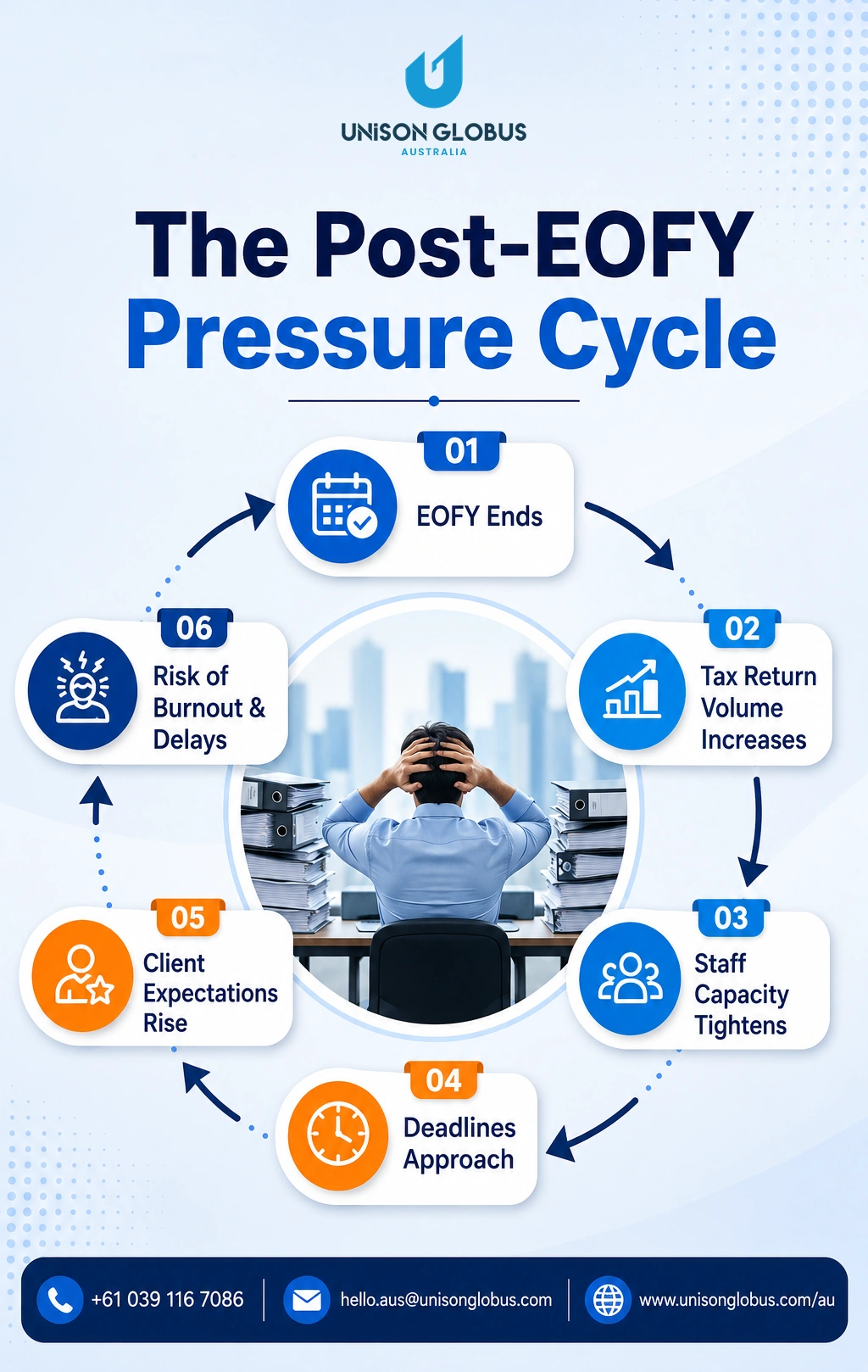
The period following EOFY is often one of the busiest times for accounting practices.
Teams are simultaneously managing:
- Individual and business tax returns
- Financial statement preparation
- BAS and compliance obligations
- Client queries and document collection
- Advisory engagements and business planning discussions
For many firms, the challenge isn’t expertise it’s capacity.
When workloads surge, even high-performing teams can experience delays, overtime, and mounting pressure. This is where effective post EOFY tax workload management becomes critical.
When workloads increase, the first instinct is often to hire.
Why Hiring More Staff Isn't Always the Best Solution?
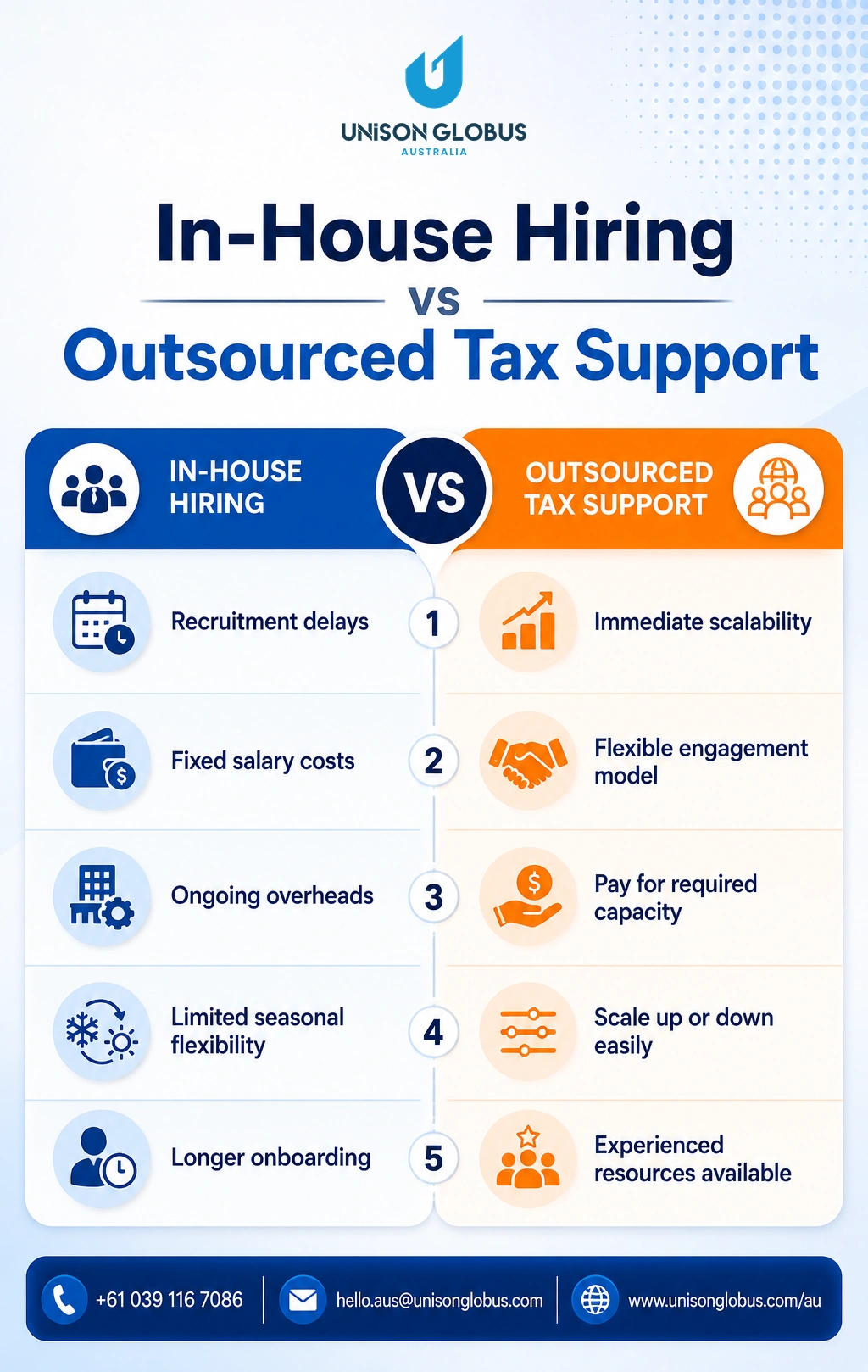
However, recruiting experienced tax professionals in Australia has become increasingly difficult. Between rising salaries, lengthy hiring processes, onboarding costs, and ongoing overheads, expanding an internal team isn’t always practical for seasonal demand.
The challenge is simple, tax season spikes are temporary, but employment costs are permanent.
As a result, many firms are turning to accounting outsourcing for CPA firms Australia as a more flexible alternative.
Instead of adding fixed costs, firms can access skilled tax professionals only when additional support is required.
What Tax Preparation Outsourcing Actually Includes?
Many firm owners still assume outsourcing means handing over complete control. In reality, outsourcing functions as an extension of your existing team.
Common outsourced tax support includes:
- Individual & Business tax return preparation
- Workpaper preparation
- Financial statement support
- Reconciliations and data processing
- Review-ready tax files
- Compliance documentation support
Is your team still working through the post-EOFY backlog?
Unison Globus helps Australian accounting firms handle the tax season surge without the overhead of permanent hires.
7 Reasons Australian Accounting Firms Are Outsourcing Tax Preparation After EOFY
1. Instantly Increase Capacity During Peak Tax Season
One of the biggest advantages of CA firms outsourcing tax preparation is immediate access to additional resources.
Rather than overloading internal teams, firms can distribute work more effectively and handle larger return volumes with confidence.
2. Meet Deadlines More Consistently
Tax deadlines don’t move, regardless of staff availability. By leveraging offshore tax preparation services Australia, firms can reduce delays and maintain smoother workflows during high-demand periods.
3. Improve Profitability Without Increasing Fixed Costs
Permanent hiring comes with recruitment fees, salaries, benefits, and training expenses. Outsourcing provides a scalable model where support can be increased or reduced based on workload demands.
This is one of the key benefits of outsourcing tax preparation for CPA firms looking to protect margins.
4. Free Senior Staff for Higher-Value Work
When experienced accountants spend excessive time preparing returns, advisory opportunities often take a back seat.
Outsourcing routine tax preparation enables senior team members to focus on:
- Strategic client conversations
- Tax planning
- Business advisory services
- Practice growth initiatives
5. Reduce Staff Burnout
Extended overtime and seasonal pressure can impact morale and retention.
Firms that successfully reduce tax season workload outsourcing accounting tasks often create healthier, more sustainable working environments.
6. Maintain Consistent Service Quality
Quality can suffer when teams are stretched. Structured outsourcing processes help firms maintain consistency, accuracy, and review readiness even during peak periods.
7. Create a More Scalable Growth Model
Growth shouldn’t be limited by headcount.
Many firms using accounting firms outsourcing services Australia are able to onboard more clients without immediately expanding internal teams. The result is a more agile and scalable operating model.
Common Concerns About Outsourcing and the Reality
For many firms, the hesitation around outsourcing isn’t about capability, it’s about trust. Here are some of the most common concerns and what they look like in practice.
1. What About Data Security?
Handing over sensitive financial information can feel like a big step. That’s why established outsourcing partners rely on secure systems, confidentiality agreements, and controlled access protocols to safeguard client data and maintain privacy throughout the engagement.
2. Will Quality Be Maintained?
Quality doesn’t disappear when work is outsourced, it depends on the process behind it. Your firm continues to review and approve the final output, while the outsourced team follows your workflows and standards to deliver consistent, accurate work.
3. Will We Lose Control of Client Relationships?
Not at all. Outsourcing is designed to support your team, not replace it. Your clients still communicate with your firm, while the outsourced professionals handle the preparation work behind the scenes. The result is often better responsiveness, faster output timelines, and more time for meaningful client conversations.
4. Can Outsourcing Support Compliance?
Yes. In fact, compliance is one of the main reasons many firms turn to Australian tax compliance outsourcing. During busy periods, when deadlines are tight and workloads keep growing, it’s easy for small mistakes to slip through. Working with an experienced outsourcing partner gives your team extra support to handle the volume while following Australian tax requirements and maintaining the accuracy and consistency your clients expect.
Signs Your Firm May Need Outsourced Tax Support
Ask yourself:
✓ Is your team regularly working overtime after EOFY?
✓ Are tax return backlogs becoming difficult to manage?
✓ Are advisory projects being delayed because compliance work is taking priority?
✓ Do staff capacity issues arise every tax season?
✓ Are growth plans being constrained by resource limitations?
If you answered “yes” to several of these questions, outsourcing may provide the flexibility your firm needs.
This is increasingly becoming part of how accounting firms manage post EOFY workload without compromising client service.
Choosing the Right Outsourcing Partner
Not all providers offer the same level of expertise.
When evaluating a partner, look for:
- Experience supporting Australian accounting firms
- Strong understanding of Australian taxation processes
- Scalable resource availability
- Robust data security practices
- Clear communication channels
- Proven quality assurance procedures
The most successful outsourcing relationships feel less like vendor arrangements and more like an extension of the firm’s internal team.
Whether you’re considering offshore tax preparation services for Australian firms or broader accounting support, selecting the right partner is essential.
Conclusion
The post-EOFY period places significant pressure on accounting firms, but capacity challenges don’t have to limit growth. As tax return volumes increase and deadlines tighten, firms need solutions that provide flexibility without increasing permanent overheads. That’s why more firms are choosing to outsource tax preparation in Australia and leverage strategic support models that improve efficiency, protect staff wellbeing, and maintain service quality.
The firms that thrive after EOFY aren’t necessarily the ones with the largest teams they’re the ones with the smartest capacity strategies. And for most, that thinking doesn’t stop at tax. Once seasonal demand is managed effectively, many firm owners begin evaluating where else operational efficiency can be gained.
Tax preparation is often the starting point, but bookkeeping tends to follow. It is one of the more time-intensive back-office functions and, when handled internally, can limit the bandwidth available for higher-value client work. Addressing that through structured outsourcing allows firms to operate more consistently, improve turnaround times, and position their teams for advisory-focused growth. The same logic applies beyond Australia, UK firms navigating similar capacity pressures are increasingly turning to digital bookkeeping solutions to achieve the same outcome. For the firms that have made that shift, outsourcing is no longer a contingency measure it is simply how a well-structured practice is run.
EOFY demands more than longer hours, it demands the right support.
Unison Globus Australia helps accounting firms scale tax preparation without compromising quality or deadlines.
Looking for Reliable Support This EOFY?
Discover how Unison Globus Australia can simplify your EOFY tax preparation Australia workflow with expert support that keeps your team ahead.
FAQ’s
Many firms choose to outsource tax preparation Australia after EOFY because tax return volumes increase significantly during this period. Outsourcing helps firms manage workload peaks, meet lodgement deadlines, reduce staff pressure, and maintain service quality without hiring additional full-time employees.
Yes. Reputable providers offering Australian tax compliance outsourcing implement strict data security measures, confidentiality agreements, controlled access protocols, and secure technology environments. Firms also retain oversight and final review authority over all tax work.
Some of the key benefits of outsourcing tax preparation for CPA firms include increased capacity during peak seasons, reduced operational costs, faster delivery timelines, improved staff productivity, lower burnout risk, and the ability to focus on higher-value advisory services.