


 [gtranslate]

Summarize and analyze this article with:
- Why India Has Become a Significant Accounting Delivery Market
- As firms evaluate accounting outsourcing to India, the most effective approach is often to begin with clearly defined workflows, established review processes, and measurable capacity objectives.
- Why CPA Firms Are Evaluating Accounting Outsourcing to India
- Which Accounting Functions Are Suitable for Outsourcing?
- Which Outsourcing Model Fits Your CPA Firm?
- How Should You Evaluate an Accounting Outsourcing Provider in India?
- How Should You Implement Accounting Outsourcing to India?
- How Should You Manage the Relationship After Launch?
- Final Decision Checklist for CPA Firm Leaders
- Need additional capacity before tax season?
- Conclusion
- Accounting Outsourcing Is a Global Operating Model
- Frequently Asked Questions
- What is outsourcing in accounting?
- Which accounting functions can US companies outsource to India?
- When should a CPA firm choose a dedicated offshore accounting team?
- How do CPA firms maintain quality when accounting work is performed in India?
- Does a CPA firm need client consent before sending tax information to India?
- What should firms look for in an accounting outsourcing provider in India?
CPA firms often reach a crossroads when growing workloads outpace their existing teams’ capacity. The question is no longer simply how to add more production capacity. It is how to add capacity without creating new pressure on review, turnaround, client service, or partner oversight.
Recruiting experienced accountants is one option. Redistributing work internally is another. This is one reason US companies outsource to India for defined accounting, bookkeeping, tax preparation, financial reporting, and audit-support activities.
But choosing India for accounting work is more than a labor-arbitrage decision. The model has to fit the firm’s workflows, technology environment, documentation, review structure, client requirements, and professional responsibilities. The external team may prepare and execute defined work, while the CPA firm retains professional judgment, client relationships, review, final approval, and engagement accountability.
That makes Accounting Outsourcing to India an operating-model decision as much as a resourcing decision. The real questions are what should be done, what should be done with the firm, which delivery model fits the workload, and what a provider should demonstrate before the relationship begins.
Accounting outsourcing to India enables CPA firms to expand capacity by delegating bookkeeping, accounting, tax preparation, financial reporting, audit support, payroll, and back-office functions to qualified offshore professionals while retaining professional judgment, review responsibility, and client relationships.
This guide provides a practical framework for evaluating those decisions, from identifying suitable workflows and selecting an outsourcing model to assessing providers, establishing security and governance controls, and building a sustainable review process.
Why India Has Become a Significant Accounting Delivery Market
India has become an increasingly important delivery market for U.S. accounting firms because of the depth of its professional talent base and the growing integration of India-based teams into global accounting operations.
The shift is visible among established U.S. firms. In 2025, Reuters reported that RSM US, Moss Adams, Sikich, and CohnReznick were expanding their India operations as U.S. firms faced a tightening supply of accounting talent. RSM US subsequently reported more than 3,400 professionals across its India operations in December 2025 and described India as strategically important to its global capabilities.
For CPA firms considering Accounting Outsourcing to India, the significance is less about the size of the market alone and more about the capabilities available within it. India has developed a substantial professional workforce supporting accounting, tax, finance, audit, technology, and business-process functions for global organizations. That gives firms access to external teams that can be structured around defined workflows rather than limited to one-off administrative tasks.
(Source: AICPA & CIMA)
The more important question, however, is whether a particular provider can translate that broader talent availability into reliable accounting firm support. A firm’s evaluation should therefore focus on U.S. accounting experience, familiarity with the firm’s systems and procedures, team qualifications, continuity, security controls, review processes, and the ability to work within the firm’s existing delivery model.
India can provide the talent and delivery infrastructure. The provider still must demonstrate that its people, processes, technology, and governance are appropriate for the firm’s specific work.
As firms evaluate accounting outsourcing to India, the most effective approach is often to begin with clearly defined workflows, established review processes, and measurable capacity objectives.
Why CPA Firms Are Evaluating Accounting Outsourcing to India
For CPA firms, the decision to outsource often starts with a capacity constraint. A firm may have strong demand and an experienced leadership team while still struggling to absorb additional work because senior professionals are spending too much time on recurring production activities. Tax preparation, bookkeeping, reconciliations, financial reporting, and audit support can all create capacity pressure when internal teams are stretched.
The capacity question usually comes down to a few practical conditions:
- Recurring workload pressure: The same production bottlenecks appear across multiple periods rather than during one isolated deadline.
- Senior professionals in production roles: Managers or partners spend substantial time preparing or reworking tasks that could potentially follow documented procedures.
- Seasonal demand: Tax season, audits, year-end closing, and other recurring deadlines create workload spikes that are difficult to staff permanently.
- Growth constraints: The firm has opportunities to add clients or services but lacks enough preparation capacity behind its client-facing professionals.
- Recruitment limitations: Hiring may take longer than the firm’s workload cycle allows, particularly when experienced professionals are required.
The objective is to determine which work requires internal expertise and which execution activities can be supported through a structured external team.
What Should Your Firm Assess Before Outsourcing?
The strongest outsourcing relationships generally begin with a clear understanding of the firm’s existing workflow.
Before approaching providers, determine where the work begins, what information it requires, what the completed output should contain, who reviews it, and where professional judgment enters the process.
A readiness assessment should cover:
- Work suitability: Identify recurring activities that can be documented, assigned, and reviewed against defined expectations.
- Process documentation: Review SOPs, checklists, templates, workpapers, and examples to determine whether another professional could follow the firm’s process.
- Review ownership: Identify the internal professional responsible for reviewing the output and resolving exceptions.
- Technology access: Determine which accounting, tax, document, and workflow systems the external team would need to use.
- Management capacity: Assign an internal owner who can coordinate the relationship, answer questions, and monitor performance.
- Security requirements: Establish access, confidentiality, information-handling, and contractual requirements that apply to client work.
A firm may need to improve its internal process before transferring it externally. If a workflow is poorly documented or reviewers are already overloaded, outsourcing can simply move the bottleneck from preparation to review.
Which Accounting Functions Are Suitable for Outsourcing?
The right question is not whether a task is easy or difficult. It is whether the process can be clearly defined, performed consistently, and reviewed by the appropriate professional.
Common starting points include bookkeeping, reconciliations, accounts payable and receivable support, tax preparation support, financial reporting assistance, and selected audit-support activities.
These workflows often have identifiable inputs, repeatable procedures, and defined outputs.
| Workflow | What an external team may prepare | What the firm typically retains |
|---|---|---|
| Bookkeeping | Transaction recording, categorization, reconciliations, recurring close activities, supporting schedules | Review, accounting judgments, client communication, final approval |
| Accounts payable | Invoice processing, coding, supporting documentation, payment-preparation activities | Payment authorization, policy decisions, exception approval |
| Accounts receivable | Billing support, receipt posting, aging schedules, reconciliation support | Client decisions, collection strategy, final oversight |
| Tax preparation | Workpapers, supporting schedules, data organization, draft returns, defined preparation activities | Tax positions, professional judgment, review, client advice, final approval |
| Financial reporting | Trial-balance support, schedules, reporting packages, recurring statements | Interpretation, review, adjustments requiring judgment, final reporting decisions |
| Audit support | Documentation, selected testing support, workpaper preparation, evidence organization | Engagement supervision, conclusions, professional judgment, final review |
The appropriate scope depends on the firm’s processes, engagement requirements, client circumstances, and applicable professional obligations.
That is why Outsourced Bookkeeping and accounting should be defined at the workflow level rather than described simply as moving an entire accounting function outside the firm.
What Should Remain with the CPA Firm?
Outsourcing execution does not transfer the firm’s professional responsibility.
The CPA firm should maintain ownership of activities that depend on professional judgment, client relationships, engagement decisions, and final approval.
These responsibilities generally include:
- Client communication: The firm’s professionals understand the client relationship, expectations, and broader engagement context.
- Professional judgment: Accounting conclusions and tax positions can require experience, interpretation, and engagement-specific judgment.
- Tax planning and advisory: Strategy depends on the client’s objectives, circumstances, and risk considerations.
- Partner and manager review: Internal review provides the firm’s quality and professional oversight layer.
- Final approval: The firm responsible determines whether the deliverable is ready for the client or filing.
- Engagement accountability: The CPA firm remains responsible for its engagement and client service obligations.
An external team can prepare work. The firm’s professionals remain responsible for determining whether that work meets the firm’s standards and the requirements of the engagement.
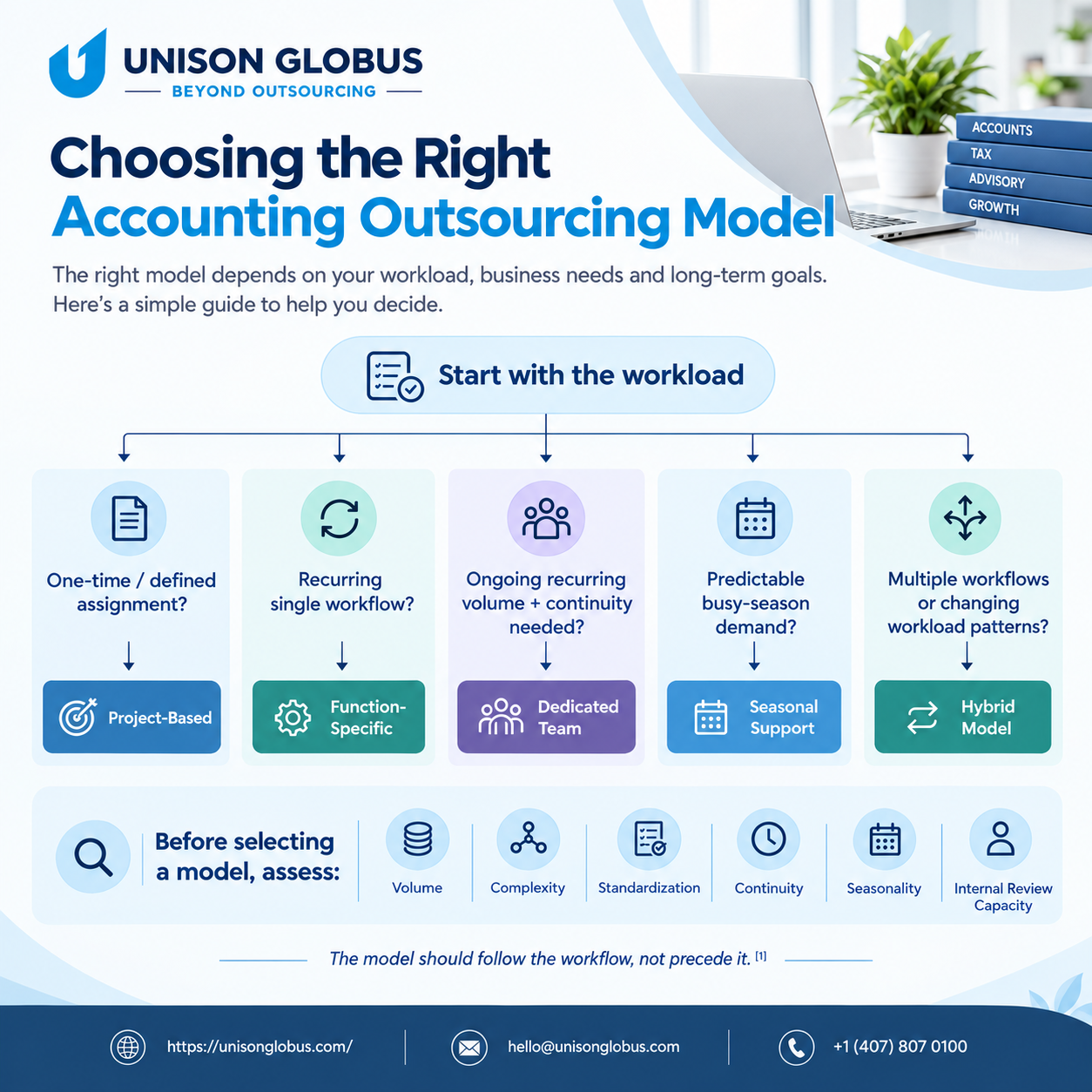
Which Outsourcing Model Fits Your CPA Firm?
Once the work has been defined, the next decision is how the external capacity should be structured.
Different models solve different operating problems. A firm testing one workflow may need a different arrangement from a practice that requires recurring preparation capacity throughout the year.
| Model | Best suited for | How it typically operates | Main consideration |
|---|---|---|---|
| Project-based | Defined cleanup, backlog, year-end, or one-time assignments | The provider completes an agreed scope within a defined period | Requires precise scope and handoffs |
| Function-specific | Recurring workflows such as bookkeeping or reconciliations | The external team supports a defined business function | Requires clear process ownership |
| Dedicated team | Ongoing workload requiring continuity | Assigned professionals become familiar with the firm’s processes and review expectations | Requires structured onboarding and ongoing management |
| Seasonal support | Predictable periods of increased workload | Additional external capacity is introduced around defined peak periods | Requires advance planning and training |
| Hybrid | Firms with multiple workload patterns | Different models are used for different workflows or periods | Requires strong coordination between teams |
A Dedicated offshore accounting team is generally considered when a firm has recurring volume that justifies continuity, firm-specific training, and a deeper understanding of its processes.
A project-based arrangement may be more appropriate when the firm wants to test a workflow before expanding the scope.
Firms that choose to Hire Offshore Accountants through a direct employment or similar structure should also consider the management, employment, administration, and continuity responsibilities that come with that model. A provider-managed arrangement can structure those responsibilities differently.
The decision should follow the workflow assessment, not precede it.
How Should You Evaluate an Accounting Outsourcing Provider in India?
A search for the Top accounting outsourcing companies in India can help create a shortlist, but rankings and provider websites do not establish operational fit.
The more useful evaluation asks what the provider can demonstrate.
| Evaluation area | Questions to ask | Evidence worth requesting |
|---|---|---|
| CPA firm experience | What accounting, tax, and audit-support workflows do you routinely handle for U.S. firms? | Relevant client examples, references, service scope |
| Team qualifications | Who will perform the work, and how are professionals trained? | Role profiles, training framework, qualification information |
| Workflow alignment | How do you adopt a firm’s SOPs, templates, workpapers, and review standards? | Sample workflow, onboarding process, documentation approach |
| Quality control | What review occurs before work reaches the firm? How are recurring errors identified? | Review checklist, escalation process, quality reporting |
| Technology | Can the team work within the firm’s existing accounting, tax, document, and workflow systems? | Supported-system information, access process, implementation plan |
| Communication | Who manages questions, escalations, deadlines, and status updates? | Communication cadence, named contacts, escalation structure |
| Continuity | What happens when assigned personnel are absent or responsibilities change? | Backup plan, transition process, staffing structure |
| Security | How is client information protected and how is access controlled? | Relevant certifications or assurance reports, policies, contractual controls |
The goal is to test whether the provider can operate inside the firm’s existing workflow.
For example, asking whether a provider “supports QuickBooks” is less useful than asking how it handles access, firm-specific chart-of-accounts procedures, reconciliation standards, review notes, and changes to client files.
The same principle applies to tax software, document-management platforms, and workflow applications.
What Security, Compliance, and Governance Controls Should You Review?
When an external team receives access to client information, security and compliance need to be addressed before work begins.
For tax return information, Treasury Regulation §301.7216 generally requires written taxpayer consent when a tax return preparer discloses return information to another preparer located outside the United States, subject to the regulation’s authorised-disclosure provisions and exceptions. The regulation also contains specific rules concerning Form 1040-series returns and the disclosure of Social Security numbers to preparers outside the United States, including requirements related to data-protection safeguards.
The FTC Safeguards Rule may also apply to tax preparation firms and other covered financial institutions. Covered firms have obligations relating to information-security programs and service-provider oversight, including selecting capable providers, establishing contractual safeguards, and periodically assessing provider safeguards.
The exact requirements depend on the firm’s circumstances, the information involved, and applicable regulations. Firms should confirm specific legal and professional obligations with qualified advisors.
From an operational standpoint, provider due diligence should cover:
- Access management: Confirm that users receive only the permissions required for their responsibilities and that access can be changed or removed promptly.
- Information handling: Understand how client information is transmitted, stored, accessed, and disposed of.
- Service-provider oversight: Review relevant contractual commitments, assurance reports, security policies, and ongoing assessment procedures.
- Business continuity: Understand how the provider handles employee absence, system disruption, connectivity issues, and other operational interruptions.
- Review ownership: Keep the firm’s internal review and approval responsibilities clearly defined.
- Incident escalation: Establish how security, workflow, or client-data incidents are reported and handled.
The objective is not to collect security terminology from a provider’s sales material. It is to understand the controls, the responsibilities attached to them, and how they operate in the actual engagement.
How Should You Implement Accounting Outsourcing to India?
A pilot gives the firm an opportunity to test the workflow before committing to a broader scope.
A practical implementation sequence is:
Pilot → Measure → Refine → Scale
Before the Pilot
Before the pilot begins, establish the following:
- Define the workflow: Specify the tasks, inputs, outputs, deadlines, exclusions, and escalation points.
- Document the process: Provide SOPs, examples, templates, workpapers, checklists, and review instructions.
- Assign responsibilities: Identify the external preparer, provider-side manager, internal reviewer, and final approver.
- Set up access: Establish the systems, permissions, security procedures, and user accounts required for the work.
- Set success criteria: Decide how the firm will assess quality, communication, review effort, exception handling, and workflow fit.
During the Pilot
During the pilot, monitor the following:
- Track questions: Capture recurring questions and unclear instructions so they can be incorporated into process documentation.
- Review output: Record exceptions and rework rather than evaluating the pilot only on whether deadlines were met.
- Monitor review effort: Measure the internal time required to review the work so the firm can assess the actual capacity impact.
- Update procedures: Revise instructions when the pilot exposes gaps or ambiguity.
After the Pilot
Once the pilot is complete, focus on the following:
- Refine the workflow: Resolve recurring issues before adding more scope.
- Confirm reviewer capacity: Make sure internal professionals can absorb the review requirements.
- Expand gradually: Add related workflows in stages rather than transferring multiple unfamiliar processes simultaneously.
This approach makes the pilot a genuine operating test rather than simply a trial period.
How Should You Manage the Relationship After Launch?
The work does not become self-managed once the provider is onboard.
A defined governance cadence helps the firm identify workload, quality, communication, and process issues before they become larger problems.
A practical can include:
- Weekly: Review workload, exceptions, open questions, and upcoming deadlines to resolve immediate blockers and keep work aligned.
- Monthly: Examine quality trends, rework, capacity, and recurring process issues to identify patterns and improve the workflow.
- Quarterly: Review scope, staffing needs, procedures, technology, and future workload to determine whether the operating model still fits the firm’s needs.
The exact cadence can vary by engagement, size and complexity, but ownership should remain clear.
An internal relationship owner should know what work is being performed, whether the review process is working, where exceptions are recurring, and whether the provider’s capacity continues to match the firm’s needs.
For Outsourced Accounting Services, this feedback loop is particularly important because recurring errors can indicate unclear procedures or handoff problems rather than simply individual performance issues.
Final Decision Checklist for CPA Firm Leaders
Before choosing a provider or expanding an existing arrangement, confirm the following:
| Decision area | Ready when… | Warning sign |
|---|---|---|
| Capacity | The firm has identified a recurring workload constraint | The outsourcing decision is based only on a general desire to “do more” |
| Scope | Specific workflows and deliverables are defined | The firm wants to outsource an entire function without mapping the work |
| Documentation | SOPs, examples, and review standards exist | Instructions depend primarily on individual employee knowledge |
| Review | Internal reviewers have time and authority to review the work | Existing reviewers are already overloaded |
| Technology | Required systems and access procedures are established | External users would need informal or uncontrolled access |
| Provider | Experience, people, quality, security, and continuity are evidenced | Selection is based primarily on price |
| Pilot | Scope, success criteria, and review process are documented | The firm intends to move a large volume immediately |
| Governance | Internal ownership and communication cadence are established | No one is responsible for managing the relationship |
If several of these areas remain unresolved, improving the internal process may be the right first step.
Need additional capacity before tax season?
Discover how a dedicated offshore accounting team can support your bookkeeping, tax preparation, financial reporting, and audit workflows.
Conclusion
Accounting outsourcing becomes easier to evaluate when the decision is made at the workflow level.
Start with the capacity constraint. Identify which activities are repeatable, documented, and reviewable. Separate execution work from professional judgment and client responsibility. Then choose the delivery model that matches the firm’s volume, continuity, seasonality, and management capacity.
From there, provider evaluation should extend beyond price. The right assessment covers people, process alignment, technology, security, quality control, communication, and business continuity. A controlled pilot can then establish whether the arrangement actually fits the firm’s operating model before additional workflows are introduced.
For firms considering Offshore Accounting Services or Global accounting outsourcing services, the objective should be a delivery structure that adds execution capacity while keeping professional responsibility with the firm.
Unison Globus supports U.S. CPA and accounting firms with accounting, bookkeeping, tax preparation, financial reporting, payroll, and audit-support services. As an accounting outsourcing provider in India, its model combines defined workflows, dedicated support, AI-assisted accounting workflows supported by experienced accounting professionals.
If your firm is evaluating whether external accounting capacity fits its current workload, explore Unison Globus’s accounting outsourcing services for CPA firms and start with the workflows creating the greatest capacity pressure.
Accounting Outsourcing Is a Global Operating Model
The considerations in this guide apply beyond U.S. accounting firms. UK and Australian practices are also evaluating external accounting capacity to support recurring bookkeeping, tax, compliance, reporting, and peak-period workloads. While regulatory requirements differ across jurisdictions, many firms face similar challenges around talent shortages, operational efficiency, scalability, and turnaround times.
For example, UK accounting firms are increasingly leveraging Accounting & Bookkeeping Outsourcing Services to support compliance-driven workflows and growing client demands, while Australian firms are using offshore support models to strengthen bookkeeping, tax preparation, BAS, payroll, and year-end accounting processes. The specific workflows, regulations, and professional requirements may vary by market, but the fundamentals remain the same: define the work, establish review ownership, protect client information, and choose a delivery model that aligns with the firm’s operational needs.
Frequently Asked Questions
Accounting outsourcing is the practice of assigning defined accounting, bookkeeping, tax preparation, financial reporting, or audit-support activities to an external team while the CPA firm retains responsibility for professional judgment, review, client relationships, and final approval. The external team typically works within the firm’s established processes, technology systems, documentation standards, and review structure.
Common examples include bookkeeping, bank and account reconciliations, accounts payable and receivable support, defined tax preparation activities, financial reporting support, and selected audit-support work. Suitability depends on the firm’s documentation, workflow, technology, review structure, and engagement requirements.
A dedicated team can make sense when the firm has a recurring workload that requires continuity, firm-specific process knowledge, and ongoing preparation capacity. Firms with a one-time backlog or a narrowly defined project may find a project-based arrangement more appropriate.
Quality depends on documented procedures, clear deliverables, defined review points, controlled system access, communication protocols, exception tracking, and internal professional review. The firm’s responsible professionals retain final review and approval.
Certain disclosures of taxpayer return information to a tax return preparer located outside the United States require written taxpayer consent under Treasury Regulation §301.7216, while the regulation also provides for authorized disclosures and specific exceptions. It contains additional provisions concerning Form 1040-series returns and Social Security numbers. Firms should confirm the requirements applicable to their engagement before transferring covered information.
Evaluate the provider’s experience with U.S. accounting firms, team qualifications, workflow alignment, review procedures, technology compatibility, communication structure, security controls, business continuity planning, and evidence of quality. A provider should be evaluated on how wsell it can operate within the firm’s existing workflow, not simply on its quoted rate.