


 [gtranslate]
Summarize and analyze this article with:
- What Causes Accounting Review Delays Before Q3
- Why Clients Notice a Thin Review Before You Do
- The Mid-Year Accounting Checklist for CPA Firms: What a Real Review Covers
- Feeling the pressure of completing a thorough mid year accounting review with limited staff capacity?
- Role of Accounting Technology in Mid-Year Reviews
- Accounting Outsourcing Services for CPA Firms: Closing the Gap
- Conclusion
- Looking to improve review quality, turnaround times, and client service without expanding your in-house team?
- Frequently Asked Questions
- What should CPA firms review at mid-year?
- Why is a mid year accounting checklist important before Q3?
- How do CPA firms prepare accounting records before Q3?
- What are the risks of skipping a mid-year financial review?
- How can accounting outsourcing support mid-year reviews?
- When should CPA firms consider hiring dedicated accounting experts?
- How does Unison Globus help CPA firms with accounting reviews?
By July, six months of transaction history are already sitting in the books. Whether that’s an asset or a liability has less to do with intent and more to do with capacity: whether anyone actually had the hours to look closely at what’s there.
That distinction matters more this year than usual, because three pressures are now feeding each other in a way that’s harder to ignore than in past mid-year cycles. Staffing shortages are compressing how much review time firms can give each client. Compressed review time is letting small errors sit longer before anyone catches them. And clients, who are more aware than ever of what good service should look like, are starting to notice and switch firms over it. None of these are new problems individually. What’s changed is how directly they’re now causing each other.
A mid year accounting checklist is the intervention point that breaks that chain before it reaches Q3, where it stops being theoretical and starts being expensive. September 15 is the third estimated tax payment deadline for 2026, and it’s a partly projected payment, built on income through a month that hasn’t even fully closed yet. Clean books going into that date are the difference between an accurate estimate and an expensive guess.
This is the accounting review before Q3 that matters: not a formality, but the last real checkpoint before small gaps turn into either a penalty, an audit flag, or a client wondering why their accountant didn’t catch something sooner.
What Causes Accounting Review Delays Before Q3
Most firms run on a division of labor nobody ever writes down: production work gets queued, a manager works through it when nothing else is on fire, and a partner does a final pass before anything reaches the client. That holds up fine when one client needs attention at a time. It breaks the moment two do, which in practice is most weeks of the year.
When that happens, the deadline rarely moves. The depth of the mid year accounting review does:
- The math doesn’t work like it looks. Adding headcount doesn’t close the gap fast. A new hire needs ramp-up time and review of their own work before they’re a net add to capacity, often for months. The gap that prompted the hire is usually still open when Q3 arrives, which is exactly why firms increasingly look at Hire Dedicated Accounting Experts models instead of a slow in-house build-out.
- A full mid year accounting checklist gets compressed into a glance. A reconciliation that should take an hour gets fifteen minutes. “We’ll catch it at close” replaces the actual review.
- Capacity strain measurably increases errors. Gartner has found that a third of accountants make several errors a month, with capacity strain named directly as a driver: a late submission during close forces a rushed data quality review, and the time spent fixing those errors leaves less room for complex work, like intercompany eliminations, that needed careful attention in the first place.
- The pattern is self-reinforcing. Less time produces more errors. More errors eat the time that should go toward catching the next one, the opposite of what an accounting review before Q3 is supposed to achieve.
- The damage shows up quietly. Not as one dramatic failure, but as review getting a little thinner each cycle, and small items getting noted “for later” instead of caught now.
That “for later” pattern is exactly what a mid year accounting checklist for CPA firms exists to interrupt before it reaches Q3.
Why Clients Notice a Thin Review Before You Do
A gap noted “for later” doesn’t stay internal. It surfaces, eventually, on the client’s side. And when it does, it doesn’t read as a scheduling hiccup. It reads as a service failure.
This isn’t a guess about client psychology. Wolters Kluwer’s research found that 87% of SME clients want their accountant to act as a trusted business advisor rather than a compliance provider, and 67% say they’d switch accountants for a better digital experience. Specifically: 82% want their accountant to reach out proactively when something relevant changes, rather than waiting to be asked. One major industry survey went further, finding proactive advice was the single biggest factor in client satisfaction. Not technical skill. Not speed. Proactivity.
Here’s the structural problem. A compressed mid year accounting review doesn’t just risk an error slipping through. It can’t produce proactive flagging at all, because catching something before it becomes a problem takes exactly the kind of close attention that gets cut first when review time is short. The client never sees the capacity squeeze upstream. They just experience an accountant who mentioned the cash flow issue after it mattered, instead of before.
The churn data makes the stakes concrete. Poor responsiveness, inconsistent service, and a lack of proactive communication are named as the major preventable drivers of client churn in accounting. Preventable is the key word there. These are operational gaps, not pricing problems or technical shortfalls, which means they’re fixable with the right process rather than something to apologize for and hope the client stays.
And the upside is just as concrete. Most business decision-makers say they see clear value when their accountant helps them save money through proactive advice or smarter planning. That’s the opposite of finding out about a problem after the fact, from the same accountant who’s supposed to have caught it first.
This is where how to prepare accounting records before Q3 stops being a back-office task. Clean books mid-year aren’t just about a more accurate September 15 estimate. They’re what makes the proactive conversation possible in the first place: here’s what I’m seeing, here’s what to do about it, said before the client has to ask why nobody mentioned it sooner.
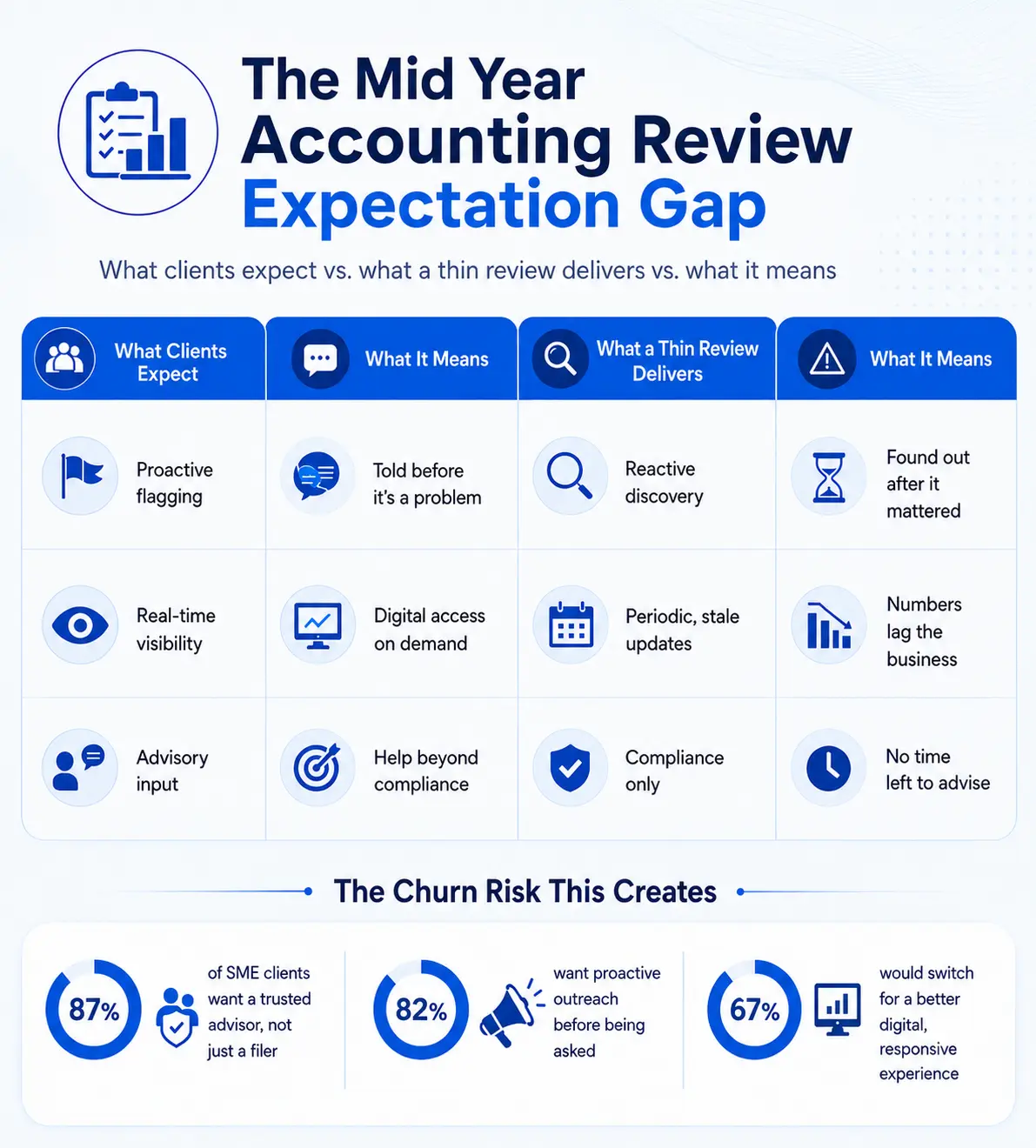
This infographic highlights the gap between client expectations and actual service delivery during compressed review cycles.
The Mid-Year Accounting Checklist for CPA Firms: What a Real Review Covers
Knowing that a thin review creates client trust problems is one thing. Knowing where the gaps tend to hide is another. This CPA firm accounting checklist is not a broad sweep of the books. It is a targeted pass through the areas where six months of transaction volume most reliably produces errors that compound quietly into Q3.
Here is what a complete mid-year accounting review should cover:
- Bank and credit card reconciliations: All accounts reconciled through June, no unresolved items older than 30 days.
- Accounts receivable aging: Invoices older than 90 days reviewed, reserved, or written off. Overstated receivables directly distort the September 15 estimated tax payment.
- Accounts payable and accrued liabilities: Recurring vendor obligations fully posted, accruals reflecting what has been incurred but not yet invoiced.
- Payroll liabilities: Tax deposits matched to withholdings, liabilities cleared after each pay period.
- Intercompany accounts: Balances netted to zero across all entities.
- Fixed assets and depreciation: New additions properly capitalized, disposals removed, depreciation current through June.
- Deferred revenue and prepaid expenses: Both reviewed for proper recognition, nothing sitting on the balance sheet past its useful period.
- Owner and shareholder transactions: Draws, loans, and personal expenses through the business properly classified.
- Estimated tax positioning: Year-to-date income assessed against current installments ahead of September 15.
This is what it means in practice to prepare accounting records before Q3. The list itself is not the hard part. Having the review time to work through it properly is. That is the gap between a mid-year financial review checklist for CPA firms that functions as a real checkpoint and one that gets compressed into a formality under capacity pressure, and it is exactly what the right outsourcing model is built to close.
Feeling the pressure of completing a thorough mid year accounting review with limited staff capacity?
Role of Accounting Technology in Mid-Year Reviews
Technology plays a central role in enabling accurate and efficient mid-year reviews. Most US CPA firms operate within integrated accounting ecosystems that include platforms such as QuickBooks, NetSuite, and Xero, along with workflow and document management tools.
However, the effectiveness of these systems depends on consistent data entry, reconciliation, and review processes.
Outsourced accounting teams are trained to work directly within these platforms, ensuring:
- Real-time data updates
- Standardised workflows across clients
- Improved visibility into financial performance
- Seamless collaboration with in-house teams
When combined with a structured mid-year review process, technology and operational support create a scalable system that maintains accuracy even at high volume.
Accounting Outsourcing Services for CPA Firms: Closing the Gap
Everything up to this point describes a structural problem, not a discipline problem. Firms aren’t missing reconciliations because nobody cares. They’re missing them because review time and production time are fighting for the same hours, and there’s no fast way to add more hours from inside the firm alone. This is where an Accounting Outsourcing Company earns its place in the conversation, not as a cost play, but as the missing capacity layer.
Here’s specifically how outsourced capacity closes that gap, rather than just promising to.
- It works on a different clock than your firm does. Most outsourced accounting teams operate from time zones eight to twelve hours ahead of US business hours. A file sent at 5pm Eastern can be reconciled, coded, and ready for review by the time your team is back at 9am the next morning. That’s not a minor convenience. It means production work happens overnight instead of competing with same-day review for the same staff hours, which is the exact bottleneck described earlier in this piece.
- It separates production from judgment, on purpose. The model that holds up isn’t “hand off the client.” It’s “hand off the parts of the work that don’t require a partner’s judgment to execute, reconciliations, first-pass coding, vendor file cleanup, draft close packages, and keep judgment, sign-off, and the client relationship in-house.” Accounting Outsourcing Services for CPA Firms are built around exactly this split: outsourced teams do the volume work, your reviewers do what only they can do, decide what’s worth flagging.
- It changes what review time actually buys. When a reconciliation has already been done correctly before it reaches a reviewer, the reviewer’s hour goes toward catching the things that matter, the owner draw misclassification, the unaccrued revenue, the items from earlier in this piece that a rushed glance misses. That’s the direct link back to the client-trust problem: capacity at the production layer is what buys back the attention proactive advisory work actually requires.
- The numbers are consistent across the industry. Firms using outsourced support during high-volume periods report 25 to 30% faster turnaround on average, a difference visible enough that clients notice it directly. A quarter of US accounting firms are already offshoring core functions like bookkeeping and tax prep, and roughly two-thirds of those already doing it plan to expand the engagement in the next year, which says more about results than intent.
This is also the practical version of what it means to Hire Dedicated Accounting Experts without the months-long hiring cycle covered earlier in this piece. A few things worth confirming before choosing a partner, since this is still client financial data:
- SOC 2 Type II certification, documentation available on request, not just a claim of it.
- Documented IRC §7216 consent in engagement letters, required before sharing taxpayer data with any third party, onshore or offshore.
- Defined SLAs with error-rate and turnaround targets, not vague assurances of quality.
- A short pilot first. Running a handful of clients through a trial period with full review before scaling is the standard way firms validate a new partner without betting the whole book on it.
None of this replaces the work your team already does well. It’s the layer underneath it, so review time goes toward judgment instead of getting consumed by production before judgment ever gets a turn.
Conclusion
A strong mid year accounting review gives CPA firms the opportunity to identify issues while there is still time to correct them. From reconciliations and accruals to tax planning and financial reporting, every item reviewed today can prevent larger challenges later in the year. Completing a comprehensive mid year accounting checklist before Q3 helps improve accuracy, reduce compliance risk, and create a stronger foundation for client advisory services.
The difficulty for many firms is not understanding what needs attention. The challenge is having sufficient capacity to complete a detailed accounting review before Q3 while balancing client work, staffing limitations, and ongoing deadlines. When reviews are rushed, firms risk overlooking issues that can affect reporting quality, tax estimates, and client satisfaction.
This is where Accounting Outsourcing Services for CPA Firms can provide meaningful support. By partnering with an experienced Accounting Outsourcing Company, firms can free up valuable internal resources and focus on higher-value review and advisory work. Choosing to Hire Dedicated Accounting Experts allows CPA firms to maintain quality standards, improve turnaround times, and execute a more effective CPA firm accounting checklist without increasing internal workload.
At Unison Globus, we support CPA firms with dedicated accounting professionals who assist with bookkeeping, reconciliations, financial statement preparation, and other essential back-office functions. Our approach helps firms strengthen their review processes, improve operational efficiency, and prepare accounting records before Q3 with greater confidence.
As the year progresses, firms that prioritize a thorough mid year financial review checklist for CPA firms will be better positioned to deliver accurate reporting, proactive guidance, and a higher level of service to their clients.
Looking to improve review quality, turnaround times, and client service without expanding your in-house team?
Frequently Asked Questions
A comprehensive mid year accounting review should cover bank and credit card reconciliations, accounts receivable and payable, payroll liabilities, fixed assets, depreciation, intercompany transactions, deferred revenue, prepaid expenses, and estimated tax positioning. The goal is to identify and correct issues before they affect Q3 reporting and compliance.
A mid year accounting checklist helps firms verify the accuracy of financial records before entering the second half of the year. Addressing discrepancies early can reduce compliance risks, improve financial reporting, and support more accurate tax planning ahead of key deadlines.
To prepare accounting records before Q3, firms should reconcile all balance sheet accounts, review outstanding receivables and payables, update depreciation schedules, validate accruals, assess tax liabilities, and investigate any unusual transactions. A structured review process ensures the books accurately reflect the business’s financial position.
Without a mid year financial review checklist for CPA firms, errors can remain undetected for months. This can lead to inaccurate financial statements, incorrect tax estimates, cash flow surprises, compliance issues, and reduced client confidence.
An Accounting Outsourcing Company can help by handling time-intensive tasks such as bookkeeping, reconciliations, account clean-up, and financial statement preparation. This gives internal teams more time to focus on review, analysis, and client advisory services.
Firms should consider Hire Dedicated Accounting Experts solutions when workload consistently exceeds internal capacity, review timelines become compressed, or hiring and training additional in-house staff is not practical. Dedicated accounting support can help maintain service quality during busy periods and throughout the year.
Unison Globus provides specialized Outsourcing Services for CPA Firms, including bookkeeping, reconciliations, financial reporting support, tax preparation assistance, and dedicated accounting staffing. By acting as an extension of a firm’s team, Unison Globus helps CPA firms complete reviews more efficiently while maintaining high-quality standards.