

 [gtranslate]

Summarize and analyze this article with:
- Why Accounting Firms Should Start SMSF Year-End Preparation Early
- 1. Are SMSF Financial Records Ready for Year-End Review?
- 2. Trace Member Transactions Carefully: Contributions, Rollovers and Benefit Payments
- 3. Do Not Carry Forward Old Asset Values Without Reviewing the Evidence
- What valuation evidence should the accounting team collect?
- 4. Look Beyond the Ledger: Review Transactions That Could Trigger Compliance Issues
- 5. Build an Audit-Ready File Before the Auditor Requests It
- Keep SMSF Year-End Work Moving
- 6. From Year-End Records to the SMSF Annual Return: What Happens Before Lodgement?
- 7. Who Is Responsible for What? Keep Trustees, Accountants and Auditors Aligned
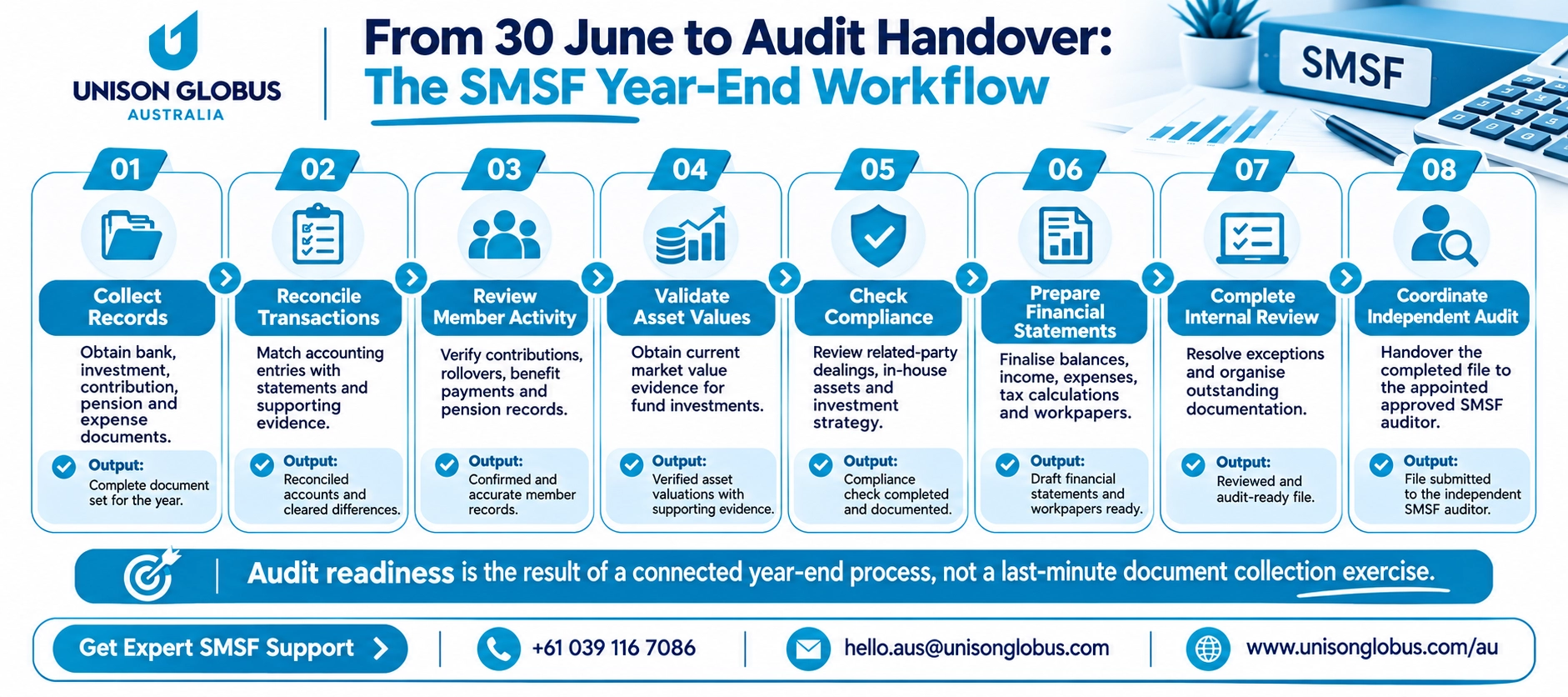
- SMSF Year-End Checklist: 8 Key Areas to Review
- 9. Managing SMSF Workloads Without Compromising Review Quality
- Related SMSF Insights
- How Unison Globus supports Australian SMSF practices?
- Conclusion
- Get Ahead of the SMSF Audit Rush
- Frequently Asked Questions
- What should trustees review before SMSF audit preparation?
- When should SMSF year-end preparation begin?
- What documents are required for SMSF year-end preparation?
- Are SMSF trustees required to obtain independent asset valuations every year?
- What causes delays during SMSF audit preparation?
- What happens if an SMSF audit identifies a compliance issue?
- How often should SMSF asset valuations be reviewed?
- Can outsourced SMSF administration reduce year-end workload?
- Does an SMSF need an audit if it has had no transactions during the year?
- What should an accounting firm check before choosing an SMSF outsourcing provider?
An SMSF file can appear ready for year-end until a missing investment statement, an unexplained member balance or an outdated asset valuation holds up the review.
For Australian accounting firms managing multiple SMSF clients, these gaps can quickly turn routine year-end work into repeated follow-ups and delayed audit handovers.
Effective SMSF Year-End Preparation starts well before the auditor requests the file. From reconciling member transactions and validating asset values to reviewing compliance matters and organising supporting evidence, each stage contributes to a more reliable reporting process.
So, what should account teams review before audit season begins? Here are eight important areas to prioritise.
What Is SMSF Year-End Preparation?
SMSF Year-End Preparation is the process of reviewing financial records, member transactions, asset valuations, compliance requirements and supporting documentation before the annual audit and SMSF annual return process.
Why Accounting Firms Should Start SMSF Year-End Preparation Early
For Australian accounting firms, SMSF year-end preparation is no longer a task that can be left until the audit file is requested. Growing SMSF portfolios, increasing compliance requirements, and tighter reporting timelines mean that delays in one stage of the process can quickly affect the entire workflow.
Many firms experience year-end pressure due to:
- Rising SMSF client volumes.
- Increased staff workloads during the reporting season.
- Delays in obtaining trustee documents and supporting evidence.
- Audit bottlenecks caused by incomplete files.
- Client expectations for faster turnaround times.
Early preparation allows accounting teams to identify reconciliation issues, outstanding documentation, asset valuation gaps, and compliance concerns before they reach the audit stage. This approach is similar to the structured year-end compliance workflows commonly adopted for payroll and other recurring compliance engagements. It also provides more time to resolve exceptions, reducing last-minute follow-ups and helping firms maintain review quality across multiple SMSF engagements.
For practice owners and managers, a structured year-end process can improve operational efficiency while helping teams stay focused on technical review and client advisory work rather than document chasing.
According to the Australian Taxation Office (ATO), the SMSF sector includes more than one million members and remains one of the largest segments of Australia’s superannuation industry. As SMSF numbers continue to grow, accounting firms are managing increasing reporting, compliance, and audit preparation obligations each year.
1. Are SMSF Financial Records Ready for Year-End Review?
Before reviewing complex compliance matters, establish whether the fund’s basic accounting records are complete and consistent.
This is the starting point for reliable SMSF Accounting Services and year-end financial reporting. If the underlying ledger contains missing transactions or unexplained balances, subsequent calculations and compliance checks may also be affected.
Reconcile every account before moving to financial statements
The first step is to compare the accounting records with the original financial evidence.
The review should cover:
- SMSF bank accounts and term deposits.
- Brokerage and investment accounts.
- Listed shares and managed fund statements.
- Property-related income and expenses.
- Loan accounts and outstanding receivables.
- Member contribution and benefit payment records.
- Accrued expenses, tax liabilities and other outstanding balances.
For example, consider an SMSF that owns an investment property. The bank statement shows rental income received throughout the year, but one payment has not been recorded in the accounting ledger.
If the discrepancy remains unresolved, the fund’s rental income, cash balance and financial statements may be misstated. The accounting team should identify the missing entry, verify it against the rental statement and supporting bank transaction, and record the adjustment appropriately.
A reconciliation should establish why a difference exists, not simply force the ledger balance to match the statement.
Check opening balances and outstanding entries
Opening balances should agree with the previous year’s signed financial statements and closing records. This is particularly important when the fund has changed accounting providers or software.
Review:
| Area | What the accounting team should check? |
|---|---|
| Opening balances | Agreement with prior-year financial statements |
| Suspense accounts | Unidentified or incorrectly allocated transactions |
| Outstanding deposits | Receipts recorded in the wrong reporting period |
| Unpresented payments | Payments issued but not yet reflected in bank records |
| Investment balances | Agreement with broker and investment statements |
| Tax and expense accounts | Correct classification and supporting documentation |
Suspense accounts deserve particular attention. An unexplained balance should not simply be carried forward because the original transaction is difficult to identify. The team should investigate its source and determine whether it relates to a contribution, expense, investment movement or another transaction.
For firms managing several hundred funds, a standard reconciliation checklist and consistent exception-reporting process can help reviewers identify incomplete files before financial statement preparation begins. Similar reconciliation and compliance review procedures are also commonly used in BAS review and finalisation engagements to improve reporting accuracy and identify unresolved issues before lodgement.
2. Trace Member Transactions Carefully: Contributions, Rollovers and Benefit Payments
Member transactions require more than matching deposits and withdrawals to bank statements. Their classification, timing and supporting evidence can affect member balances, tax calculations and the fund’s compliance position.
This makes transaction-level review an essential part of SMSF Year-End Preparation.
Contributions: Confirm the source, type and allocation
The accounting team should identify and reconcile all relevant contributions, including:
- Employer contributions.
- Salary-sacrifice contributions.
- Personal contributions.
- Spouse contributions.
- Government contributions, where applicable.
- Other contribution types permitted under the applicable rules.
The source of a payment does not always establish its correct classification. For example, a personal contribution may be eligible for a deduction only where the relevant conditions are satisfied and the required notice has been provided and acknowledged within the applicable timeframes.
The review should therefore confirm:
- Who made the contribution?
- When did the fund receive it?
- How has it been classified?
- Has it been allocated to the correct member?
- Does the supporting documentation agree with the accounting entry?
- Are any contribution caps or reporting requirements relevant?
Incorrect allocation can affect member balances and contribution reporting. Where a payment has been returned, reclassified or received close to year-end, the accounting team should retain sufficient evidence to explain how it was treated.
Rollovers and benefit payments: Verify the movement, not just the amount
Rollovers should be supported by relevant transfer documentation and records showing the amount received or transferred. The accounting team should also check that the movement has been reflected in the correct member account.
Benefit payments require a separate review.
Before recording a payment as a pension or lump sum, confirm that the member has satisfied the relevant condition of release and that the payment has been processed in accordance with the applicable requirements.
For pension accounts, review:
- Pension commencement documentation.
- The member’s pension balance.
- Required minimum pension payments.
- Actual payments made during the financial year.
- Any applicable pension concessions.
- The correct classification of payments.
Minimum pension requirements can vary depending on the member’s circumstances, pension type and applicable rules. A previous year’s calculation should not automatically be reused without checking the current requirements.
A practical example: An SMSF makes regular payments to a retired member. The bank records show that the payments were made, but the file does not clearly establish whether they were pension payments or lump sum withdrawals. The accounting team should verify the member’s pension documentation and payment history before finalising the member’s account.
This distinction matters because an incorrect classification can affect financial reporting and the fund’s compliance assessment.
3. Do Not Carry Forward Old Asset Values Without Reviewing the Evidence
Asset valuation is one of the most important areas of SMSF Audit Preparation, particularly where the fund holds property, unlisted investments or assets that do not have readily available market prices.
Under Australian SMSF requirements, trustees must value fund assets at market value when preparing annual financial statements. The valuation should be supported by objective and relevant evidence.
The ATO’s March 2025 update on market valuations highlighted a significant issue. It identified more than 16,000 SMSFs that had reported property or unlisted trust assets at the same value for three consecutive years. Following its review, 80% of the SMSFs updated their property valuations, while only 48% updated their unlisted trust valuations.
The figures underline an important point: carrying forward a previous year’s value does not, by itself, establish that an asset remains correctly valued.
What valuation evidence should the accounting team collect?
The evidence will depend on the nature of the asset.
| Asset type | Relevant valuation evidence |
|---|---|
| Listed shares | Market prices, broker statements and exchange records |
| Managed funds | Annual statements and unit pricing information |
| Residential property | Recent comparable sales, rental information and valuation reports |
| Commercial property | Market appraisals, lease details, rental evidence and comparable transactions |
| Unlisted companies | Financial statements, valuation reports and relevant business information |
| Related trusts | Trust financial statements, asset information and supporting valuation calculations |
| Collectables | Appropriate market evidence and documentation relevant to the asset |
When should an independent valuation be considered?
An independent valuation is not automatically required for every SMSF asset. The valuation process must be appropriate to the asset and supported by objective information.
However, certain circumstances have specific requirements. For example, a qualified independent valuer is required when a collectable or personal-use asset is transferred to a related party.
Accounting teams should also pay attention to changes that may affect an asset’s market value, such as:
- Significant property market movements.
- Changes in rental income or occupancy.
- Major repairs or improvements.
- Changes in the financial position of an unlisted entity.
- Transactions involving related parties.
- Material changes in the asset’s condition.
Consider this scenario: An SMSF holds a commercial property that was valued several years ago. The accounting records continue to show the same figure, but the property has since undergone improvements, and the surrounding market has changed.
Simply carrying forward the previous valuation may not provide sufficient evidence of its current market value. The accounting team should request updated supporting information and ensure the trustees have an appropriate basis for the valuation.
The trustees remain responsible for providing evidence to support the fund’s asset values. The auditor independently assesses whether the available evidence is sufficient.
4. Look Beyond the Ledger: Review Transactions That Could Trigger Compliance Issues
A fund’s financial statements may balance correctly while certain transactions still require further compliance review.
This is why a structured SMSF Compliance Review should examine the nature and purpose of transactions, not just their accounting treatment.
Related-party transactions need closer examination
Related-party dealings can involve additional restrictions under the Superannuation Industry (Supervision) Act 1993 (SIS Act).
The accounting team should identify transactions involving members, relatives, related companies, trusts or other associated entities.
Areas requiring attention include:
- Loans or financial assistance involving members or related parties.
- Investments in related entities.
- Assets leased to related parties.
- Acquisitions of assets from related parties.
- Related-party income and expense arrangements.
- Transactions that may not reflect arm’s-length terms.
For instance, an SMSF may own commercial property leased to a business associated with a fund member. The accounting team should review the lease agreement, rental terms, payment records and relevant supporting evidence.
The fact that a transaction has been recorded correctly does not automatically establish that it complies with SMSF rules.
Check the in-house asset limit
Generally, an SMSF cannot hold in-house assets exceeding 5% of the market value of the fund’s total assets, subject to specific exceptions.
The ATO explains the SMSF in-house asset rules, including applicable exceptions and the requirements for reducing excess in-house assets.
Certain investments and arrangements may be excluded under the legislation. Business real property leased to a related party, for example, can qualify for an exception where the relevant conditions are met.
The accounting team should therefore establish the nature of the asset and the applicable exception before determining its treatment.
Review the investment strategy and other compliance areas
Trustees must regularly review the fund’s investment strategy and ensure it remains appropriate to the fund’s circumstances.
The review should consider:
- Investment objectives and diversification.
- Risk and expected returns.
- Liquidity requirements.
- Members’ retirement circumstances.
- Insurance considerations for members, where relevant.
Other areas may also require attention depending on the fund’s activities. These include non-arm’s-length income (NALI), non-arm’s-length expenditure (NALE), limited recourse borrowing arrangements (LRBAs), and collectable or personal-use asset restrictions.
A transaction that appears routine in the ledger may have broader implications under the SIS Act or tax legislation. Where the treatment is uncertain, the accounting team should escalate the matter for appropriate professional review rather than make assumptions.
5. Build an Audit-Ready File Before the Auditor Requests It
A complete audit file does more than reduce document follow-ups. Strong audit preparation processes help accounting firms improve documentation quality, reduce review delays, and support more efficient audit engagements. It gives the auditor a clearer basis for examining the fund’s financial position and compliance with relevant requirements.
For accounting firms, consistent documentation also improves internal review, reduces repeated requests to trustees and supports more predictable audit handovers.
Separate permanent records from annual financial records
Not every SMSF document relates to one financial year. Some records need to be retained over longer periods because they establish the fund’s structure, governance and ongoing arrangements.
| Permanent or ongoing records | Financial-year records |
|---|---|
| Trust deed and amendments | Bank and investment statements |
| Trustee and director appointment records | Contribution and rollover records |
| Trustee declarations | Pension and benefit payment records |
| Member details and relevant consents | Income and expense evidence |
| Investment strategy and trustee decisions | Asset valuation documents |
| Loan and lease agreements | Tax calculations and supporting schedules |
| Relevant historical compliance records | Prior-year audit adjustments and current audit queries |
The ATO’s record-keeping requirements generally include five-year retention periods for many financial and transaction records, while certain trustee, member and governance records must be retained for 10 years. Specific requirements vary by document type, and some tax or capital loss records may need to be retained for longer.
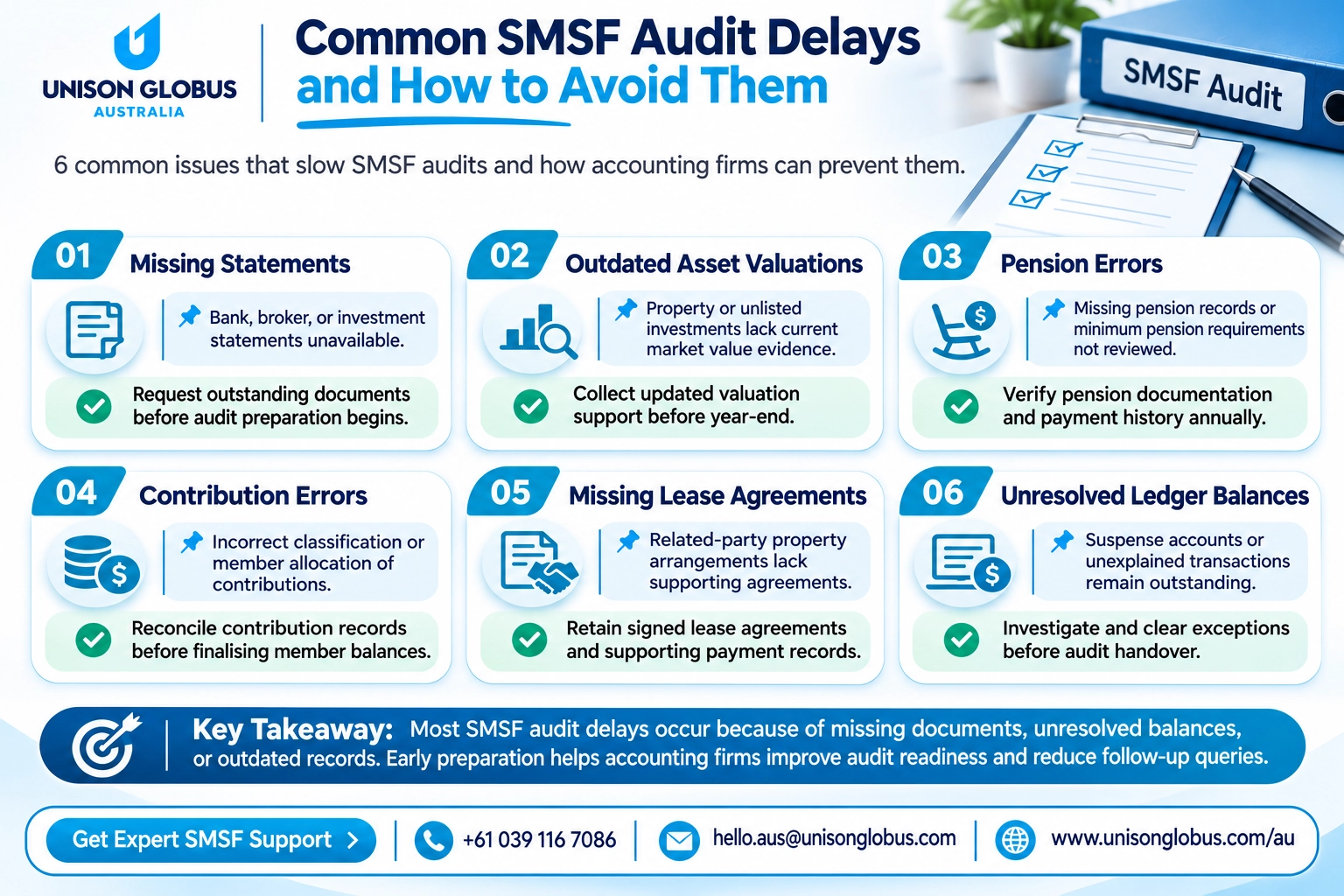
Maintain a missing-document and exception register
Rather than waiting until the audit begins to identify incomplete files, maintain a register that records outstanding documents and unresolved issues.
| Outstanding item | Why it matters | Recommended follow-up |
|---|---|---|
| Missing investment statement | Prevents verification of holdings and transactions | Request the annual statement |
| Outdated property valuation | May not support current market value | Obtain updated valuation evidence |
| Unclassified contribution | May affect member balances and reporting | Confirm source and contribution type |
| Missing related-party lease | Limits assessment of transaction terms | Obtain signed agreement and payment records |
| Incomplete pension records | Affects benefit and minimum payment review | Confirm commencement and payment details |
| Unexplained ledger balance | May result in inaccurate financial statements | Investigate and document the adjustment |
It is important to distinguish between a missing document and an unresolved accounting issue. A document may be outstanding even when the transaction itself is understood. Conversely, a transaction may have supported paperwork but still require further investigation because its accounting or compliance treatment is unclear.
Neither should be marked as complete until the required action has been addressed.
Keep SMSF Year-End Work Moving
Get additional support with reconciliations, financial statements and audit-ready documentation while your team retains control over review and approval.
6. From Year-End Records to the SMSF Annual Return: What Happens Before Lodgement?
Once the accounting records, member transactions and asset values have been reviewed, the next stage is preparing the fund’s financial statements and annual reporting information.
This stage brings together the work completed throughout the year. Any unresolved discrepancy can affect the accuracy of the final figures, which is why the quality of earlier preparation matters.
Prepare the financial statements and supporting schedules
The accounting team generally prepares the fund’s financial statements, including the statement of financial position and operating statement.
Depending on the fund’s reporting requirements, the work may involve:
- Reconciling total assets and liabilities.
- Confirming investment income and expenses.
- Calculating realised capital gains and losses.
- Reviewing member balances.
- Reconciling contributions and benefit payments.
- Assessing taxable and exempt income.
- Preparing relevant tax and compliance schedules.
For example, when an SMSF sells listed shares, the accounting team should not rely solely on the cash received from the broker. The calculation may require the sale proceeds, acquisition cost, relevant transaction costs and other information needed to establish the capital gain or loss.
Where the fund receives income from assets supporting retirement-phase pensions, exempt current pension income (ECPI) may also need to be considered. An actuarial certificate may be required in relevant circumstances, depending on the fund’s circumstances and the method used to calculate exempt income.
These calculations should be supported by appropriate workpapers and reviewed before the annual return is finalised.
The SMSF Annual Return (SAR) brings together the fund’s income tax information and relevant regulatory reporting details. It includes information such as income, deductions, member contributions and the supervisory levy.
The fund must also undergo an annual independent financial and compliance audit by an approved SMSF auditor.
According to the ATO:
- Trustees must appoint an approved SMSF auditor no later than 45 days before the SAR lodgement due date.
- The auditor must examine the fund’s financial statements and assess compliance with superannuation law.
- The audit must be finalised before the SAR is lodged.
- The auditor must be registered with ASIC and hold a valid SMSF auditor number.
The audit is required even where the fund has not received contributions or made payments during the financial year.
7. Who Is Responsible for What? Keep Trustees, Accountants and Auditors Aligned
A well-managed year-end process depends on clear responsibilities. When trustees, accounting teams and auditors understand their respective roles, the risk of duplicated work and delayed handovers can be reduced.
| Responsibility | Trustees | Accountant or administrator | Approved SMSF auditor |
|---|---|---|---|
| Maintain fund records | Ultimately responsible | May assist with record organisation | Examines relevant evidence |
| Provide transaction documents | Supply required information | Collects and organises records | Requests additional evidence |
| Prepare financial statements | Ensure required reports are prepared and signed | Prepares statements and workpapers where engaged | Audits financial statements |
| Review investment strategy | Responsible for fund decisions and review | May assist with administrative support | Assesses relevant compliance evidence |
| Prepare annual return | Responsible for fund obligations | May prepare the return | Audit must be completed before lodgement |
| Independent audit | Appoints approved auditor | May coordinate the process | Conducts independent audit |
The trustee’s responsibility remains with the trustee
Trustees remain responsible for ensuring that the SMSF complies with superannuation and tax requirements. Engaging an accountant or outsourcing provider does not transfer those statutory responsibilities.
The accounting team supports preparation and reporting
An accountant or administrator may handle transaction processing, reconciliations, member account maintenance, financial statement preparation, annual return workpapers and document coordination, depending on the engagement.
The accounting firm should maintain appropriate review and approval controls over the work.
The auditor must remain independent
The approved SMSF auditor independently examines the fund’s financial statements and compliance position. Audit preparation and coordination must not compromise that independence.
For firms using external support, it is important to distinguish between preparing an audit-ready file and performing the independent audit itself.
SMSF Year-End Checklist: 8 Key Areas to Review
Before moving a fund to audit, accounting teams should run through these essential checks to ensure records are complete and ready for review.
| Review area | Year-end checklist |
|---|---|
| Bank and investments | Reconcile bank accounts, investment balances and related transactions. |
| Income and expenses | Verify recorded income, expenses and supporting documents. |
| Member balances | Check contributions, rollovers, withdrawals and member allocations. |
| Pension accounts | Review pension payments, commencement dates and minimum payment requirements. |
| Asset records | Confirm asset ownership and obtain evidence of current market valuations. |
| Compliance checks | Review related-party transactions and the fund’s investment strategy. |
| Tax and financial statements | Check tax calculations, deductions, capital gains and financial statements. |
| Annual return and audit | Ensure annual return information, working papers and supporting documents are ready for audit handover. |
Final review: Address outstanding queries, organise missing evidence and ensure the fund is ready for independent audit review.
9. Managing SMSF Workloads Without Compromising Review Quality
For accounting firm owners and practice managers, the year-end process raises a wider operational question: how can the firm manage a growing SMSF portfolio without placing excessive pressure on its in-house accountants?
For practice owners and firm directors, SMSF growth often creates a capacity challenge rather than a technical one. As fund numbers increase, maintaining review quality, meeting audit deadlines, and managing team workloads become critical operational priorities. A structured SMSF preparation process can help firms scale services without compromising client outcomes.
The answer often involves reviewing how routine preparation and administration work is distributed. Many firms also strengthen their accounting workflow support model through outsourced accounting and bookkeeping functions that allow internal teams to focus on higher-value review and advisory activities.
When senior accountants spend a substantial part of their time chasing statements, processing transactions, reconciling accounts and organising supporting documents, less capacity remains for technical review, client communication and advisory work.
This is where SMSF preparation & outsourcing services can support a more structured operating model.
Related SMSF Insights
Accounting firms looking to improve SMSF efficiency, audit readiness, and year-end capacity management may also find these resources useful:
Related SMSF Resources for Accounting Firms
Accounting firms looking to improve SMSF efficiency, audit readiness, and capacity planning may also find these resources useful:
Identify the work that can be supported externally
Depending on the firm’s requirements and internal controls, an outsourcing partner may assist with:
- Routine SMSF administration and document management.
- Bank and investment account reconciliations.
- Contribution and pension transaction processing.
- Member balance maintenance.
- Investment accounting and supporting schedules.
- Financial statement preparation.
- Year-end finalisation and workpaper preparation.
- Annual return preparation support.
- Audit file organisation and query coordination.
The accounting firm should retain control over client relationships, technical decisions, review procedures and final approval.
How Unison Globus supports Australian SMSF practices?
Unison Globus Australia provides SMSF Accounting Services and outsourced administration support to Australian accounting firms, CPA practices, tax agents and SMSF specialists.
Its support covers day-to-day administration, transaction processing, reconciliations, member information maintenance, year-end finalisation, financial statement preparation and annual return support.
The team can also assist with audit-ready file preparation, supporting schedules, document organisation and coordination of audit queries. Where audit coordination is required, the independent audit is conducted by the appointed approved SMSF auditor. Preparation support does not replace or perform the independent audit.
The operational challenges associated with SMSF preparation are similar to those faced by accounting firms managing tax, bookkeeping, payroll, and compliance engagements in other jurisdictions. Firms supporting clients across multiple markets often look to improve documentation standards, workflow consistency, review controls, and turnaround times regardless of the specific regulatory environment.
Conclusion
A missing transaction record, an outdated asset valuation or an unreconciled member balance can hold up an otherwise complete SMSF file. These gaps are easier to resolve when identified during SMSF Year-End Preparation, rather than after the file reaches the auditor.
For accounting firms managing multiple funds, a consistent review process helps keep records accurate and audit handovers on schedule. A practical SMSF Year-End Checklist, clear task ownership and timely follow-ups can make that process easier to manage.
When workloads stretch internal teams, SMSF preparation & outsourcing services can provide additional capacity for reconciliations, accounting records, annual return preparation and audit coordination.
Unison Globus supports Australian accounting firms with these year-end requirements, helping teams keep SMSF files organised and ready for review. Give your team more room to focus on review quality, not chasing incomplete SMSF files.
Get Ahead of the SMSF Audit Rush
Keep year-end reconciliations, supporting documents and audit handovers organised
with dependable SMSF preparation and administration support.
Frequently Asked Questions
Trustees should review bank reconciliations, contributions, rollovers, pension payments, asset valuations and related-party transactions. They should also provide outstanding financial records and supporting documents so the accounting team can finalise the fund’s financial statements and prepare for the annual audit.
SMSF year-end preparation should be an ongoing process throughout the financial year. Accounting teams should monitor reconciliations, member transactions and asset valuations regularly, rather than waiting until 30 June. Early preparation gives trustees more time to address discrepancies and provide missing documentation.
Commonly required documents include bank and investment statements, contribution records, rollover confirmations, pension payment details, property valuations, rental statements, expense invoices, loan agreements and trustee decisions. Additional evidence may be needed depending on the fund’s investments and transactions during the financial year.
Trustees must ensure SMSF assets are valued at market value for annual financial statements and retain appropriate supporting evidence. An independent valuation is not mandatory for every asset. However, specific requirements apply to certain assets and transactions, including collectables or personal-use assets transferred to related parties.
Common causes include unreconciled investment accounts, missing transaction evidence, outdated asset valuations, incorrectly classified contributions and incomplete pension records. Unresolved related-party transactions can also require additional investigation. Identifying these issues during year-end preparation can reduce repeated auditor queries and delays.
Where an SMSF auditor identifies a compliance concern, additional documentation, corrective actions, or further review may be required, depending on the nature of the issue.
SMSF trustees must ensure assets are reported at market value for annual financial statement purposes. Supporting valuation evidence should be reviewed as part of each year-end process.
Yes. Outsourced SMSF support can assist with reconciliations, transaction processing, workpaper preparation, financial statements, and audit-ready documentation. This can help accounting firms improve efficiency during peak workload periods.
Yes. An operating SMSF must generally undergo an annual independent financial and compliance audit, even if it has received no contributions or made no payments during the financial year. The fund must also meet its applicable annual reporting and lodgement obligations.
Consider the provider’s SMSF experience, technical knowledge, software compatibility, workpaper standards, data security and communication processes. Establish clear responsibilities for preparation, review, escalation and approval to ensure outsourced work aligns with the firm’s internal quality controls.