


 [gtranslate]
The June quarter has a way of revealing everything that has been quietly building throughout the financial year.
A GST (Goods and Services Tax) coding error that slipped through in October, payroll figures that no longer reconcile cleanly with STP record, missing supplier invoices, unreviewed transactions sitting in suspense accounts.
For Australian accounting firms, the June BAS is rarely just another quarterly lodgement.
It marks the final BAS reporting period of the financial year and serves as a critical checkpoint before EOFY reporting, tax return preparation, and compliance reviews begin in earnest.
That is precisely why a structured ATO BAS compliance checklist 2026 is essential. Many firms rely on BAS Preparation & Lodgement Services to streamline compliance and reduce manual effort during peak BAS cycles.
The June 2026 BAS presents an opportunity not only to meet compliance obligations but also to identify risks early, improve reporting accuracy, and set clients up for a smoother EOFY process.
Whether you’re reviewing a handful of clients or managing a large portfolio, this BAS checklist for June quarter 2026 Australia can help streamline your review process and reduce year-end surprises.
Why the June BAS Matters More Than Any Other Quarter?
Every BAS matters, but the June quarter carries additional significance because it closes out the financial year.
The figures reported in Q4 form an important foundation for year-end financial statements and tax return preparation. If errors remain unaddressed at this stage, they can create a chain reaction that affects multiple compliance processes.
A seemingly minor issue can quickly snowball into:
- GST reporting discrepancies
- Payroll reconciliation challenges
- Incorrect year-end balances
- Delayed tax return preparation
For accounting firms managing multiple client engagements, a rushed review process can quickly become costly.
That’s why every firm should approach June with a structured BAS lodgement checklist June quarter rather than treating it as a routine compliance task. Similar compliance challenges exist globally. For example, firms managing VAT return compliance in the UK and sales tax filings in the US also rely on structured checklists and reconciliation processes to reduce reporting errors and ensure accuracy.
ATO BAS Compliance Checklist 2026 for a Smooth Q4 BAS Lodgement Season
1. Reconcile Every Account Before BAS Review
Before reviewing GST or PAYG amounts, ensure the underlying data is accurate.
Review and reconcile:
✓ Bank accounts
✓ Credit card accounts
✓ Loan accounts
✓ Clearing accounts
✓ Merchant facility transactions
✓ Unallocated transactions
One of the most common causes of BAS errors is incomplete reconciliations. If transactions haven’t been properly matched and reviewed, BAS figures may not accurately reflect the client’s financial position.
2. GST Coding Errors Are Easier to Fix Now Than During EOFY
GST coding issues remain a common source of BAS review adjustments for many businesses.
Pay close attention to:
- GST-free supplies
- Input-taxed transactions
- Export income
- Capital asset purchases
- Motor vehicle expenses
- Entertainment costs
- Mixed-use expenses
The June quarter is an ideal time to identify and correct coding issues before they carry over into EOFY reporting.
3. Incomplete Revenue Reporting Can Create Significant BAS Risks
Revenue recognition has become increasingly complex as businesses adopt multiple payment channels and digital sales platforms.
When reviewing BAS figures, ensure all revenue sources have been captured.
This step is particularly important for meeting BAS lodgement requirements ATO expects businesses to satisfy.
Review:
- Outstanding invoices
- Cash sales
- Online payments
- Subscription income
- Marketplace sales
- Credit notes and refunds
A comprehensive review helps ensure BAS figures accurately reflect business activity throughout the quarter.
4. Don’t Leave GST Credits on the Table Before Lodgement
GST credits can only be claimed correctly when supporting documentation and transaction records are in order.
Before lodging:
✓ Confirm supplier invoices have been entered
✓ Verify GST credits are supported by documentation
✓ Remove duplicate transactions
✓ Review large purchases
✓ Follow up on missing invoices
The ATO requires businesses to maintain adequate records supporting BAS figures, including tax invoices, payroll records, and transaction documentation. Missing or incomplete records can create compliance risks even when reported amounts are otherwise correct.
5. Payroll and STP Must Match Before You Lodge
Payroll discrepancies often remain hidden until EOFY reviews begin.
To avoid complications, compare:
- Payroll reports
- BAS wage figures
- STP data
- Employee reimbursement records
- Director remuneration entries
This forms a critical part of any BAS review checklist GST PAYG reconciliation process.
6. PAYG Errors Often Surface at the Worst Possible Time
PAYG withholding is another area where small inaccuracies can create larger compliance concerns.
Review:
✓ Employee withholding amounts
✓ Contractor withholding requirements
✓ Tax file declaration updates
✓ Payroll software calculations
✓ Reported withholding balances
7. Review PAYG Instalments Before They Impact Client Cash Flow
The June quarter provides an excellent opportunity to evaluate whether PAYG instalments still reflect the client’s financial position.
Consider:
- Current business performance
- Profitability trends
- Cash flow pressures
- Potential variation opportunities
Proactively reviewing instalments can help align tax payments more closely with current business performance.
June BAS Pressure Building Up? Scale Support Before EOFY Hits.
From BAS preparation and review to finalisation and lodgement, the right support can ease pressure without compromising quality. Unison Globus Australia helps accounting firms manage compliance workloads efficiently during peak BAS and EOFY periods.
8. EOFY Adjustments That Deserve a Second Look
The June BAS often includes transactions that require additional scrutiny because they directly affect year-end reporting.
Pay particular attention to:
- Asset acquisitions
- Asset disposals
- Inventory adjustments
- Bad debt write-offs
- Director loan accounts
- Business-use percentage adjustments
9. Correct BAS Errors Before They Become Year-End Problems
The final quarter of the year is an ideal time to identify and address GST adjustments.
Review whether any of the following apply:
✓ Private-use adjustments
✓ Change-in-use adjustments
✓ Fuel tax credit adjustments
✓ Prior BAS corrections
✓ Adjustment events affecting GST calculations
10. One Final Review Can Prevent Weeks of Rework
Before submitting the BAS, conduct one final quality review.
This is where Outsourced BAS Review & Finalisation Services help firms improve accuracy, reduce EOFY rework, and streamline compliance workflows.
Consider:
✓ Comparing figures against previous quarters
✓ Investigating unusual fluctuations
✓ Reviewing GST refund positions
✓ Obtaining client approval
✓ Retaining supporting documentation
✓ Documenting significant assumptions or adjustments
A thorough review remains one of the most effective ways to identify errors before lodgement and reduce EOFY rework.
Even globally, accounting firms face similar risks across GST, VAT, and sales tax compliance, where missing transactions, incorrect tax treatments, and reconciliation gaps can impact reporting accuracy and deadlines.
Five BAS Compliance Risks Hidden Inside the June Quarter
While every client is different, several recurring issues continue to surface across industries.
- Missing Digital Revenue Streams
With more businesses operating online, income can originate from multiple sources beyond traditional invoicing systems. Similar reporting gaps are also observed in GST/HST filing requirements in Canada, where businesses dealing with multiple digital income streams often face reconciliation challenges.
Platforms such as payment gateways, subscription services, and online marketplaces can create reporting gaps if not reviewed carefully.
- Payroll and STP Mismatches
Differences between payroll systems, STP submissions, and BAS figures remain a common EOFY issue.
- Incorrect GST Treatment of Software Subscriptions
International software purchases often create GST treatment complexities, particularly where overseas software providers and digital services are involved.
- Unsupported GST Claims
GST credits claimed without valid documentation continue to present compliance risks.
- Historical Errors That Were Never Corrected
The June BAS offers an opportunity to identify and resolve historical issues before they affect year-end reporting.
What a Good BAS Review Can Reveal?
The most successful firms recognise that BAS preparation is about far more than compliance.
Every BAS review contains valuable insights into a client’s operations.
A structured Q4 BAS checklist Australia process can help firms:
- Improve bookkeeping processes
- Identify cash flow concerns
- Strengthen payroll controls
- Enhance reporting accuracy
- Support business planning
- Prepare clients for tax season
This is also where Outsourced BAS Review & Finalisation Services can help firms maintain consistency and capacity during peak periods.
Final
Thoughts:

By the time the June BAS deadline arrives, most accounting firms are already preparing for EOFY. That’s why this lodgement deserves careful attention.
A well-structured BAS checklist Australia process provides clarity during one of the busiest times of the year. Rather than spending valuable time correcting avoidable errors, your team can focus on accurate lodgements, efficient workflows, and delivering better client outcomes. Many firms also align BAS processes with Accounting & Bookkeeping Services to maintain accurate financial records and simplify compliance reporting throughout the year.
Preparing for the June BAS Rush?
When deadlines tighten and workloads increase, additional support can make all the difference. With dedicated Accounting & Bookkeeping professionals, Unison Globus Australia supports firms with BAS Preparation & Lodgement Services, review, finalisation, and EOFY compliance assistance.
BAS Errors Impacting Compliance? Fix It with the Right Support.
Accurate BAS reporting and GST reconciliation are critical to avoiding ATO penalties. Unison Globus Australia ensures your processes are streamlined, error-free, and managed by experienced professionals.
FAQ
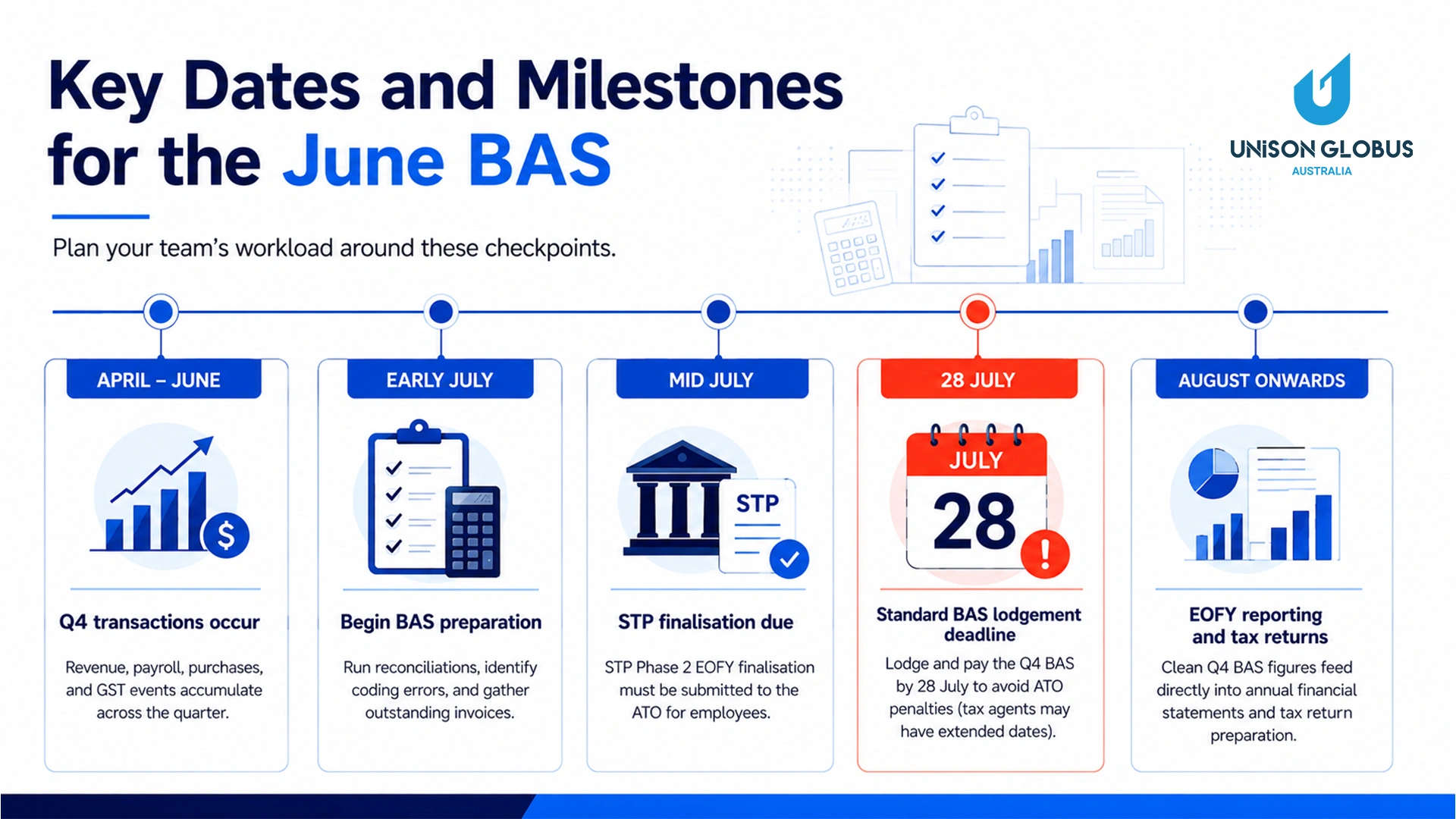
Yes. STP submissions must be finalised by mid-July. Payroll figures in the BAS must match STP data resolve any discrepancies before lodging.
Yes, if the net GST error is $10,000 or less. Larger errors or fraud-related corrections require a separate amendment request to the ATO.
Late lodgement attracts an FTL (Failure to Lodge) penalty ($313 per 28-day period, up to five units). Underpayments incur interest charges. Voluntary disclosure before an audit generally reduces penalties.