


 [gtranslate]

Summarize and analyze this article with:
- What the October 15 Tax Extension Deadline Really Costs CPA Firms
- The October 15 Extension Readiness Checklist
- Warning:
- The Checklist Only Works if the Firm Has the Capacity to Execute It
- Does your team have enough preparation capacity for the final extension stretch?
- When Additional Tax Preparation Capacity Makes Sense
- If You Use External Preparation Support, Keep the Controls Clear
- What October 16 Should Look Like
- Extend your preparation capacity without changing who owns review and filing.
- Turning October 15 Into a Filing Checkpoint, Not a Crisis
- Frequently Asked Questions
- What happens if a client misses the October 15 tax extension deadline?
- Can a taxpayer receive another extension after October 15?
- How early should CPA firms start preparing extended returns for October 15?
- What tax preparation work can CPA firms outsource before October 15?
- Does offshore tax preparation require taxpayer consent under IRC §7216?
- How can CPA firms maintain quality with outsourced tax preparation support?
For many CPA firms, October 15 is not when the pressure starts. It is when the consequences of an overloaded production schedule become difficult to hide. The recurring “we’ll catch up after April” pattern can carry unresolved preparation, client follow-ups, and outstanding K-1s into October, while reviewer capacity is already under pressure.
As firms approach the October 15 tax extension deadline, capacity becomes the more important question. When preparation hours are already stretched, outsourced tax preparation services can provide additional preparation capacity for defined work, while the CPA firm retains responsibility for review, approval, and filing.
The scale of the filing window adds another layer of pressure, with millions of taxpayers moving through the same extended deadline. The IRS estimated that more than 20 million taxpayers were expected to file by the October 15 extended due date in 2025, underscoring the concentration of filing activity around the deadline. For an individual CPA firm, however, the focus should remain on what work is still outstanding, who needs to complete it, and whether enough capacity exists to move those returns through review and filing.
What the October 15 Tax Extension Deadline Really Costs CPA Firms
Two open-return queues can look identical on a production board while requiring very different amounts of preparation, review, and client follow-up. Twenty open returns may represent a manageable workload if documentation is complete and most are ready for review. In comparison, the same twenty returns can represent a serious production problem if several still need substantive preparation, client clarification, technical research, or multiple review rounds.
That capacity pressure is reflected in current industry data. Thomson Reuters found that among firms that had reallocated tasks, 33% cited capacity constraints during busy season as the primary driver, showing that capacity constraints are influencing how some firms allocate work during peak periods.
For firms considering tax return outsourcing, the starting point should be the production constraint itself, not the decision to outsource. The underlying pressure comes from the shrinking sequence between completed preparation and an accepted filing. A return can move from “almost done” to “not ready to file” because a reviewer identifies an unresolved basis issue, a client responds with a new document, a K-1 changes, or an e-file submission is rejected. Each event consumes time that was not visible when the return was simply counted as open.
That is why October pressure also reaches beyond tax production. Reviewers who should be available for final tax work may be pulled into other client matters, while preparers are still clearing returns that were expected to be completed earlier. Q4 accounting, bookkeeping, advisory, and planning work then competes for the same people.
The consequence is not simply a stressful final week. A compressed tax workflow can push review work, client communication, and Q4 commitments into the same remaining window.
However, the extension itself does not create additional capacity. The IRS confirms that a timely Form 4868 generally moves the individual filing deadline to October 15, 2026, but does not extend the time to pay tax owed.
For firms, the operational priority is therefore clear: identify which returns must move through preparation, review, approval, and filing first, and where the sequence could break.
The October 15 Extension Readiness Checklist
The strongest October plans are not built around asking whether a return is “done.” They identify exactly where each return sits, what remains, who owns the next action, and whether the firm has enough capacity to complete it, regardless of whether the work remains in-house or forms part of a broader CPA firm outsourcing model.
Segment Every Extended Return by Status and Complexity
Treating every open return as the same unit of work can quickly misread the October queue. Start by separating status from complexity. A return can be ready for review but technically difficult, or still awaiting documents but relatively straightforward once those documents arrive.
Use a production view that distinguishes the actual next step:
| Return status | What it means | Required next action |
|---|---|---|
| Awaiting client information | Material information is still outstanding | Assign the follow-up owner and escalation date |
| Ready for preparation | Required documentation is substantially complete | Assign preparer and review-ready target |
| In preparation | Preparation work is underway | Track completion against the internal milestone |
| Ready for review | Preparation and required workpapers are complete | Reserve reviewer capacity |
| In review | Reviewer questions or corrections remain open | Assign each item to resolution |
| Awaiting client clarification | A preparation or review question requires a client response | Escalate against the next production milestone |
| Ready to file | Review and approval are complete | Confirm transmission readiness |
| Transmitted | Return has entered the e-file process | Monitor for acceptance or rejection |
Next, layer complexity onto each return so the firm can distinguish workflow status from the amount of preparation and review it is likely to require.
A straightforward Form 1040 with complete documentation should not sit behind a return requiring multiple state filings, foreign information reporting, significant basis work, or unresolved pass-through information simply because both are labelled “extended returns.”
Set Internal Deadlines Before October 15
Working toward October 15 as the primary production target leaves little room when returns are still moving through substantive review. Internal milestones should instead bring preparation, review, and approval substantially forward.
The better approach is to create internal milestones that leave time for corrections and filing exceptions:
| Internal date | Production objective |
|---|---|
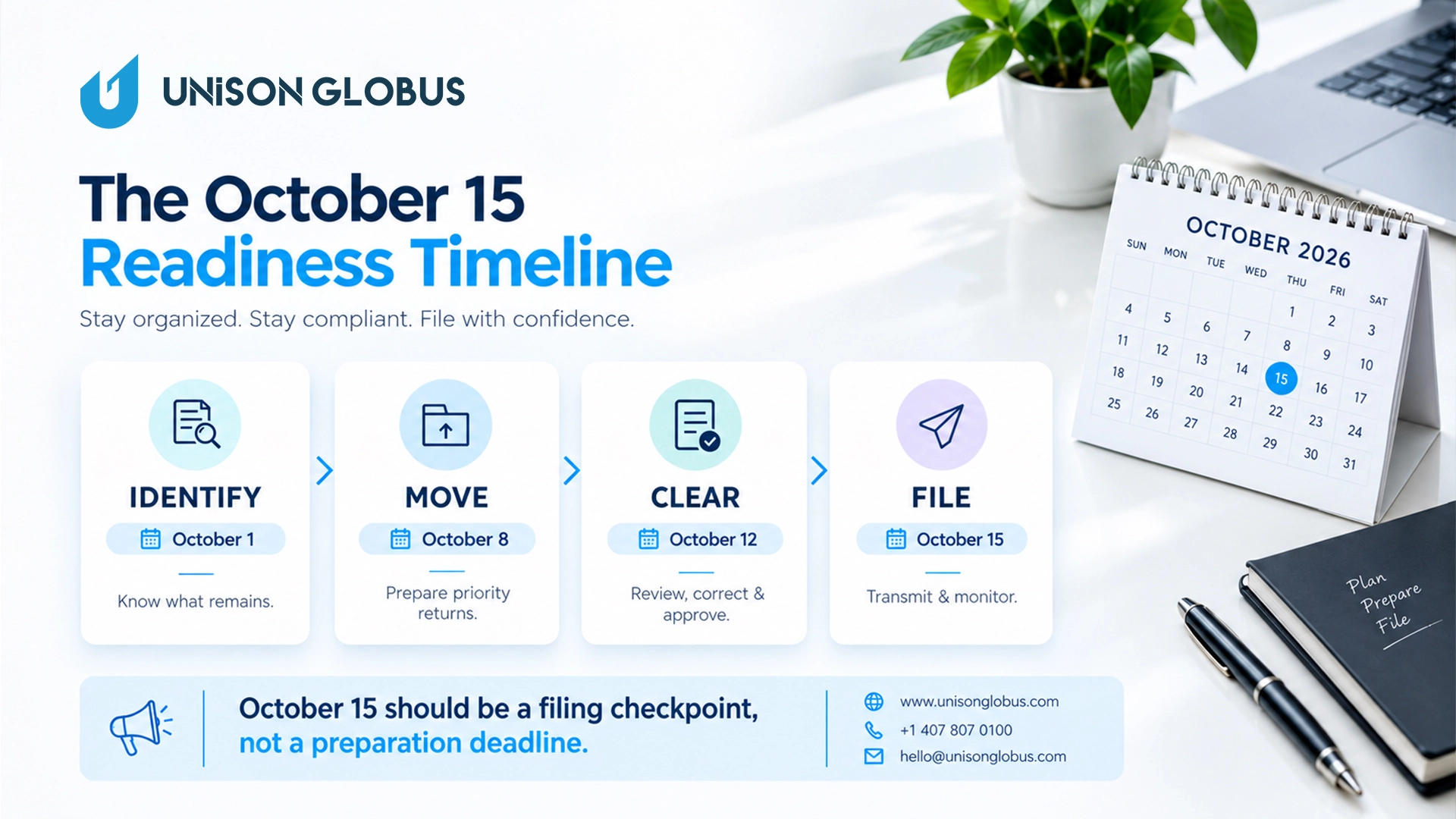
| October 1 | Material documentation gaps identified, assigned, and escalated |
| October 8 | Priority returns substantially prepared and moving through review |
| October 12 | Final review, corrections, and approvals substantially complete |
| October 15 | Transmission, acceptance monitoring, and exception handling |
These are internal operating milestones, not IRS deadlines. The IRS establishes October 15, 2026 as the extended filing date for eligible calendar-year individual returns.
The purpose of the earlier dates is to create an operating room. A return that is technically complete on October 15 still needs to move through approval and electronic transmission, and the firm’s workflow needs room to respond if that transmission does not go as expected.
A useful way to visualize the production rhythm is:
October 1 → October 8 → October 12 → October 15
Identify → Prepare → Review & Approve → Transmit & Monitor
Warning:
October 15 is not a correction window. A return that reaches the final day with unresolved review questions, missing approvals, or filing exceptions has very little operating room left. Build the correction and approval window into the schedule before October 15, not after it.
Put Ownership and Escalation Behind Every Missing Document
Labeling a missing document as simply “waiting on the client” can hide an ownership problem. A missing K-1, brokerage statement, basis schedule, foreign information statement, or state-specific document should have an owner, a follow-up date, and a defined impact on preparation.
The production board should make three things visible:
- The missing item: Name the specific document or information still required.
- The production impact: Identify whether the item blocks preparation, review, approval, or filing.
- The escalation point: Set the date when routine follow-up becomes partner or manager intervention.
Not every missing item deserves the same escalation. A document that changes taxable income or creates a filing requirement is materially different from information that can be resolved during a later review step.
That distinction prevents preparers from spending the final week repeatedly chasing low-impact items while genuinely blocking issues remain unresolved.
Reserve Reviewer Capacity Before the Final Week
Adding preparers may increase production when the preparation queue is the bottleneck, but it does not solve a review constraint when completed returns are already waiting for partner or manager attention.
The 2026 AICPA & CIMA PCPS Top Issues Survey puts that distinction in context: among firms with 11–30 professionals, hiring experienced staff ranked No. 1, while staff workload management ranked No. 3. The survey collected responses from 629 practitioners between April 20 and May 22, 2026.
Additionally, The practical measure is therefore not simply how many returns remain. It is how many review hours those returns will consume between October 8 and October 12, and how many qualified reviewer hours the firm has actually protected for that work.
Build that forecast before the final week. Include scheduled PTO, recurring management responsibilities, client meetings, other engagement deadlines, and returns likely to generate multiple review rounds. If the forecast shows more review work than available reviewer capacity, adding preparation hours alone will only move more returns into the review queue.
Pull High-Complexity Work Forward
A return with one W-2 form (Wage and Tax Statement) and standard investment reporting does not consume the same preparation or review effort as a return involving multiple states, foreign reporting, significant basis work, or pass-through activity.
Pull the returns with the highest review risk forward first:
- Multi-state returns: Identify the states involved and confirm that required income allocation and state filings are accounted for before final review.
- Foreign reporting: Identify applicable foreign information reporting requirements early rather than allowing an unresolved international item to surface during final review.
- Basis and depreciation: Resolve material basis calculations, asset dispositions, and depreciation questions before the return enters the final review queue.
- Pass-through returns: Confirm that the individual return has the required Schedule K-1 information to complete the Form 1040. A delayed or corrected K-1 can send an otherwise prepared individual return back into production.
The calendar matters here. Calendar-year Forms 1065 and 1120-S generally have September 15 extended due dates, while calendar-year individual returns with a timely Form 4868 extension generally reach October 15. Calendar-year Form 1120 corporations with a timely six-month extension also generally reach October 15.
That makes the relationship between September and October important. The partnership or S corporation return may already have passed its extended deadline, but its Schedule K-1 information can still determine whether an individual Form 1040 is ready for final review.
Treat E-Filing and Acceptance as Separate Workflow Stages
Marking a return complete at the end of preparation is not the same as having it ready for filing. The return still needs to clear review, receive approval, enter the e-file process, and be monitored for acceptance or rejection.
The IRS’s 2026 Form 1040 Modernized e-File schedule identifies October 15 as the last date for transmitting returns on extension from Form 4868. It separately identifies October 20 as the last date for retransmitting rejected, late, or returns on extension from Form 4868.
That distinction should exist in the firm’s production board as well:
| Stage | What the firm should know |
|---|---|
| Prepared | Preparation is complete and required workpapers are assembled |
| Reviewed | Review points have been cleared or formally resolved |
| Approved | The responsible professional has approved the return for filing |
| Transmitted | The return has entered the firm’s e-file process |
| Accepted | The IRS has accepted the electronic submission, or an exception has been identified and assigned |
October 20 should not become the firm’s operating plan. It is a retransmission date for specified rejected returns, not additional time to leave substantive preparation and review unfinished. The firm’s internal schedule should still create enough room to identify and resolve filing exceptions before the October 15 deadline.
Measure the Capacity Gap Before It Becomes a Deadline Problem
Counting open returns can make the workload look deceptively manageable. Twenty returns that each need two hours of preparation are a very different production problem from twenty returns that need six hours of preparation, two review rounds, and unresolved client information.
Measure the remaining work in hours, not just return counts. Compare estimated preparation hours with available preparer capacity, then compare expected review hours with reviewer capacity actually available before October 15.
If preparation capacity is short, the firm can address that gap while there is still time to work the returns through review. If review capacity is short, adding preparers may make the queue larger without making the filing position safer.
Counting returns alone can obscure the actual workload. A more useful measure is how many hours remain at each stage and how many hours the firm can actually provide.
The Checklist Only Works if the Firm Has the Capacity to Execute It
Process discipline determines how work moves through the queue, but it cannot create qualified preparation or review hours that the firm does not have.
The people preparing extended returns are also balancing Q4 accounting, bookkeeping, advisory, planning, client meetings, and management responsibilities.
This creates three different situations, and each points to a different form of tax season support for CPA firms:
- The documentation gap: The firm has enough preparation capacity, but required information is still missing. More preparers will not solve the problem.
- The preparation gap: Documentation is substantially complete, but the firm does not have enough qualified preparation hours to move the returns into review. This is where additional preparation capacity can be relevant.
- The review gap: Preparation is moving, but partners or managers do not have enough capacity to review and approve the resulting work. Adding more preparers may actually increase the backlog awaiting review.
The response should match the bottleneck rather than defaulting to a generic staffing solution.
Does your team have enough preparation capacity for the final extension stretch?
When Additional Tax Preparation Capacity Makes Sense
When the diagnosis points specifically to insufficient preparation hours, external preparation capacity becomes one possible operational lever.
Suppose the firm has a defined population of extended Form 1040 returns. Documentation is substantially complete, reviewers are already scheduled for October 8–12, and the remaining issue is that the internal preparation team does not have enough hours to complete the work before those review slots become available.
That is a preparation-capacity problem.
In that situation, outsourced tax preparation services can provide a defined layer of preparation capacity without changing who owns the client relationship or who retains responsibility for professional review and approval.
The important distinction is scope. A CPA firm may use external CPA tax preparation services for defined preparation work such as:
- Form 1040 preparation outsourcing: Preparing individual returns from complete source documentation and firm-defined instructions.
- Form 1065 preparation outsourcing: Supporting partnership return preparation where the engagement scope and filing responsibilities are clearly established.
- Form 1120S preparation outsourcing: Supporting S corporation preparation while the CPA firm retains review and approval responsibility.
- Tax return workpapers: Organizing calculations, supporting schedules, and other preparation documentation required by the firm’s workflow.
- Preparation-stage corrections: Addressing defined preparer-level corrections before the return moves back into the firm’s review queue.
The handoff is most controllable when the scope, documentation requirements, preparation standards, escalation rules, and definition of “review-ready” are established before work begins.
The firm, meanwhile, retains responsibility for the parts of the engagement that require its professional judgment and client relationship. That makes tax compliance support for CPA firms most useful when the external scope strengthens preparation capacity without shifting those professional responsibilities. The firm retains final review, resolution of material technical matters, client communication, approval, and filing, unless the engagement structure explicitly states otherwise.
This is the difference between adding preparation capacity and handing over the engagement. For firms considering offshore tax preparation support, the same distinction applies: external preparation capacity should fit within the firm’s existing review and control structure.
Whether the arrangement involves offshore tax return preparation or domestic support, geography is not the operating model. The operating model is the scope of work, information flow, quality controls, review ownership, and accountability.
Technology supports that workflow but does not replace it. Firms may already work across platforms such as UltraTax, Lacerte, QuickBooks, or Xero. What matters is whether the external preparation process can operate within the firm’s established documentation and review requirements.
The objective is not to outsource everything. It is to identify the specific preparation work consuming internal capacity and determine whether that work can be performed externally while the firm’s professional controls remain intact.
If You Use External Preparation Support, Keep the Controls Clear
The controls should cover how information is shared, how access is managed, and how review and filing responsibilities remain with the firm. The strongest arrangements make those boundaries explicit before work begins, rather than trying to define them after returns are already in production.
Define the Scope Before Work Starts
A more controlled model assigns a defined preparation scope that fits into the firm’s existing workflow.
Before work begins, establish which returns are included, what documentation must be provided, which schedules or workpapers are expected, how questions should be escalated, and what constitutes a review-ready return. For example, a firm may assign Form 1040 preparation outsourcing for a defined group of individual returns while retaining technical review, client communication, approval, and filing responsibility internally.
This also makes capacity easier to measure. The firm can identify how many preparation hours it needs externally instead of simply sending an undefined backlog to another team, which also gives CPA firm outsourcing services a measurable operating scope.
Protect Taxpayer Information and Address IRC §7216
Outsourcing may move preparation work outside the firm, including arrangements where firms choose to outsource tax preparation to India, but it does not remove the firm’s responsibility for controlling how taxpayer information moves through the engagement. The arrangement should therefore have defined information-sharing procedures, access controls, and processes for meeting applicable §7216 requirements.
IRC §7216 generally restricts tax return preparers from knowingly or recklessly disclosing or using tax return information for unauthorized purposes. The IRS explains that disclosure or use may require taxpayer consent unless a specific regulatory exception applies.
Offshore arrangements require particular attention. Treas. Reg. §301.7216-3 addresses taxpayer consent for disclosure of tax return information to tax return preparers, with specific requirements governing that consent. Separate rules also address the handling of Social Security numbers in certain offshore disclosures.
The firm’s controls should therefore cover secure document exchange, user access, permissions, retention, and vendor due diligence alongside the applicable §7216 requirements.
Keep Review, Approval, and Filing Responsibilities Clear
Additional preparation capacity should not create uncertainty about who owns the final professional decisions.
The firm’s responsibilities should be documented alongside the external team’s preparation responsibilities:
| Responsibility | Firm | External preparation team |
|---|---|---|
| Preparation scope | Define standards and required outputs | Complete assigned preparation work |
| Technical questions | Provide escalation path and final direction | Identify and escalate questions |
| Workpapers | Set documentation requirements | Prepare supporting workpapers |
| Review | Perform professional review | Resolve assigned preparation corrections |
| Client communication | Retain relationship ownership where applicable | Follow agreed communication boundaries |
| Approval | Responsible professional approves | No independent approval unless separately authorized |
| Filing | Firm controls filing responsibility unless otherwise structured | Follow defined filing workflow only where authorized |
This distinction matters because adding an external preparer should change the firm’s capacity, not blur its professional control.
Build Quality Control Into the Handoff
Leaving quality control entirely to final review becomes particularly risky as October 15 approaches. Problems identified late in the process leave less time for correction, clarification, and another review cycle.
Set the quality process before files enter production. The external team should work from defined preparation standards, document questions that require escalation, maintain the required workpapers, and return the file in a format that allows the firm’s reviewer to understand what was prepared and what remains unresolved.
The firm should also be able to see whether each assigned return is in preparation, awaiting information, ready for review, undergoing corrections, or ready for approval. With a tax preparation outsourcing company, that visibility keeps external preparation integrated with the firm’s production process rather than creating a separate queue.
What October 16 Should Look Like
A reactive October 16 typically looks familiar: filing exceptions are still being investigated, reviewers are finishing returns that should already have cleared, clients are receiving last-minute questions, and staff are carrying unfinished work into the next production cycle.
A controlled October 16 looks different. Priority returns have already moved through substantive preparation and review, e-file activity has been tracked rather than assumed, exceptions are visible and assigned, and review capacity is no longer being consumed by returns that should have been completed days earlier.
That does not mean every return will be completed exactly according to plan. Clients can still respond late, technical issues can still surface, and electronic submissions can still be rejected.
The difference is whether those events appear as isolated exceptions or as part of an unmanaged backlog.
October 16 should therefore feel like the day after a filing checkpoint, not another version of October 15.
Extend your preparation capacity without changing who owns review and filing.
Turning October 15 Into a Filing Checkpoint, Not a Crisis
October 15 pressure is rarely created on October 15.
It is created earlier, when firms allow preparation, review, missing information, client responses, and filing activity to remain in one undifferentiated queue.
A stronger approach separates those stages. It establishes internal milestones before the statutory deadline, assigns ownership to missing information, pulls complex returns forward, protects reviewer capacity, and measures remaining work in hours rather than simply counting open returns.
The decision to use outsourced tax preparation services should begin with the production gap, not with outsourcing itself. The test is whether defined preparation work can move through an external team while the CPA firm retains its professional review, client relationship, approval, and filing responsibilities.
Unison Globus USA works as a structured B2B tax preparation capacity partner for CPA firms, supporting defined preparation work within the firm’s established workflow rather than replacing its professional responsibilities. As part of the wider Unison Globus network, the organization also supports accounting professionals in the UK with region-specific accounting and tax outsourcing services.
If your capacity review shows a preparation gap before October 15, talk with Unison Globus USA about your tax preparation workflow and production requirements.
Frequently Asked Questions
For most calendar-year individuals, October 15, 2026 is the extended filing deadline. Late filing can trigger penalties, while an extension does not extend the original tax payment deadline.
For most calendar-year individual taxpayers using Form 4868, October 15, 2026 marks the end of the standard six-month filing extension. Certain taxpayers abroad, disaster-affected taxpayers, and other qualifying situations may receive additional relief.
CPA firms should establish internal milestones well before October 15. Identifying documentation gaps by October 1 and completing most review work by October 12 can protect final filing capacity.
CPA firms can outsource defined preparation work for Forms 1040, 1065, and 1120-S, including workpapers and preparation-stage corrections, while retaining final review and approval.
Not always. However, when tax return information is disclosed to a preparer located outside the United States, applicable §7216 regulations generally require taxpayer consent before disclosure, subject to specific regulatory rules and exceptions.