


 [gtranslate]
Summarize and analyze this article with:
- Why Tax Extension Season Puts More Pressure on CPA Firms Than April 15 Deadline
- Primary Obstacles in Late-Season Tax Return Preparation for CPA Firms
- Disclaimer:
- Source:
- Need experienced tax professionals before extension deadlines arrive?
- What CPA Firms Should Prepare Before Extension Season Begins
- Organize Client Documentation Before Preparation Starts
- Complete Bookkeeping and Financial Reconciliations Early
- Review Prior-Year Returns and Carryforward Information
- Prepare Entity-Specific Information for Every Return Type
- Standardize Workpapers and Review Files
- Allocate Resources Before the Workload Peaks
- Market Trend:
- Q3 Extension Readiness Checklist for Forms 1040, 1065 & 1120S
- Operational Reality: Why Planning Alone Doesn't Solve Capacity Problems
- Expert Insight:
- The Financial and Client-Service Cost of Delay
- How Taking Action in Q3 Establishes Year-Round Operational Balance
- Strengthen Your Tax Team Before Extension Deadlines Arrive
- Conclusion: Scaling Your Firm Beyond the Next Deadline
- Frequently Asked Questions
- What are the biggest challenges in 1040 Tax Return Preparation for CPA firms?
- What should CPA firms complete before September 15?
- Is outsourcing 1040, 1065, and 1120S preparation secure?
- Why is 1065 Tax Return Preparation often time-consuming for CPA firms?
- How does tax return preparation for CPA firms improve profitability?
- What makes 1120S Tax Return Preparation complex during extension season?
Walk into most CPA firms in July, and you will notice the same habit. Many firms treat the months after April 15 as a breather, a chance to catch up on email before the “real” work resumes in September. This assumption hurts tax return preparation for CPA firms. Instead of staying ahead, firms end up scrambling through the extension season.
The hidden cost of this habit is significant. Staff who are already running on fumes from spring get almost no recovery time before the September 15 deadline for partnership and S-corporation returns arrives, followed closely by the October 15 deadline for individual and corporate filings. Review backlogs grow, senior staff get pulled into preparation work they shouldn’t be doing, and client communication becomes reactive instead of proactive.
According to NASBA, there were approximately 653,000 actively licensed CPAs in the United States as of 2025. At the same time, the Thomson Reuters 2025 State of Tax Professionals found that clients now expect faster responses, online access, and proactive advice, not just an annual tax return. With fewer professionals available and higher client expectations, CPA firms must deliver more while managing increasingly demanding workloads.
This is why Q3 is the most important planning window for CPA firms. How smoothly firms navigate the extension season depends on what they do in July and August, long before the extension deadlines actually arrive. Firms that treat Q3 as a systems-building window, rather than a quiet stretch between deadlines, walk into fall with returns already drafted and staff who are not burned out before the real crunch begins.
- Extension season is a workflow challenge, not just a deadline challenge. Managing Forms 1040, 1065, and 1120S simultaneously requires early planning, standardized processes, and sufficient review capacity.
- Q3 is the ideal time to prepare extension engagements. Completing bookkeeping, collecting client documents, standardizing workpapers, and prioritizing returns before September helps prevent last-minute bottlenecks.
- A structured checklist improves consistency but not capacity. Even the best workflows depend on having enough qualified preparers and reviewers to execute them efficiently.
- Delaying preparation increases costs and affects client service. Review backlogs, overtime, slower turnaround times, and reduced advisory opportunities become more common as deadlines approach.
- Building Scalable capacity creates long-term operational stability. Combining efficient workflows with dedicated offshore tax professionals enables CPA firms to meet extension deadlines while supporting future growth.
Why Tax Extension Season Puts More Pressure on CPA Firms Than April 15 Deadline
Extension season often creates greater operational pressure than the April filing deadline. During this period, firms must complete more complex returns while balancing advisory work, bookkeeping, and client communication.
Many firms shift their focus after April 15, leaving extension work until later in the year. The work itself does not disappear. Instead, priorities shift as teams catch up on deferred projects, respond to client requests, and resume advisory engagements. By the time extension work returns to the forefront, firms are managing a significantly larger volume of complex returns within a shorter filing window.
Early-season filings often involve more standardized returns supported by predictable workflows. Extension season, however, typically consists of engagements requiring additional documentation, multiple review cycles, and greater professional judgment.
CPA firms frequently prepare Forms 1040, 1065, 1120S, and, in many cases, Form 1120 corporate tax returns simultaneously. Each return type has unique documentation requirements, dependencies, and review considerations, making workflow coordination significantly more demanding than during the initial filing period.
At the same time, tax return preparation for CPA firms is only one part of the workload. During Q3, experienced professionals are also managing mid-year tax planning, IRS notices, bookkeeping cleanup, estimated tax calculations, and advisory engagements. These responsibilities compete for the same preparers, reviewers, and partners, making capacity management just as important as technical accuracy.
As extension deadlines draw closer, even small workflow delays can ripple across multiple engagements. Returns awaiting client information, partner review, or supporting documentation remain in the pipeline longer, reducing overall throughput and leaving less flexibility for new work or unexpected issues.
Primary Obstacles in Late-Season Tax Return Preparation for CPA Firms
By the time September arrives, most CPA firms already know which returns require attention. The challenge is no longer identifying the work. It is moving every return efficiently through preparation, review, revision, and filing without creating bottlenecks across the practice.
As extension deadlines approach, additional client documents continue to arrive, review queues expand, and returns progress through multiple revision cycles before filing. Maintaining a consistent workflow across individual, partnership, and corporate returns becomes increasingly difficult when the same senior professionals are responsible for reviewing every stage of the process.
The most common obstacles that slow tax return preparation for CPA firms include the following:
Delayed Client Documentation Compresses the Entire Workflow
Every tax return depends on complete and accurate client information. When essential documents arrive late, the preparation timeline immediately shrinks. According to IRS data, extension filers account for 84% of total adjusted gross income (AGI) and 80% of total tax liability, even though they represent a smaller share of total returns. Many of the most complex, document-intensive engagements, therefore, fall within the extension period.
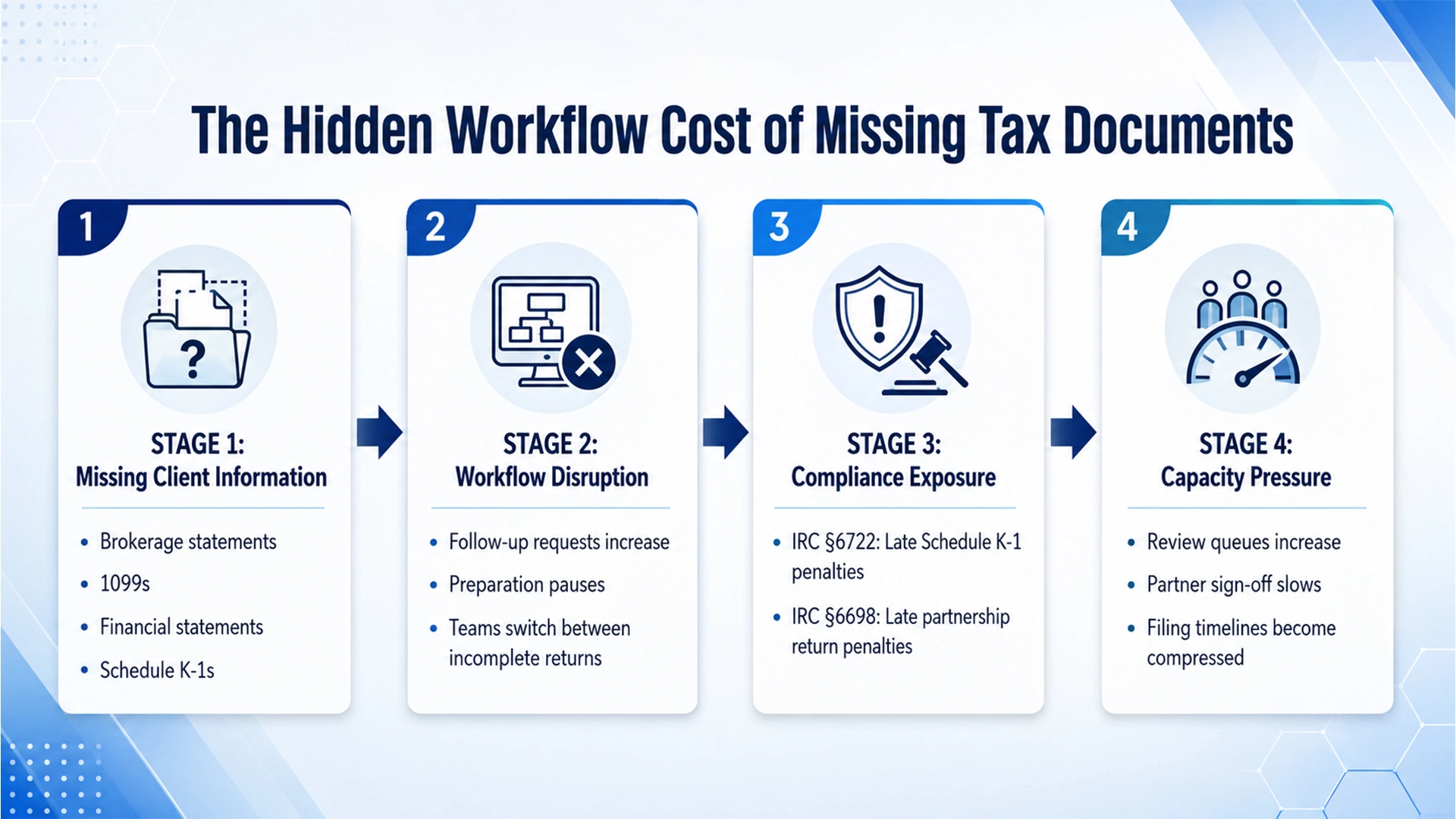
Missing brokerage statements, Forms 1099, Schedules K-1, adjusted trial balances, or shareholder information can delay preparation and review across individual, partnership, and S corporation returns.
The delay also triggers dual penalty clocks:
- Late Schedule K-1 (IRC §6722): Up to $340 per form, reduced if corrected within prescribed IRS timelines.
- Late partnership return (IRC §6698): $255 per partner, per month (or part month), for up to 12 months.
Disclaimer:
Penalty figures reflect IRS inflation adjustments published under IRS Revenue Procedure 2024-40 . Specific statutory relief, reasonable cause provisions, or individual taxpayer facts may alter final penalty assessments.
The damage doesn’t stay contained to a single engagement. Staff spend additional hours chasing down clients, reorganizing work queues, and context-switching back into partially completed returns. That administrative friction drags down productivity across the entire team and makes consistent scheduling nearly impossible as deadlines approach. Every week documentation sits outstanding and is a week closer to crossing a penalty threshold your firm didn’t need to face.
Reviewer Capacity Often Becomes the Largest Production Constraint
Expanding preparation capacity alone rarely removes the biggest production bottleneck. Industry benchmarking shows that a relatively small group of partners and senior managers is responsible for reviewing work produced by a much larger pool of preparers. As completed returns reach the review stage together, review queues naturally begin to build, even when preparation remains on schedule.
The challenge becomes more pronounced during extension season, when Forms 1065, 1120S, and 1040 all move through review within the same filing window. Increasing the number of preparers raises the volume of completed returns entering review, but it does not increase reviewer capacity at the same pace. As a result, completed work waits longer for sign-off, bringing filing deadlines closer without reducing compliance risk.
This is why many firms focus not only on preparation capacity but also on balancing review workloads across the entire tax production process.
Source:
Thomson Reuters, The Rosenberg Survey highlights resilience and change in accounting firms.
Managing Multiple Return Types Requires Different Workflows
Preparing Forms 1040, 1065, and 1120S involves far more than using a different tax software template. Each return type requires different documentation, review procedures, and compliance considerations.
For example:
- Form 1040 Tax Preparation Services: Individual returns often depend on brokerage statements, retirement distributions, charitable contribution records, and pass-through information received from partnerships or S corporations.
- Form 1065 Partnership Tax Return Preparation: Partnership returns require finalized financial statements, capital account analyses, partner allocation schedules, and accurate Schedule K-1 reporting before filing.
- Form 1120S S Corporation Tax Preparation: S corporation returns frequently involve shareholder basis calculations, officer compensation reviews, distributions, and state-specific filing requirements.
When firms process these returns using the same workflow, unnecessary delays often occur because each return type reaches readiness at a different pace. Segmenting work based on return complexity and documentation requirements helps teams prioritize work more effectively throughout Q3.
Disconnected Workflows Delay Tax Return Filing
Extension returns move faster when bookkeeping, accounting, and tax preparation follow standardized processes. When these functions operate independently, delays accumulate quickly.
A common example is bookkeeping that remains incomplete while tax preparation has already been scheduled. Preparers pause work until reconciliations are completed, reviewers wait for updated workpapers, and filing dates continue to shift. Similar delays occur when depreciation schedules, fixed asset records, or payroll adjustments are finalized after the tax engagement has already entered review.
Standardized workflows supported by accounting and tax platforms such as QuickBooks, NetSuite, Xero, UltraTax CS, and CCH Axcess help reduce these interruptions by ensuring that preparers receive consistent, review-ready information.
Limited Capacity Magnifies Every Small Delay
No firm plans for work to arrive all at once, yet the extension season often creates that exact situation.
As deadlines approach, even minor friction begins to compound:
- A missing client document delays preparation.
- Delayed preparation stalls review.
- A stalled review compresses filing time.
When these delays occur across multiple engagements, they create a chain reaction that is difficult to reverse. What begins as a single outstanding document or review quickly affects scheduling, resource allocation, and the overall pace of return completion.
This is why many firms are rethinking how they build capacity. Instead of relying solely on last-minute seasonal hiring, they are creating scalable production models that combine internal expertise with specialized support. Whether through standardized workflows or dedicated US tax preparation outsourcing, the objective remains the same: complete high-quality returns on time without placing unnecessary strain on internal teams.
Need experienced tax professionals before extension deadlines arrive?
What CPA Firms Should Prepare Before Extension Season Begins
Successful tax extension seasons are built long before filing deadlines arrive. Organizing client records, workpapers, tax data, and review workflows during Q3 enables CPA firms to complete returns more efficiently while maintaining quality and reducing last-minute pressure.
Once extension deadlines are on the calendar, the focus naturally shifts to completing returns. However, the firms that consistently meet filing deadlines with fewer operational challenges start the process long before September. They use Q3 to eliminate administrative work, resolve documentation gaps, and organize engagements so preparers and reviewers can focus on technical tax work instead of chasing missing information.
Effective preparation goes beyond simply gathering documents. It involves creating a structured workflow that allows every engagement to move through preparation, review, and filing with minimal interruptions.
The following areas deserve attention before extension workloads begin to peak:
Organize Client Documentation Before Preparation Starts
Every return moves faster when preparers receive complete and organized information from the start. Waiting until a return reaches the preparation stage to identify missing documents creates avoidable delays and repeated client follow-ups.
For 1040 tax return preparation, firms should confirm receipt of brokerage statements, Forms W-2, Forms 1099, Schedules K-1, charitable contribution records, and other supporting documents. Partnership (Form 1065) and S corporation (Form 1120S) returns require finalized financial statements, ownership details, fixed asset schedules, loan information, and prior-year workpapers.
Creating standardized document request lists and sending reminders during July or early August provides clients with sufficient time to respond while reducing last-minute administrative work for the engagement team.
Complete Bookkeeping and Financial Reconciliations Early
Tax preparation depends on accurate financial data. If bookkeeping services are incomplete or delayed, every subsequent stage of the engagement slows down.
Before returns enter production, firms should ensure that bank and credit card reconciliations, payroll adjustments, depreciation schedules, and year-end journal entries are complete. Reviewing trial balances beforehand also confirms that financial statements accurately reflect the client’s records.
For clients using accounting software like QuickBooks, Xero, or NetSuite, finalizing these reconciliations before tax preparation begins allows preparers to work from static books: preventing costly rework from late financial adjustments.
Review Prior-Year Returns and Carryforward Information
A well-prepared extended return begins with understanding the prior year’s filing.
Carryforward items such as net operating losses, capital loss carryovers, depreciation schedules, tax credits, shareholder basis, and partner capital accounts often directly influence the current year’s return. Reviewing these items early helps preparers identify potential discrepancies before they disrupt production schedules.
This step also provides an opportunity to document recurring, client-specific adjustments, reducing unnecessary review comments later in the process.
Prepare Entity-Specific Information for Every Return Type
Although many firms use standardized workflows, every entity type has unique preparation requirements. Recognizing these differences early helps allocate work more effectively throughout the extension season.
- For Form 1040 Tax Preparation, preparers should verify income sources, investment activity, retirement distributions, and pass-through income before beginning calculations.
- For Form 1065 Partnership Tax Return Preparation, attention should focus on partner allocations, capital account reporting, debt allocations, and Schedule K-1 accuracy.
- For Form 1120S S Corporation Tax Preparation, shareholder basis schedules, officer compensation, distributions, and state filing requirements should be reviewed before returns enter the preparation queue.
Batching similar return types allows preparers to work more efficiently while maintaining consistency across filings.
Standardize Workpapers and Review Files
Preparation efficiency is determined not only by technical expertise but also by how information is organized.
Every engagement should follow a consistent workpaper structure that places supporting documentation, reconciliation schedules, client correspondence, review notes, and tax calculations in clearly defined locations. Standardized naming conventions and file organization reduce the time reviewers spend searching for information, allowing review items to be resolved much faster.
Many firms integrate these practices within their tax workflow software, creating a repeatable process across every engagement, regardless of who prepares the return.
Allocate Resources Before the Workload Peaks
One of the most common mistakes firms make is assigning resources as the deadlines approach. By then, reviewer schedules are already full, client requests are increasing, and engagement priorities become more difficult to manage.
Q3 provides an opportunity to assess preparation capacity, reviewer availability, and expected extension workloads before production reaches its busiest phase. Firms that identify resource gaps early can redistribute work internally or supplement their teams with experienced offshore tax professionals to maintain steady production without overburdening existing staff.
Planning capacity in advance also gives partners greater flexibility to focus on complex reviews, advisory engagements, and client relationships instead of routine preparation tasks.
By completing these preparatory steps during Q3, firms build a stronger operational foundation for the extension season. The next step is transforming these priorities into a repeatable execution framework. A structured checklist helps ensure every engagement follows the same process, reducing variability, improving review quality, and keeping returns on track as filing deadlines approach.
Market Trend:
Increasingly, CPA firms are shifting from seasonal staffing strategies to year-round capacity planning. Rather than viewing outsourcing as a temporary solution during busy seasons, many firms now use outsourced tax preparation for CPA firms to create a scalable operating model that supports extension season, year-end planning, and future growth with greater consistency.
Q3 Extension Readiness Checklist for Forms 1040, 1065 & 1120S
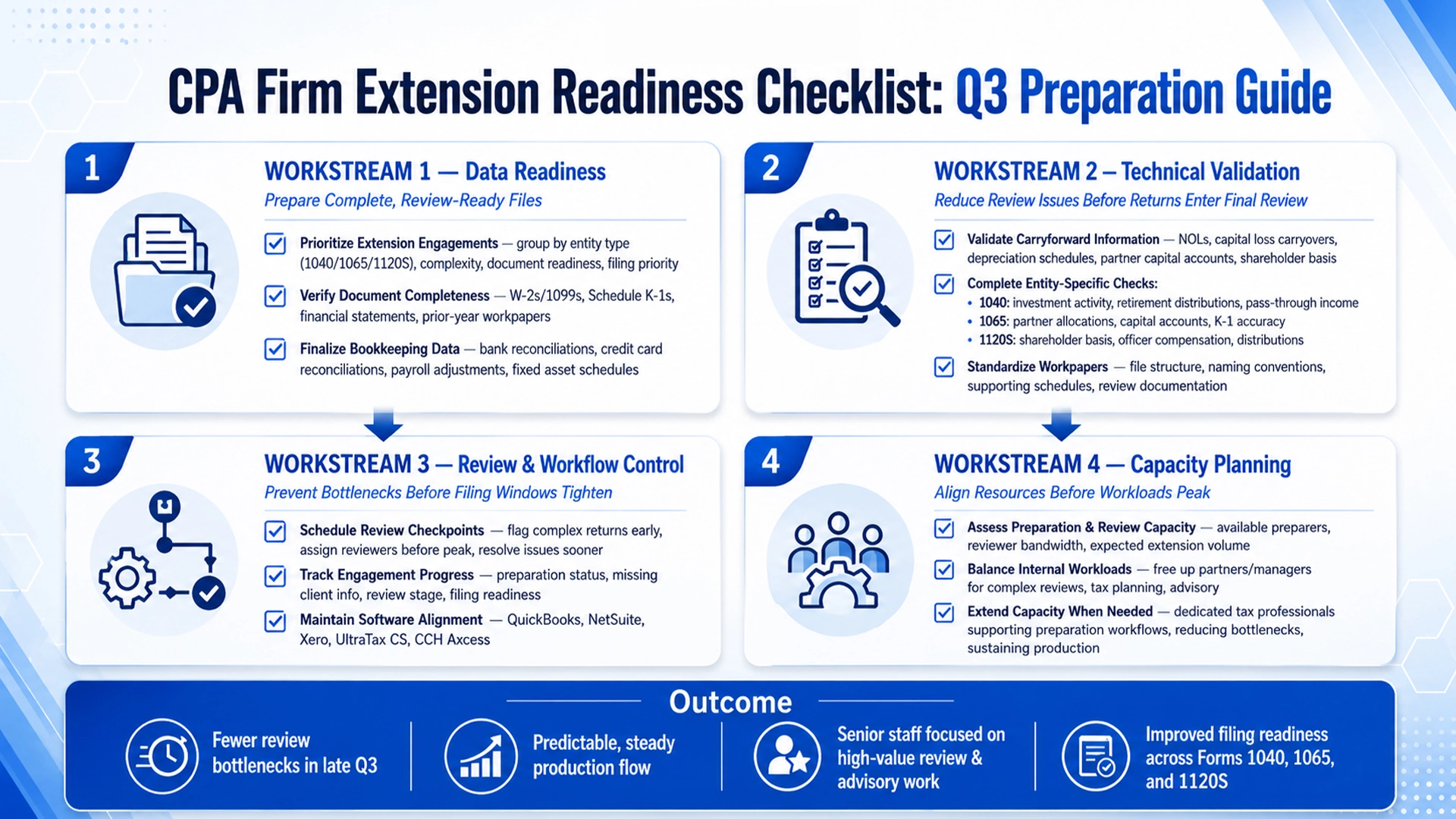
- Prioritize Extension Engagements Dynamically: Categorize returns by entity type, complexity, filing deadline, and document readiness. This allows managers to assign returns that are ready to move forward instead of forcing preparers to repeatedly switch between incomplete returns.
- Verify Data and Document Completeness: Confirm that all required tax documents, financial statements, depreciation schedules, prior-year workpapers, and supporting records are present before assigning the file. A standardized document checklist helps minimize interruptions and reduce non-billable tracking time.
- Complete Bookkeeping and Core Reconciliations: Ensure bank reconciliations, credit card balances, payroll adjustments, fixed asset schedules, and journal entries are finalized. Returns prepared from incomplete books often require multiple time-consuming revisions during the senior review stage.
- Validate Carryforward Information and Basis Logs: Review prior-year filings for capital loss carryovers, depreciation schedules, shareholder basis calculations, partner capital accounts, estimated tax payments, and other recurring tax attributes. Resolving structural discrepancies early prevents critical delays during technical review.
- Standardize Workpapers and Digital Files: Organize supporting schedules, client correspondence, tax calculations, and review notes using consistent file structures. Standardized workpapers reduce reviewer search time and simplify collaboration across internal and external teams.
- Leverage Integrated Cloud Software Platforms: Keep bookkeeping and tax data synchronized across software platforms such as QuickBooks, NetSuite, Xero, UltraTax CS, CCH Axcess, or GoSystem Tax RS. Integrated cloud environments reduce manual data transfers and improve data accuracy throughout the engagement.
- Schedule Intermediate Review Checkpoints: Establish clear review milestones for highly complex returns instead of waiting until returns are fully completed. Early technical reviews identify issues before they affect filing deadlines, which significantly reduces the volume of last-minute revisions.
- Monitor Workflow Dashboards in Real Time: Track every engagement based on preparation status, review stage, pending client information, and filing readiness. Real-time visibility enables managers to redistribute work across the team before operational bottlenecks develop.
- Communicate Proactively with Extension Clients: Share clear document deadlines, engagement status updates, and expected filing timelines throughout Q3. Consistent communication reduces client uncertainty and improves the likelihood of receiving outstanding information before peak filing weeks.
- Plan Hybrid Resource Allocation in Advance: Compare projected workflows with available internal preparation and review capacity during July and August. Addressing resource gaps before September creates greater scheduling flexibility and supports more consistent delivery across all entity types.
Operational Reality: Why Planning Alone Doesn't Solve Capacity Problems
A checklist tells a firm what to do, but execution still depends on having enough qualified professionals available. During Q3, most CPA firms simply lack that extra capacity.
Even a well-designed process stalls when there aren’t enough people to execute it. Senior reviewers get stretched thin across dozens of returns. Hiring seasonal staff takes months in an already constrained talent market, and summer vacations often overlap with increasing extension workloads. Consequently, partners end up spending valuable hours preparing returns rather than advising clients. Furthermore, even the most efficient client portals cannot prevent late-arriving documents, making quality control harder to maintain as deadlines compress.
The most common capacity strategies are compared below:
| Strategy | Ramp-Up Speed | Cost Predictability | Long-Term Capacity | Quality Control |
|---|---|---|---|---|
| Hiring temporary Q3 staff | Medium. Accelerated hiring can take 2-4 weeks before staff contribute across a full range of returns. | Low. Recruitment costs and seasonal salary premiums vary significantly with the talent market. | Limited. Capacity disappears after the extension season, requiring another hiring cycle the following year. | Moderate. Suitable for routine work but limited familiarity with firm-specific clients and review expectations. |
| Workflow automation and client portals | Medium. Technology can be implemented quickly, but client adoption and workflow changes take time. | High. Subscription-based pricing provides predictable operating costs. | Good. Improves workflow efficiency over time but does not increase preparation capacity on its own. | High. Standardized workflows help improve consistency once processes are established. |
| Dedicated offshore tax team | Medium. Typically requires 2-4 weeks for onboarding, workflow alignment, security setup, and software training before reaching steady productivity. | High. Dedicated engagement models generally provide stable, predictable monthly costs. | Excellent. Provides scalable capacity that can expand or contract with seasonal demand without restarting recruitment. | High. Strong quality is achievable when supported by documented workflows, structured reviews, and close collaboration with the firm’s internal team. |
To address this gap, many firms now hire offshore tax preparers as part of their long-term operating model. While temporary hiring offers short-term relief, recruiting and onboarding seasonal staff in July leaves little time before September deadlines arrive. Similarly, automation and client portals are worthwhile investments that streamline workflow, yet they primarily optimize existing capacity rather than expand it.
An experienced tax preparation outsourcing company provides dedicated offshore tax professionals who integrate with existing workflows, allowing internal teams to focus on review, advisory services, and client relationships.
In that context, CPA outsourcing services become a practical strategy for building year-round capacity rather than a seasonal solution.
Expert Insight:
The most resilient CPA firms do not build their operations around filing deadlines. They build them around capacity. As client expectations continue to rise and experienced accounting talent becomes harder to find, firms are shifting from seasonal staffing decisions to year-round capacity planning. Standardized workflows, technology, and dedicated offshore support work best together, creating an operating model that remains efficient well beyond extension season.
The Financial and Client-Service Cost of Delay
Delaying extension season preparation increases operating costs, creates severe bottlenecks, and degrades the client experience. As September approaches, firms spend more time managing urgent tasks than delivering proactive, high-quality service.
Every delay carries a cost. While a backlog often starts with something as simple as missing client documents or unfinished reconciliations, its impact quickly spreads across the entire firm. The most common consequences include:
- Higher Overtime Costs: Longer working hours help firms meet deadlines, but they also inflate payroll costs and accelerate staff burnout. Consequently, profitability declines as more billable hours are spent catching up rather than serving new clients.
- Growing Review Backlogs: When dozens of returns reach reviewers simultaneously, quality control becomes compromised. A balanced review pipeline gives senior professionals the time needed to validate complex tax positions, resolve open questions, and maintain consistent filing quality.
- Reduced Client Confidence: Clients judge a return by their overall experience. Delayed updates, repeated document requests, and uncertain filing timelines weaken client confidence, even when returns are ultimately filed on time.
- Lost Advisory Revenue: Every hour spent resolving last-minute compliance work is an hour taken away from tax planning, entity structuring, and proactive advisory services that drive firm growth.
- Greater Pressure on Senior Leadership: Managers and partners often step back into tax preparation work when workloads exceed available capacity. This limits their ability to conduct high-level reviews, mentor junior staff, and focus on business development.
How Taking Action in Q3 Establishes Year-Round Operational Balance
Q3 provides CPA firms with the best opportunity to organize workflows, strengthen capacity, and prepare extension returns before deadlines compress production schedules. Decisions made during July and August directly influence operational performance well beyond extension season.
While many firms view Q3 merely as a breather between two busy seasons, leading firms treat it as a strategic window. Rather than waiting for September workloads to arrive, they use July and August to strengthen internal processes, evaluate capacity, and draft engagements already on extension. This proactive approach reduces uncertainty and creates a balanced workflow throughout the remainder of the year.
The primary operational advantages of maximizing this summer window are outlined below:
Q3 Creates Space for Process Improvement
When day-to-day pressure eases, firms gain the flexibility needed to improve internal operations. July and August offer the ideal timeframe to review workflow consistency, update client request procedures, standardize workpapers, refine review protocols, and test technology integrations. Operational improvements made during Q3 continue delivering value through the fall extension season and into future spring filing cycles.
Capacity Decisions Have Long-Term Benefits
Hiring decisions, workflow enhancements, and outsourcing strategies require lead time to implement effectively. Waiting until September severely limits available options because production is already underway. Planning in Q3 gives leadership sufficient time to onboard resources, balance workloads, and establish clear quality control procedures before deadline pressure mounts.
Scalable Operations Support Sustainable Growth
Firm growth brings opportunity, but it also increases operational complexity. Every new client engagement adds preparation volume, review responsibilities, and communication demands. Building scalable processes allows firms to expand their client base without overloading senior professionals or compromising service quality.
Whether growth comes from new tax clients, expanded advisory engagements, or organic referrals, a structured operating model provides the foundation needed to support it. Q3 offers the single best window to build that foundation before extension deadlines begin dictating daily priorities.
Strengthen Your Tax Team Before Extension Deadlines Arrive
Conclusion: Scaling Your Firm Beyond the Next Deadline
Preparing Forms 1040, 1065, and 1120S before the extension season arrives is ultimately about building a workflow that supports consistent, high-quality delivery year-round. Firms that use Q3 to organize documentation, standardize processes, and expand capacity enter the fall extension period with greater confidence and fewer last-minute bottlenecks.
Meeting extension deadlines shouldn’t mean overloading your team or compromising quality. Let us help strengthen your tax preparation capacity while your professionals stay focused on client relationships and advisory work. Contact us today to learn how we can support your team before the next filing deadline arrives.
Frequently Asked Questions
Firms should finish bookkeeping cleanup, complete document collection, and have 1065 and 1120S returns drafted and largely reviewed, since that deadline arrives a full month before the individual and corporate filing date.