


 [gtranslate]
Summarize and analyze this article with:
By mid-year, most CPA firms have a clear picture of where their clients stand financially. The books have been reconciled, outstanding issues have been identified, and the numbers tell a reliable story. As we discussed in our previous article on mid-year accounting reviews, that level of accuracy is essential because every planning decision that follows depends on it.
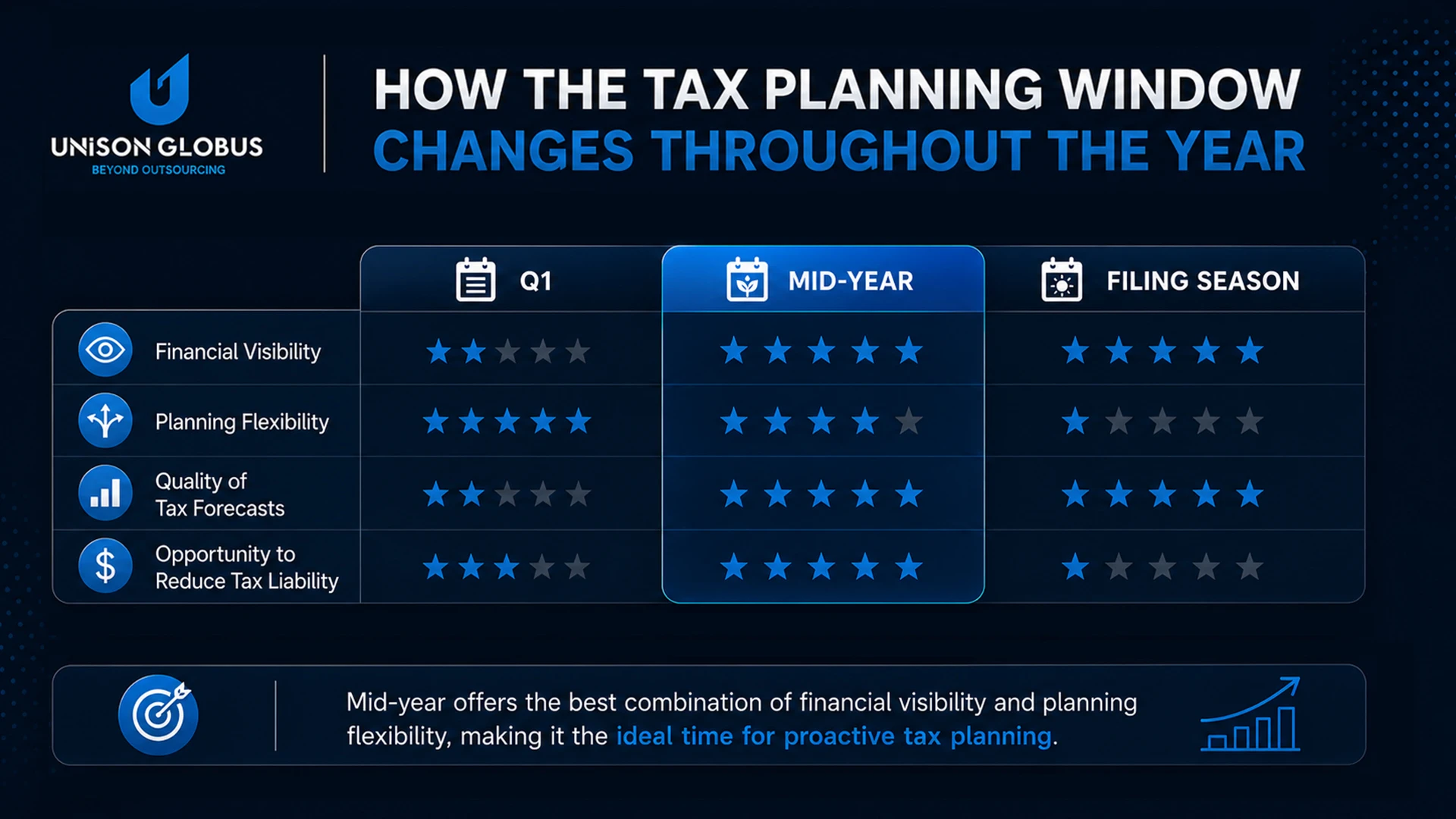
But accurate financial records are only the foundation. The greater opportunity lies in using those insights while there is still time to influence the outcome. Unlike tax season, which is largely focused on reporting completed transactions, the second half of the year is the ideal time for CPA tax planning mid year, allowing firms to help clients make strategic decisions that can reduce tax liabilities, improve cash flow, and prepare both businesses and individuals for a more predictable year-end.
This shift from compliance to advisory is becoming increasingly important. According to the 2025 State of Tax Professionals Report by Thomson Reuters, 75% of tax professionals reported that their clients strongly desire additional tax and business advisory services beyond tax preparation. The finding reinforces a broader shift in client expectations, with businesses increasingly looking to their CPA firms for proactive planning throughout the year, not just support during filing season.
This article explores the key Mid-Year Tax Strategies 2026 USA for CPA Firm, highlighting practical considerations for both business and individual tax returns. It also examines how proactive planning helps CPA firms strengthen client relationships, improve operational efficiency, and enter tax season with greater confidence.
Why Mid-Year Tax Planning Should Be a Priority for CPA Firms
This proactive approach delivers value on multiple fronts:
- Improves tax outcomes by identifying planning opportunities before year-end deadlines.
- Supports better financial decisions with more accurate projections of taxable income and cash flow.
- Strengthens advisory relationships through timely, strategic conversations instead of last-minute compliance.
- Reduces filing season pressure by spreading planning, documentation, and review work across the second half of the year.
Are You Spending More Time Preparing Returns Than Planning Them?
Business Tax Planning Strategies to Implement Before Year-End
By the middle of the year, most businesses have moved beyond forecasts and are operating on real financial performance. This is where tax planning becomes significantly more valuable. Rather than waiting until filing season to interpret the numbers, CPA firms can use this period to challenge assumptions, identify emerging risks, and help clients make decisions that improve their year-end tax position. Whether delivering mid year tax planning support CPA firms or providing business tax return outsourcing (1120, 1120S, 1065), the objective is the same: use today’s insights to influence tomorrow’s outcomes.
Reassess Whether the Business Is Tracking as Expected
Annual tax strategies are often built around budgets prepared months earlier, but businesses rarely perform exactly as planned. Revenue growth, margin fluctuations, unexpected expenses, or changing market conditions can significantly alter a company’s projected tax liability.
A mid-year review helps determine whether the original tax strategy still reflects the client’s financial reality. If it doesn’t, CPA firms have time to recommend adjustments before year-end, rather than explaining missed opportunities after the return has already been prepared.
Don’t Let Estimated Tax Payments Become a Year-End Surprise
Estimated tax payments are intended to reflect expected profitability, not lock businesses into assumptions made at the beginning of the year. When financial performance changes, those estimates should change too.
Reviewing estimated tax obligations mid-year helps businesses avoid unnecessary underpayment penalties while preventing excess payments that could otherwise be used to support operations, growth initiatives, or working capital. For clients, it’s not just about tax accuracy. It’s about making smarter cash flow decisions.
Plan Around Business Decisions, Not After Them
Some of the most valuable tax planning opportunities are tied to business decisions that haven’t happened yet. Expansion plans, capital investments, financing arrangements, ownership changes, or acquisitions all have tax implications that depend on timing and structure.
These conversations are far more valuable before decisions are finalized. Mid-year gives CPA firms the opportunity to evaluate different scenarios, helping clients choose the approach that best supports both their commercial objectives and their tax position.
Identify Risks Before They Reach the Tax Return
Tax planning isn’t only about finding opportunities. It’s also about identifying issues that could create unnecessary complexity during filing season. A business entering a new state, changing its operating structure, or falling behind on documentation may not recognize the tax implications until much later.
Addressing these issues while there is still time to act reduces compliance risks, shortens review cycles, and creates a more efficient path to year-end tax preparation. It also allows CPA firms to spend less time resolving avoidable issues and more time delivering strategic advice.
As client expectations continue to evolve, firms that combine proactive planning with scalable CPA tax outsourcing services can expand capacity without compromising quality. Effective business tax planning is ultimately about creating choices. The earlier CPA firms understand where a business is headed, the more opportunities they have to influence the outcome instead of simply reporting it.
Firms with clients operating internationally should also consider country-specific planning requirements. If you support businesses in the UK, our guide on Mid-Year Tax Planning for UK Businesses explores planning opportunities under the UK’s tax regime.
Individual Tax Planning Strategies for the Second Half of 2026
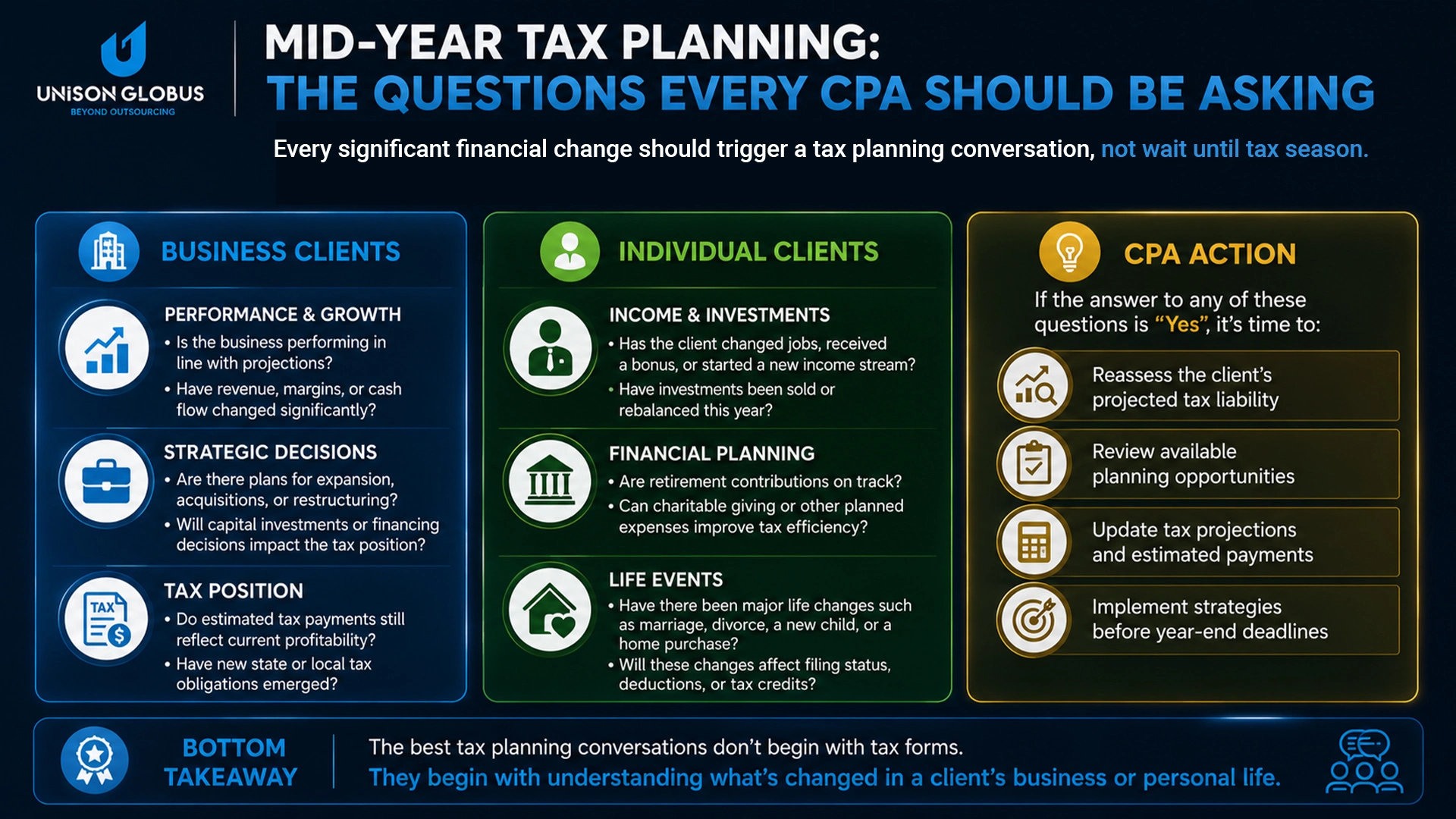
Don’t Wait for Clients to Raise Tax Questions
Many clients assume they’ll discuss taxes when it’s time to file their return. By then, opportunities to optimize withholding, adjust estimated payments, or restructure financial decisions have often passed.
Reaching out proactively not only improves tax outcomes but also reinforces the firm’s role as a trusted advisor rather than a seasonal compliance provider.
Look Beyond Income to the Decisions Driving It
A higher salary doesn’t always create the biggest tax impact. Exercising stock options, selling investments, starting a side business, receiving rental income, or taking early retirement distributions can all change a client’s tax position in ways they may not anticipate.
Understanding what’s changing in a client’s financial life allows CPA firms to provide advice that’s tailored to future decisions instead of past transactions.
Make Tax Planning Part of Wealth Planning
Tax planning becomes more valuable when it’s connected to broader financial goals. Reviewing retirement contributions, investment strategies, charitable giving, or education funding as part of a wider financial discussion helps clients see tax planning as an ongoing strategy rather than an annual obligation.
These conversations also create opportunities for stronger collaboration between CPAs, financial advisors, and wealth managers, resulting in more cohesive advice for the client.
Use Life Events as Advisory Opportunities
Major life events rarely happen according to the tax calendar, but they almost always affect a client’s tax position. Marriage, divorce, the birth of a child, buying a home, changing jobs, or starting a business can all alter filing status, deductions, credits, or reporting obligations.
Instead of waiting until filing season to account for these changes, CPA firms can use them as natural touchpoints for proactive planning, helping clients adapt their tax strategy as their circumstances evolve.
The most effective individual tax planning isn’t driven by deadlines. It’s driven by conversations that happen at the right time. For firms looking to expand these proactive advisory services while balancing growing workloads, outsourced tax planning support USA can provide additional capacity, allowing teams to focus on high-value client relationships without compromising service quality.
Tax-Saving Opportunities to Identify Before Year-End
Are Clients Still Using the Right Tax Entity?
Entity selection is rarely revisited unless a client specifically asks about it, yet businesses can outgrow their original structure surprisingly quickly. An S Corporation that worked well five years ago may no longer be the most efficient option after significant revenue growth, new investors, succession planning, or expansion into multiple states.
Rather than assuming the current structure is still appropriate, use the mid-year review to ask a simple question: “If we were setting this business up today, would we choose the same entity?” That conversation alone can uncover planning opportunities long before the next filing cycle.
Are Valuable Tax Credits Being Missed?
Most planning meetings naturally focus on deductions because they’re familiar. Credits, however, often require a more deliberate review of how a business operates.
A manufacturer investing in process improvements, a software company developing proprietary technology, or a business improving the energy efficiency of its facilities may all qualify for credits that aren’t immediately obvious from the financial statements alone. The opportunity is significant. According to the Joint Committee on Taxation, the federal R&D tax credit is projected to reduce federal revenue by $188.9 billion between FY2025 and FY2029, making it one of the largest business tax incentives available. The challenge isn’t whether the credit exists. It’s whether eligibility is identified before supporting documentation becomes difficult to assemble.
Has Growth Quietly Changed the Client’s Tax Footprint?
Growth creates complexity, and tax obligations often expand long before clients realize it.
Hiring remote employees, selling into additional states, acquiring another business, or opening a second location can introduce new nexus and filing requirements without changing the day-to-day operation of the business. These issues are much easier to address while expansion is still underway than during return preparation, when the focus shifts from planning to compliance.
Are Owners Looking at the Bigger Picture?
Business owners often make decisions that affect both the business return and their individual return without considering the interaction between the two. Compensation, distributions, retirement planning, succession, and major asset purchases shouldn’t be discussed independently because each decision influences the client’s overall tax position.
Looking at both sides together allows CPA firms to recommend strategies that support the owner’s broader financial objectives instead of optimizing one return at the expense of the other.
Which Clients Deserve a Mid-Year Planning Meeting?
Not every client needs the same level of attention. Firms can create far more value by identifying clients whose circumstances have materially changed during the year. That could include rapid business growth, acquisitions, expansion into new jurisdictions, significant investment activity, or major life events affecting individual taxpayers.
Prioritizing these clients early also creates a more predictable workflow for tax return preparation outsourcing, allowing planning engagements to be completed before returns move into production. The result is fewer last-minute revisions, more meaningful advisory conversations, and a smoother transition into filing season.
Building Capacity for Proactive Tax Planning
The result is a more balanced delivery model. Instead of asking partners and managers to choose between production and advisory, firms can build processes where both happen simultaneously. That’s also why services such as outsourced tax preparation services USA, outsourced tax preparation and review services, and tax review services for CPA firms have become an integral part of how many firms scale without continually increasing headcount.