


 [gtranslate]
Summarize and analyze this article with:
- TL;DR
- The Late-Summer Compression: Where the October 15 Workload Starts to Strain Firms
- Where the October Bottleneck Actually Shows Up
- Clarification:
- Is late-summer tax compression eroding your firm's review capacity and delaying key filings?
- Why International Tax Work Creates a Different Capacity Problem
- How Expat Tax Outsourcing Services Relieve the Late-Season Compression
- What CPA Firms Should Evaluate Before Choosing Expat Tax Preparation Services for CPA Firms
- Disclaimer:
- What Does Waiting Until the October Rush Cost CPA Firms?
- What a Review-Ready Expat Tax Outsourcing Model Looks Like
- Managing the October 15 Workload With Greater Control
- Don't let complex expat returns bottleneck your October 15 filings.
- Frequently Asked Questions
- How far in advance of October 15 should a firm start an expat tax outsourcing engagement?
- Does outsourcing expat tax preparation shift professional responsibility away from the CPA firm?
- What client consent is required before international tax data is sent to an outsourced provider?
- Can outsourced preparers work within a firm's existing tax software?
- How should a firm communicate an outsourcing arrangement to expatriate clients?
- What security controls should CPA firms evaluate before sharing international tax data with an outsourced provider?
By late summer, CPA firms enter a familiar stretch of the calendar: the extended-return queue grows heavier while complex international filings demand more preparation and review time. These include expatriate filings, foreign information returns, and multi-jurisdiction cases that resist standardized processing. For these cases, expat tax outsourcing services can provide specialized preparation support.As a result, firms can move complex returns forward while preserving senior professionals’ time for technical review and client matters.
Additional internal effort can provide temporary relief, but it does not solve a workload that is structurally more complex than domestic 1040 preparation. International returns introduce specialized forms, foreign income considerations, treaty provisions, and additional review requirements that can place disproportionate demands on experienced tax professionals.
As these complexities converge with the October 15 extended deadline, firms face greater pressure to complete specialized returns within increasingly limited review windows. For some firms, outsourced expat tax preparation can become part of the operating strategy, providing review-ready preparation support while keeping final review, client relationships, and filing decisions under the firm’s control.
TL;DR
- The late-season filing cycle can create a concentrated review bottleneck. Complex expatriate returns add specialized preparation, reporting, and review requirements.
- International tax work requires specialized expertise. Forms 2555, 1116, 8938, 5471, FBAR, and related calculations can add significant review complexity.
- General seasonal staffing may not solve the problem. Additional preparers without international tax experience can create more rework for senior reviewers.
- A structured outsourcing model can support specialized preparation. Defined workflows help organize foreign documents, calculations, forms, and supporting workpapers.
- Review-ready preparation protects senior review capacity. Provider-side quality checks and clear open-item notes can reduce avoidable review cycles.
- Firms should evaluate providers carefully. International tax experience, Section 7216 requirements, security controls, workflow integration, and quality processes all matter.
- Starting early provides greater control. Establishing the workflow before the October rush allows firms to test processes and resolve handoff issues ahead of peak workload.
The Late-Summer Compression: Where the October 15 Workload Starts to Strain Firms
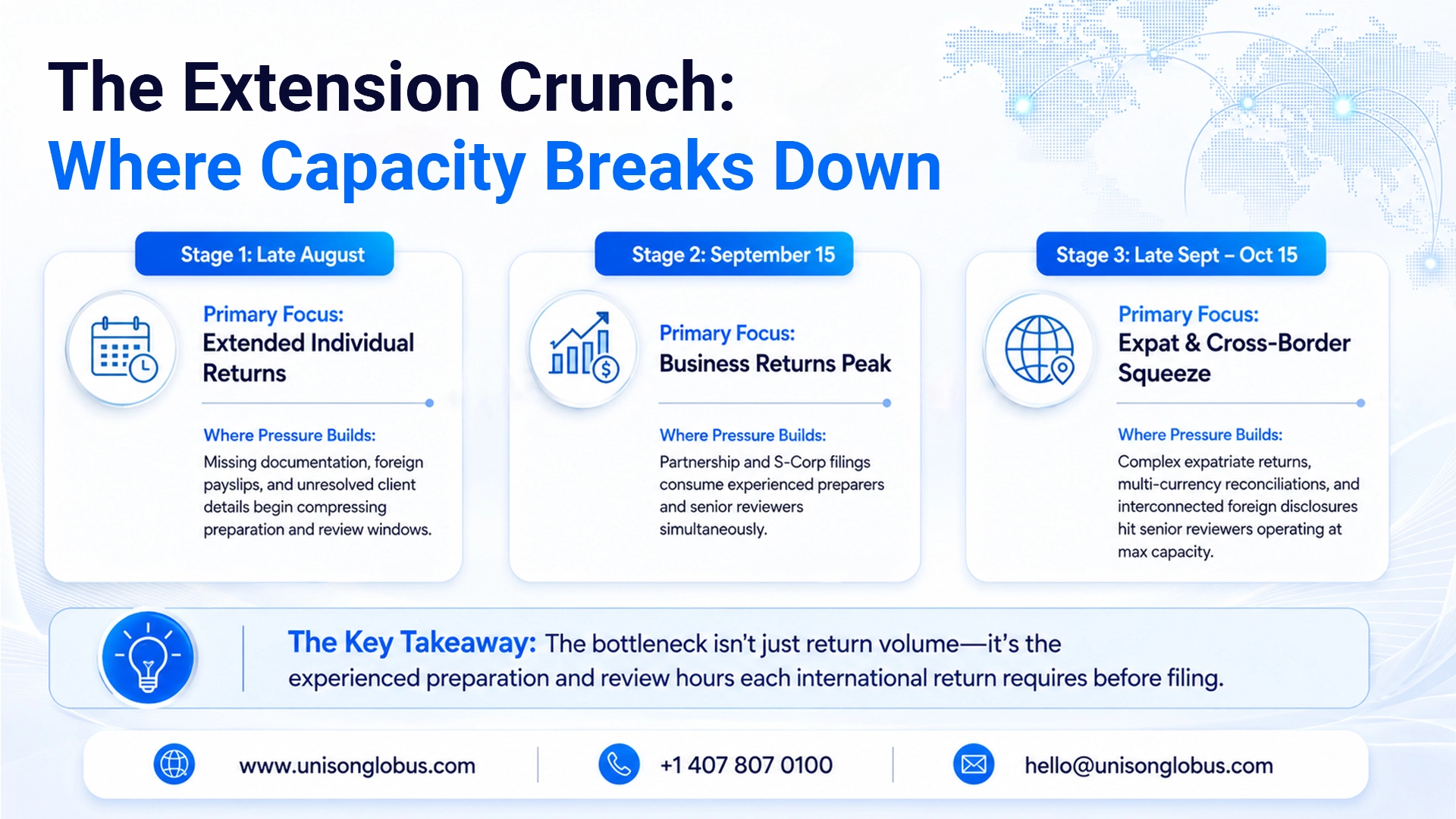
As Q3 moves toward Q4, extended individual returns begin competing for the same preparation and review resources supporting other engagements. Complex individual, business, and international filings can converge within the same limited review window.
The workload typically develops across three overlapping periods:
| Period | Primary Focus | Where Pressure Builds |
|---|---|---|
| Late August | Extended individual returns | Missing documentation and unresolved client information begin compressing preparation and review time |
| September 15 | Business returns | Partnership and S corporation filings compete for experienced preparation and review resources |
| Late September–October | Individual and international returns | Complex expatriate filings, foreign information reporting, and additional review requirements increase senior-level workload |
Extended Individual Returns
Extended individual returns can involve complex investment activity, multiple income sources, multi-state considerations, or international elements. As outstanding client information arrives through late August and September, preparation and review windows become progressively tighter.
Business Return Workload
The September filing cycle for partnerships and S corporations can already place significant demands on experienced preparers and reviewers. As that work overlaps with the October individual-return queue, firms may have fewer senior resources available for specialized international files.
Cross-Border Returns
Returns involving U.S. citizens abroad and other taxpayers with international interests can require more specialized preparation and review than standardized domestic returns. Cross-border tax preparation services can help firms address this specialized work through defined preparation workflows.
Foreign Information Reporting
International clients may also have reporting requirements involving foreign accounts, assets, entities, or income. Foreign income reporting services can support the organization and preparation of this information before it reaches the firm’s review team. These requirements introduce additional data-gathering and review steps that can extend the time needed to bring a return to completion.
Review Workload
The pressure ultimately becomes most visible at the review level. International returns may require experienced professionals to validate technical positions, reconcile supporting information, and resolve gaps before a file can move forward. When the same reviewers are handling multiple categories of extended work, even a manageable number of complex returns can create a meaningful bottleneck. For firms managing recurring international engagements, expat tax review services can also help structure the handoff between preparation and senior-level review.
The AICPA’s 2026 CPA Firm Top Issues Survey found that hiring experienced staff was the No. 1 issue for firms with 11–30 professionals, while managing staff workload and capacity ranked among their leading concerns. These constraints become more consequential when specialized international work competes for the same experienced preparation and review resources. The bottleneck is therefore not simply the number of returns remaining, but the experienced preparation and review time each file requires.
Where the October Bottleneck Actually Shows Up
The operational bottleneck becomes more pronounced as an international return progresses through data validation, preparation, information reporting, and review.
The main friction points include:
Foreign Income Documentation
Foreign payslips, pension records, investment statements, and other documents can arrive in different formats. Preparers may need to interpret and organize them before incorporating the information into the U.S. return. International tax support for CPA firms can help organize these inputs before they reach the firm’s review process.
The challenge is not simply collecting the documents. Preparers must determine whether the information is complete, identify missing details, and organize the underlying data correctly before preparation can proceed.
Multi-Currency and Foreign Tax Information
Currency conversion adds another layer of complexity. Foreign income, taxes paid, and account balances may need to be converted into U.S. dollars using the applicable exchange-rate approach for the reporting requirement.
Foreign tax credit calculations can add further reconciliation work when income, taxes paid, carryovers, and supporting documentation come from multiple sources. Incomplete or inconsistent information can turn what appears to be a straightforward calculation into a senior-level review issue.
Form Preparation and Information Reporting
A single expatriate return can involve several interconnected reporting requirements. Depending on the taxpayer’s circumstances, the file may include Form 2555, Form 1116, Form 8938, or Form 5471. Information from one part of the engagement can affect another.
This interdependence creates additional opportunities for rework. Missing information in one area can affect another calculation or disclosure, extending the review cycle beyond the original preparation task.
FBAR and FATCA-Related Work
Foreign financial accounts introduce another layer of data gathering and reconciliation. FBAR filing is separate from the federal income tax return, while Form 8938 is reported with the income tax return. The underlying account information still needs to be complete and consistent across the client file.
Account ownership, maximum balances, financial institutions, and other required details may need to be gathered and validated before the file is ready for review. FATCA compliance services can support the preparation and organization of applicable foreign-asset information, although the specific reporting requirements depend on the taxpayer’s circumstances. Missing information can hold up an otherwise substantially complete return.
Clarification:
FBAR is filed with FinCEN separately from the federal income tax return, while Form 8938 is filed with the income tax return. These are separate reporting requirements, and one does not replace the other.
Review-Level Bottlenecks
This is where the operational impact becomes most apparent.
International tax positions can require senior professionals to validate foreign tax credit calculations, income classifications, treaty considerations, and information-return completeness. A return that is technically prepared but lacks clear supporting documentation can create another review cycle before it is ready for client delivery.
The result is a handoff bottleneck between preparation and review. Even when preparers complete the return, qualified reviewers may still need to resolve technical questions, documentation gaps, and inconsistencies before the file can move forward.
Is late-summer tax compression eroding your firm's review capacity and delaying key filings?
Why International Tax Work Creates a Different Capacity Problem
The constraint is not simply the number of preparers. It is the specialized calculation, reporting, and review work that requires international tax expertise.
A domestic 1040 may follow a familiar preparation and review path. An expatriate return can require analysis of foreign earned income, foreign taxes, financial accounts, and ownership interests. Decisions in one area can affect calculations and disclosures elsewhere.
This added complexity becomes evident in several areas of international tax preparation and reporting:
Forms 2555, 1116, 8938, and 5471
Form 2555 is used to claim the Foreign Earned Income Exclusion, with eligibility depending in part on the physical presence or bona fide residence test. Form 2555 preparation services should therefore account for the taxpayer’s qualifying facts and supporting documentation. Form 1116 is used to calculate the foreign tax credit, including applicable income categorization, sourcing, and limitation calculations.
Form 8938 (Statement of Specified Foreign Financial Assets) requires determining whether specified foreign financial assets exceed the applicable reporting thresholds based on the taxpayer’s circumstances. Form 8938 preparation services require complete foreign-asset information and appropriate supporting records. Form 5471 can introduce substantially more complex foreign-corporation reporting, depending on the taxpayer’s ownership and filing category. For engagements involving foreign corporations, form 5471 preparation services may also require more specialized data gathering and review.
These are not simply additional schedules attached to a standard return. Together, these forms introduce additional data requirements, technical judgments, and interconnected review considerations.
Specialized Calculations
International calculations often depend on facts that must be established before the return can be completed. Travel history, foreign tax payments, account balances, ownership structures, and foreign-source income can all affect the applicable treatment.
That means preparation requires more than familiarity with tax software. The preparer must understand how the underlying facts affect the relevant tax rules and reporting requirements. Firms evaluating whether to hire offshore tax preparers should therefore assess technical experience, review processes, and familiarity with international forms rather than relying on general tax preparation experience alone.
The same principle applies to form 1116 preparation services, where the quality of the underlying income, tax, and sourcing information directly affects the preparation and review process.
Preparation Versus Review Complexity
The preparation-versus-review distinction matters as much as overall capacity. A domestic return following a familiar workflow may be relatively straightforward for an experienced reviewer. An expatriate return involving foreign tax credits, information reporting, or foreign entities can require substantially more review time. The reviewer is validating technical positions, not simply checking completed calculations.
This makes specialized preparation support particularly important. When international returns are prepared by professionals familiar with the applicable forms, calculations, and documentation requirements, the CPA firm’s reviewers can focus on technical validation rather than correcting basic preparation issues.
Why Specialized International Tax Support Matters
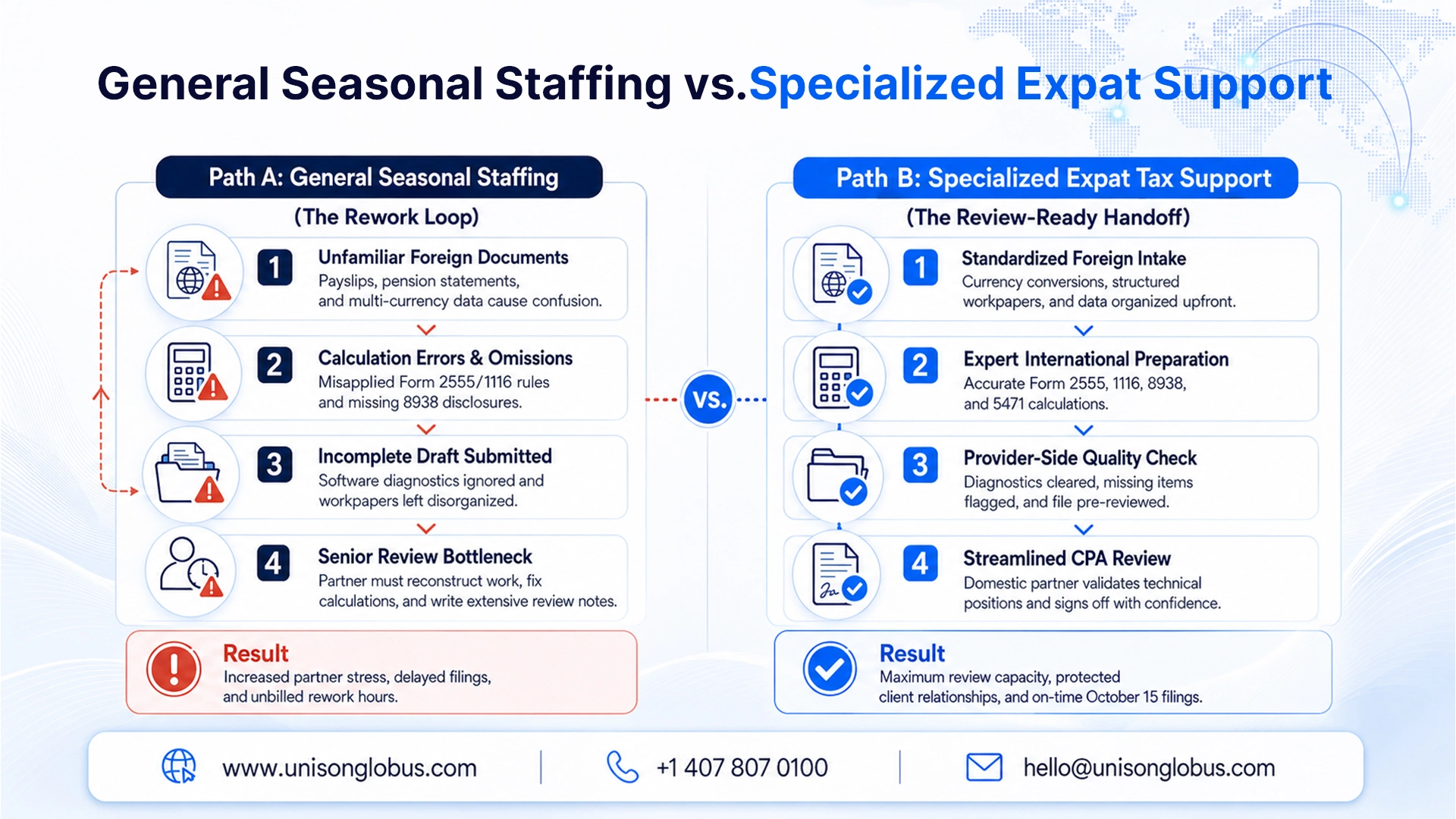
Seasonal hiring can address a volume problem, but it does not automatically address the specialist requirements of international tax work. If additional preparers need substantial guidance or correction, the firm’s experienced professionals may still carry the underlying review burden.
The relevant question is therefore not simply how many preparers a firm can add, but whether they can independently handle defined international preparation work to the firm’s required standards. For CPA firms, specialized preparation support can provide a more targeted approach when international filings require familiarity with specific forms, calculations, and documentation requirements.
The objective is to match defined preparation responsibilities with appropriate expertise, allowing the firm’s senior professionals to concentrate on technical review and final decisions.
How Expat Tax Outsourcing Services Relieve the Late-Season Compression
A structured outsourcing workflow addresses the capacity problem by assigning defined preparation activities to professionals with relevant international-return experience. Outsourced international tax preparation can extend specialized preparation capability while keeping professional judgment and final review within the CPA firm’s established workflow.
The workflow typically follows six stages:
Defined Preparation Scope
The engagement should establish which return types, forms, schedules, and preparation activities are included before work begins. Clear boundaries reduce mid-season questions about responsibility and help the domestic team maintain control over the review process.
Structured Data Organization
Foreign source documents, income information, currency data, and supporting schedules are organized before preparation begins. Standardized workpapers and clearly identified missing information create a consistent preparation file. They also reduce avoidable review questions.
Tax Software Integration
Where the engagement permits, outsourced preparers should work within the firm’s established tax software and workflow environment. This helps maintain consistency in return preparation, workpapers, diagnostics, and handoffs rather than creating a parallel process that the domestic team must later reconcile. For CPA firms using external preparation teams, tax preparation outsourcing for CPA firms works best when the provider can follow the firm’s existing software, documentation, and review conventions.
Provider-Side Quality Review
A qualified reviewer on the provider side should conduct an initial quality check before the file reaches the domestic CPA team. This review can identify missing information, preparation inconsistencies, software diagnostics, and other issues that would otherwise consume senior review time.
Domestic CPA Review and Final Approval
The domestic CPA firm retains responsibility for professional judgment, final review, client communication, and filing decisions. The outsourced team provides defined, reviewable preparation work, while the firm’s professionals determine whether the return is complete and appropriate for the client.
Time-Zone Leverage
When workflows are structured appropriately, work performed across time zones can extend the production window without requiring domestic professionals to lengthen their working day. Where staffing schedules and system access support it, files submitted toward the end of the U.S. business day can continue through defined preparation stages before returning to the domestic team for review. An offshore tax team for accounting firms can provide this time-zone leverage when access, security, and handoff procedures are properly established.
A well-structured model therefore does more than add hands to the workflow. International tax outsourcing services can create a controlled handoff between specialized preparation and domestic review, helping files reach the firm’s professionals in a more review-ready state.
What CPA Firms Should Evaluate Before Choosing Expat Tax Preparation Services for CPA Firms
Professional Responsibility and Section 7216
IRC Section 7216 governs the disclosure and use of tax return information by tax return preparers. Firms should confirm that the outsourcing arrangement complies with applicable Section 7216 requirements, including any required taxpayer consent, information-handling rules, and clearly defined responsibilities for everyone involved in preparation.
The CPA firm should retain control over professional judgment, final review, client communication, and filing decisions while clearly defining the outsourced team’s preparation responsibilities.
Disclaimer:
This overview is general in nature. Firms should confirm applicable Section 7216 consent and disclosure requirements with qualified legal or tax counsel before entering an outsourcing arrangement, as requirements can vary by engagement.
Data Security and Access Controls
International tax files can contain foreign account information, financial records, identification documents, and other sensitive taxpayer data. Before transmitting client information, firms should evaluate the provider’s security certifications, access controls, and authentication practices. They should also review data-handling procedures and remote-access policies.
The goal is not simply to verify that a provider has security documentation. Firms should understand how those controls operate within the actual tax preparation workflow.
Software and Workflow Integration
A provider that cannot work effectively within the firm’s existing tax preparation environment can create administrative work instead of reducing it.
Firms should confirm compatibility with their tax software, workpaper structure, diagnostic processes, file naming conventions, review notes, and handoff procedures. The closer the provider’s workflow aligns with the firm’s existing process, the less time senior professionals spend adapting or rebuilding the work.
International Tax Experience
General tax preparation experience is not enough by itself. Firms should ask specifically about the provider’s experience with expatriate returns and forms such as Forms 2555, 1116, 8938, and 5471.
Ask about the team’s experience, training, review structure, typical engagement complexity, and familiarity with the international tax issues relevant to the firm’s client base. A provider should be able to demonstrate specialized capability rather than rely on broad claims of international expertise.
U.S. expatriate work is often only one part of a client’s international tax landscape. When UK tax requirements also come into play, our UK Tax Preparation and Outsourcing Services guide provides a practical look at supporting those engagements within an established firm workflow.
Quality Control and Review Handoffs
Provider-side quality control should identify preparation inconsistencies, missing information, diagnostics, and documentation gaps before the file reaches the CPA firm’s review team. Firms should ask who performs this review, what it covers, and how findings are documented.
The objective is measurable: issues identified during provider-side review should be resolved or clearly flagged before the file enters the firm’s review queue.
Total Cost Per Review-Ready Return
Per-return or hourly pricing alone does not capture the actual cost of an outsourcing arrangement.
Firms should consider preparation fees alongside internal review time, rework, partner involvement, onboarding, workflow management, and correction costs. A lower quoted rate that produces returns requiring extensive partner-level correction can ultimately cost more than a slightly higher rate that consistently delivers review-ready work.
The right question is not simply what the provider charges per return. It is what the firm ultimately spends to move that return from source documents to final review and approval. For firms comparing expat tax preparation services for CPA firms, that broader workflow cost provides a more useful basis for evaluation than the quoted preparation fee alone.
What Does Waiting Until the October Rush Cost CPA Firms?
Firms that wait until late September to evaluate outsourcing options have less time to establish and test an effective workflow. Onboarding a new provider, establishing secure access, aligning workpaper standards, and learning the firm’s review process all take time. Engaging a provider earlier gives the firm more opportunity to complete that setup before the October workload intensifies.
The alternative is to absorb the additional workload internally. When international returns require specialized preparation and review, this can place further demands on experienced professionals. Rushed preparation can lead to missing information, calculation corrections, or additional review cycles that consume senior professionals’ time.
The cost is therefore not limited to overtime. It can also appear as rework and opportunity cost when partners spend October resolving preparation issues instead of focusing on client and advisory work. The earlier a firm establishes a structured workflow for specialized international preparation, the more opportunity it has to test the process, clarify responsibilities, and resolve handoff issues before the workload reaches its peak.
What a Review-Ready Expat Tax Outsourcing Model Looks Like
- Standardized foreign document intake: Source documents such as foreign income statements, pension records, tax certificates, and account information are organized consistently before preparation begins.
- Structured currency and foreign tax workpapers: Foreign income and taxes are documented with the applicable exchange-rate approach, supporting calculations, and source information needed for review.
- Complete international form package: Applicable international forms, such as Forms 2555, 1116, 8938, and 5471, are prepared consistently with the underlying client information and related schedules.
- Foreign asset and account reconciliation: Information used for FBAR and Form 8938 reporting is checked against the supporting account records and broader return information.
- Provider-side quality review: A qualified reviewer checks the completed preparation for missing information, inconsistencies, diagnostics, and other issues before the file reaches the domestic team.
- Clear open-items documentation: Missing documents, unresolved questions, assumptions, and items requiring CPA judgment are clearly identified rather than buried within the workpapers.
- Structured review handoff: The domestic CPA receives the completed return, supporting workpapers, and relevant review notes in an agreed format that fits the firm’s existing workflow.
- Defined responsibility boundaries: The outsourced team handles the agreed preparation activities, while the CPA firm retains its established review, approval, client communication, and filing responsibilities.
The objective is straightforward: the domestic reviewer should spend time evaluating the return, not reconstructing how it was prepared.
Managing the October 15 Workload With Greater Control
That distinction is central to how Unison Globus supports CPA firms. With 20+ years of experience, Unison Globus provides structured B2B preparation support for expat and international tax work within established firm workflows. Its teams support applicable international forms, FBAR preparation, and related U.S. expatriate compliance work while the CPA firm retains responsibility for final technical decisions and filing.
Need additional support for complex expat and international tax work? Contact Unison Globus to explore a structured preparation model built around your firm’s review processes.
Don't let complex expat returns bottleneck your October 15 filings.
Frequently Asked Questions
Ideally, firms should begin onboarding before the peak workload, allowing time for secure access, workflow alignment, scope definition, and process testing. Starting earlier also gives firms time to evaluate expat tax outsourcing services within their existing review processes before October workload intensifies.
No. Outsourcing delegates defined preparation activities, while the CPA firm retains professional oversight, review, client communication, approval, and filing responsibilities.
Firms should determine whether taxpayer consent is required under applicable Section 7216 rules before disclosing return information to an external provider. The specific requirements depend on the nature of the provider, services, and disclosure.
Yes, depending on the engagement and provider capabilities. Firms should confirm software compatibility, access requirements, workflow integration, and workpaper standards before onboarding.
Firms should explain that certain preparation activities are performed by an external support team within the firm’s established workflow. They should also address any applicable consent requirements and clarify how clients can direct questions or decisions through the CPA firm’s existing relationship.
CPA firms should evaluate security certifications, access controls, authentication practices, data-handling procedures, and remote-access policies. They should also confirm how these controls protect sensitive taxpayer information throughout the tax preparation workflow.