


 [gtranslate]
Summarize and analyze this article with:
- Why the Post-EOFY (end of financial year) Period Creates the Greatest Operational Pressure?
- The Hidden Cost of Manual Tax Return Preparation
- Why Traditional Hiring Models Fall Short During Peak Tax Season?
- What High-Performing CPA Firms Are Doing Differently in 2026?
- Make Tax Season More Manageable
- Scaling Through Offshore Tax Preparation Support Without Compromising Compliance
- Which Tax Preparation Activities Can Be Supported Offshore?
- Why Scalable Tax Preparation Is Key to Year-Round Profitability?
- Signs Your Firm Has Outgrown Its Current Tax Preparation Process
- Preparing for the 2026 Tax Season Starts Before Workload Peaks
- Sustainable Growth Requires Scalable Tax Preparation
- Turn Tax Season into a Growth Opportunity
- FAQ’s
- Is hiring the only way to manage the post-EOFY tax workload?
- What tax returns can be outsourced by Australian CPA firms?
- When should a CPA firm consider offshore tax preparation support?
- Does offshore tax preparation mean giving up control?
- Can offshore support improve client experience?
- How can I get started with Unison Globus Australia's tax preparation support?
As the financial year closes, firms transition from end of financial year reconciliations and financial reporting into one of the busiest operational periods of the year. Individual tax returns, business tax returns, and trust tax return begin arriving in high volumes, often alongside incomplete documentation, evolving ATO requirements, and client expectations for faster turnaround.
The pressure is particularly evident during the lead-up to the tax lodgements deadlines Australia 2026, where CPA firms tax workload Australia continues to rise as firms manage increasing return volumes without compromising financial accuracy or regulatory compliance.
This is why Tax return Preparation Australia 2026 is no longer just about processing returns efficiently. It is about creating scalable workflows that support compliance, improve turnaround times, and enable firms to manage growing client portfolios sustainably.
For firms looking to remain competitive throughout the tax season, scaling capacity through structured processes and strategic support is becoming an operational necessity rather than a growth initiative.
Why the Post-EOFY (end of financial year) Period Creates the Greatest Operational Pressure?
The months immediately following EOFY present one of the most demanding workload cycles for Australian accounting practices.
Unlike other compliance periods, post-EOFY requires firms to manage multiple reporting obligations simultaneously. Individual income tax returns continue to increase throughout July and August, while business entities, trusts and partnerships begin preparing financial information for tax lodgements.
This overlapping workload creates significant scheduling pressure across preparation, review and finalization stages.
Several factors contribute to this operational surge:
- Increasing individual tax return workload immediately after fiscal year-end
- Simultaneous preparation of business tax returns Australia CPA firms manages for multiple entities
- Growing demand for income tax return services Australia
- Additional review requirements for trust and partnership structures
- Ongoing client correspondence to obtain outstanding financial documentation
- Strict adherence to ATO tax compliance for accounting firms
Each stage introduces review dependencies that can slow workflow progression if preparation standards are inconsistent.
Rather than being constrained by tax complexity alone, many firms experience reduced productivity because routine preparation activities consume valuable senior accounting capacity.
The Hidden Cost of Manual Tax Return Preparation
The impact of manual tax preparation extends well beyond longer working hours.
When teams rely heavily on repetitive administrative processes, every additional return increases operational pressure across the firm.
Common workflow inefficiencies include:
- Manual data entry across multiple systems
- Reconciliation inconsistencies requiring additional review
- Version control issues when multiple team members access files
- Time-consuming document follow-ups with clients
- Rework resulting from incomplete working papers
- Extended review cycles caused by inconsistent preparation standards
These challenges directly affect operational efficiency and create unnecessary compliance risk during peak lodgement periods.
For firms managing hundreds of client files, preparation delays quickly amplify. Senior accountants spend more time correcting routine errors rather than providing strategic tax advice or reviewing complex engagements.
Every additional review cycle increases operational cost without necessarily improving quality.
The issue is not simply preparing for more tax returns. It is ensuring every return progresses through a consistent, review-ready workflow that supports financial accuracy from the outset.
This is where scalable tax preparation delivers measurable operational value by reducing preparation delays before they affect compliance with timelines.
Why Traditional Hiring Models Fall Short During Peak Tax Season?
Recruitment has traditionally been the default response to increasing tax workloads.
However, the Australian accounting profession continues to experience ongoing talent shortages, rising employment costs and increased competition for experienced tax professionals.
Temporary hiring may increase capacity, but it also introduces additional challenges:
- Recruitment and onboarding costs
- Training time during peak periods
- Inconsistent preparation quality
- Limited seasonal utilization
- Reduced profitability once tax season concludes
Adding more staff without improving operational processes often shifts workload rather than eliminating inefficiencies.
High-performing firms are increasingly recognizing that sustainable growth depends on building scalable operating models rather than adding full-time staff every tax season.
Capacity is created through workflow optimization, process standardization and access to specialist support, not solely through recruitment. Increasingly, firms are investing in Tax Preparation & Compliance Solutions for Australian Businesses that improve operational consistency, strengthen compliance, and provide the flexibility to manage seasonal demand without continuously expanding internal teams.
What High-Performing CPA Firms Are Doing Differently in 2026?
Leading CPA firms aren’t responding to the post-EOFY workload surge by simply adding more resources, they’re redesigning how tax preparation is delivered.
As the demands of EOFY tax preparation Australia continue to grow, the most successful firms are shifting from reactive workload management to scalable operational models that improve consistency, strengthen compliance and maximize productivity.
Their objective is clear to increase capacity without increasing compliance risk.
Three operational practices consistently distinguish high-performing firms.
Build Consistency into Every Tax Return
Operational efficiency begins with standardization.
Structured preparation checklists, standard working paper templates and clearly defined review procedures create a consistent approach across every engagement. This reduces preparation errors, minimizes unnecessary review cycles and ensures returns move efficiently from preparation through to lodgements.
A standardized workflow also enables junior accountants to manage routine preparation confidently, allowing senior professionals to dedicate more time to technical reviews and complex compliance matters.
Strengthening Workflow Visibility Through Technology
Technology delivers the greatest value when it improves process visibility rather than simply accelerating tasks.
Practice management platforms, secure document collection systems, workflow tracking tools and automated data capture streamline administrative activities while providing greater oversight across every engagement.
However, compliance cannot be automated. Professional review remains essential for validating tax treatments, identifying reporting inconsistencies and ensuring every return aligns with evolving ATO requirements.
The result is stronger governance, greater transparency and more efficient tax preparation workflows.
Align Technical Expertise with Return Complexity
Not every tax return requires the same level of technical involvement.
Routine individual tax returns benefit from standardized preparation processes, while business entities, trust tax return preparation & filing, and technically complex engagements require greater senior oversight.
Allocating resources according to complexity improves resource utilization, reduces workflow delays and enables experienced accountants to focus on high-value compliance reviews instead of routine preparation activities.
The Strategic Advantage
Operational scalability is achieved through disciplined processes, not longer working hours.
By combining standardized workflows, technology-enabled visibility and complexity-based resource allocation, leading CPA firms create a tax preparation model that strengthens ATO compliance, improves financial accuracy and supports higher client volumes throughout the Australian tax season.
Make Tax Season More Manageable
Scale your tax preparation capacity without increasing pressure on your team. Unison Globus Australia helps CPA firms improve efficiency, maintain ATO-aligned quality, and handle growing workloads with confidence.
Scaling Through Offshore Tax Preparation Support Without Compromising Compliance
The increasing complexity of the Australian tax season 2026 is prompting many CPA firms to rethink how they build operational capacity. Rather than relying solely on recruitment, many firms now outsource tax preparation Australia through structured offshore operating models that extend internal capacity while maintaining complete control over quality, review standards, and ATO compliance.
This is where offshore services have evolved from a cost-saving measure into a strategic operational advantage. Today, firms use offshore tax preparation services to scale preparation capacity, improve turnaround times, and maintain consistent quality during Australia’s busiest tax periods. A well-structured offshore model supports the preparation of tax returns under clearly defined Australian workflows and quality standards. Preparation activities are completed using firm-specific procedures, while Australian accountants retain responsibility for technical reviews, client communication and final lodgements.
When implemented correctly, offshore support enables firms to:
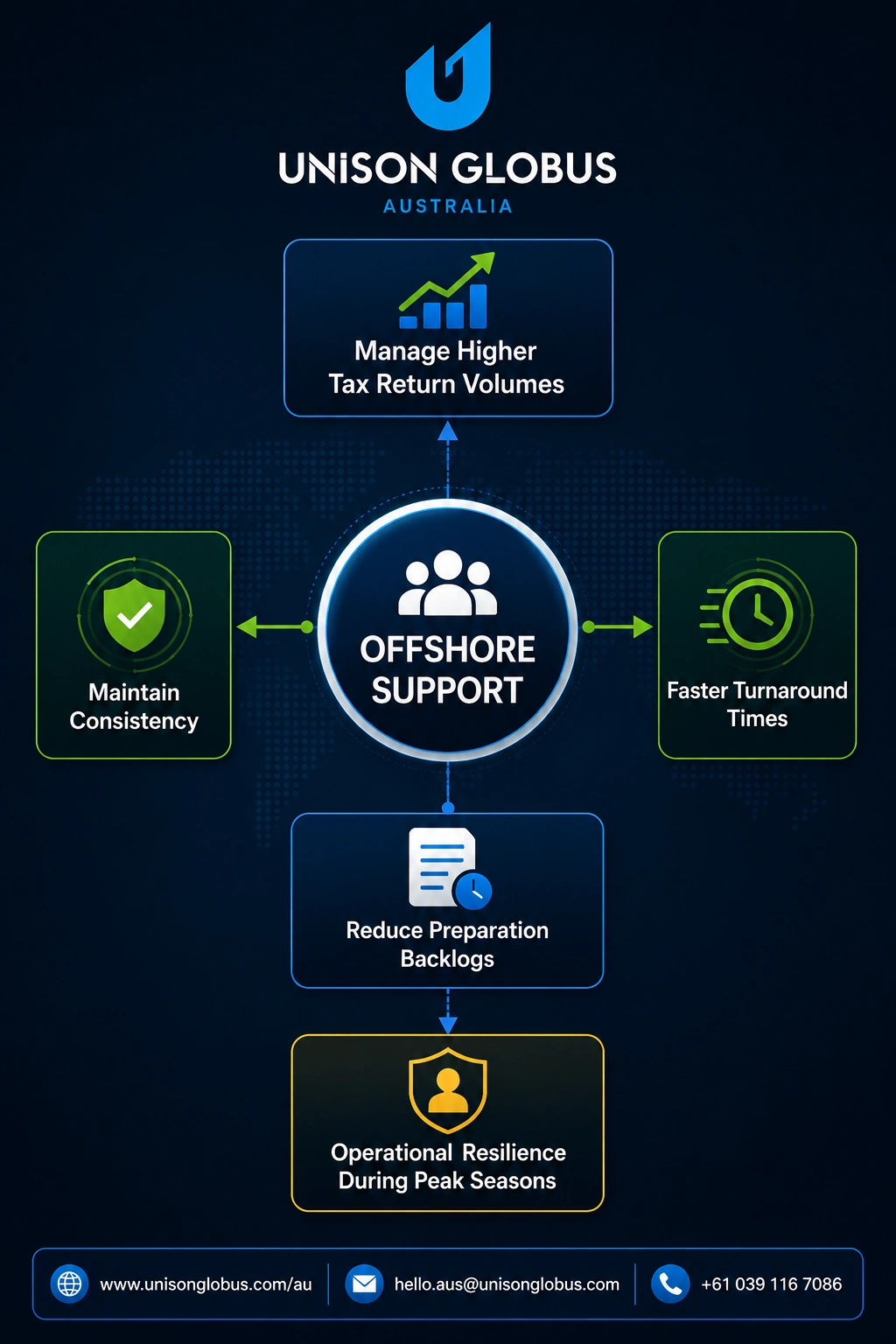
The value lies not in replacing Australian expertise but in extending it. For firms experiencing increasing CPA firms tax workload Australia, offshore preparation capacity provides the flexibility to manage higher return volumes while maintaining consistent compliance and service quality.
For firms managing growing client portfolios, Offshore tax compliance services for Australian firms provide additional preparation capacity that allows internal teams to focus on higher-value compliance reviews, advisory work and client relationships.
Which Tax Preparation Activities Can Be Supported Offshore?
Not every aspect of tax compliance should be delegated. Strategic oversight, technical judgement and client advice remain core responsibilities of Australian CPA firms.
However, many preparation activities follow structured processes that can be efficiently supported through an offshore delivery model.
| Suitable for Offshore Preparation | Typically Retained by Australian CPA Firms |
|---|---|
| Individual income tax return preparation | Client advisory services |
| Working papers and supporting schedules | Final technical review |
| Financial statement preparation | Tax planning strategies |
| Business tax return preparation | Complex tax structuring |
| Trust Tax Return Preparation & Filing support | Client relationship management |
| Document reconciliation and file organization | Final lodgement and sign-off |
This balanced approach enables firms to increase capacity while maintaining complete control over compliance outcomes and client service standards.
Why Scalable Tax Preparation Is Key to Year-Round Profitability?
Scaling tax preparation is not simply about processing more returns. It is about improving operational performance across the firm.
Enhance Capacity Without Permanent Recruitment
Seasonal workload fluctuations make permanent recruitment difficult to justify.
By implementing scalable tax preparation solutions, firms can increase preparation capacity during peak periods while maintaining a leaner operating model throughout the remainder of the year.
Improved Compliance Outcomes
Meeting ATO tax compliance requires consistent documentation, accurate reporting and structured review processes.
Standardized preparation workflows reduce reporting inconsistencies before files reach senior reviewers, supporting higher-quality submissions and reducing the likelihood of avoidable amendments or delays.
Greater Operational Efficiency
When senior accountants spend less time correcting routine preparation errors, they can focus on technical reviews, advisory services and client engagement.
This improves resource allocation across the firm while shortening overall turnaround times.
Operational efficiency becomes a competitive advantage rather than simply an internal objective.
Reduced Cost Pressure
Recruitment, onboarding and staff retention continue to increase operating costs across the Australian accounting sector.
Strategic offshore support enables firms to expand delivery capacity without proportionally increasing fixed employment costs, creating a more sustainable operating model during periods of fluctuating demand.
Enhanced Client Experience
Clients increasingly expect faster responses, accurate reporting and timely lodgements.
Efficient preparation workflows enable firms to meet these expectations while maintaining high compliance standards, strengthening long-term client relationships and supporting future business growth.
Signs Your Firm Has Outgrown Its Current Tax Preparation Process
Many firms assume increasing pressure is simply part of tax season. In reality, recurring delays often indicate that operational processes require improvement.
Your current approach may no longer be scalable if:
- Review queues continue to grow each quarter.
- Senior accountants spend significant time correcting routine preparation work.
- Tax return turnaround times continue to increase.
- Overtime becomes the norm during every EOFY cycle.
- Recruitment is the only strategy considered for increasing capacity.
- Client communication slows because internal resources are fully allocated.
- Meeting the tax lodgement deadlines Australia 2026 depends on extended working hours rather than efficient workflows.
These indicators suggest that the limitation is no longer technical capability, it is operational capacity.
Preparing for the 2026 Tax Season Starts Before Workload Peaks
The firms that perform most effectively during peak tax periods are rarely the ones reacting fastest; they are the ones that are prepared earliest.
Building operational resilience begins well before the first surge in tax return lodgements.
Practical steps include:
- Forecast expected client volumes early.
- Segment returns according to complexity and risk.
- Standardize preparation checklists and working paper templates.
- Strengthen internal review procedures.
- Improve document collection processes to reduce preparation delays.
- Incorporate technology to improve workflow visibility.
- Establish scalable offshore preparation capacity before demand reaches its peak.
Forward planning enables firms to manage increasing workloads without sacrificing compliance, quality or profitability.
Sustainable Growth Requires Scalable Tax Preparation
The post-EOFY period continues to place significant operational pressure on Australian CPA firms. Rising client expectations, increasing compliance obligations and compressed lodgement timelines require a more strategic approach than simply adding more resources.
The firms best positioned for success in tax return preparation will be those that combine structured workflows, technology-enabled processes and scalable delivery models to manage growing demand efficiently.
Today, building capacity extends beyond processing more returns. It requires repeatable, compliant, and efficient preparation processes that support long-term growth.
Unison Globus Australia supports CPA firms by delivering structured, ATO-aligned preparation workflows through scalable offshore support. Our offshore model enables firms to manage increasing volumes of individual and business tax returns, strengthen financial accuracy, reduce compliance risk and improve operational efficiency without compromising control over client relationships or regulatory obligations.
As workload expectations continue to grow across Australia, firms that invest in smarter operating models today will be better equipped to deliver consistent compliance outcomes, improve profitability and confidently meet future demand.
Turn Tax Season into a Growth Opportunity
Increase capacity, maintain compliance, and deliver consistent tax preparation quality without expanding your internal team. Unison Globus Australia helps CPA firms scale efficiently and stay ahead during peak tax seasons.
FAQ’s
Not always. Many firms increase capacity by streamlining workflows and adding scalable offshore tax preparation support, reducing pressure without permanently expanding their team.
Australian CPA firms commonly outsource preparation support for individual tax returns, company tax returns, trust tax returns, partnership returns, working papers, reconciliations, and supporting schedules while retaining final review and lodgement responsibilities.
If turnaround times are increasing, review bottlenecks are becoming common, or workload peaks are placing pressure on internal teams, offshore tax preparation support can help firms scale capacity while maintaining compliance and service quality.
No. Australian accountants continue to oversee technical reviews, client communication, and final lodgements, while structured preparation work is completed under the firm’s established processes.
Yes. Faster turnaround times, fewer preparation delays, and more time for client communication often lead to smoother experience for both firms and their clients.
Getting started is simple. Contact the Unison Globus Australia team to discuss your firm’s tax preparation requirements, workload challenges, and capacity goals. Our specialists will help you identify the right offshore support model to improve efficiency, maintain ATO-aligned compliance, and scale confidently during peak tax seasons.