


 [gtranslate]


Summarize and analyze this article with:
- Key Takeaways
- Why small payroll errors compound across the year
- Warning:
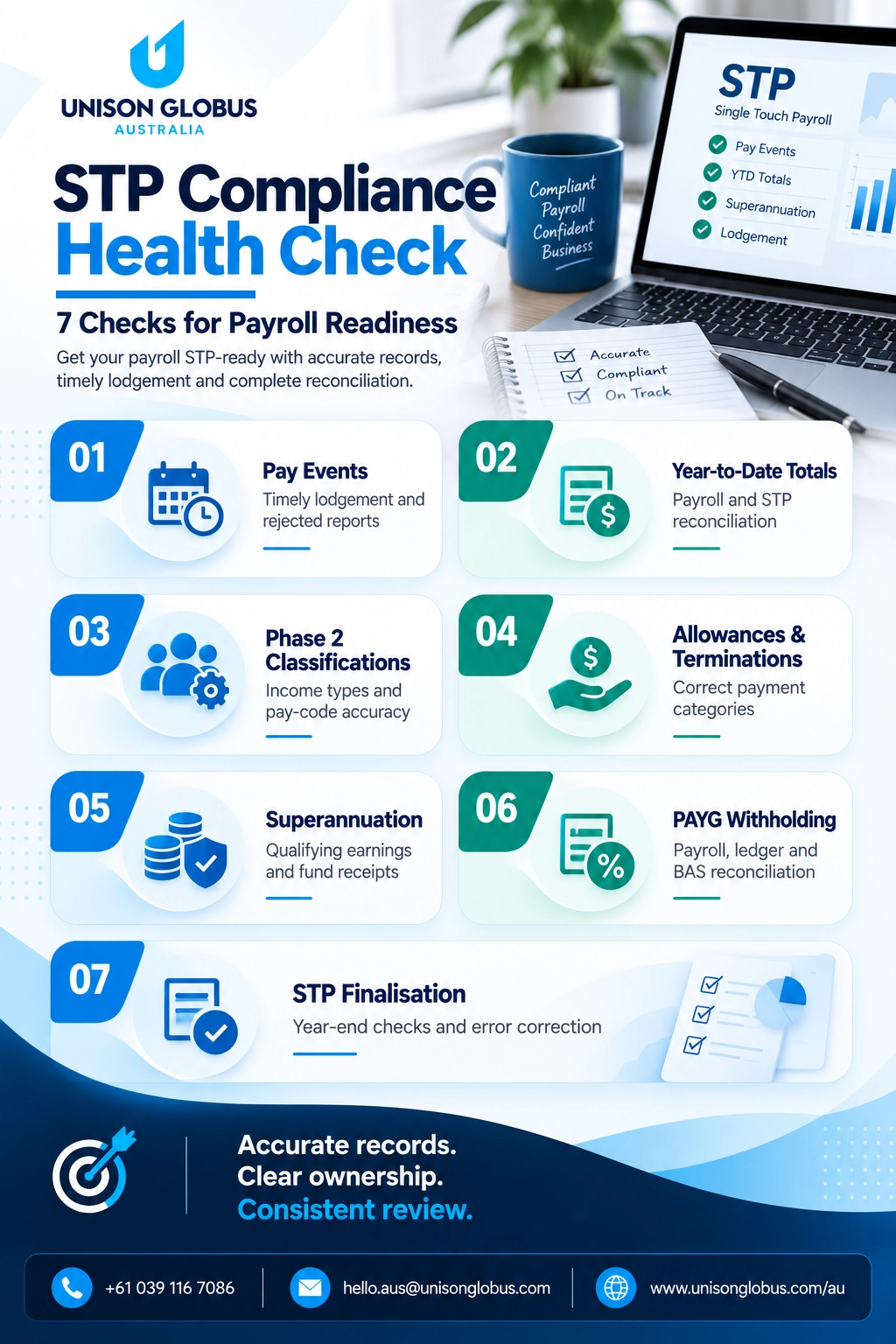
- The seven-point STP compliance health check
- 1. Pay events that reach the ATO late or out of sequence
- 2. Year-to-date totals that drift from the payroll summary
- 3. Income types and employment basis recorded incorrectly under Phase 2
- 4. When payroll teams assign allowances and termination payments to the wrong category
- 5. Superannuation calculations and payments that do not agree
- Warning:
- Make Payroll Compliance More Manageable
- Review capacity, not technical knowledge, often decides the outcome
- What outsourced payroll support can absorb and what stays with you
- How Payroll Compliance Differs Across Markets
- A health check shortens the gap between error and detection
- Build More Capacity into Your Payroll Workflow
- Frequently Asked Questions
- How often should we run this STP compliance health check?
- Does the ATO’s first-year Payday Super approach reduce our obligations?
- What should we fix first when the health check identifies several problems?
- How does Single Touch Payroll Compliance connect to BAS and tax return work?
- Who remains responsible when we outsource payroll tasks?
- When might outsourced payroll support not suit our business?
- How can businesses identify STP errors before year-end finalisation?
- Should STP compliance checks be performed after changing payroll software?
- Which payroll records should be retained to support STP compliance reviews?
Your payroll software lodged every pay event on time, and the ATO accepted each submission. Yet at year end, the STP report still fails to match the payroll summary, and nobody can explain when the gap opened.
That pattern highlights a core challenge in Single Touch Payroll Compliance: lodgement confirms submission, not the accuracy of every underlying figure. A misclassified payment or unrecorded adjustment can affect STP reporting, superannuation, activity statements and employee income statements before anyone identifies the original error.
Payday Super took effect on 1 July 2026 and adds a time-sensitive control to each pay cycle. Employers must calculate super guarantees under the applicable qualifying earnings rules and generally ensure the fund receives contributions within seven business days of payday, subject to applicable exceptions and extended timeframes. Check the current ATO Payday Super guidance for employers before applying the rule to a specific situation.
This health check gives Australian businesses and accounting practices seven practical tests to identify gaps, improve review controls and prepare for the months ahead.
Key Takeaways
- Successful lodgement is only one control. Reconcile employee-level STP figures with payroll records and investigate unexplained differences.
- Review payroll classifications regularly. Check Phase 2 income types, allowances, termination payments and pay-code mappings when employee circumstances or payroll settings change.
- Treat Payday Super as a pay-cycle control. Verify qualifying earnings, contribution calculations and fund receipts against the requirements that apply to each payment.
- Reconcile related records. Compare payroll with STP, the general ledger, PAYG withholding figures and super contributions, documenting timing differences and corrective actions.
- Assign clear ownership. Give each exception a responsible person, a resolution process and a documented review trail.
- Define outsourced work carefully. External payroll support can assist with reconciliations, exception tracking and preparation, while responsibilities and approval authority must remain clear.
- Review before finalisation. Resolve outstanding errors early and retain evidence of corrections, approvals and submissions.
What is STP compliance?
Single Touch Payroll (STP) compliance means reporting the required employee payroll information to the Australian Taxation Office (ATO) through compliant payroll software, following the applicable reporting rules and correcting errors when they arise. It also requires accurate employee records, appropriate payment classifications and reliable year-to-date figures. Successful lodgement alone does not confirm that payroll data is accurate or that the business has met every related obligation.
Why small payroll errors compound across the year
Payroll data supports more than pay runs. It informs STP reporting, PAYG withholding, superannuation obligations, BAS reconciliation and year-end reporting. When one figure goes wrong, downstream records can inherit the error.
The ATO’s Payday Super guidance explains the new payment timing and qualifying earnings requirements. The ATO also uses STP finalisation to make income information available to employees, which makes accurate year-to-date records important well before the final declaration.
Warning:
The ATO’s first-year Payday Super compliance approach guides its compliance focus but does not suspend employers’ legal obligations.
The seven-point STP compliance health check
Work through these checks in order to strengthen payroll controls and support ongoing ATO payroll compliance. The first four focus on pay-event accuracy and employee classifications. The remaining checks test superannuation, reconciliations and year-end controls.
1. Pay events that reach the ATO late or out of sequence
Off-cycle payroll runs, backdated adjustments and rejected submissions can leave pay events out of step with actual paydays. A processed pay run does not always mean the software has successfully lodged the associated STP report.
Check each pay cycle:
- Lodgement timing: Compare each payday with the applicable STP reporting requirement and submission record. Investigate late or rejected submissions and document the resolution.
- Rejected submissions: Review error messages and assign an owner to each unresolved rejection.
- Off-cycle payments: Confirm that your team reports additional or corrected payments through the appropriate process.
- Evidence: Retain submission confirmations and records of corrective action.
A clear exception log helps reviewers identify recurring problems instead of treating each rejected submission as an isolated incident.
2. Year-to-date totals that drift from the payroll summary
Manual adjustments, voided payments and payroll software changes can create differences between STP data and payroll records. Mid-year migrations deserve particular attention because the team must preserve accurate year-to-date information and handle payroll identifiers correctly.
The ATO’s STP finalisation guidance explains the requirements that apply when employers change software or manage payroll identifiers.
Test the following:
- Employee-level reconciliation: Compare gross payments, PAYG withholding and relevant reported amounts in each employee’s STP record with the payroll summary. Investigate differences before reconciling withholding to BAS figures.
- Adjustment trail: Trace manual and negative adjustments to their source records and approvals.
- Software migration: Check opening balances, year-to-date totals and employee identifiers after a system change.
- Exception resolution: Document each difference, its cause, the corrective action and the person responsible.
Do not assume that a balanced payroll control account proves every employee’s STP record is correct. Check the individual records as well.
3. Income types and employment basis recorded incorrectly under Phase 2
STP Phase 2 requires employers to report relevant payment components under the applicable income types and categories. Incorrect pay-code mappings or outdated employee records can misclassify gross payments, allowances and other reportable amounts, causing the same error to recur across pay runs.
For each employee, compare the payroll record with the current employment or engagement details. Check income type, employment basis, allowances and other reportable components against the ATO’s Phase 2 employer reporting guidelines.
Review records whenever an employee changes employment status or the business changes a pay code. Also check contractor arrangements where the nature of the engagement may create super obligations. The ATO explains when super guarantee can apply to independent contractors.
4. When payroll teams assign allowances and termination payments to the wrong category
Termination payments and less common allowances can attract errors when payroll teams rely on software defaults or process unusual cases without a second review.
For each termination, check:
- The termination reason and supporting records.
- Unused leave payments and the applicable reporting category.
- Employment termination payment classifications, where relevant.
- Lump sum codes and other required details.
- The final payment against the employee’s payroll and STP records.
Use the ATO’s Phase 2 reporting guidelines to confirm the applicable payment classifications.
Resolve classification questions before finalising the employee’s income statement. When the circumstances require professional interpretation, refer the issue to the responsible payroll or tax specialist rather than relying on the default setting.
5. Superannuation calculations and payments that do not agree
Payday Super makes the connection between payroll calculations and contribution receipts particularly important. Employers generally need to ensure the super fund receives contributions within seven business days of payday, unless an applicable extended timeframe applies.
A payroll system can calculate a liability correctly while a rejected contribution, incorrect fund detail or delayed payment creates a separate compliance problem.
Check these areas:
- Qualifying earnings: Review pay-code mappings against the applicable Payday Super qualifying earnings rules. Identify differences from existing ordinary time earnings (OTE) settings and confirm the correct treatment for each payment type.
- Contribution calculations: Reconcile the super liability with the amounts due for each payday.
- Fund receipts: Check payment records and available fund receipt evidence, not just the payment instruction.
- Rejected contributions: Record each rejection, assign responsibility and confirm when the issue closes.
- Employee details: Review fund information and eligibility where the circumstances warrant it.
Refer to the ATO’s Payday Super guidance for the applicable requirements.
Warning:
A contribution that misses the required timeframe can create super guarantee charge exposure. Review the facts promptly and follow the ATO’s super guarantee charge guidance where a payment is late or insufficient.
6. PAYG withholding that does not reconcile to the activity statement
Payroll records, STP reports, the general ledger and BAS figures serve related but distinct purposes. Differences can arise when a team posts manual journals, processes off-cycle payments or records adjustments in different periods.
Reconcile payroll withholding to the relevant activity statement figures, including W1 and W2, each reporting period. Also compare payroll control accounts with the general ledger and investigate unexplained balances.
| Reconciliation | What to compare | What to investigate |
|---|---|---|
| Payroll to STP | Employee-level gross payments, PAYG withholding and relevant reported amounts | Rejected pay events, incorrect classifications or unexplained differences |
| Payroll to general ledger | Payroll expenses, liabilities, journals and control-account balances | Unposted journals, duplicate entries, timing differences or unexplained balances |
| PAYG withholding to BAS | Payroll withholding records against W1 and W2 for the relevant activity statement period | Differences in reporting periods, adjustments or amounts reported |
| Super liability to contributions | Super amounts due against payments and available fund receipt records | Incorrect employee or fund details, rejected contributions, shortfalls or late receipts |
| Year-to-date totals | Payroll summaries against employee-level STP records before finalisation | Migration errors, manual adjustments, missing records or unresolved corrections |
Reliable reconciliations also strengthen BAS preparation support by giving the reviewer a clearer trail from payroll records to reported figures.
Clarification:
Every difference needs an explanation, but not every report must match line by line. Confirm the reporting basis, timing and treatment of adjustments before deciding whether a difference represents an error.
7. Finalisation that targets the wrong year or leaves corrections unresolved
STP finalisation brings the year-to-date reporting process together. An incorrect financial year, incomplete employee records or unresolved adjustments can create problems just as the team approaches its deadline.
Before submitting the finalisation declaration:
- Confirm the correct financial year and employee population.
- Reconcile year-to-date payroll totals with STP reports.
- Resolve outstanding rejections and investigate material differences.
- Check employee classifications and termination records.
- Retain the reconciliation, approval and submission evidence.
The ATO generally sets 14 July as the STP finalisation deadline, although different arrangements and deferrals can apply. Check the requirements that apply to your employer or client.
If you discover an error after finalisation, follow the ATO’s STP correction guidance. The ATO’s general guidance calls for corrections within 14 days of detection or, where the pay cycle exceeds 14 days, by the next regular pay-event due date. Check whether the correction also requires an adjustment to W1 or W2 on the affected activity statement.
Make Payroll Compliance More Manageable
Unison Globus Australia helps accounting practices manage payroll workflows, reconciliations and reporting without adding pressure to their existing teams.
Review capacity, not technical knowledge, often decides the outcome
Experienced accounting teams may understand the reporting rules but still struggle to maintain a consistent review schedule across a large client portfolio. The risk grows when nobody owns the exception log or when staff resolve individual errors without correcting the underlying process.
The consequences extend beyond STP reporting. Unresolved withholding differences complicate BAS reconciliation, while unreconciled wages, super expenses and payroll liabilities can create additional work in the general ledger and year-end workpapers. These records also support company tax return preparation, broader accounting and bookkeeping services and relevant compliance audit support engagements.
The priority is to shorten the time between an error and its detection. Regular reconciliations, clear ownership and documented review steps help the team identify problems while the relevant pay run and supporting records remain easy to trace.
What outsourced payroll support can absorb and what stays with you
Providers of payroll outsourcing services can support defined, repeatable payroll tasks within an agreed workflow. The arrangement works best when the business or accounting practice defines the scope, sets review standards and retains appropriate oversight.
An external support team can undertake tasks such as:
- Data checks: Review employee records, pay-code mappings and supporting documents against agreed procedures.
- Reconciliation schedules: Prepare payroll-to-STP, payroll-to-ledger and PAYG withholding-to-BAS reconciliations.
- Finalisation preparation: Organise year-to-date checks, supporting schedules and unresolved items for the responsible reviewer.
- Exception management: Record rejected submissions and unexplained differences, identify the required action and track each issue through escalation.
- Evidence preparation: Organise reconciliation records and supporting workpapers for internal review.
These activities can support Australian accounting practices that need additional capacity across recurring payroll workflows. The workflow should run from data preparation to checking, exception escalation, internal review and final sign-off, with responsibilities and approval authority clearly defined.
Outsourcing a task does not automatically transfer an employer’s statutory obligations. The responsibilities of a registered tax agent or BAS agent depend on the engagement, the work performed, the provider’s registration status and the applicable Tax Practitioners Board (TPB) requirements. Define the task allocation, supervision, escalation and approval process in writing, and check the TPB’s outsourcing and offshoring guidance where relevant.
Before engaging a provider, agree on:
- Scope and frequency: List the checks, reporting cycles and expected deliverables.
- Access controls: Limit system access to what each task requires and review permissions regularly.
- Review and approval: Name the person who investigates exceptions and approves the completed work.
- Evidence and escalation: Set out how the provider records findings, flags urgent issues and escalates unresolved questions.
Where an external provider accesses Australian payroll information from overseas, assess the applicable Australian Privacy Principles, including APP 8 where relevant, along with confidentiality, access controls and secure information handling. Limit access to employee personal information and Tax File Numbers (TFNs) to authorised personnel who need it for the agreed work. Review the OAIC’s guidance on overseas disclosures and the TPB’s outsourcing and offshoring guidance before finalising the arrangement.
Outsourcing may not suit every payroll environment. Very small volumes, incomplete payroll records, undefined exception ownership, highly bespoke award interpretation or limited system access can make an external arrangement harder to justify. Define the workflow and internal controls before deciding which tasks, if any, an external provider should undertake.
How Payroll Compliance Differs Across Markets
Payroll compliance requirements vary across countries, reflecting differences in reporting systems, tax obligations, payment deadlines and employer responsibilities. Australian businesses must account for Single Touch Payroll (STP) reporting and Payday Super requirements, while UK payroll processes involve requirements such as PAYE, National Insurance and Real Time Information (RTI) reporting. In the USA payroll compliance involves federal, state and, where applicable, local tax withholding, reporting and employment requirements.
Although the specific rules differ, accurate employee records, regular reconciliations, clear responsibility for resolving discrepancies and documented review procedures remain important across all three markets. Payroll controls should therefore be designed around the relevant jurisdiction rather than applying one country’s compliance process universally.
A health check shortens the gap between error and detection
Single Touch Payroll Compliance works best as a continuous control process, with clear ownership of each check and a documented route for resolving exceptions. Applying these seven checks regularly helps teams detect discrepancies earlier and enter finalisation with a clearer audit trail.
For accounting practices seeking payroll outsourcing services, Unison Globus provides flexible support that fits existing systems and review workflows. Our AI-ready, platform-agnostic professionals assist with data preparation, reconciliations and exception handling, working within established technology environments and AI-enabled workflows where appropriate. This approach supports Payroll Outsourcing Services Australia for CPA Firms while allowing your team to retain professional judgement, review and final sign-off.
Build More Capacity into Your Payroll Workflow
Get support with recurring payroll tasks while your team retains review oversight and professional judgement.
Frequently Asked Questions
Review pay-event submissions, payroll totals, super payments and withholding reconciliations each pay cycle. Run the full seven-point check before STP finalisation and after significant changes to payroll software, employee classifications or reporting processes. This schedule is a practical control recommendation, not an ATO-prescribed checklist.
No. Payday Super took effect on 1 July 2026. The ATO’s first-year compliance approach guides its compliance focus, but employers must still meet the applicable payment and reporting requirements.
Prioritise employee pay errors, overdue super contributions and issues that could affect statutory deadlines. Then address the underlying cause, such as incorrect pay-code mapping or a faulty reconciliation process, so the same problem does not recur.
STP records support employee income reporting, while payroll withholding figures also feed into activity statement reconciliation. Single Touch Payroll Compliance therefore depends on reconciling each record to the appropriate source, rather than assuming that one successful lodgement confirms every related figure.
The allocation depends on the applicable law, the engagement and the specific task. Outsourcing does not automatically remove an employer’s statutory obligations or a tax or BAS agent’s professional responsibilities. Document the division of work and retain suitable oversight.
It may offer limited value where payroll volumes are very small, the work requires highly bespoke interpretation, or the provider cannot access the necessary records securely. Compare the expected workload, control requirements and review arrangements before deciding whether external support fits.
The most effective approach is to perform regular reconciliations throughout the year rather than waiting until finalisation. Compare employee-level STP records against payroll reports, PAYG withholding balances, superannuation obligations, and general ledger accounts. Early reviews make it easier to correct discrepancies while supporting records are still readily available.
Yes. After a payroll software migration, businesses should verify employee records, year-to-date balances, payroll identifiers, pay-code mappings, and STP reporting settings. A post-migration review helps confirm that payroll data has transferred correctly and reduces the risk of reporting errors carrying forward into future pay events and finalisation processes.
Businesses should retain payroll reports, STP lodgement confirmations, reconciliation workpapers, PAYG withholding records, superannuation payment evidence, employee payroll records, and documentation supporting adjustments or corrections. Maintaining clear records helps support internal reviews and provides evidence if questions arise regarding payroll reporting accuracy.ss