

 [gtranslate]

Summarize and analyze this article with:
- What Should a Pre-Year-End VAT Health Check Cover?
- Common VAT Mistakes UK SMEs Should Identify Before Year-End
- The Practical VAT Health Check: Six Areas to Review
- Warning:
- Warning:
- Warning:
- Warning:
- Warning:
- Warning:
- Identify VAT discrepancies before year-end.
- How a VAT Review Supports the Wider Year-End Accounting Review
- What Should a Business Do When It Finds a VAT Discrepancy?
- How Unison Globus Can Support VAT Workflows?
- Conclusion: Make VAT Review a Defined Part of Year-End Planning
- Strengthen your VAT review process with practical support for reconciliations, documentation and compliance
- Frequently Asked Questions
- What is a VAT health check?
- When should a UK SME carry out a VAT health check?
- What records are needed for a VAT health check?
- How should a business correct a VAT error?
- How can a VAT health check help prevent HMRC penalties?
- Should a VAT health check include digital accounting records?
- What are the most common VAT mistakes made by UK SMEs?
- Can a VAT health check help prepare for an HMRC review?
- Can VAT errors affect year-end accounts?
- How often should VAT records be reconciled?
A VAT return can be submitted on time and still contain errors that are not immediately obvious. Incorrect VAT codes, unrecorded credit notes or unsupported input VAT claims can create reporting discrepancies and complicate year-end accounting.
For UK SMEs, a pre-year-end VAT health check helps verify reported figures against underlying transactions, review supporting evidence and identify issues that may require correction before they affect future returns. It also supports HMRC VAT Compliance by highlighting gaps in records and reporting processes.
The aim is to establish what the records show, resolve discrepancies where possible and determine whether further action or specialist advice is needed.
What Should a Pre-Year-End VAT Health Check Cover?
A pre-year-end VAT health check is a focused review of VAT records, transaction treatments, reporting processes and supporting documentation. Unlike routine VAT Return Preparation & Filing, which focuses on calculating and submitting returns, a health check examines whether the reported figures are accurate, consistent and supported by appropriate evidence.
The scope may range from targeted reconciliations to a broader review of selected transactions and controls. It can complement a wider year-end accounting review, although the financial year-end and VAT accounting periods may not coincide. The review is also distinct from a formal audit or comprehensive compliance examination, as its depth depends on the agreed scope.
Year-end provides a useful opportunity to carry out this review because businesses are already examining financial records, reconciling balances and preparing accounts. Addressing discrepancies at this stage can help resolve reporting issues before they affect subsequent accounting work. However, businesses should investigate material VAT discrepancies as they arise rather than wait until year-end.
With the purpose and timing established, the next step is to identify the key areas that require attention during a practical VAT health check.
Why VAT Compliance Reviews Remain Important
According to HMRC’s latest Measuring Tax Gaps publication, the UK VAT gap was estimated at £12.1 billion, representing approximately 6.6% of total theoretical VAT liabilities. While this figure reflects the wider UK VAT compliance environment rather than errors made by individual businesses, it highlights the importance of maintaining accurate VAT records, reconciliations, and supporting documentation throughout the year.
Why Accountancy Practices Should Perform VAT Health Checks Before Year-End
For accountancy practices managing multiple SME clients, year-end VAT reviews can help identify recurring compliance issues before they affect accounts preparation, corporation tax work, or future VAT returns.
A structured VAT health check allows firms to:
- Identify unexplained VAT balances earlier.
- Standardise VAT review procedures across clients.
- Improve documentation quality.
- Reduce last-minute year-end adjustments.
- Improve readiness for HMRC enquiries and compliance reviews.
For firms supporting growing SMEs, VAT health checks can also help identify VAT registration issues, inconsistent coding, and record-keeping weaknesses before these issues carry into the next reporting period
Common VAT Mistakes UK SMEs Should Identify Before Year-End
Many VAT discrepancies originate from routine processing errors rather than complex tax issues.
Common VAT mistakes include:
- Applying incorrect VAT codes to transactions.
- Claiming input VAT without appropriate supporting evidence.
- Failing to process credit notes correctly.
- Missing VAT registration obligations due to business growth.
- Not reconciling VAT returns with accounting records.
- Incorrect treatment of overseas transactions.
- Carrying unresolved VAT differences into future periods.
Identifying these issues before year-end can help reduce correction work and strengthen VAT reporting controls.
The Practical VAT Health Check: Six Areas to Review
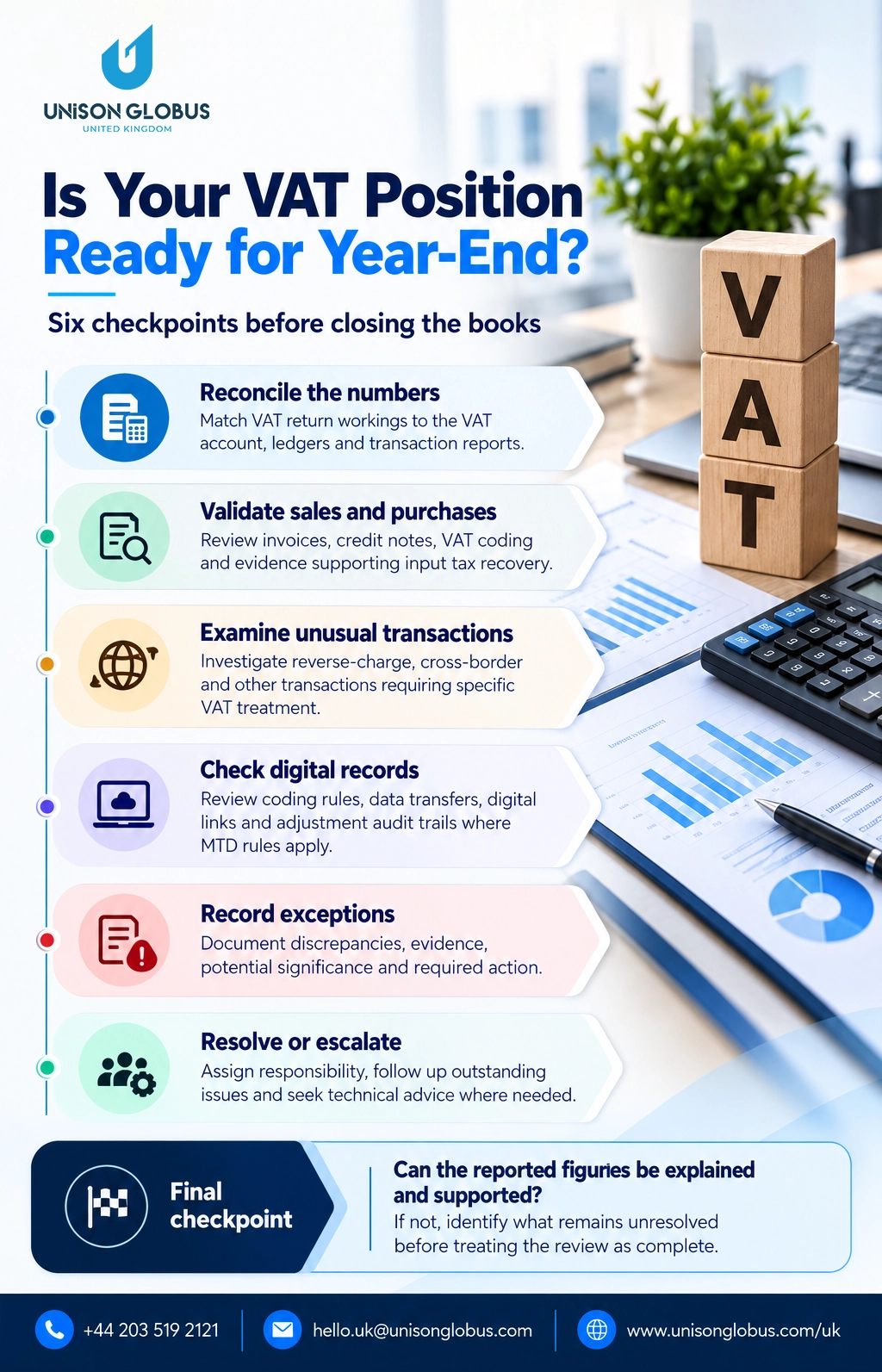
A useful review follows a consistent process rather than relying on a quick glance at the latest VAT return. The following six areas provide a practical framework for UK SMEs and accounting practices assessing the quality of VAT records.
1. Reconcile VAT returns with the accounting records
Start by comparing the submitted or draft VAT return with the relevant sales and purchase ledgers, VAT reports and VAT control account.
The purpose is to establish whether the reported figures can be traced back to the transactions and whether the accounting records explain the amounts included in the return.
Review:
- VAT return workings and transaction-level reports.
- Output VAT and input VAT balances.
- VAT control account movements.
- Manual adjustments and prior-period corrections.
- Differences between the accounting system and the figures used to prepare the return.
Warning:
The VAT control account contains an unexplained balance, or the accounting report does not agree with the return workings.
Consider an SME whose accounting software reports £18,400 of input VAT, while its return preparation schedule shows £17,900. The £500 difference does not, by itself, establish that the return is wrong. It could reflect a timing difference, an excluded transaction, a correction or a coding issue.
The reviewer should identify the transactions contributing to the difference and establish whether the treatment is justified.
What to do:
Record the discrepancy, trace the relevant entries and document the explanation. If the difference remains unresolved or could materially affect the VAT position, obtain an appropriate professional assessment before deciding on the next step.
HMRC's guidance explains how a VAT account links output tax, recoverable input tax and adjustments to the figures reported on a return. Maintaining this audit trail makes reconciliation more meaningful than simply comparing totals.
2. Review sales transactions and output VAT
The next step is to establish whether the VAT treatment applied to sales reflects the nature of each transaction.
Review sales invoices, credit notes, refunds and unusual transactions. Pay particular attention to inconsistent coding across similar sales and changes in products, services or trading arrangements that may affect the appropriate treatment.
For example, an SME that previously sold standard-rated goods may introduce a new product with a different VAT treatment. If the accounting software continues applying the existing code automatically, the resulting report may look consistent while still requiring investigation.
Other areas to examine include:
- Credit notes and whether they have been reflected in the appropriate records.
- Refunds, discounts and changes to the value of supplies.
- Unusual or one-off transactions.
- Differences between invoice dates and the relevant tax points.
- Transactions involving customers or suppliers outside the UK
Warning:
Similar transactions have different VAT treatments without a clear explanation, or a credit note appears in the sales ledger but not in the relevant VAT workings.
What to do:
Compare the accounting entry with the original invoice, credit note and transaction details. Where liability, place of supply or another technical question is uncertain, obtain VAT advisory support instead of applying a blanket rule.
A reviewer should establish the facts before recommending a correction. Similar-looking transactions do not always receive identical VAT treatment, particularly where contractual terms or the nature of the supply differ.
3. Check purchase records and input VAT recovery
Recording a purchase and establishing the right to recover its VAT are not the same thing.
Input VAT recovery depends on the applicable rules, the nature of the purchase and the supporting evidence. A transaction appearing in a purchase ledger does not automatically mean the VAT is recoverable in full.
Review:
- Supplier invoices and supporting purchase documentation.
- Duplicate entries and missing records.
- VAT codes applied to material or unusual purchases.
- Whether the purchase relates to the business and its relevant taxable activities.
- Whether restrictions, partial exemption rules or other special provisions may apply.
Warning:
Input VAT appears in a report, but the supporting invoice cannot be located, the transaction details are incomplete or eligibility for recovery has not been assessed.
What to do:
Retrieve the relevant documents and assess the claim against the applicable requirements. Where the evidence is incomplete, determine what alternative evidence, if any, HMRC permits. Do not assume that every amount of VAT shown on a document is automatically recoverable.
For accounting practices, a consistent evidence-review process is particularly useful when several team members prepare returns across different clients. It helps establish which claims need further documentation and which require technical review before approval.
4. Investigate adjustments and transactions requiring special treatment
Not every transaction can be assessed using a standard domestic VAT code. Depending on the business, a review may need to consider reverse-charge transactions, imports, exports, cross-border supplies, partial exemption or other arrangements with specific VAT rules.
Examine adjustment schedules, supplier invoices, import documentation and the workings supporting unusual entries.
Warning:
A transaction has been processed using the business's usual VAT code even though its nature suggests that different rules may apply.
For example, an invoice from an overseas supplier should not automatically be treated like an ordinary domestic purchase. The correct treatment depends on the type of supply, the parties involved, the place-of-supply rules and any applicable reverse-charge requirements.
Similarly, a business making both taxable and exempt supplies may need to consider whether input tax recovery is restricted. The relevant facts and calculations should be reviewed rather than applying a standard percentage without checking its basis.
What to do:
Establish the transaction's nature, the parties involved and the relevant VAT rules. Review the supporting calculations and seek specialist advice where the treatment remains uncertain.
5. Review digital records and automated VAT coding
Digital bookkeeping systems can improve consistency, make reconciliations easier to trace and help identify unusual entries. They do not independently establish whether every transaction has received the correct VAT treatment.
Review how invoices are captured, how transactions are coded, how information moves between systems and how adjustments are recorded.
Where Making Tax Digital (MTD) for VAT requirements apply, the business should check that its digital records and software arrangements meet the relevant requirements.
HMRC’s record-keeping guidance explains that specified VAT records must be maintained digitally in functional compatible software. Where the rules require digital links between software components, data must be transferred in accordance with those requirements. Copying and pasting data between software products does not constitute a digital link.
Review:
- Whether VAT codes reflect the transactions being recorded.
- Whether changes to coding rules are authorised and documented.
- Whether information transfers between systems maintain the required digital links.
- Whether manual adjustments have an identifiable audit trail.
- Whether recurring exceptions are investigated instead of repeatedly carried forward.
Warning:
VAT codes have changed without explanation, adjustments cannot be traced or data is transferred through a process that may not satisfy applicable MTD requirements.
What to do:
Investigate the source of the issue, correct the process where necessary and retain an appropriate audit trail. Do not assume that every manual step is prohibited; the specific MTD rules, software arrangement and any relevant exceptions must be considered.
6. Document unresolved issues and assign responsibility
A health check delivers limited value if its findings remain in a spreadsheet without an owner or a deadline.
Maintain an exception log that records:
- The discrepancy and relevant VAT period.
- The amount involved, where known.
- The supporting evidence reviewed.
- The potential significance of the issue.
- The action required and person responsible.
- The status, target date and final resolution.
Warning:
The same unexplained balance appears in successive reviews, or an issue remains open because nobody has been assigned responsibility for resolving it.
What to do:
Prioritise findings according to their potential significance, urgency and technical uncertainty. Routine bookkeeping corrections may be handled through the normal accounting process, while complex or potentially material matters may require professional VAT judgement.
For accounting practices, this log can also support workflow management. Practice managers can identify work awaiting client documents, directors can review unresolved technical matters, and partners can decide which issues need escalation before a return is approved.
The key is to distinguish an issue that has been investigated and explained from one that has simply been marked as reviewed.
Identify VAT discrepancies before year-end.
Get the support you need to keep your VAT records accurate and reporting on track.
How a VAT Review Supports the Wider Year-End Accounting Review
VAT should not be examined in isolation from the accounting records that support it.
An unexplained VAT balance may indicate an issue with transaction posting, documentation or an adjustment. Missing purchase evidence may also need attention during accounts preparation. Inconsistent coding may reveal a weakness in the bookkeeping controls that should be corrected before the next reporting period.
A wider accounting review may also cover accruals, prepayments, fixed assets, stock and other balances, depending on the business’s circumstances. These areas should be assessed on their own merits rather than treated as automatic extensions of a VAT health check.
The distinction matters for tax reporting, too. VAT compliance and corporation tax compliance involve different rules, calculations and reporting obligations. A VAT review may identify information relevant to the accounts, but it does not establish that a corporation tax return is correct.
For example, an adjustment to a purchase record might affect both the VAT reporting process and the expense balance used in preparing the annual accounts. The accounting entry, the VAT treatment and the tax implications should each be assessed under the relevant rules.
A joined-up process can help the business avoid reviewing the same records repeatedly, provided each review retains its own objectives and checks.
A practical year-end review table
| Review area | Key question | Evidence to retain |
|---|---|---|
| VAT reconciliation | Can the return figures be traced to the accounting records? | VAT account, ledger reports and reconciliation workings |
| Sales and output tax | Is the VAT treatment supported by the transaction details? | Sales invoices, credit notes and relevant contracts |
| Purchases and input tax | Is the recovery claim supported and permitted? | Supplier invoices and supporting purchase records |
| Adjustments | Is the calculation and treatment justified? | Adjustment schedules and supporting calculations |
| Digital records | Does the software process meet applicable record-keeping requirements? | System reports, digital records and audit trails |
| Outstanding matters | Has each discrepancy been resolved or escalated? | Exception log, evidence and documented decisions |
The table is a practical review aid, not a substitute for the detailed statutory requirements applicable to a particular business
What Should a Business Do When It Finds a VAT Discrepancy?
Finding a difference is the beginning of an investigation, not the final decision.
A structured response helps distinguish a genuine error from a timing difference, an incomplete record or a transaction that needs specialist interpretation.
Step 1: Trace the transaction
Compare the VAT return workings with the ledger, source documents and relevant supporting reports. Identify the VAT period and the entries contributing to the difference.
Avoid correcting a total before establishing which transactions produced it.
Step 2: Establish the cause
Determine whether the difference reflects a timing issue, a missing entry, an incorrect code, an adjustment or a potentially incorrect VAT treatment.
If the explanation depends on the nature of a supply or the interpretation of a VAT rule, obtain appropriate technical input rather than relying solely on the software’s default settings.
Step 3: Document the conclusion
Record the amount, relevant period, evidence examined, reasoning and action required. If the issue remains uncertain, state what additional information or assessment is needed.
A clear record is useful for subsequent reviews and helps another team member understand why a decision was made.
Step 4: Follow the appropriate correction process
If a return already submitted to HMRC may be wrong, consult the current VAT error-correction guidance, Notice 700/45.
The guidance explains how to correct VAT errors and make adjustments or claims. The appropriate route depends on the circumstances, including the nature and value of the error and the applicable rules.
Businesses should not automatically add every identified difference to their next VAT return. They should establish the correct method under the current guidance and retain the supporting records.
Where an issue involves a potentially material error, a deliberate inaccuracy or a technically uncertain treatment, obtain appropriate advice promptly.
How Unison Globus Can Support VAT Workflows?
Unison Globus provides UK VAT services covering registration, return preparation and filing, compliance, risk management and advisory support.
For businesses and accounting firms requiring additional capacity, Outsourced VAT services can support reconciliations, return preparation and related compliance work, with clear responsibilities and internal oversight.
When evaluating a provider, consider its review procedures, documentation standards and ability to work within existing accounting processes. The scope should match the support required, whether routine preparation, a detailed review or specialist advice.
Explore Unison Globus’s UK VAT services to learn more.
Conclusion: Make VAT Review a Defined Part of Year-End Planning
A pre-year-end VAT health check helps UK SMEs identify discrepancies; review supporting evidence and resolve outstanding issues before accounts are finalised. Maintaining accurate digital records and following the correct VAT correction process also supports HMRC VAT compliance and VAT Return Compliance.
Unison Globus UK provides VAT support alongside accounting and bookkeeping services to help businesses and accounting practices manage reporting requirements and review workloads effectively.
The priority is to establish a clear VAT position; address identified issues and assign unresolved matters for further review.
Strengthen your VAT review process with practical support for reconciliations, documentation and compliance
Frequently Asked Questions
A VAT health check reviews VAT returns, accounting records and supporting evidence to identify discrepancies and potential compliance risks before they become bigger issues.
Before year-end is a useful time to review unexplained balances, missing invoices and inconsistent VAT coding. However, significant discrepancies should be investigated as soon as they arise.
Businesses may need sales and purchase invoices, credit notes, VAT account records, transaction reports and adjustment workings. Digital records and links should also be reviewed where Making Tax Digital requirements apply
The business should establish the error, review the supporting evidence and follow HMRC’s applicable correction procedure.
It can identify incorrect VAT treatments, missing records and reporting discrepancies early, giving businesses an opportunity to investigate and correct errors under HMRC guidance.
Yes. Reviewing digital records, VAT codes and transaction links help UK SMEs identify inconsistencies and maintain compliance with Making Tax Digital requirements.
Common VAT mistakes include incorrect VAT coding, unsupported input VAT claims, missing invoices, duplicate transactions, and failing to reconcile VAT returns to accounting records.
Yes. A VAT health check helps businesses review documentation, reconciliations, and VAT treatments before potential HMRC compliance checks or enquiries.
Yes. VAT discrepancies can affect expense classifications, balance sheet accounts, management reports, and year-end financial statements.
Many businesses reconcile VAT monthly or quarterly. A more detailed VAT review is often performed before year-end to identify unresolved issues and improve reporting accuracy.