

 [gtranslate]
Summarize and analyze this article with:
- Year-End Bookkeeping Checklist for UK SMEs
- Need support keeping your books accurate and organised before year-end?
- What Should You Prepare Before Handing Records to Your Accountant?
- How Can You Make the Next Year-End Easier?
- When Should an SME Consider Additional Bookkeeping Support?
- Why Accounting Firms Benefit from Additional Bookkeeping Capacity at Year-End
- Cross-Country Perspective: Bookkeeping Across the UK, USA and Australia
- Strengthen your year-end delivery process with bookkeeping capacity that integrates with your practice workflows, reporting standards and review procedures.
- Preparing for Year-End: Next Steps
- Frequently Asked Questions
- What are the steps involved in a year-end accounting closing checklist?
- When should I start preparing for year-end bookkeeping?
- Do I still need year-end bookkeeping if I use Xero or QuickBooks?
- What records should I give my accountant for year-end accounts?
- How long should I keep year-end bookkeeping records?
- Do sole traders and limited companies follow the same year-end bookkeeping process?
- Can an accountant or external provider help with year-end bookkeeping?
A business can have well-maintained books, up-to-date reconciliations and reliable accounting software, yet still need to resolve important questions at year-end. A supplier invoice may arrive after the reporting date, a customer balance may need reviewing, or a payment made during the year may cover costs relating to the next accounting period.
These are not necessarily signs of poor financial management. They reflect the work involved in establishing an accurate year-end position, where transactions, supporting documents and accounting adjustments must be reviewed together before the accounts are finalised.
For UK SMEs, a structured year-end bookkeeping checklist helps bring these checks into one process. It is also a useful framework for accountants and providers of outsourced bookkeeping services UK firms rely on to support year-end compliance and reporting requirements.
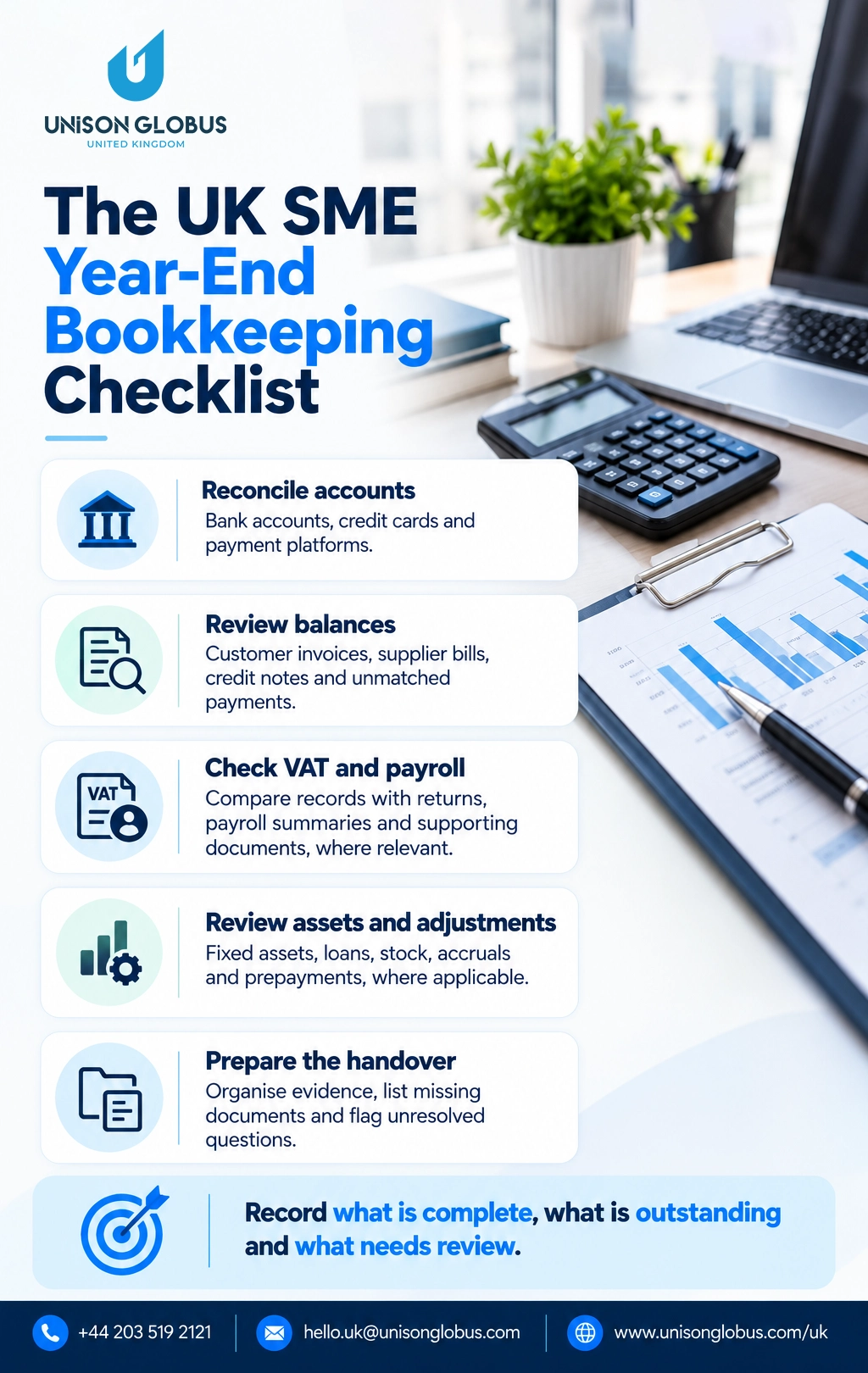
- Reconcile bank accounts, payment platforms and outstanding balances before year-end.
- Review VAT, payroll, fixed assets, loans and stock where applicable.
- Identify potential accruals, prepayments and other adjustments for review by the accountant.
- Organise supporting documents and list missing information or unresolved queries.
- Maintain records throughout the year to make year-end preparation more manageable.
- Check applicable record-retention requirements and statutory filing deadlines.
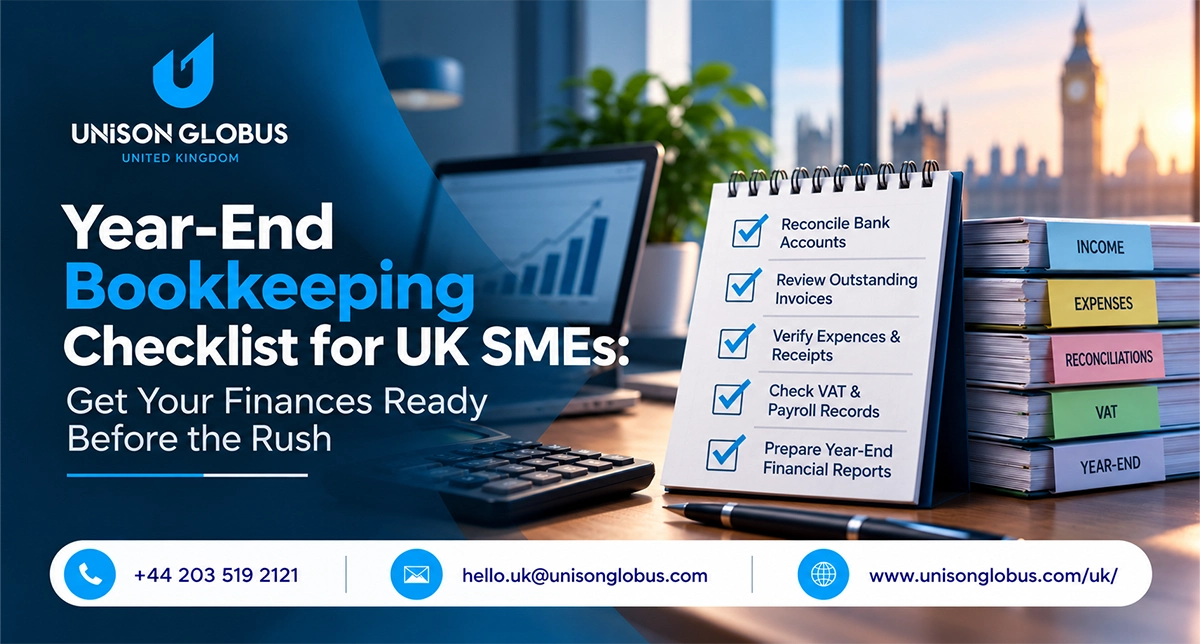
Year-End Bookkeeping Checklist for UK SMEs
This year-end accounting checklist helps UK SMEs review their records systematically, identify missing evidence and flag balances that may need further investigation before the accounts are finalised.
1. Reconcile Bank Accounts, Credit Cards and Payment Platforms
Start by checking that the balances in your accounting software agree with the relevant statements at the year-end date. This includes business bank accounts, credit cards, loan accounts where applicable, and payment platforms used to collect customer payments.
Accounting software and bank feeds can save time, but they do not guarantee that every transaction has been recorded correctly. Duplicate entries, missing bank charges, transfers posted as income, unmatched payments and transactions assigned to the wrong account can all affect the figures.
Investigate differences rather than adjusting a balance simply to make the numbers agree. Check whether each difference is a genuine timing issue, an entry error or an unidentified transaction. Record the explanation and supporting evidence for resolved items, and list any outstanding differences, the checks already completed and the information still needed. Refer unexplained balances or accounting questions to your accountant.
2. Review Sales, Customer Balances and Supplier Records
Once the main accounts have been reconciled, review what customers owe the business and what the business owes its suppliers. An aged debtors report helps identify overdue invoices, unallocated payments and balances requiring follow-up. Check disputed invoices and consider whether any outstanding amounts require further assessment rather than assuming that every unpaid invoice will be collected.
On the supplier side, confirm that bills received during the year have been recorded and that outstanding liabilities are included. Compare supplier statements with the balances in your accounting system where available. Investigate discrepancies, check that relevant credit notes have been recorded, and identify costs relating to the period that may not yet have been invoiced. Keep a note of any items requiring further information or review.
These checks help produce a more reliable picture of income, expenses and outstanding balances. They also support year-end accounts preparation by giving the accountant clearer records and a list of items that still require attention.
3. Review VAT and Payroll Records
If the business is VAT-registered, compare the bookkeeping records with the VAT returns submitted and review the VAT control-account balance. Check relevant sales and purchase transactions, investigate unusual balances or VAT codes and confirm that supporting invoices and credit notes are available. Record any differences that need further investigation rather than assuming that a completed VAT return or software reconciliation confirms the figures are correct. Under Making Tax Digital for VAT, businesses generally need to maintain specified VAT records digitally and use compatible software to submit returns, unless an exemption applies. Consistent VAT compliance and bookkeeping help businesses maintain supporting records and identify discrepancies before their figures are finalised.
For example, a supplier credit note may have been received but not recorded in the bookkeeping system. Check that it has been entered correctly and that the related VAT treatment is supported by the documents and applicable rules.
Payroll records also need to be complete where the business employs staff or pays directors through payroll. Compare payroll summaries with the amounts recorded in the accounts and check that wages, employer National Insurance, pension contributions and other relevant payroll costs have been accounted for correctly. Investigate differences between payroll reports, payments made and the bookkeeping entries rather than assuming that the software has captured every item.
The objective is to identify inconsistencies before the year-end figures are finalised. Specific payroll reporting obligations and deadlines depend on the business’s arrangements and the relevant tax year.
4. Check Fixed Assets, Loans and Other Significant Balances
Review the fixed asset register against purchases and disposals during the year. Check that equipment, vehicles, computers and other business assets have been recorded appropriately, and make sure that disposals or assets no longer held are not left incorrectly on the register. Keep the relevant purchase invoices and disposal records available for review. Depreciation is an accounting adjustment and should be considered in line with the applicable accounting policy.
Loan balances also deserve attention. Compare outstanding amounts with lender statements and separate capital repayments from interest where the accounting treatment requires it. For limited companies, director loan account balances may need particular attention because they can affect the accounts and may have tax implications.
If the business holds inventory, carry out an appropriate stock count at or near the year-end date and compare the results with the accounting records. Investigate differences and identify damaged, obsolete or unsaleable items for review. Stock values can affect reported profit, so adjustments should be supported by evidence and handled in accordance with the applicable accounting requirements.
Not every SME needs a stocktake or a complex asset review. Focus on the balances and transactions relevant to the business, and raise unusual items with the accountant before making adjustments that are not supported by the records.
5. Identify Accruals, Prepayments and Other Year-End Adjustments
Bookkeeping records do not always show the full financial position simply because every bank transaction has been entered. Some income and expenses relate to a different accounting period from the date cash was received or paid. This is why the year-end review should identify potential accruals, prepayments and other adjustments for the accountant to assess.
For example, a utility cost relating to March may be invoiced in April. An annual insurance premium paid during the year may cover months in the following accounting period. A customer may also pay in advance for work that has not yet been completed. These items may require adjustments so that income, expenses, assets and liabilities are presented in the appropriate period.
Prepare the available invoices, contracts, payment details and explanations for these items. The accountant can then determine the appropriate treatment under the applicable accounting framework. Avoid posting unsupported journals simply to reach an expected profit figure. A year-end bookkeeping checklist also helps identify which items are ready for review and which still need supporting evidence.
Many UK accounting firms use outsourced bookkeeping support to manage year-end workloads efficiently while maintaining established review and compliance procedures.
Need support keeping your books
accurate and organised before year-end?
Our UK bookkeeping specialists help businesses maintain
compliant financial records and prepare accounts-ready bookkeeping.
What Should You Prepare Before Handing Records to Your Accountant?
A good handover gives the accountant the records needed to complete the work, along with enough context to understand anything unusual. Sending a large collection of files without explaining missing documents or unresolved balances can create additional questions and delay the process.
Before handing over the records, organise the following where relevant to your business:
- Bank and credit card records: Statements and completed reconciliation reports.
- Sales and supplier records: Sales invoices, supplier bills and details of outstanding customer and supplier balances.
- VAT information: VAT returns and supporting records, if the business is VAT-registered.
- Payroll information: Payroll summaries and relevant pension or employment cost information.
- Assets and loans: Fixed-asset details, purchase and disposal records, and loan statements.
- Stock records: Stock count results, where the business holds inventory.
- Unusual transactions: Details of director loan balances and potential year-end adjustments that need review.
- Missing information: A list of missing documents, disputed balances and questions that remain unresolved.
Alongside the documents, prepare a short exceptions list showing which items remain unresolved, what checks have already been completed and what information is still required. Use your year-end bookkeeping checklist to ensure that outstanding queries are clearly documented and ready for the accountant to review.
The most useful handover is not necessarily the one with the most files. It is the one that makes the status of the records clear. Tell your accountant what is complete, what remains uncertain and where supporting evidence can be found. This helps prioritise outstanding work and distinguish unresolved queries from confirmed accounting adjustments.
How Can You Make the Next Year-End Easier?
Year-end preparation is generally more manageable when bookkeeping is maintained throughout the year rather than left until the reporting deadline approaches. Regular reconciliations, timely invoice processing and periodic reviews of outstanding balances help identify issues while the relevant information is still easy to obtain. Good financial record keeping in the UK involves maintaining accurate records, retaining supporting evidence and making information available when it is needed.
A simple monthly routine can include reconciling bank and payment accounts, reviewing customer and supplier balances, checking VAT records where applicable, and monitoring other significant balances. Businesses with payroll, stock or more complex transactions may also benefit from scheduled reviews of those areas. Revisiting the year-end bookkeeping checklist throughout the year helps track completed checks and address outstanding items before the reporting deadline.
Record retention requirements depend on the type of record and the business’s circumstances. VAT records generally need to be retained for at least six years, although different requirements may apply to other business and tax records. Check the relevant GOV.UK guidance on VAT records, company accounting records and self-employed records to confirm the applicable requirements.
Keeping documents organised by accounting period, retaining supporting evidence and documenting adjustments also makes it easier to answer questions after the year-end work has been completed.
When Should an SME Consider Additional Bookkeeping Support?
Some businesses can maintain their bookkeeping internally but need help resolving accumulated discrepancies before year-end. Others need more regular support because transaction volumes have grown, the internal team has limited capacity or the business has several reporting requirements to manage. Bookkeeping for small businesses in the UK may be managed internally, supported externally or divided between an internal team and a specialist provider, depending on transaction volumes and available resources.
The appropriate level of support depends on the condition of the existing records, the complexity of the transactions and the work the business expects to retain internally. For businesses reviewing their bookkeeping arrangements, the key consideration is whether the proposed service covers the tasks they need and fits their existing accounting process. Businesses considering outsourced bookkeeping in the UK should establish which tasks are included, who will resolve missing information, how queries will be handled and who is responsible for reviewing and approving the completed work.
Additional bookkeeping support is most useful when responsibilities and handover arrangements are clear. It should help maintain reliable records and a consistent workflow, while the business owner and appointed accountant retain the responsibilities that belong to them.
Why Accounting Firms Benefit from Additional Bookkeeping Capacity at Year-End
As client demands increase during year-end, accounting firms often need additional support to maintain turnaround times and manage routine bookkeeping workloads. Tasks such as bank reconciliations, accounts payable and receivable reviews, VAT record checks and transaction processing can consume substantial internal resources.
Additional bookkeeping capacity can help firms keep client records organised, identify issues earlier and prepare information for year-end accounts preparation. When aligned with existing workflows and review procedures, this support.
The right support model should align with the firm’s existing workflows, quality-control procedures and reporting standards. When responsibilities are clearly defined, additional bookkeeping capacity can help firms maintain service levels, improve efficiency and manage seasonal demand more effectively.
Cross-Country Perspective: Bookkeeping Across the UK, USA and Australia
The core bookkeeping practices are similar across markets: reconcile transactions, retain supporting evidence, review outstanding balances and investigate unusual items before finalising figures. However, statutory and tax requirements vary by jurisdiction.
For example, US businesses may need to maintain records for federal and state tax reporting, while Australian businesses may need records for Business Activity Statements (BAS) and other Australian Taxation Office obligations. These requirements differ from UK VAT, Companies House and HMRC processes. Businesses operating across countries should maintain consistent internal processes while applying the rules relevant to each entity and jurisdiction.
Strengthen your year-end delivery process with bookkeeping capacity that integrates with your practice workflows, reporting standards and review procedures.
Preparing for Year-End: Next Steps
A structured year-end bookkeeping process helps UK SMEs identify discrepancies, organise supporting records and prepare outstanding questions before the accounts are finalised. Regular reconciliations and a clear handover can also reduce avoidable delays.
At Unison Globus UK, our accounting and bookkeeping services in the UK support UK accountancy practices with accounting and bookkeeping workflows that fit their existing processes. Our AI-ready professionals can work within clients’ existing technology environments, including AI-enabled platforms where appropriate, combining accounting expertise with platform fluency to prepare work for review.
For limited companies, remember that annual accounts filing, Corporation Tax payment and Company Tax Return deadlines are separate. Late filing can result in penalties. Check the relevant GOV.UK guidance on company accounts and tax returns and Companies House late-filing penalties for the applicable requirements.
Frequently Asked Questions
Reconcile bank accounts, review customer and supplier balances, check VAT and payroll records, verify relevant assets and liabilities, and identify potential year-end adjustments.
Maintain reconciliations and process invoices throughout the year. Begin a focused year-end review before the reporting date where possible, allowing time to resolve discrepancies and obtain missing documents.
Yes. Accounting software helps organise transactions, but year-end checks are still needed to identify missing records, incorrect entries, unexplained balances and adjustments requiring review.
Provide relevant bank statements, reconciliation reports, sales invoices, supplier bills, VAT and payroll records, loan statements, asset details and stock records. Include a list of missing documents and unresolved queries where applicable.
Retention periods depend on the type of record and the business structure. VAT records generally need to be kept for at least six years, while different requirements apply to company and self-employed records.
Many bookkeeping checks are similar, but reporting obligations differ. Limited companies must meet statutory accounts and Corporation Tax requirements, while sole traders generally use their business records to prepare Self Assessment.
Yes. Depending on the agreed scope, they may help reconcile transactions, investigate discrepancies and organise records for review. Confirm responsibilities, exclusions and how outstanding queries will be handled before work begins.