
Categories
Audit & Assurance Auditing

Why August Is the Best Time for CPA Firms to Fix EBP Audit Gaps Before Peak Season

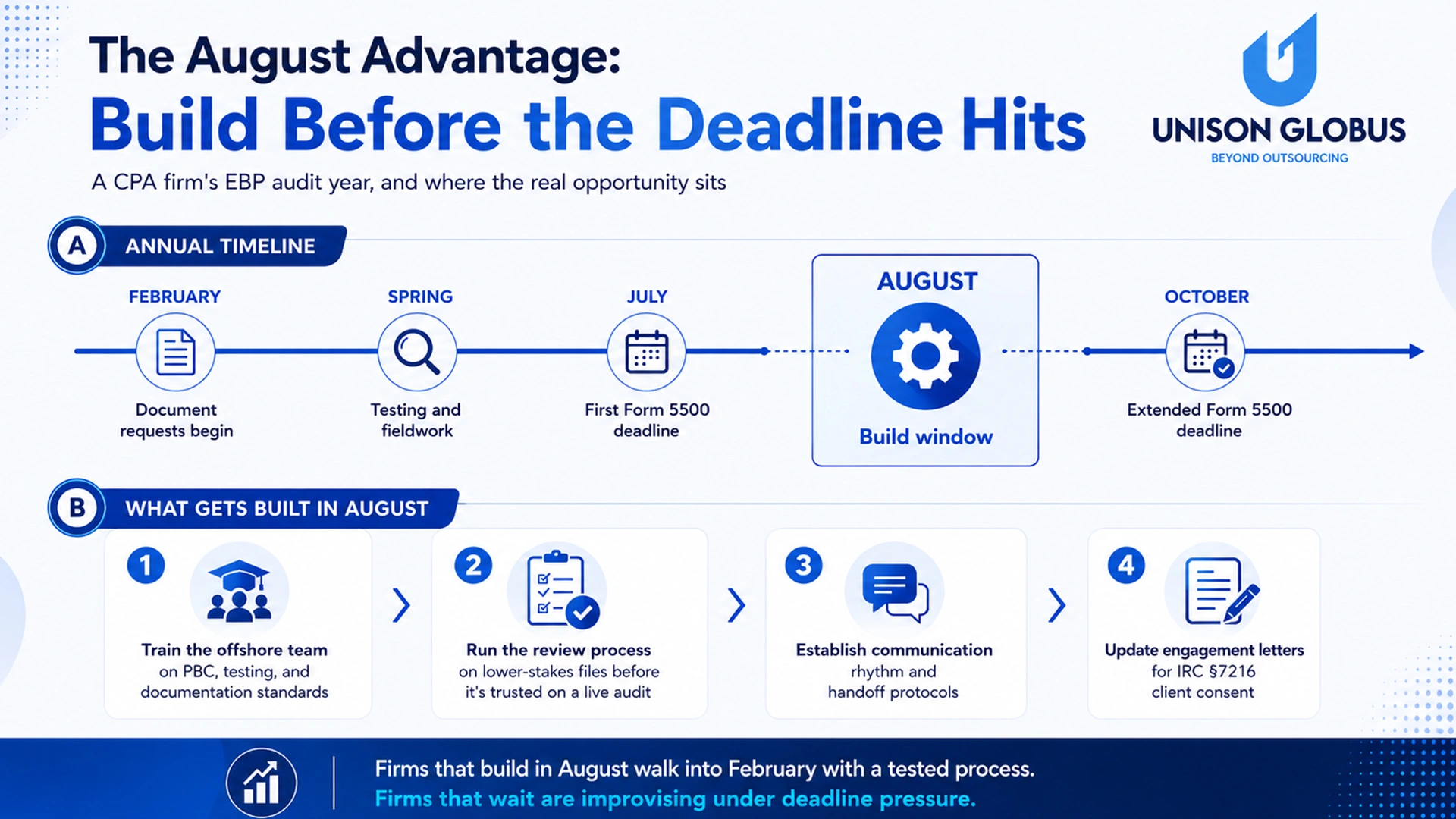
Ask any CPA firm that handles Employee Benefit Plan audits what their year feels like, and the answer is usually some version of “fine until it isn’t.” Spring brings the document chase. July brings the first Form 5500 deadline. Then, for a few weeks in August, the phone stops ringing, and the inbox slows down, before October brings the second deadline for firms that filed an extension. Most firms treat that August stretch as recovery time. Catch up on email, take a vacation, regroup before the next plan year’s paperwork starts arriving in February. 

That instinct is understandable, but it wastes the one window in the calendar where a firm actually has the bandwidth to look at its Employee Benefit Plan (EBP) Audit Support process honestly. Not while a client is waiting on a draft report. Not while a reviewer is buried in testing. In August, there’s room to ask harder questions: where did the last cycle bog down, what kept getting flagged in review, and where did the firm rely on one overworked person to catch problems a better process should have caught earlier.

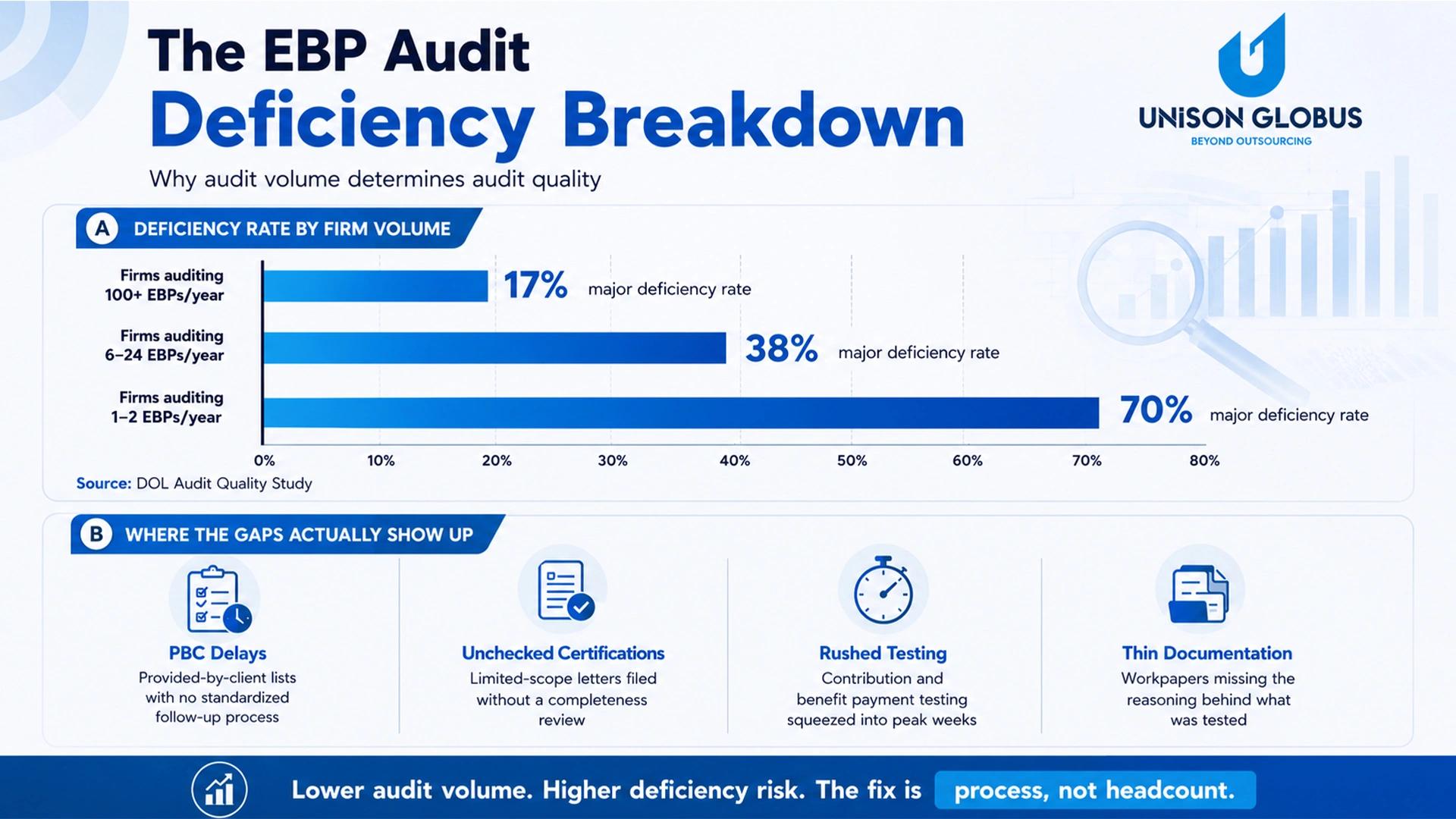
Those questions matter more in EBP work than almost anywhere else in a CPA firm’s practice, because the margin for error is thinner and the regulatory scrutiny under ERISA is sharper. The DOL’s most recent Audit Quality Study found that 30% of employee benefit plan audits contain one or more major deficiencies, and that 70% of audits performed by firms handling just one or two plans a year fall into that same category. A gap that goes unaddressed in August doesn’t stay quiet. It resurfaces in February as a missing PBC item, in June as a rushed testing schedule, and in October as a deficiency letter nobody saw coming.

This blog looks at what those gaps usually look like and why CPA firm EBP audit outsourcing, brought in during the quieter months, tends to hold up better once peak season hits.

Where Employee Benefit Plan(EBP) Audit Support Gaps Actually Show Up

“Audit gap” sounds abstract until you’ve sat through a peer review that flags the same three things every firm seems to struggle with: testing that didn’t go deep enough, contribution and benefit payment procedures that were rushed, and documentation that doesn’t fully back up the work performed. None of these are exotic failures. They’re the kind of thing that happens when a firm is moving fast and a senior reviewer doesn’t have the hours to look closely enough.


A few patterns show up again and again in firms offering Audit & Assurance Services for CPAs without a dedicated EBP specialty:

  • PBC lists that drag on for weeks: Getting a complete, accurate, provided-by-client list out of a plan sponsor is often the single biggest source of delay. When a firm doesn’t have a standardized process for chasing this down, the entire engagement timeline shifts later, leaving less room for actual testing.
  • Limited-scope certifications that get accepted without a second look: A certification letter from the plan’s custodian is supposed to be reviewed for completeness, not just filed. Skipping that step is a quiet way deficiencies creep into ERISA audit support work.
  • Testing schedules built under time pressure: Contribution testing and benefit payment testing both require a level of detail that’s hard to maintain when one reviewer is covering five engagements at once during peak weeks.
  • Thin documentation trails: Workpapers that explain what was tested and why hold up under peer review. Workpapers built in a rush, with the reasoning left out, don’t. This is one of the easiest gaps to prevent when there’s time to build a checklist instead of relying on memory.

The common thread isn’t a lack of knowledge. It’s a lack of hours, and that shortage isn’t going away on its own. Only 6% of accounting and finance leaders say they currently have the talent they need for their highest-priority work, and unemployment in the field sits at roughly 2 percent, meaning most of the people who could fill that gap are already employed somewhere else. For firms providing 401(k) audit support services, that math doesn’t leave much room to simply add another reviewer before next season starts.


This is the part of the picture that makes August worth taking seriously: every one of these gaps is fixable with planning, but only if the fix happens before the workload returns.
Curious what offshore EBP audit support could take off your team's plate this season?

Closing the Gaps with Employee Benefit Plan Audit Outsourcing

Once you can name the gaps specifically, the fix stops being vague too. Each pattern from the last section has a direct counterpart in how a well-run Employee Benefit Plan audit outsourcing arrangement is structured. This is less about adding headcount and more about adding a layer of dedicated capacity an in-house team doesn’t have room to build on its own.

  • PBC management gets a dedicated owner: Instead of a senior reviewer chasing documents between other engagements, an offshore team can own the PBC list end to end, tracking what’s outstanding and flagging missing items early enough to matter. Offshore teams working overnight can have completed work waiting for the in-house team the next morning, turning a multi-day back-and-forth into an overnight cycle.
  • Certifications get reviewed, not just filed: A trained offshore Employee Benefit Plan (EBP) Audit Support team checks limited-scope certification letters against the plan’s investment data as a standard workflow step, rather than something that gets skipped once the engagement gets busy.
  • Testing gets the hours it needs: Offshore EBP audit services can run contribution and benefit payment testing in parallel with the in-house team’s other work, instead of squeezing it into whatever time is left during peak weeks. The work still gets reviewed and signed off by the US team, but it isn’t rushed to fit around five other engagements at once.
  • Documentation becomes a built-in habit, not an afterthought: Firms that build outsourcing into their process typically standardize workpaper templates and run them through layered review before anything reaches the US team. A structured offshore delivery model puts work through self-review, a senior peer review, and a final US-side check, with error rates tracked weekly, rather than caught after the fact in a peer review.

None of this is theoretical anymore. The AICPA’s National Pipeline Advisory Group has pointed to the talent shortage as a direct cause of financial reporting delays across US businesses, and roughly 80% of accounting firm executives say they plan to increase their use of offshore teams over the next three to five years, according to a 2025 William Blair survey.


This is also where offshore audit support for CPA firms earns its place specifically in ERISA audit support work, where judgment requirements are higher and oversight is stricter than in most other outsourced accounting functions. The firms getting this right aren’t handing off audit opinions or Expert CPA Audit Services. They’re handing off the volume work, testing prep, documentation assembly, and PBC tracking, so the in-house team’s limited hours go toward review and judgment instead of data entry and follow-up.


That’s the version of CPA firm EBP audit outsourcing worth setting up in August, while there’s time to train the offshore team and work out the kinks before the next cycle starts. It’s also how firms turn a single outsourced engagement into a repeatable part of their broader audit & assurance solutions, ready well before 401(k) audit support services are needed again.

What Has to Be True Before an Offshore Team Touches a Live File

Outsourcing in an ERISA engagement raises a fair question before a comfortable one: what’s actually allowed to leave the building, what does it cost, and what does a client need to be told? Four things have to be settled before Employee Benefit Plan audit outsourcing works.


Where the line stays: AICPA independence standards separate staff augmentation, where outsourced staff perform procedures under the firm’s direction and review, from management functions, which can’t be delegated regardless of where the provider sits. An offshore EBP audit services team can prepare testing schedules, assemble documentation, track PBC items, and flag exceptions. Risk assessment, materiality decisions, and signing the opinion stay exclusively with the engagement partner. Every file coming back is a draft for review, run through the same self-review, senior peer review, and final US-side check the firm already uses in-house.


What has to be secure: Plan data includes SSNs, account balances, and beneficiary information, higher-sensitivity than a typical financial statement audit. Before any engagement letter is updated, confirm the provider has SOC 2 Type II reporting, encryption in transit and at rest, a documented retention policy, and role-based access controls. These belong in the same August planning window as training, and they’re usually the first thing a peer reviewer asks about.


What sponsors need to hear: Satisfying IRC §7216 consent requirements is one thing; a sponsor actually understanding that an overseas team will touch their plan’s data is another. Most sponsors aren’t troubled by offshore audit support for CPA firms, they’re troubled by learning about it after the fact. A short, proactive conversation confirming partner supervision and the security controls above usually turns this into a non-issue.


What it costs, and what it’s worth: CPA firm EBP audit outsourcing is typically priced well below the fully loaded cost of a US senior associate, and since EBP capacity needs are seasonal (roughly 12–16 weeks a year), cost scales with actual volume instead of carrying a full-time load year-round. The harder number to quantify is the cost of a deficiency: re-performed procedures, extra partner hours, and repeat-offender exposure with the DOL. The right comparison isn’t offshore cost against zero, it’s offshore cost against the deficiency rates already cited.


What this looks like in practice: Firms that do this well start August with a quick audit of last cycle’s deficiencies and turn that into the offshore team’s training curriculum, built on the firm’s own templates. The team then runs two or three closed, lower-stakes files through the full review hierarchy before touching anything live. By February, they’re already working inside the firm’s process, not learning it under deadline pressure. Firms that skip this end up doing the same onboarding anyway, except now it’s competing with live deadlines, which is exactly the trade-off 401(k) audit support services are meant to avoid.

The Cost of Waiting Until February

Every firm reading this already knows what February looks like. Document requests start landing, the same reviewers who were stretched thin last cycle are stretched thin again, and there’s no time to fix anything, only to get through it. Whatever gaps existed last year are still there, waiting for the workload to expose them again.


The honest picture here is more complicated than “the pipeline is collapsing.” New CPA exam candidates hit a record low of just 27,994 in 2024, the fewest since NASBA began tracking in 2008, but first-half 2025 data showed 16,448 new candidates, suggesting a real rebound toward pre-2024 levels. The pipeline is recovering. What isn’t recovering as fast is the staffing already inside firms today. Industry data shows the average share of staff holding an active CPA license at accounting firms fell from 56.0% in 2020 to 48.4% in 2024, dropping below half for the first time, and the ratio is even lower at large firms.


That’s the gap firms are actually managing through this year and next: not a pipeline that will never refill, but a workforce that’s thinner right now than it’s been in years, with the recovery still a few years from showing up on engagement teams. Treating that gap as a problem to figure out fresh each February means absorbing the same crunch every cycle. The alternative is building Employee Benefit Plan audit outsourcing into the firm’s process before the workload hits, not after.

Why August Is the Right Time to Make the Move

That’s exactly why August matters. Every benefit of outsourcing depends on the offshore team and the in-house team actually knowing how to work together before a live file lands on either desk, and that’s not something built in a week.


Onboarding isn’t instant, and treating it like a plug-and-play fix is usually where firms run into trouble. Firms that have gone through the process consistently name training as the top challenge, citing the extended onboarding period, offshore staff needs, and the difficulty of finding time for domestic staff to do that training when everyone is already busy. What a slow month actually allows a firm to build:

  • A shared way of working, not just a handoff: Before anyone touches a live file, the in-house team can walk an offshore EBP audit services team through how the firm actually operates: where PBC requests get logged, how testing schedules are structured, what a finished workpaper is supposed to look like. That groundwork is what makes the relationship feel like an extension of the team rather than a vendor waiting for instructions.
  • A review process that’s been run a few times before it matters: Structured offshore delivery models are typically built around layered review: self-review, senior peer review, and a final US-side check, with error rates tracked over time. That rhythm needs a few practice cycles on lower-stakes work before it’s trusted on a live ERISA audit support engagement.
  • Comfort with a new rhythm of communication: Time zone handoffs, file-sharing protocols, and who to flag when something looks off all take a few rounds to feel natural. Working that out in August means nobody’s learning it for the first time while a client is waiting.
  • The paperwork that has to happen before any data moves: IRC Section 7216 requires explicit client consent before any tax- or return-related data is shared with a third-party provider, including an offshore provider. Hence, engagement letters need to be updated in advance. That’s a conversation worth having with clients in a quiet month, not buried in a February intake call.

None of this is about flipping a switch in August and being fully scaled by September. It’s about using the slow season to lay the foundation for CPA firm EBP audit outsourcing, so that when document requests start arriving for the next plan year, the 401(k) audit support services team isn’t being introduced to the firm’s process. They’re already working inside it. A firm that waits until the cycle is underway ends up training a new team and running a live audit at the same time, which is exactly the kind of pressure that produces the deficiencies covered earlier, and exactly what strong offshore audit support for CPA firms is meant to prevent.


What changes year to year isn’t the deficiency risk or the staffing pressure behind it. What changes is whether a firm uses its quietest month to get ahead of that reality or spends it waiting for next season to arrive. For firms ready to build CPA firm EBP audit outsourcing, offshore EBP audit services, and 401(k) audit support services into how they actually operate, August is the month that the decision gets made.
The Window Is Open Now

August won’t last. By the time document requests start arriving in February, the firms that spent this stretch building Employee Benefit Plan audit outsourcing into their workflow will be running a tested process. The ones that didn’t will be improvising under the same pressure that produced the deficiencies covered earlier.


Unison Globus works with CPA firms to build that capacity ahead of time, with offshore EBP audit teams trained on a firm’s specific PBC, testing, and documentation standards before peak season ever starts. Our Audit & Assurance Services also help accounting firms across North America strengthen audit quality and expand engagement capacity year-round. If your firm is ready to close this year’s gaps before next year’s deadlines arrive, talk to Unison Globus. .

Ready to build EBP audit capacity before next year's deadlines hit?

Frequently Asked Questions

Yes, fully. Offshore staff work under the engagement partner’s supervision and review, the same as any in-house associate. Every conclusion, judgment call, and signature stays with the US team, regardless of how much of the underlying work is handled through Employee Benefit Plan audit outsourcing.

Requirements vary by state and by the nature of the engagement, and some boards require specific disclosures around outsourced procedures. Firms should confirm current requirements with their state board and legal counsel before finalizing any CPA firm EBP audit outsourcing arrangement, since this is jurisdiction-specific and changes over time.

For tax- or return-related data, IRC Section 7216 requires explicit, documented client consent before that data is shared with any third-party provider, onshore or offshore. Engagement letters should be updated to reflect this before any file moves to an offshore EBP audit services team.

A documented retention and deletion policy should specify how long data remains on the offshore provider’s systems and confirm secure deletion once the engagement closes. This should be agreed upon and documented before the engagement begins, not addressed after the fact, as part of any offshore audit support for CPA firms arrangement.

Most firms see a meaningful difference between a team trained for a few weeks on practice files in a quiet month versus one introduced mid-cycle. There’s no fixed timeline, but the August-to-February runway is what most firms use to get an Employee Benefit Plan (EBP) Audit Support team comfortable before live engagements start.

Sponsors generally respond better to a direct, proactive conversation about outsourcing than to finding out informally. While the formal requirement is client consent for return-related data, raising it as part of the engagement letter discussion avoids surprises later, particularly for firms building out ERISA audit support or 401(k) audit support services through an offshore partner.
Categories
Audit & Assurance Auditing

EBP & NFP Audits in 2026: Compliance Challenges and How CPA Firms Can Prepare Early

For many CPA firms, Employee Benefit Plan (EBP) and nonprofit (NFP) audits are no longer routine compliance engagements. Regulatory expectations continue to evolve, audit quality remains under scrutiny, and staffing pressures are making it increasingly difficult to deliver engagements efficiently during peak periods.

In 2026, firms performing an employee benefit plan audit or managing NFP audit compliance responsibilities must navigate a complex environment shaped by ERISA requirements, ongoing SECURE 2.0 implementation, updated federal guidance for nonprofits, and heightened expectations around audit documentation and reporting. At the same time, clients expect timely service, accurate reporting, and proactive guidance on emerging compliance risks.

For employee benefit plans, requirements under SAS No. 136 continue to influence audit execution and reporting, while Form 5500 filing obligations remain a critical deadline for both plan sponsors and auditors. Nonprofit organizations are adapting to updated Single Audit thresholds and evolving funding requirements, creating new considerations for firms supporting nonprofit audit preparation and compliance efforts.

Adding to these challenges, CPA firms continue to face talent shortages, growing workloads, and increased pressure to adopt new technologies. As engagement complexity rises, many firms are evaluating how to maintain audit quality while managing capacity constraints.

This article explores the key developments affecting ERISA audit compliance and nonprofit audit requirements in the USA, the most common challenges firms face in 2026, and practical strategies for preparing audit teams for a demanding year ahead.

The Employee Benefit Plan Audit Landscape in 2026

The regulatory environment surrounding employee benefit plan audits continues to evolve, requiring CPA firms to stay current with changing compliance expectations and audit standards. As plan sponsors adapt to legislative updates and increased oversight, auditors are expected to perform more robust procedures, maintain stronger documentation, and provide greater assurance around plan operations and financial reporting.


For firms providing Employee Benefit Plan (EBP) Audit Support, understanding the key requirements shaping the 2026 audit cycle is essential for delivering high-quality engagements and helping clients remain compliant

1. ERISA Audit Requirements Continue to Drive Audit Obligations

Under the Employee Retirement Income Security Act (ERISA), retirement plans that meet applicable large-plan filing requirements generally must include audited financial statements with their annual Form 5500 filing. While the 100-participant threshold is commonly associated with audit requirements, plan classification rules and reporting provisions can affect whether an audit is required.


An employee benefit plan audit extends beyond the review of financial statements. Auditors are expected to evaluate participant data, contributions, distributions, investments, administrative expenses, and plan operations to determine whether financial information is fairly presented and required disclosures are complete.

2. SAS No. 136 Has Raised the Bar for Audit Quality

Several years after its implementation, SAS No. 136 continues to influence how firms approach ERISA audit compliance.


The standard introduced enhanced responsibilities for auditors, including more rigorous risk assessment procedures, expanded communication requirements with plan management, and updated reporting standards. It also strengthened expectations around evaluating certifications provided by custodians and trustees.


The standard has increased expectations around planning, documentation, auditor communications, and risk assessment procedures. As regulators continue to emphasize audit quality, firms are expected to apply a structured and risk-focused approach throughout the engagement lifecycle.

3. Form 5500 Deadlines Remain a Critical Compliance Milestone

For calendar-year plans, July 31, 2026 remains the standard filing deadline for Form 5500. Plan sponsors that file Form 5558 on time may generally extend their filing deadline until October 15, 2026.


Because the audit report is a required component of the filing process for many plans, audit readiness directly impacts a sponsor’s ability to meet regulatory deadlines.


Late or incomplete Form 5500 filings can result in significant regulatory penalties and corrective actions. To reduce filing risks and avoid delays, many CPA firms encourage plan sponsors to begin audit preparation well in advance of the reporting deadline.

4. SECURE 2.0 Continues to Influence Plan Operations

While many SECURE 2.0 provisions have already taken effect, implementation challenges continue to surface throughout 2026.


Plan sponsors are working through requirements related to:

  • Catch-up contribution provisions
  • Employee eligibility tracking
  • Automatic enrollment requirements
  • Plan amendment deadlines
  • Participant communication obligations

These changes affect not only plan administration but also audit procedures. Auditors must understand how sponsors are implementing new requirements and whether supporting documentation demonstrates compliance.

As a result, SECURE 2.0 remains an important consideration during audit planning and risk assessment.

5. Determining the Appropriate Audit Type

Another key area of focus involves determining whether a plan qualifies for an ERISA Section 103(a)(3)(C) audit, formerly referred to as a limited-scope audit.


This determination affects:

  • Certification requirements
  • Audit procedures performed
  • Auditor reporting responsibilities
  • Documentation expectations

Plans that qualify for an ERISA Section 103(a)(3)(C) audit must obtain appropriate certifications from qualified institutions, while plans that do not qualify may require more extensive audit procedures.


Given the documentation requirements involved, firms should evaluate audit eligibility early in the engagement process.

6. Common Compliance Risk Areas for EBP Audits

Although every plan is unique, regulators continue to identify several recurring compliance concerns.


Some of the most common issues include:

  • Late participant contribution deposits
  • Inaccurate participant eligibility tracking
  • Inconsistent Form 5500 reporting
  • Errors in distributions and loans
  • Incomplete audit documentation
  • Investment valuation concerns
  • Related-party and party-in-interest transactions

Many of these issues originate from operational processes rather than accounting errors, making early communication between auditors and plan sponsors especially important.


For firms evaluating how to prepare for EBP audits in 2026, the most effective strategies remain consistent: engage clients early, establish standardized audit procedures, address documentation requests proactively, and monitor regulatory developments that may affect plan administration and reporting requirements.

7. EBP Audit Readiness Checklist

✓ Review participant census data
✓ Verify employee eligibility calculations
✓ Reconcile contributions and distributions
✓ Confirm investment balances and valuations
✓ Request SOC 1 reports from service providers
✓ Review plan amendments and SECURE 2.0 updates
✓ Evaluate internal controls and documentation
✓ Reconcile Form 5500 information to audited statements
✓ Confirm ERISA 103(a)(3)(C) audit eligibility

For CPA firms, maintaining ERISA audit compliance in 2026 requires a combination of technical expertise, early planning, and consistent execution. As regulatory expectations continue to evolve, firms that invest in strong audit methodologies, staff training, and proactive client communication will be better positioned to manage risk, support compliance, and deliver high-quality audit outcomes.

Nonprofit Audit Requirements USA: What CPA Firms Need to Know

While employee benefit plan audits continue to evolve, nonprofit organizations are navigating their own set of regulatory and reporting challenges. Changes to federal grant compliance requirements, varying state audit thresholds, and increasing expectations around financial transparency are creating a more complex environment for both nonprofits and the CPA firms that serve them.


For firms supporting nonprofit clients, understanding current nonprofit audit requirements USA is essential for managing compliance risks, improving audit readiness, and helping organizations meet the expectations of regulators, grantors, donors, and governing boards.

1. The Single Audit Threshold Has Increased

One of the most significant recent developments affecting the nonprofit sector is the increase in the federal Single Audit threshold from $750,000 to $1 million in federal expenditures. The revised threshold applies to fiscal years beginning on or after October 1, 2024, making 2026 the first full audit cycle in which many organizations are operating under the updated requirements.


As a result, organizations that expend $1 million or more in federal awards during their fiscal year are generally subject to Single Audit requirements under Uniform Guidance. Unlike a standard financial statement audit, a Single Audit also evaluates compliance with federal program requirements and internal controls over federal awards.


For CPA firms, this change requires careful planning, particularly when clients receive funding from multiple federal programs or pass-through entities.

2. Audit Requirements Extend Beyond Federal Funding

Federal expenditure thresholds are only one factor that may trigger a nonprofit audit.


Many organizations obtain audited financial statements because of:

  • State regulatory requirements
  • Grantor or funding agency requirements
  • Lending agreements
  • Board policies or organizational bylaws
  • Donor expectations

As a result, nonprofits should evaluate audit obligations holistically rather than relying solely on federal funding levels.

3. State Audit Thresholds Continue to Vary

Unlike federal requirements, nonprofit audit requirements vary significantly by state.

Examples of commonly cited state thresholds include:

StateCommonly Referenced Audit Threshold*
California$2 million in annual gross revenue
New York$1 million in annual gross revenue
Pennsylvania$750,000 in annual revenue
Massachusetts$500,000 in annual revenue
Connecticut$500,000 in annual revenue
Rhode Island$300,000 in annual revenue

*State audit requirements may depend on charitable registration rules, fundraising activity, organizational structure, or other state-specific provisions. Organizations should review current state regulations to determine their specific obligations.

4. Financial Reporting Remains a Core Compliance Requirement

Accurate financial reporting remains central to effective NFP audit compliance.


Most nonprofit organizations prepare four primary financial statements:

  • Statement of Financial Position
  • Statement of Activities
  • Statement of Cash Flows
  • Statement of Functional Expenses

These reports provide donors, grantors, regulators, and board members with critical information about an organization’s financial condition, operating results, liquidity, and use of resources.


Maintaining complete supporting documentation for these statements is often one of the most important aspects of successful nonprofit audit preparation.

5. Common Challenges in Nonprofit Audit Preparation

Many nonprofit organizations operate with lean finance teams and limited administrative resources, creating challenges throughout the audit process.


Common issues include:

  • Incomplete grant documentation
  • Delayed account reconciliations
  • Weak documentation of donor restrictions
  • Revenue classification errors
  • Inconsistent expense allocations
  • Limited segregation of duties
  • Delays in financial reporting

Addressing these issues before fieldwork begins can improve audit efficiency and reduce the likelihood of audit adjustments or compliance findings.

6. Managing Restricted Funds Requires Strong Controls

One of the most common compliance challenges in the nonprofit sector involves managing donor-restricted funds.


Organizations must maintain documentation supporting:

  • The purpose of restricted contributions
  • Spending activity against restrictions
  • Remaining restricted balances
  • Releases from restriction

Failure to properly track restricted funds can affect financial statement accuracy and create compliance concerns during the audit process.

7. Revenue Classification Remains a Common Risk Area

Another recurring challenge involves distinguishing between contribution revenue and exchange transactions.


For example, revenue generated through program services may require different accounting treatment than donor contributions. Incorrect classification can affect financial statement presentation, reporting accuracy, and compliance assessments.


Given the variety of funding sources used by nonprofit organizations, revenue recognition remains an important area of audit focus.

8. Nonprofit Audit Readiness Checklist

✓ Review grant agreements and funding requirements
✓ Confirm federal expenditure calculations
✓ Reconcile restricted and unrestricted fund balances
✓ Verify revenue classifications
✓ Update governance and board documentation
✓ Complete account reconciliations
✓ Review expense allocation methodologies
✓ Prepare required financial statements
✓ Organize grant and donor support documentation
✓ Address internal control gaps before fieldwork

As compliance expectations continue to evolve, successful NFP audit compliance depends on strong financial reporting processes, proactive documentation practices, and early audit preparation. CPA firms that help clients identify and address issues before fieldwork begins are often better positioned to improve audit efficiency, reduce disruptions, and support successful engagement outcomes.

Top Compliance Challenges CPA Firms Face in 2026

As regulatory expectations continue to evolve, CPA firms are being asked to deliver higher-quality audits while managing increasingly complex compliance requirements. For firms providing Audit & Assurance Services for CPAs, maintaining technical accuracy and audit quality has become just as important as meeting engagement deadlines.


Whether performing an employee benefit plan audit or supporting nonprofit organizations, firms must navigate changing regulations, heightened scrutiny, and recurring risk areas that can impact both compliance outcomes and audit quality.

1. Audit Quality Remains a Key Regulatory Focus

Employee benefit plan audits continue to receive significant attention from regulators.


The U.S. Department of Labor’s most recent audit quality study found that approximately 30% of reviewed EBP audits contained at least one deficiency. While this represents an improvement compared to previous studies, the findings highlight the ongoing challenges firms face in maintaining consistent audit quality.


Perhaps more importantly, the study found a strong correlation between audit quality and firm experience. Firms that perform a higher volume of employee benefit plan audits generally demonstrate lower deficiency rates than firms that perform only a small number of engagements annually.

2. DOL Audit Quality Findings

  • 30% EBP audits reviewed contained at least one deficiency
  • 18% Major deficiency rate among firms performing 100+ EBP audits annually
  • 25% Major deficiency rate among firms performing 25+ EBP audits annually
  • 55% Major deficiency rate among firms performing fewer than 25 EBP audits
  • 70% Deficiency rate among firms performing only 1–2 EBP audits

These findings reinforce the importance of specialized training, standardized methodologies, and sufficient engagement experience when performing employee benefit plan audits.

3. Common Challenges in Employee Benefit Plan Audits

Many deficiencies identified by regulators stem from recurring operational and compliance issues rather than highly technical accounting matters.


Some of the most common challenges in employee benefit plan audits include:

  • Late participant contribution deposits
  • Errors in participant eligibility tracking
  • Inconsistent Form 5500 reporting
  • Incomplete or insufficient audit documentation
  • Distribution and loan processing errors
  • Investment valuation and reporting concerns
  • Related-party and party-in-interest transactions
  • Internal control deficiencies

These areas often require auditors to evaluate not only financial records but also plan administration processes and supporting documentation.


As a result, firms performing EBP engagements must maintain a thorough understanding of both accounting requirements and ERISA compliance obligations.

4. Regulatory Scrutiny Continues to Increase

Regulators continue to place significant emphasis on accurate reporting, timely filings, and audit quality.


Form 5500 filings are subject to review by both the Department of Labor and the IRS, making consistency between audited financial statements and regulatory filings particularly important.


Late filings, incomplete information, or unresolved compliance issues can expose plan sponsors to penalties, corrective actions, and additional scrutiny. This places additional pressure on CPA firms to ensure audits are completed accurately and on schedule.

5. Common Nonprofit Compliance Challenges

While nonprofit organizations face different regulatory requirements, many of their compliance challenges are equally complex.


One recurring issue involves revenue classification. Determining whether revenue should be recognized as a contribution, grant revenue, or an exchange transaction requires careful analysis and proper documentation.


Another common challenge involves managing donor-restricted funds. Organizations must maintain clear records demonstrating how restricted contributions are received, tracked, spent, and reported.


Additional nonprofit compliance challenges often include:

  • Incomplete grant documentation
  • Weak internal controls
  • Delayed financial reporting
  • Inconsistent expense allocations
  • Limited segregation of duties
  • Inaccurate functional expense reporting

When these issues are not addressed proactively, they can create audit delays, increase the likelihood of adjustments, and complicate compliance reporting.

6. Documentation and Internal Controls Continue to Matter

Across both employee benefit plan and nonprofit audits, strong documentation remains one of the most important factors influencing audit quality.


Incomplete supporting schedules, missing approvals, inconsistent reconciliations, and weak control documentation can significantly increase audit risk and engagement complexity.


For CPA firms, developing standardized procedures and encouraging clients to address documentation requirements early can help improve efficiency while reducing compliance risks throughout the audit process.


As regulatory expectations continue to evolve, firms that invest in specialized expertise, strong audit methodologies, and proactive client communication will be better positioned to navigate the growing compliance demands of both EBP and nonprofit audit engagements.

Operational Pressures Are Reshaping Audit Delivery

While regulatory compliance remains a primary concern, many CPA firms are finding that operational challenges have become just as significant as technical audit requirements. Growing engagement complexity, talent shortages, evolving technology expectations, and seasonal workload spikes are creating capacity constraints across the profession.


For firms managing both employee benefit plan and nonprofit audit engagements, balancing quality, turnaround times, and resource availability has become increasingly difficult.

1. Talent Shortages Continue to Impact CPA Firms

The accounting profession continues to face ongoing workforce challenges. Many firms report difficulty recruiting and retaining qualified professionals, particularly in specialized service areas such as audit and assurance.


Several factors are contributing to these staffing pressures, including:

  • Fewer accounting graduates entering the profession
  • Increased retirement of experienced CPAs
  • Growing demand for specialized audit expertise
  • Competition for experienced accounting and audit talent

As a result, firms often find themselves managing increasing workloads with limited resources, particularly during peak reporting periods.

2. Audit Complexity Is Increasing

Today’s audit engagements often require more than financial statement testing.


Employee benefit plan audits may involve evaluating plan operations, participant data, eligibility requirements, investment activity, and regulatory compliance considerations. Nonprofit audits frequently require auditors to assess grant compliance, donor restrictions, revenue recognition, and functional expense allocations.


At the same time, regulatory expectations around documentation, risk assessment, and audit quality continue to evolve.


As engagement requirements become more complex, firms must dedicate additional time to planning, review, quality control, and staff training.

3. Technology Adoption Is Creating New Demands

Technology continues to transform the audit profession.


Many firms are investing in:

  • Audit automation tools
  • Data analytics platforms
  • Workflow management systems
  • Document collaboration technologies
  • Artificial intelligence and machine-learning applications

While these investments can improve efficiency and enhance audit quality, implementation requires significant time, training, and ongoing process improvements.


For many firms, the challenge is no longer deciding whether to adopt new technology, but determining how to integrate it effectively while maintaining productivity and service quality.

4. Seasonal Workloads Create Capacity Constraints

One of the most persistent challenges facing audit practices is workload seasonality.


Audit demand often concentrates around key reporting deadlines, including:

  • Form 5500 filing deadlines
  • Single Audit reporting deadlines
  • Year-end financial reporting cycles
  • Tax season support activities

These periods can create sharp spikes in workload that are difficult to address through permanent staffing alone.


As engagement volumes increase, firms may face difficult decisions between hiring ahead of demand, relying on overtime, delaying work, or seeking additional support resources.

5. Balancing Growth and Audit Quality

Many firms are experiencing growth in audit demand while simultaneously navigating resource limitations.


As engagement portfolios expand, maintaining consistent quality becomes increasingly dependent on effective resource allocation, standardized processes, and efficient workflow management.


Without sufficient capacity, firms may face:

  • Extended turnaround times
  • Increased staff burnout
  • Reduced scheduling flexibility
  • Delays in client deliverables
  • Greater pressure on managers and reviewers

These operational pressures are prompting many firms to reassess how audit work is performed and how resources are deployed across engagements.


For firms seeking sustainable growth, the challenge is not simply completing more work. It is developing a delivery model that supports audit quality, compliance, scalability, and long-term profitability while continuing to meet client expectations.

Prepare for EBP and NFP audits with confidence in 2026.

How CPA Firms Can Prepare for EBP and NFP Audits in 2026

As compliance requirements become more complex and staffing pressures continue across the profession, preparation is becoming one of the most important factors influencing audit quality and engagement efficiency.


For firms managing employee benefit plan and nonprofit audits, successful execution often depends on actions taken months before fieldwork begins. Early planning, standardized processes, staff training, and proactive client communication can help reduce compliance risks while improving engagement outcomes.

1. Begin Audit Planning Early

One of the most effective ways to improve audit readiness is to start planning well before key filing deadlines.


For employee benefit plan engagements, many industry specialists recommend engaging auditors and beginning audit preparation several months before the Form 5500 filing deadline. Early planning provides additional time to:

  • Gather participant and plan data
  • Review internal controls
  • Identify potential compliance issues
  • Resolve documentation gaps
  • Coordinate with third-party service providers

Starting early can help firms avoid the bottlenecks that often occur as filing deadlines approach.

2. Request SOC 1 Reports as Early as Possible

Many employee benefit plans rely on third-party administrators, custodians, payroll providers, and other service organizations.


Obtaining SOC 1 reports from these providers is often a critical component of the audit process. However, these reports are not always immediately available and may take several weeks to obtain.


Requesting SOC 1 reports early in the engagement lifecycle can help prevent unnecessary delays and provide auditors with sufficient time to evaluate relevant controls and supporting documentation.

3. Standardize Audit Processes and Documentation

As engagement volumes grow, consistency becomes increasingly important.


Firms that rely on standardized procedures, templates, and documentation requirements are often better positioned to:

  • Improve audit efficiency
  • Reduce rework
  • Support quality control efforts
  • Simplify staff training
  • Enhance engagement consistency

This is particularly valuable for firms managing multiple EBP and nonprofit engagements during compressed reporting periods.

4. Invest in Technical Training

Regulatory requirements continue to evolve across both employee benefit plan and nonprofit audits.


Audit teams should remain informed about developments related to:

  • ERISA compliance requirements
  • SECURE 2.0 implementation
  • Form 5500 reporting obligations
  • Single Audit requirements
  • Nonprofit financial reporting standards
  • Audit quality expectations

Ongoing education helps firms maintain technical competency while reducing the risk of compliance issues and audit deficiencies.

5. Strengthen Client Communication

Many audit delays originate from incomplete information, missing documentation, or unresolved client questions.


Establishing clear communication timelines and expectations can help firms obtain required information more efficiently and improve overall engagement management.


Best practices often include:

  • Providing documentation request lists early
  • Scheduling planning meetings in advance
  • Establishing milestone deadlines
  • Communicating status updates throughout the engagement

A proactive approach can significantly reduce last-minute issues and improve the client experience.

6. Develop Audit Readiness Checklists

Structured checklists can help both audit teams and clients prepare for fieldwork more effectively.


For employee benefit plan audits, an EBP audit checklist may include:

✓ Participant census review
✓ Eligibility testing review
✓ Contribution and distribution reconciliation
✓ Investment verification
✓ SOC 1 report collection
✓ Form 5500 reconciliation
✓ Internal control assessment
✓ Plan amendment review

For nonprofit engagements, readiness checklists often focus on:

✓ Grant agreement review
✓ Federal expenditure calculations
✓ Restricted fund reconciliation
✓ Revenue classification review
✓ Functional expense allocation review
✓ Financial statement preparation
✓ Governance documentation updates

7. Prioritize Quality Before Deadlines

Meeting deadlines remains important, but maintaining audit quality is equally critical.


As regulatory scrutiny continues and engagement complexity increases, firms should ensure that resource planning, review processes, and quality control procedures receive the same attention as scheduling and delivery targets.


Firms that prepare early, maintain consistent methodologies, and invest in staff development are often better positioned to manage compliance requirements, improve efficiency, and deliver high-quality audit outcomes throughout the 2026 audit cycle.

Why CPA Firms Are Expanding Capacity with Offshore Audit Support

As employee benefit plan and nonprofit audits become more demanding, many CPA firms are reassessing how they allocate resources across audit engagements. Increasing regulatory requirements, staffing shortages, seasonal workload fluctuations, and rising client expectations have made capacity management a growing priority for firms of all sizes.


In response, many firms are incorporating Offshore audit support for CPA firms into their delivery models to improve scalability, strengthen operational flexibility, and support consistent audit execution.

1. Addressing Capacity Challenges Without Overhiring

One of the most significant challenges facing audit practices is balancing workload fluctuations throughout the year.


Demand often increases sharply around:

  • Form 5500 filing deadlines
  • Single Audit reporting periods
  • Year-end financial reporting cycles
  • Tax season support activities

Building permanent staffing capacity for peak workloads can be difficult, particularly when engagement volumes vary significantly throughout the year.


As a result, many firms are exploring flexible resourcing models that allow them to scale support based on workload demands while maintaining operational efficiency.

2. Supporting Audit Teams Across the Engagement Lifecycle

Offshore professionals can assist with a variety of audit-related activities, allowing in-house teams to focus on planning, review, client communication, and technical decision-making.


Depending on firm requirements, support may include:

  • Audit workpaper preparation
  • Lead schedule preparation
  • Financial statement drafting
  • Documentation organization
  • Account reconciliations
  • Testing support
  • Administrative audit procedures

This approach can help firms manage engagement volume more effectively while preserving valuable time for senior auditors and managers.

3. Supporting Employee Benefit Plan Audit Engagements

For firms providing Employee Benefit Plan (EBP) Audit Support, workload demands often intensify as Form 5500 deadlines approach.


Tasks such as documentation preparation, testing support, participant data organization, and workpaper preparation can require substantial time and resources.


By utilizing outsourcing EBP audit preparation services, firms can often improve workflow efficiency while allowing engagement leaders to focus on higher-value activities such as risk assessment, audit strategy, review procedures, and client advisory discussions.

4. Enhancing Nonprofit Audit Delivery

Nonprofit audits frequently involve extensive documentation requirements, grant-related reporting, restricted fund analysis, and financial statement preparation.


Additional support resources can help firms manage these requirements more efficiently, particularly during periods of increased engagement activity.


When integrated effectively, offshore professionals can operate as an extension of the firm’s existing audit team while following established methodologies, quality standards, and engagement procedures.

5. Protecting Audit Quality While Improving Scalability

Successful offshore support initiatives are not simply about reducing costs.


For many firms, the primary objective is creating additional capacity while maintaining quality, consistency, and responsiveness.


An effective support model can help firms:

  • Improve resource utilization
  • Reduce turnaround times
  • Increase scheduling flexibility
  • Support engagement growth
  • Reduce pressure on internal teams
  • Maintain focus on quality control and review processes

As audit requirements continue to evolve, scalable resource strategies are becoming an increasingly important component of long-term practice management.

6. Building a Sustainable Audit Delivery Model

The challenges facing CPA firms in 2026 are unlikely to disappear in the near future. Regulatory expectations continue to increase, competition for talent remains strong, and clients expect both technical excellence and timely service.


As a result, firms are increasingly evaluating how technology, process improvements, and strategic resourcing can work together to support sustainable growth.


For many firms, offshore support has become one component of a broader strategy designed to strengthen audit & assurance solutions, improve operational resilience, and create the capacity needed to serve clients effectively in an increasingly complex audit environment.

Conclusion

The compliance landscape for employee benefit plan and nonprofit audits continues to evolve in 2026. From ongoing SECURE 2.0 implementation and ERISA audit requirements to updated nonprofit audit thresholds and increasing audit quality expectations, CPA firms are navigating a more demanding environment than ever before.


At the same time, staffing shortages, seasonal workload spikes, and growing engagement complexity are placing additional pressure on audit teams. Firms that prioritize early planning, standardized processes, technical training, and effective resource management will be better positioned to maintain compliance, deliver quality engagements, and support client needs.


For firms seeking additional audit capacity, Unison Globus provides specialized support through its Audit & Assurance Services for CPAs, including Employee Benefit Plan (EBP) Audit Support, nonprofit audit assistance, workpaper preparation, testing support, and other audit-related functions. By serving as an extension of your team, we help firms manage workload fluctuations, improve operational efficiency, and maintain focus on high-value client and review activities.


Looking to strengthen your EBP and NFP audit capacity in 2026? Contact Unison Globus to learn how our offshore audit support solutions can help your firm scale with confidence.

Ready to strengthen your audit capacity?

Categories
Audit & Assurance Auditing

Employee Benefit Plan (EBP) Audits: Planning Early to Avoid Compliance Risks

If July 31 isn’t already flagged in your firm’s calendar, now is the time. For CPA firms managing multiple clients with calendar-year plans, the Form 5500 filing deadline arrives faster than it should, and the firms that feel it most are the ones that waited too long to start.
Employee benefit plan audits are one of the most technically demanding, deadline-sensitive engagements in public accounting. They require deep ERISA audit support, meticulous documentation, and careful coordination across multiple parties. And in 2026, with SECURE 2.0 changes still rippling through plan operations and regulators sharpening their focus on compliance accuracy, the stakes are higher than ever.
This is not the season to wing it.

Why EBP Audit Season 2026 Is Different

Every year brings its share of EBP audit complexity. But 2026 has added a few new layers that CPA firms need to account for, literally and figuratively.

SECURE 2.0 Is Still Reshaping Plan Operations

The SECURE 2.0 Act continues to drive operational changes across 401(k), 403(b), and defined benefit plans. Updated catch-up contribution rules, revised eligibility tracking requirements, and new amendment deadlines mean plan sponsors are navigating a moving target, and auditors need to keep pace.

For CPA firms, this means EBP audit planning for CPA firms that worked cleanly last year may need adjustment. Workpapers need to reflect current law. Testing approaches need to account for mid-year changes. And staff need to be briefed before fieldwork begins, not during it.

Regulatory Scrutiny Is Up

The Department of Labor and the IRS are not easing up. In 2026, regulators continue to emphasize operational accuracy and documentation consistency, with recurring focus areas including late participant contribution deposits, inconsistent Form 5500 reporting, eligibility tracking errors, and insufficient internal control documentation.

The DOL has also long flagged high deficiency rates among auditors who do not regularly perform ERISA compliance audits. If your firm is taking on EBP engagements without dedicated expertise or support, that is a compliance risk for your clients and for your firm.

The July 31 Deadline Is Closer Than It Looks

For calendar-year plans, the EBP audit deadline for the United States standard is July 31, 2026. An extension via Form 5558 pushes that to October 15, but extesnsions are not a strategy; they are a safety nest. And with employee benefit plan audits taking three to four months from engagement to final report, firms starting in May are already working with a tight window.

What Makes EBP Audits So Demanding for CPA Firms

Understanding the pressure points is the first step to managing them. Employee Benefit Plan (EBP) Audit Support looks structurally different from standard financial statement audits, and the documentation demands alone can derail an unprepared team.

Multi-Party Coordination Takes Time

EBP audits involve more moving parts than most engagements. The plan sponsor, recordkeeper, custodian, investment advisor, and third-party administrator all play a role, and getting information from each of them takes time your team may not have budgeted for.

SOC 1 reports from service providers, for example, can take four to six weeks to obtain. If your team requests them in June, you are already behind.

Document Volume Is Substantial

A thorough EBP audit requires plan documents and all amendments, the IRS determination or opinion letter, the trust agreement, the Summary Plan Description, service provider contracts, year-end financial statements, payroll reconciliations, and participant-level transaction data. That is before fieldwork even begins.

For firms managing five, ten, or fifteen EBP clients simultaneously, the document management burden alone can stretch a team to its limits.

Participant-Level Testing Is Labor Intensive

Unlike a standard audit, EBP audit services USA procedures require participant account testing, verifying contributions, distributions, loans, eligibility, and vesting across individual participant records. For large plans, this is a significant time investment that requires both technical accuracy and ERISA fluency.

Capacity Peaks Collide

EBP audit season lands right after tax season, which means the same staff that just wrapped April 15 engagements are expected to pivot immediately into intensive plan audit work. For many CPA firms, especially small and mid-size practices, this capacity crunch is the single biggest threat to EBP audit quality and on-time delivery.

The Real Cost of Starting Late

Late EBP audit planning does not just create internal stress; it creates compliance exposure.
Missing the July 31 Form 5500 filing deadline without an approved extension triggers DOL and IRS penalties that can reach $250 per day. Incomplete filings, particularly those missing required audit attachments, frequently invite regulator correspondence and additional scrutiny. And findings that require retroactive corrections cost far more in time, fees, and client trust than proactive preparation would have.
For CPA firms, a delayed or deficient ERISA compliance audit engagement also carries reputational risk. Clients expect their auditors to be the steady hand in a complex process. Showing up underprepared is not a position any firm wants to be in, especially with DOL compliance testing drawing increased attention in 2026.

Your July 31 deadline is closer than it looks. Partner with
Unison Globus and go into EBP audit season ready.

How CPA Firms Can Get Ahead of EBP Audit Season

The good news: if your firm is acting in May, you are not too late. But the window for comfortable preparation is narrowing. Here is what early planning actually looks like in practice.

Confirm Your EBP Audit Client List Now

Start by identifying every client that requires an employee benefit plan audit for the 2025 plan year. Pay particular attention to plans approaching the 100-participant threshold. First-time audit requirements carry their own set of complexities and onboarding demands.

For plans in the 80 to 120 participant range, confirm whether the prior-year filing status allows deferral or triggers an immediate audit requirement. Do not assume, verify.

Get Engagement Letters and Document Requests Out Immediately

Every week of delay at the front end compresses the timeline at the back end. Send engagement letters, establish internal contacts at each plan sponsor, and issue your document request lists now. The sooner your clients start gathering materials, the smoother the fieldwork will run.

Request SOC 1 Reports Without Delay

This is the step most firms underestimate. SOC 1 reports for recordkeepers, custodians, and TPAs are essential to EBP audit procedures, and they take weeks to arrive. Requesting them in May gives you a reasonable buffer. Requesting them in June does not.

Run Discrimination Testing Early

ADP/ACP testing for Actual Deferral Percentage and Actual Contribution Percentage is another area where late action creates downstream problems. Getting this done early means corrections, if needed, can be processed without deadline pressure compounding the complexity.

Assess Your Firm’s Internal Capacity Honestly

How many EBP audits can your current team realistically handle between now and July 31? Factor in review time, client communication, and the inevitable back-and-forth on missing documents. If the honest answer is fewer than your client list requires, that is not a failure of planning. It is a signal that additional support is needed.

Why CPA Firms Are Turning to Outsourced EBP Audit Support

Across the US, CPA firms of all sizes, from growing solo practices to established regional players, are increasingly partnering with offshore EBP audit services specialists to manage capacity, maintain quality, and meet deadlines without burning out their teams.
Outsourced EBP audit support is not about replacing your CPAs. It is about giving them the bandwidth to do what they do best: review, advise, and sign off, while a trained offshore team handles the documentation-heavy, time-intensive groundwork.
Here is what that looks like across firm sizes:
  • Small CPA firms growing their EBP audit practice remove the capacity ceiling that limits how many clients they can serve
  • Mid-size firms managing seasonal overflow get a flexible, reliable extension of their existing team
  • Larger firms seeking cost-efficient output at scale get high-quality, audit-ready deliverables without the overhead

What Unison Globus Covers

Unison Globus provides Employee Benefit Plan (EBP) Audit Support focused on ERISA and regulatory requirements, built specifically around the way CPA firms operate. Here is the full scope of what we support:

Core EBP Audit Support

  • Audits of 401(k), pension, and defined contribution or defined benefit plans across all plan types
  • Testing support for participant data, contributions, distributions, and plan activity
  • Preparation of audit schedules and internal control documentation
  • Coordination with plan administrators, custodians, and third-party service providers

Additional EBP Audit Services

  • Form 5500 Support: Preparation, review, and reconciliation assistance for Form 5500 filings
  • DOL Compliance Testing: Testing aligned with Department of Labor compliance requirements
  • SOC 1 Report Reviews: Review and documentation of SOC 1 reports for plan custodians and recordkeepers
  • Discrimination Testing Support (ADP/ACP): Assistance with Actual Deferral Percentage and Actual Contribution Percentage testing

Your CPAs retain full control of every engagement. Unison Globus extends your capacity, not your liability.

Why Unison Globus

Unison Globus is not a general accounting outsourcing firm that happens to offer EBP audit support. It is a dedicated audit & assurance solutions partner built specifically for Audit & Assurance Services for CPAs across the United States.
Our team brings hands-on experience in US GAAS standards, ERISA requirements, and the exacting documentation expectations that define quality employee benefit plan audits. Every deliverable we produce is formatted, labeled, and review-ready from day one, so your senior staff spends their time on judgment calls, not chasing paperwork.
We work with firms of all sizes. Whether you are a small practice taking on EBP audit planning for CPA firms for the first time, a mid-size firm looking for dependable outsourced EBP audit support, or a larger firm building a scalable employee benefit plan audit outsourcing model, Unison Globus fits into your workflow without friction.
The July 31 deadline is eleven weeks away. We are ready to onboard now.

Start Your EBP Audit Planning Today

The firms navigating EBP audit season smoothly in 2026 are the ones making decisions right now, not in June, and certainly not in July.
If your CPA firm is looking to strengthen its employee benefit plan audits practice, manage seasonal capacity, and deliver consistent, compliant results for your clients, Unison Globus is ready to support you.

Get in touch with the Unison Globus team today and find out how our offshore EBP audit services can help your firm stay ahead of the deadline and the competition.

Get Ahead of the July 31 Deadline with Expert EBP Audit Support

Partner with Unison Globus to eliminate documentation gaps, ensure ERISA compliance, and deliver high-quality audits on time.

Categories
Audit & Assurance Auditing

How CPA Firms Use Offshore EBP Audit Support to Meet the July 31 ERISA Deadline Without Burnout

The Department of Labor rejects nearly 1 in 3 EBP audit reports it reviews due to quality deficiencies. Not because CPA firms lack technical knowledge, but because these engagements demand a level of preparation and coordination that is difficult to sustain during peak season.

July 31 does not move. Your team’s bandwidth does.

EBP Audits Are Not Just Another Assurance Engagement

Most audit work follows a rhythm. Employee Benefit Plan audits follow one too, but it is far less forgiving.


Plans with 100 or more participants require an annual audit, filed alongside Form 5500 seven months after the plan year ends. For most calendar year plans, that deadline lands on July 31. On paper, it seems manageable. In practice, firms are often handling multiple engagements at once, all with identical deadlines and documentation requirements.


This is where Employee Benefit Plan (EBP) Audit Support becomes essential, and why many firms begin to rely on Employee Benefit Plan audit outsourcing as their EBP client base grows.


The challenge is not the testing itself. Teams experienced in delivering Audit & Assurance Services for CPAs are well-equipped to handle that phase. The pressure builds much earlier, in the preparation work that must be completed before testing can even begin.


Census data arrives incomplete or unreconciled. SOC 1 reports must be obtained, reviewed, and documented. Contribution schedules require detailed tracing across payroll runs. Workpapers need to be structured and formatted to support review. Plan documents must be aligned with actual operations.


Even within 401(k) audit support services, the level of coordination required across payroll systems, trustees, and participant records can slow progress long before the audit formally begins.


Individually, these tasks are manageable. Together, across multiple engagements, they create a steady drain on time and attention that is easy to underestimate and difficult to recover from once deadlines begin to close in.

The Real Cost Is Not the Deadline. It Is What Happens to Your Team

The strain of EBP season rarely shows up all at once. It builds gradually.


Senior staff begin picking up preparation work that should have been completed earlier. Review timelines compress as testing starts later than planned. Attention to detail becomes harder to maintain when everything is happening at once.


This is where ERISA audit support becomes more than a convenience. It becomes a way to protect both quality and team capacity.


When preparation, testing, and review phases begin to overlap, the entire engagement gets compressed into a window that is too narrow for the work to be done at its best. Reviewers have less time to evaluate documentation thoroughly. Issues surface later than they should. The audit is completed, but with less margin for error than anyone is comfortable with.


Firms that rely solely on internal teams for every stage of the process often find themselves using highly experienced staff for work that does not require their level of judgment, while increasing the risk of missed details in the process.


This is not a question of effort. It is a question of structure, and whether the firm has the right audit & assurance solutions in place to support the workload.

Take control of your EBP timeline
before it starts controlling your team.

Why Offshore EBP Audit Services Fit the Way These Engagements Actually Work

The shift toward offshore support for CPA firms has become less about experimentation and more about practical necessity.


EBP engagements, in particular, are well suited for this model because so much of the workload sits in structured preparation. Tasks such as census reconciliation, SOC documentation, contribution tracing, and workpaper organization require consistency, accuracy, and familiarity with EBP requirements, but not constant client interaction or partner-level oversight.


This is what makes offshore EBP audit services effective when they are set up correctly.


Preparation work is completed in advance by teams that understand what an audit-ready file should look like. By the time the engagement moves into testing, your internal team is working with clean, organized documentation instead of building it under time pressure.


For many firms, this naturally evolves into a broader CPA firm EBP audit outsourcing model, where preparation is consistently handled outside the core team, allowing internal resources to stay focused on higher-value work.


Time zone differences also become an operational advantage. Work handed off at the end of the day can be ready for review the next morning, helping teams maintain momentum during the busiest parts of the season.


From a cost perspective, the model is equally practical. Senior staff time is best used on analysis, review, and client communication. Shifting preparation work to a dedicated offshore team allows firms to use their resources more efficiently without compromising quality.

What Working With Unison Globus Looks Like

For more than 19 years, Unison Globus has supported accounting firms with audit & assurance solutions designed around real engagement workflows. Our approach to expert CPA audit services reflects the way firms actually operate during peak periods.


Firms working with us for Employee Benefit Plan audit outsourcing can expect a structure built around clarity, consistency, and reliability.


Our teams include qualified CAs, CPAs, and specialists who understand ERISA requirements, Department of Labor expectations, and the level of documentation needed for a clean audit file. Every engagement is handled with a clear understanding of what your reviewers and partners expect to see.


We integrate directly into your existing systems, using your templates and aligning with your internal processes. The goal is not to change how your team works, but to support it in a way that feels seamless. When your staff picks up a file, it is organized, complete, and ready for the next stage.


Data security is managed through ISO/IEC 27001:2022 certified systems, with strict protocols in place to ensure confidentiality and continuity across all engagements.


Our delivery model is built around fixed timelines, with dedicated teams assigned to each engagement to maintain consistency and accountability. As your EBP portfolio grows, our support scales with you, allowing you to adjust capacity without restructuring your internal team.

The Firms That Plan Ahead Own the Season

EBP audits are becoming more demanding. Regulatory scrutiny continues to increase, documentation standards are tighter, and more plans are crossing the threshold that requires an audit.


The firms that manage this well are not necessarily the largest. They are the ones that understand where time is spent and make deliberate decisions about how that time is used.


They ensure preparation is handled early and consistently. They build workflows that deliver clean files into the testing phase. They allow senior staff to focus on areas where their expertise has the greatest impact.


In many cases, that includes integrating offshore audit support for CPA firms as part of a broader, more sustainable approach to audit delivery.


This is not about changing how audits are performed. It is about structuring the work so it can be completed at a high standard without putting unnecessary strain on the team.


If your firm is already looking at EBP season and thinking about how to stay ahead of the workload, now is the time to put the right support in place. Working with Unison Globus allows you to approach the July 31 deadline with a clearer structure, stronger preparation, and a team that is not constantly playing catch-up.

Let’s talk about your EBP season

Categories
Auditing Tax Preparation

Assurance in Numbers: Dissecting Internal and External Audits During Tax Season

With tax season on the horizon, the emphasis on financial transparency, accuracy, and compliance intensifies. Achieving these critical attributes necessitates thorough auditing—a fundamental process for examining and verifying financial records. Internal and external audits, while both vital, serve distinct functions within this framework. This article explores the differences between these two types of audits, emphasizing their unique roles during the crucial tax season.
At Unison Globus, we excel in delivering top-tier Audit & Assurance Services, guiding organizations through the complexities of financial oversight. Our extensive expertise in outsourced taxation and accounting services makes us a trusted partner for CPAs, EAs, and accounting firms throughout the USA. Our professional yet approachable approach highlights our proficiency in accounting, taxation, and outsourcing, all while remaining customer-focused and helpful. As we delve into the distinctions between internal and external audits, we will illustrate how Unison Globus can support your audit needs, ensuring your organization stays compliant and transparent during tax season and beyond.

What are Internal Audits?

Internal audits are conducted by an organization’s own team of auditors or by certified internal auditors from specialized internal audit services. Their main goal is to assess and enhance the effectiveness of internal controls, risk management, and governance processes. Unlike external audits, internal audits are a continuous process, aimed at providing ongoing evaluations and improvements.

Key Features of Internal Audits:

Purpose Focus on strengthening internal controls, improving risk management, and enhancing governance processes.
Frequency Performed regularly throughout the year, ensuring continuous oversight and improvement
ScopeComprehensive, covering a wide range of organizational activities and processes.
Reporting Findings are communicated to management and the board of directors to support strategic decision-making and operational enhancements.

Ensure Compliance with
Unison Globus

Expert Audit & Assurance Services and Financial Statement Audits.

Contact

What are External Audits?

External audits are conducted by independent audit firms to provide an unbiased verification of an organization’s financial statements. These audits are crucial during tax season, as they validate the accuracy and completeness of financial reports, ensuring compliance with accounting standards and regulatory requirements.

Key Features of External Audits:

PurposeEnsure the reliability and accuracy of financial statements, enhancing credibility with stakeholders.
FrequencyTypically conducted annually or as mandated by regulatory authorities.
ScopePrimarily focuses on financial records and statements, assessing their fairness and compliance.
ReportingResults are presented in an audit report shared with stakeholders, including shareholders, regulators, and the public

Internal vs. External Audits

When it comes to financial transparency and accountability, internal and external audits are essential. Understanding their differences in focus, scope, objectives, and goals is crucial for CPA firms in providing exemplary service tailored to client needs. Knowing how external audits work can help internal auditors better prepare and ensure compliance with regulatory requirements. According to the Institute of Internal Auditors’ Global Perspectives and Insights report, several key differences exist between internal and external audits.

Benefits of Internal Audits

  • Enhanced Internal Controls: Internal audits identify weaknesses in internal controls and recommend necessary improvements.
  • Effective Risk Management: They help recognize potential risks and develop strategies to mitigate them.
  • Operational Efficiency: Internal audits provide insights into operational inefficiencies, suggesting ways to boost productivity and effectiveness.

Benefits of External Audits

  • Increased Credibility: External audits add credibility to financial statements, strengthening stakeholder trust and confidence.
  • Regulatory Compliance: They ensure that the organization adheres to relevant laws and regulations, crucial during tax season.
  • Fraud Detection: External audits play a significant role in detecting and preventing fraudulent activities through an objective review of financial records.

Audit Purpose

Internal Audit:

Objective: Internal audits analyze and improve organizational controls and performance. They evaluate the organization’s entire risk and control landscape, assess risk management effectiveness, and consider implications for strategy and performance. Internal audits identify risks that could prevent an organization from achieving its goals and proactively recommend improvements to mitigate these risks.

External Audit:

Objective: Internal audits analyze and improve organizational controls and performance. They evaluate the organization’s entire risk and control landscape, assess risk management effectiveness, and consider implications for strategy and performance. Internal audits identify risks that could prevent an organization from achieving its goals and proactively recommend improvements to mitigate these risks.

Audit Focus

Internal Audit:

Scope: Internal audits assess organizational health holistically, determining whether business practices support strategic objectives and identifying risks that could impact those objectives.

External Audit:

Scope: External audits, conducted by regulatory agencies or government auditors, look for compliance deficiencies or violations. They focus on whether the organization’s financial accounts accurately and fairly represent its performance, primarily through a backward-looking and reactive approach

Audit Scope

Internal Audit:

Coverage: Internal audits provide insights and suggestions to management covering all governance, risk, and control processes. They are preventative and ongoing

External Audit:

Coverage: External audits typically occur annually or at least once every five years. For compliance audits, the scope is determined by the regulatory body conducting the audit and is limited to financial statements.

Primary Audience

Internal Audit:

Reporting: Internal audits report directly to the board of directors, senior management, the audit committee, and other groups within the organization’s governance structure, providing governance assurance.

External Audit:

Reporting: Internal audits report directly to the board of directors, senior management, the audit committee, and other groups within the organization’s governance structure, providing governance assurance.

Auditor Skills

Internal Audit:

Qualifications: Internal auditors come from various academic and professional backgrounds. Objectivity and independent assurance are key principles, even though internal auditors are employees of the organization they audit.

External Audit:

Qualifications: External auditors are certified accountants (for financial audits), compliance professionals, or government employees (for compliance audits). They may be requested by customers to verify that an organization meets their requirements.

Employment Relationship

Internal Audit:

Independence: Internal auditors report to senior management, the audit committee, and the board rather than the business areas being audited. They maintain objectivity by avoiding professional or personal involvement with the areas being audited.

External Audit:

Independence: External auditors are not employees of the organization being audited. Despite the different purposes and outcomes of internal and external audits, they can share information to avoid duplication and enhance audit coverage.

Focus and Scope

Internal Audit:

Focus: Internal audits focus on identifying potential risk areas, evaluating the effectiveness of internal controls, and improving internal processes. CPA firms can use internal audits to provide management with insights and recommendations for enhancing financial controls.

External Audit:

Focus: External audits evaluate the accuracy and reliability of financial statements and ensure compliance with applicable laws and regulations. CPA firms conducting external audits provide assurance to stakeholders, such as shareholders and regulators.

Objectives and Goals

Internal Audit:

Objective: The primary objective of internal audits is to help the organization improve its internal processes, identify risk areas, and ensure compliance with internal policies and procedures. They help clients enhance internal processes and mitigate potential risks.

External Audit:

Objective: External audits assure stakeholders that financial statements are accurate and reliable and that the organization complies with applicable laws and regulations.

Standards and Regulations

Internal and external audits adhere to different standards and regulations, which are crucial to understand. Internal audits follow internal policies and procedures, guided by standards like the International Standards for the Professional Practice of Internal Auditing (IPPF) and the Institute of Internal Auditors (IIA) standards. External audits adhere to standards like Generally Accepted Accounting Principles (GAAP), International Financial Reporting Standards (IFRS), Generally Accepted Auditing Standards (GAAS), and the Sarbanes-Oxley Act (SOX).

Stakeholders and Reporting

Internal audits are conducted for management and the board of directors, with results reported to these stakeholders. External audits cater to a broader range of stakeholders, including shareholders, regulators, and creditors, with results reported in the company’s financial statements.

Pros, Cons, and Impact

Internal Audit:

  • Pros: Comprehensive review of operations and processes, risk management, and governance. Helps identify and mitigate risks, improve internal controls, and enhance operational efficiency.
  • Cons: Potential lack of independence and objectivity, limited expertise in certain areas, and less oversight than external audits.
  • Impact on CPA Firms: Offering internal audit services can expand service offerings and help clients improve internal controls and risk management.

External Audit:

  • Pros: Independent assessment of financial statements, ensuring compliance with standards, identifying material misstatements, and improving financial statement accuracy.
  • Cons: Higher cost, less in-depth review of operations, and potential disruption during the audit process.
  • Impact on CPA Firms: Offering external audit services can be a significant revenue stream, but maintaining independence and objectivity is critical.

Conclusion

Both internal and external audits are essential for ensuring financial transparency and accountability. CPA firms can help clients choose the right audit service for their needs and offer additional support in areas like bookkeeping, tax preparation, and financial reporting. By partnering with Unison Globus, firms can provide a comprehensive range of financial services, ensuring clients’ financial reporting and compliance needs are expertly managed. With your firm’s auditing expertise and Unison Globus’ outsourcing services, clients can achieve their financial goals with confidence.

Categories
Auditing

Navigating the Changes: A Guide to SAS 142 and Its Impact on Audit Evidence

The American Institute of Certified Public Accountants (AICPA) issued the Statement on Auditing Standards (SAS) No. 142 titled “Audit Evidence” in May 2019. This standard replaces SAS No. 122, “Statements on Auditing Standards: Clarification and Recodification.” It is applicable to audits of financial statements for periods ending on or after December 15, 2022.

SAS 142 introduces significant changes to the auditing standards related to audit evidence. The standard introduces updated definitions, mandates, and guidelines concerning the adequacy and reliability of audit evidence. It also outlines auditors’ obligations in evaluating and documenting audit evidence in a comprehensive manner.

Effective Date of SAS 142

SAS 142 is effective for audits of financial statements for periods ending on or after December 15, 2022. However, early implementation is permitted for audits of financial statements for periods ending on or after December 15, 2018.

CPA firms should thoroughly comprehend the requirements outlined in SAS 142 in order to accurately determine the necessary adjustments to their audit methodologies and processes, thereby ensuring compliance with the new standard.Early implementation presents an advantageous opportunity for CPA firms to proactively prepare for the upcoming changes, enabling them to navigate the transition to the new standard smoothly and seamlessly.

Key Changes in SAS 142

SAS 142 introduces significant changes to the auditing standards related to audit evidence. The standard includes new definitions, requirements, and guidance related to the appropriateness and sufficiency of audit evidence, as well as the responsibilities of auditors for evaluating and documenting audit evidence.

Changes to the Definition of Audit Evidence

SAS 142 revises the definition of audit evidence to include information that is both relevant and reliable. This new definition emphasizes the importance of considering the source and reliability of information when evaluating audit evidence.

Responsibilities of Auditors for Evaluating and Documenting Audit Evidence

SAS 142 establishes new requirements related to the responsibilities of auditors for evaluating and documenting audit evidence. The standard requires auditors to evaluate the quality of the audit evidence obtained and document the nature, timing, and extent of the procedures performed to obtain audit evidence.

Impact of Technology on Audit Procedures

SAS 142 recognises the influence of technology on audit procedures and promotes its utilisation in gathering and assessing audit evidence. Technology enables auditors to access more pertinent and dependable information, automate audit procedures, and enhance the overall efficiency of the audit process.

However, the use of technology in audit procedures also presents challenges and limitations. Auditors should be aware of these challenges and limitations and ensure that the use of technology does not compromise the quality of the audit evidence obtained.

Importance of Appropriate Audit Evidence

One of the key changes in SAS 142 is the emphasis on the appropriateness of audit evidence. Audit evidence must be relevant, reliable, and sufficient to support the auditor’s conclusions. The standard defines the term “appropriateness” as the measure of the quality of audit evidence, indicating its relevance and reliability in providing support for the audit opinion.

Appropriate audit evidence is critical for audit quality, as it helps the auditor to reach valid and reliable conclusions about the financial statements. Inappropriate audit evidence, on the other hand, can lead to inaccurate and misleading audit opinions. Examples of inappropriate audit evidence include unreliable documents, incomplete records, or unreliable third-party confirmations.

To obtain appropriate audit evidence, auditors must exercise professional judgment when assessing the relevance and reliability of the evidence collected. The standard offers guidance on factors to consider, such as the source, nature, and reliability of the evidence.

How Unison Globus Can Help

As the effective date for SAS 142 approaches, CPA firms may need assistance in complying with the new standard. Unison Globus is a leading provider of audit and assurance services, and we can help your firm navigate the changes introduced by SAS 142.

Our team of experienced professionals has a deep understanding of the new standard and can provide guidance on how to comply with the new requirements. We can help your firm assess the impact of the standard on your audit practice and develop a plan to implement the necessary changes.

We offer a range of services to assist CPA firms in complying with SAS 142, including:

  • Audit readiness assessments
  • Audit process redesign
  • Technology enablement
  • Data analytics and automation
  • Training and education

Working with Unison Globus can help your firm to improve the quality and efficiency of your audit practice, while ensuring compliance with the new standard.

Conclusion

SAS 142 represents a significant change in the audit evidence standard, with a focus on the appropriateness of audit evidence and the use of technology in audit procedures. CPA firms need to be prepared for the changes introduced by the new standard and take action to ensure compliance.

In summary, SAS 142 introduces significant changes to the audit evidence standard and requires auditors to use professional judgment in evaluating the appropriateness of audit evidence. The standard also emphasizes the use of technology in audit procedures, presenting both opportunities and challenges for CPA firms.

At Unison Globus, we are committed to helping CPA firms comply with the new standard and improve the quality and efficiency of their audit practice. We can provide guidance and support to ensure that your firm is ready for the changes introduced by SAS 142.

Categories
Auditing

Internal VS External Audit: Difference between Internal and External Audit

Internal VS External Audit

You understand the importance of maintaining financial transparency, accuracy, and compliance for your clients. One way to achieve this is through auditing, a process of examining and verifying financial records to ensure they are reliable and compliant.

However, there are two types of auditing services that you can provide to your clients: internal and external audits. While both types of audits may seem similar, they differ in their focus, scope, and approach. Understanding the differences between these two types of audits is essential for selecting exemplary service for your clients.

In this article, we’ll explore the key differences between internal and external audits to help you provide the best auditing services to your clients.

Internal VS External Audit – An Introduction

When it comes to financial transparency and accountability, there are two critical types of auditing services that every organization should be aware of: internal and external audits. As a CPA firm, you need to understand the differences between these two types of audits and their focus, scope, objectives, and goals to provide your clients with exemplary service for their unique needs.

Understanding how external auditing works can help internal auditors better prepare for an audit and ensure that their organizational reporting and documentation meet requirements. It can also provide valuable talking points when explaining the internal audit report function to management, the board, or other stakeholders. According to the Institute of Internal Auditors’ Global Perspectives and Insights report, there are several key differences between internal and external audits.

Internal VS External Audit – Audit Purpose

Internal Audit

Analyzes and improves organizational controls and performance.
Evaluates the organization’s entire risk and control landscape, risk management effectiveness, and implications for organizational strategy and performance.

Identifies the risks that alerts leaders to these risks, could prevent an organization from achieving its goals, and proactively recommends improvements to help reduce the risks.

External Audit

Focuses primarily on financial and compliance controls.
Has no responsibility to evaluate governance, risk management, and compliance (GRC) activities or suggest improvements, except for identifying corrective actions needed to address noncompliance issues or reporting internal control problems that may arise in their audit work.

Internal VS External Audit – Audit Focus

Internal Audit

Assesses organizational health holistically, determining whether business practices support strategic objectives and identifying risks that could impact those objectives.

External Audit

Auditors from regulatory agencies or government look for any compliance deficiencies or violations.

Focuses on whether the organization’s business accounts accurately and fairly represent its financial performance.

Is primarily backward-looking and reactive.

Internal VS External Audit – Audit Scope

Internal Audit

Provides insights and suggestions to management covering all governance, risk, and control processes.
Is preventative and ongoing.

External Audit

Tends to happen annually or at least once every five years.
For compliance audits, the scope is determined by the regulatory body conducting the audit.

Has a scope limited to financial statements.

Internal VS External Audit – Primary Audience

Internal Audit

Reports directly to the board of directors, senior management, the audit committee, and/or other groups within the organization’s own governance boundary.

Provides governance assurance.

External Audit

Reports to a different audience, which may include shareholders, regulators, company members, customers, or investors that are not part of the organization’s internal governance structure.

Is part of a wholly independent third party.

Internal VS External Audit – Auditor Skills

Internal Audit

May come from a variety of academic or professional backgrounds.
Objectivity and independent assurance are key principles.

Despite having a vested interest in the organization, internal auditors should still be independent of the activities they audit.

External Audit

Are certified accountants (for financial audits), compliance professionals, or government employees (for compliance audits)?
May be requested by potential or existing customers to verify that an organization is meeting their requirements.

Employment Relationship

Internal Audit

Reports to the senior management, audit firm/committee and/or board rather than the business areas being audited.
Maintains objectivity through “no professional or personal involvement with or allegiance to the area being audited.” Internal audit departments can facilitate better communication and coordination by ensuring their risk assessments, reports, work papers, and other documentation are prepared and in an easy-to-use format.

External Audit

Is not an employee of the organization being audited?

Although internal and external audits’ purpose, focus, and outcomes differ, they can share information to avoid duplication and improve audit coverage.

Internal VS External Audit – Focus and Scope

Internal audits focus on identifying potential risk areas, evaluating internal controls’ effectiveness, and improving internal processes. As a CPA firm, you can use internal audits to provide management with insights and recommendations for improving the organization’s financial controls.

External audits, on the other hand, are focused on evaluating the accuracy and reliability of financial statements and ensuring compliance with applicable laws and regulations. As a CPA firm, you can provide assurance to stakeholders, such as shareholders and regulators, by conducting external audits.

Internal VS External Audit – Objectives and Goals

The primary objective of internal audits is to help the organization improve its internal processes, identify risk areas, and ensure compliance with internal policies and procedures. Internal audits can help your clients improve their internal processes and mitigate potential risks.

External audits, on the other hand, are designed to assure stakeholders that the financial statements are accurate and reliable and that the organization complies with applicable laws and regulations.

Internal VS External Audit – Standards and Regulations

Internal and external audits are subject to different standards and regulations. It is essential to understand the standards and regulations that govern these audits. Internal policies and procedures typically govern internal audits.

Internal audit report is guided by internal audit standards and best practices, such as the International Standards for the Professional Practice of Internal Auditing (IPPF) and the Institute of Internal Auditors (IIA) standards.

While external audits are governed by auditing standards and regulations, such as the Generally Accepted Accounting Principles (GAAP) and the International Financial Reporting Standards (IFRS), Generally Accepted Auditing Standards (GAAS), and the Sarbanes-Oxley Act (SOX). Compliance with these standards and regulations is essential to ensuring the effectiveness and integrity of the auditing process.

Internal VS External Audit – Stakeholders and Reporting

Internal and external audits have different stakeholders and reporting requirements. It is essential to understand the reporting requirements for each type of audit. Internal audits are typically conducted for management and the board of directors, and the results are reported to these stakeholders.

External audits are conducted for a broader range of stakeholders, including shareholders, regulators, and creditors, and the results are reported in the company’s financial statements.

Internal Audit – Pros, Cons, and Impact

Pros:

Provides a more comprehensive review of an organization’s operations and processes, including risk management and governance practices.
Helps identify and mitigate risks before they become more significant issues.

Provides recommendations for improving internal controls, risk management practices, and compliance with laws and regulations.
Can help improve the overall efficiency and effectiveness of an organization’s operations.

Helps ensure compliance with internal audit standards and best practices.

Cons:

May need more independence or objectivity, as internal auditors are employees of the organization they are auditing.

It may need more expertise or resources in certain areas, such as complex financial transactions or regulatory compliance.

May have a different level of oversight and scrutiny than external audits.

Impact on CPA firms:

As a CPA firm, offering internal audit services can help you provide a more comprehensive range of services to your clients and help them improve their internal control systems and risk management practices.

External Audit – Pros, Cons, and Impact

Pros:

Provides an independent and objective assessment of an organization’s financial statements, which can increase stakeholder confidence in the organization’s financial reporting.

  • Helps ensure compliance with accounting standards and principles, such as GAAP and IFRS.
  • Can help identify material misstatements or errors in financial reporting.
  • Can help improve the overall accuracy and reliability of financial statements.
  • Can help identify weaknesses or gaps in internal controls.

Cons:

  • Can be more expensive than internal audits, as external auditors may require more time and resources to complete their work.
  • May provide a different level of an in-depth review of an organization’s operations and processes than internal audits.
  • Can be disruptive to an organization’s operations during the audit process.

Impact on CPA firms:

As a CPA firm, offering external audit services can be a significant revenue stream, as organizations are required by law to have their financial statements audited annually. However, competition in this market can be intense, and maintaining independence and objectivity is critical.

Overall, both internal and external audits play an essential role in ensuring financial transparency and accountability for organizations and can provide opportunities for CPA firms to offer valuable services to their clients.

The final road…

In conclusion, as a CPA firm, you have the expertise to help your clients choose the exemplary auditing service for their specific needs. However, sometimes your clients require additional support in areas such as bookkeeping, tax preparation, and financial reporting. This is where outsourcing services from firms such as Unison Globus can be valuable.

By partnering with Unison Globus, you can offer your clients a comprehensive range of financial services, providing them with the peace of mind that their financial reporting and compliance needs are being taken care of by experts in the field. With your firm’s auditing expertise and Unison Globus’ outsourcing services, your clients can easily achieve their financial goals.

Categories
Accounting and Bookkeeping Auditing Tax Preparation

What Parameters to Consider while Evaluating a “Better CPA”?

Best CPA Parameters Overview

Are you looking for the best CPA for your organization? Let me say that it is not that easy to hire the best as per your need. There are 478,783+ CPAs currently employed in the US. Though, to hire best one you need to consider some parameters.

Let us talk about some of those in this blog which are as follows:

1. Industry Expertise

Choose a CPA with experience working with clients in your industry, as they will have a better understanding of the unique accounting requirements and regulations that apply to your business.

2. Professionalism and Communication Skills

Look for a CPA who is professional and has strong communication skills, as this will be important skill for negotiations and for building a productive working relationship.

3. Service Offerings

Ensure that the CPA provides the specific services you need, such as tax preparation, bookkeeping, or financial planning and Audit.

4. Availability and Responsiveness

Choose a CPA who is available when you need them and is responsive to your requests and inquiries.

5. References and Reviews

Check references and read reviews from previous clients to get a sense of the CPA’s reputation and quality of service. By considering these factors, you can make an informed decision about which CPA is best for your needs.

Skills that make a better CPA

1. Technical Accounting Knowledge

A strong foundation in accounting principles and concepts is essential for a CPA, as they will be responsible for preparing and analysing financial statements, conducting audits, and ensuring compliance with relevant regulations. So, technical accounting knowledge is one of the CPA parameters.

2. Taxation Expertise

Tax laws and regulations are complex and constantly changing. A CPA with expertise in taxation can help clients minimize tax liabilities, ensure compliance with tax laws, and make strategic tax planning decisions.

3. Analytical Skills

A CPA should have strong analytical skills to interpret financial data, identify trends and patterns, and make sound financial decisions.

4. Communication Skills

A CPA should be able to communicate financial information clearly and effectively to clients and stakeholders, including non-financial professionals.

5. Problem-Solving Skills

A CPA should be able to identify and solve complex financial problems, using their knowledge and expertise to provide strategic solutions for clients.

6. Ethical Standards

A CPA should adhere to high ethical standards and maintain confidentiality when dealing with sensitive financial information.

7. Technology Skills

A CPA should be proficient in accounting software, data analysis tools, and other technology used in the accounting profession.

What can the CPA do for better client results? 

Accounting is a very intricate and detail-oriented business and while it may seem mundane and repetitive, one size doesn’t fit all. A detailed understanding of your client’s business and their day-to-day workings is a must to provide the optimal results for your clients. Here are four things we suggest every CPA should do to provide a personalized and optimal results for their clients. 

1. Build Domain or Industry expertise

With changing regulatory and business requirements, it is important that you are savvy with the business and the industry of your client. This not only helps you provide them with the right guidance but also stay on top of any regulatory, compliance or industry changes happening in their domain. After all, agility and quick response are two traits that can set you apart as a CPA amongst your peers or competitors.  

2. Create a Vertical Team of Cross-domain Experts

The world of finance and accounting is so deep that it’s impossible for a single person to know everything. It’s always beneficial if you work as a panel or a team. Apart from basic accounting and bookkeeping a team that is savvy in corporate law, financial analysis, compliance and banking can go a long way to support your client and build credibility for your CPA practice 

3. Upskill Yourself

We understand that it’s not always possible to find the right talent, especially in our field, but it is possible to continually upskill yourself in areas that can not only help your client but also you as a business owner.  

4. Get Help where you need it

When the going gets tough don’t be afraid to ask for help. Outsourcing your work to a well-qualified and reliable partner with infrastructure, expertise and resources is the best way to build your credibility and support provide personalized and optimal results for your clients. Outsourcing also enables you to grow your practice quickly and efficiently without increasing your costs. 

Conclusion: CPA Parameters

As we shared all information in detail, we are now confident that you’ll be able to find best one for your needs. Although, if you are still confused to hire one, let us make your task easy. Contact our experts at Unison Globus and they’ll get you the best.

Categories
Accounting and Bookkeeping Auditing Management Accounting Payroll Tax Preparation

20+ Apps that must be pinned to every CPA’s Desk

Best Apps for CPAs in 2023 Overview

Are you searching for the “Best Apps for CPAs” or right apps for your accounting firm?

Are you missing out on opportunities because of improper communication?

Or

Are you dealing with these problems?

  • Want to have client and team accessibility smoothly?
  • Are you facing issues with the Sophisticated client call forwarding system to not avoid any calls?
  • Do you need a Birds Eye System for all your accounting solutions, management, and data entries?

Your search ends here, and you get the solution to all your problems.

You have landed at the right space where every app you have downloaded or are using on laptops or computers must know its proper utility and maximum benefit.

As we all are aware of the rapidly changing economy. The innovative world is growing, and technological changes have made the life of a working professional easier and faster. As there are many challenges concerning deadlines and demand for timely client communications (From Client Onboarding to Billing ), other things need utmost care, as these take a major time and energy.

Technology welcomes the requirements with both hands. Let us see how technology shapes life and provides excellent services in every sector.

To cater to the needs of every industry, specific applications are being used by every working professional that makes their work quicker. From scratch to final documentation, along with other aspects of communication, and designing, we need such apps that make the life of accountants and CPAs easier. These devices or applications will be a significant part of our daily lives.

Best Apps for CPAs or Accountants

Not only accounting apps, but these are the Best apps for accountants that will aid and provide excellent services, including accounting also in the areas of productivity and communication that are vividly described for smooth implementation of the accounting and financial process.

We need friendly help from the robust technology for prospecting new clients, to track systems and time, we need a streamlined process that helps make the work automated and efficient.

In the booming accounting industry, auditing & taxation- Applications knock on every CPA desk’s door and provide great services.

Let us know the apps you also need to install at your Computer Desk!!!!!

These are the apps that are for every working professional(Apps for accountants, CPAs, and other working industry persons)

For accounting & Communications

The financial and accounting processes need various tools to bring all systems in place. For integrating various systems, one has to maintain a proper communication channel.

As major clients will be global, one needs a handy communication system for managing all your accounting compliances. There is the application that one can use for communication:

1. RingCentral

It combines all the communication platforms to keep in touch with clients and prospects.

The Growing Robust Technology has provided a live, interactive communication facility, and Ring Central has been the supportive application to fulfill all the client’s requirements. Some varied competitors are in the same business. Any firm failing to keep pace with changing client requirements due to a lack of communication results in losing opportunities. Thus RingCentral gives us the following features.

One-Stop Solution for the security of Business.

  • Video-Conferencing
  • Messaging Facility, Cloud-Based Phone Calls
  • Simple user interface
  • Easy to use on all devices (Both IOS and Android).

The following services are available :

1. Voice Mail – This is not your ordinary voice mail, but it’s a visual voice mail, and it is more convenient for them to read it, rather than listen to it. This app directs mail to your mailbox.

2. Call Forwarding – Every phone call matters, because in the online world and growing needs=0and requirements, every organization has to be very quick, so any call missed can miss any opportunity. This app routes incoming calls to every device at any location or department.

3. Auto Attendant – If any company faces receptionist issues, your organization’s virtual assistant will greet all your callers and direct them to other required people. This will help in benefitting the business to grab all the opportunities.

RingCentral app is helping accountants provide excellent services as they can easily communicate all queries with streamlined communication processes. The Remote Mode is on after Covid Scenarios, and the importance of reliable communication is very effective here. It helps to keep a personal touch and reassure them of the services.

Better client experiences and accessibility grows as we can share screens, and ask all the possible questions without any hassle making this system useful.

2. Kashoo

The integrated app has various powerful features and is accessible from any location. Kashoo app helps in managing finances and makes the process automatic. This app is specifically designed for small business owners where not much accounting knowledge is required. Here the accountants or working accounting professionals (Assistants) also can track bills and receipts by taking snapshots.

This also helps in report generation; the system regularly produces reports. It gives a clear picture and provides insights into the financial health of a business. It also maintains the double entry accounting programs by implementing necessary functionalities (Like Tracking of Expenses, Sending of invoices, and also Processing of Payments)

3. Sage One

The app that helps you to manage your workflow with Google-based platforms is SAGEONE. It automates the online invoicing and accounting app and integrates its workflows with Google Apps. It provides the following services:

1. It sends money/bills to the customers and easily takes payments.

2. Real-time supportive assistance is also provided to the client.

3. This app helps in creating invoices, mailing them to clients, and also assist in the reconciliation of BANK accounts.

4. It submits financial returns from any place, anytime, even without an internet connection.

4. Xero App – User Friendly and Compatible Supportive System

Xero is the most optimal accounting solution for effectively carrying out various accounting functions, including invoices, claims, reimbursements, and transactional reports. This works in real-time making it more useful for the company and the clients.

Following are the advantages of the application. This can also be termed an accountant app that provides easy services for accountants to work on their goals.

1. User-friendly interface- Easy and convenient to use, and for new users, it becomes easy to navigate their issues and use the same. Additionally, with several users being added, there are no charges which differentiate it from other users.

2. Simple Utilities -It integrates everything in a database of clients and team members to review it easily.

3. Suits for Small Owners and Founders -It is an easy client to seal with as one can add flexibility options by using add-ons as per their requirement.

5. Boomr-Time Tracking systems for CPA firms and clients.

There are challenges and deadlines for the accounting and finance industry as they have to work within the deadlines, and running for compliance is a mandatory thing in this industry.

The specialty of Boomr app is integrating a timesheet management system along with the accounting solution specified for every work. It gives wholesale price benefits to the clients.

Tracking time is very effective for any bookkeeper, but it is a thing that can be automated, and so bookkeepers can handle other tasks if Boomr takes care of that task.

Following are the advantages of the app.

1. It can save many clients money because unnecessary expenditures and overheads for timesheet paddings are saved.

2. Effective utilization of time and getting time for high-end strategic tasks.

3. Time Tracking benefits invoicing as some services are based on time per client.

6. HubDoc – Pathway of secure access to Client’s Bank Accounts.

There are many clients whose accounting and taxation need to have a review of bank accounts. With increasing internet hackers’ activity, clients have a risk and being the owner, one needs to maintain that bank statements or books with utmost care.

Normally one has to send n number of emails asking them to send it, and grant access which increases the unproductive time. But this application allows you to log into the banking account and that time, set up the HubDoc connection so that one can securely keep a check on the entire banking data.

The following services are available :

1. Downloading of banking documents and extraction of Paypal CSV files.

2. It takes care of Invoices, Credit card receipts, and Bills.

3. It allows you to sync these documents with other apps, including XERO and Quick Books.

7. LastPass – Sharing of Passwords with the Clients.

Sharing Passwords in the process becomes difficult for clients and the team. Growing security mishaps has breached the trust of many people. Lastpass app simplifies matters and makes the work of accounting firm owners and clients simple. It shares the password simply with the client and securely manages the same.

The following features are available:

1. An Administrative Plan is supported, which can give details of controls to manage the passwords and logins of everyone in the team with an array of detailed controls.

2. It notes or stores them in a very secure place.

3. It also helps create a master password, and the system automatically works for the passwords to be secured.

8. HubSpot CRM – A convenient CRM Tool

Customer resource management is an important issue to be dealt with; unlike other CRM applications, Hubspot CRM offers us customer solutions that are free to use, and it integrates with RingCentral, and calls can be made via this application along with customer management.

Simplicity is provided; users can select Ringcentral as the call provider once Hubspot and RingCentral Integrate. This will allow us to utilize voice mail, send/receive messages, and access Ring Central to call or schedule messages.

In Hubspot, the special feature is the integrated marketing platform which is best suitable as it keeps the CRM up to the mark, and there is an easy flow of leads from the marketing aspects to software(Be it their Emails, Landing pages, and website)

9. UCollect

Most of our revenue cycle will be affected if any organization does not receive payments for the services provided. It has become a very significant issue, and it is mandatory to keep a check on our revenue cycle by tracking the receivables. The online medium and remote working zones have been increasing; We have to keep a strict eye on proper billing systems to track the receivables cycle.

Here Comes Ucollect automatically synchronizes your Xero invoices to collect payments. It is easy to use and has built up great reliability and trust amongst the firm billings and client setup requirements.

10. Deputy

It is an efficient employee scheduling system that can replace your time clock, and the vital thing here is that it integrates with your payroll, which can also align its features with XERO. Quickbooks and employee times sheets can be directly marked into the payroll system for the calculation of month-end salaries effectively. The manual task of entering every data into the payroll system is now hassle-free, because of DEPUTY.

11. Expensify

There are many employee expenses be it in the offices for their commutation or in the remote working zone for their internet connection. These claims increase the use of paper, and the process goes through various stages and takes time for every stage to get approved in any organization. It is essential to protect nature and ensure that employees get their reimbursements correctly and systematically.

Here comes Expensify, where employees can submit their expenses and get reimbursed without any paper hassle. This becomes automated in the system; employees can track their reimbursement status and ensure a paper-free environment.

12. Gusto

This app offers workers and employers the benefit of insurance and other health benefits concerning employees. Gusto automates the process of remitting the taxes of payroll. It also has a system that files the salary returns, and the user is relieved of filing returns without additional effort.

In accounting firms, it is essential to file returns on time as employers often waste a lot of time asking the employees for timely filing of returns, so they do not forget doing these compliances, which is essential for both employer and employee on equal terms grounds.

13. Squarespace

In this era, everything comes with a click on the Internet. In accounting and financial aspects, any organization to grow must have a medium to showcase its services, customer satisfaction, and testimonials that reflect its working pattern.

This social media presence is extremely necessary for every person who needs the services of CPA firms to enroll and inquire about them. For this website, the building is necessary. A good website with clearly defined services, beautiful eye-catching lines, and testimonials would attract many users.

It will attract newbies if the website is informative, useful, and attractive. The organizations here can use SQUARESPACE, which makes the task easier and does not need to invest heavily in designers and other personnel (Web developers). Thus here, this app can create an informative, engaging beautiful website simply.

14. Buffer

Social Media is everywhere. Major clients in the post covid zones come with the publicity, one does on social media. Ensuring genuine publicity in terms of services for constantly updating your changing services, offers, and new clients descriptions are provided.

Providing content that helps the users and building the trust of the user by constantly engaging with them through various social media platforms is necessary. One has to trust an application that automates the process of having strong visibility across various social media platforms.

Here comes Buffer, which helps in frequently posting with ease, and it has the right tools to help manage and connect to various social media platforms and schedule future posts. This saves time and builds a strong online presence.

15. Grasshopper

Grasshopper provides an easy way of automating 800 numbers for the firm. There is no specific need for hardware. Here calls can be forwarded to your mobile phones. One can make outgoing calls from the 800 number using any IOS or Andriod-based phone. It also offers unlimited extensions, and one can easily scale this up.

16. Practice Ignition

Practice Ignition app helps prepare online contract proposals, digital signatures, contract preparations, invoicing, billing, changing the scopes, and building up the engagements with the client. This ensures is helping the organization with Total Client Management. This app ensures great management practices and develops great sales practices.

17. Canva

This is widely used in almost all organizations. As one says a picture reflects many words. Here in CANVA, with the help of its varied features and easy-to-use system, one can design posts or websites with engaging content. This increases audience engagement and is widely used on many social media platforms to create content online.

Content is king, and here in the accounting industry, one can design posts, inform people, and build testimonials or websites; it helps create a great marketing presence through professional templates and create good sales copy for the website to attract leads.

18. Slack

The integrated and collaborative platform for accountants. Slack provides an easy way of communicating between clients and accountants; it bridges the gap and helps smooth communication between them.

Varied channels can be created on this messaging platform. One can share and discuss information and keep updated with the latest changes.

This brings fresh information communicated, which helps both the clients and the customers. Another feather on the cap is the number of users that can be easily added to the business without any interferences or inconveniences.

19. Skype

It is the most recognized app that is used for video conferencing. It has more than 10 million users on the Google play store, which brings us to the highly trusted apps factor.

In the changing global scenarios with an increase in malware or hacking issues, every financial organization will only trust the safe application. Thus Skype is a highly trusted application consisting of the following features.

1. Adds 250 people in a single meeting.

2. Feature of Recordings and messaging is available.

3. One can share data like photos, videos, and files with clients and team members.

Thus this application saves time and helps communication without restrictions on location.

20. Evernote

Evernote app features notebooks as one can easily accumulate all the photos, and documents and then properly list them and arrange them in a systematic format. It has a simple interface that aids in making the notes simpler and is a digital file cabinet.

It helps in controlling the information by organizing them into formats. This app presents the information in a presentable format providing clarity and conciseness.

21. Asana

The versatile application Asana helps track and plan the accounting tasks that need to justify the deadlines and helps prioritize tasks.

Here seamless integration is there between the clients and the team members by offering them common sharing of accounting data on their platforms. It also can integrate with Google Drive and Dropbox, which will help users so that they don’t have to send emails repeatedly.

22. Trello

A project management app Trello that helps the users with easy-to-use functionalities will help in enhancing work productivity. It simplifies accounting tasks. This application has a card-based format that helps create to-do lists, adding attachments, due dates, and comments. One can collaborate tasks with team members and add them to do the specific tasks. It helps in the synchronization of data across various devices, which helps the users to accomplish their checklists.

Conclusion – Best Apps for CPAs

Thus the utility of technology in a positive aspect has brought phenomenal changes in business and personal lives. We have a variety of smartphones and other computer gadgets and laptops with significant designs and functionalities. Still, the optimal use depends on our apps to make our work quicker and help businesses accomplish goals.

The Right app is required to figure out all the requirements of the business, and if a business is blessed with the right utilities of these apps, the work can function smoothly, and the process becomes easy. In the technological and booming era of remote working spaces, CPAs and accountants will be blessed if they use these apps and get the maximum benefit for completing their accounting tasks within the deadlines and challenges.

If you have not used these apps or are not aware of it-Go and check them out.

For further information about accounting and global accounting updates- Follow https://unisonglobus.com/