


 [gtranslate]

Summarize and analyze this article with:
- Why Are CPA Firms Rethinking Their Tax Preparation Capacity?
- How Should CPA Firms Prepare for Tax Preparation Outsourcing Before Busy Season?
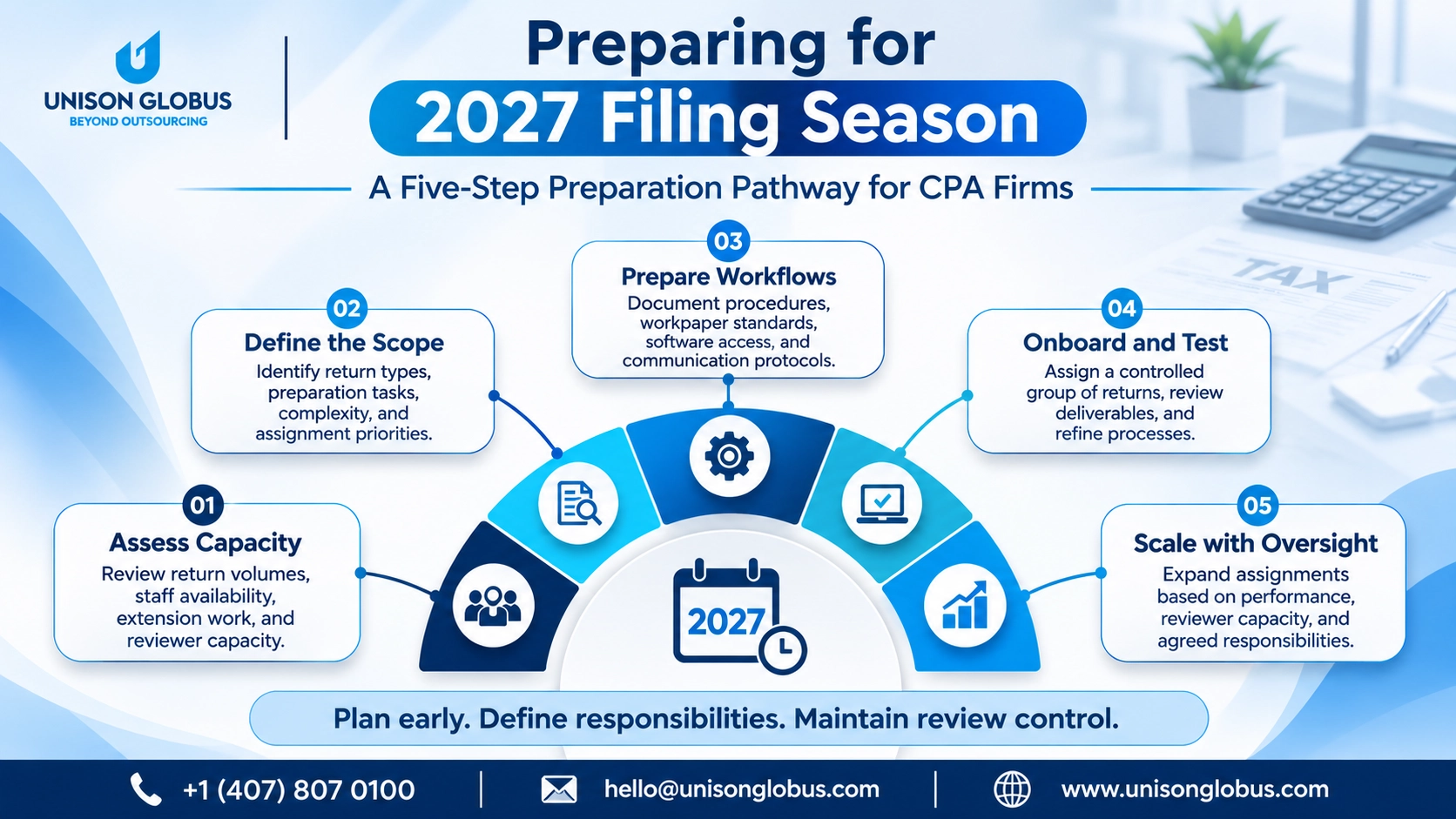
- Preparing for 2027 Filing Season
- Which Tax Preparation Activities Can CPA Firms Outsource?
- Is Your Firm Prepared for the 2027 Filing Season?
- Which Tax Preparation Support Model Fits Your Firm?
- How Should CPA Firms Evaluate an Outsourced Tax Preparation Provider?
- What Security and Compliance Considerations Should Firms Review?
- How Do CPA Firms Maintain Tax Preparation Quality and Oversight?
- How Tax Preparation Outsourcing Supports Firms in the UK and Australia
- Planning Your 2027 Tax Preparation Capacity with Unison Globus USA
- Prepare for the 2027 Tax Season
- Frequently Asked Questions
- Why are CPA firms outsourcing tax preparation before the 2027 filing season?
- What tax preparation tasks can CPA firms outsource?
- How early should a CPA firm arrange outsourced tax preparation support?
- What is the difference between seasonal and dedicated tax preparation staff?
- How do CPA firms maintain quality when using offshore tax preparers?
- What should firms evaluate before selecting an outsourced tax preparation provider?
As CPA firms look ahead to the 2027 filing season, one question deserves attention early: will existing tax preparation capacity be enough to manage the workload?
Seasonal return volumes, recruitment requirements, extension work, and reviewer availability can put pressure on internal teams. As filing deadlines approach, firms have less time to recruit, train, and integrate additional professionals.
Against this backdrop, CPA firms are evaluating Outsourced Tax Preparation Services before workloads reach their peak. For firms anticipating preparation-capacity gaps, early evaluation provides time to assess external support and establish appropriate workflows.
The sections below examine the preparation activities firms can delegate, the support models available, and the operational and compliance considerations involved in selecting a provider.
Why Are CPA Firms Outsourcing Tax Preparation Before the 2027 Filing Season?
CPA firms are considering tax preparation outsourcing ahead of the 2027 filing season to address projected workload increases, preparation-capacity constraints, and pressure on internal teams. Evaluating support options before peak demand allows firms to establish operating procedures, onboard external professionals, and validate workflows before substantial return volumes arrive.
- Plan preparation capacity early: Assess expected return volumes, internal resources, and reviewer availability before the 2027 filing season reaches peak demand.
- Define what to delegate: Identify suitable individual, business, and fiduciary return preparation activities, along with supporting schedules and workpapers.
- Choose the right support model: Project-based, seasonal, dedicated, and hybrid arrangements serve different workload and continuity requirements.
- Prepare workflows before onboarding: Establish preparation standards, software access, documentation requirements, communication channels, and escalation procedures.
- Verify provider capabilities and compliance: Assess US tax experience, PTIN requirements, quality checks, data security, and applicable Section 7216 obligations.
- Keep review and approval responsibilities clear: External professionals can support preparation, while the CPA firm maintains its established review, client-service, and engagement responsibilities.
Why Are CPA Firms Rethinking Their Tax Preparation Capacity?
CPA firms are reassessing preparation capacity because seasonal workloads, recruitment requirements, and reviewer availability can create competing demands during filing season.
Workforce data provides useful context, although it does not establish that every accounting firm faces the same hiring challenges. The U.S. Bureau of Labor Statistics projects 5% employment growth for accountants and auditors between 2025 and 2035, with approximately 115,300 openings annually. Many openings are expected to arise from professionals transferring to other occupations or leaving the workforce. The BLS also identifies longer working hours during periods such as tax season.
The longer-term talent pipeline shows some improvement. The AICPA’s Spring 2026 update reported a 5.7% year-over-year increase in undergraduate accounting enrollment, including an 8.9% increase in four-year undergraduate programs. However, higher enrollment does not immediately expand the pool of experienced tax preparers available for the 2027 filing season.
For individual firms, the decision comes down to whether projected return volumes exceed the preparation capacity available internally. Several factors can influence that assessment:
- Seasonal return volumes: Filing-period demand can increase substantially, requiring firms to manage more assignments while preserving time for client communication and review.
- Recruitment and onboarding: New employees need time to learn firm procedures, tax software, documentation standards, and client expectations. Hiring close to peak demand can limit that preparation time.
- Reviewer availability: Managers and partners must balance technical review, client questions, tax planning, and practice management. Additional preparers are useful only when sufficient review capacity is available.
- Workload distribution: Internal teams may handle original returns, extensions, amended returns, and other engagements simultaneously. Defined external support can help distribute suitable preparation assignments.
- Continuity requirements: Firms with recurring preparation needs may require support beyond the main filing period, particularly when extension work continues.
These pressures vary by firm size, client mix, return complexity, and operating model. The first step is to identify where additional preparation capacity would make a practical difference.
How Should CPA Firms Prepare for Tax Preparation Outsourcing Before Busy Season?
Tax Preparation Outsourcing Before Busy Season requires more than selecting a provider. Firms need to define the work, prepare their processes, and establish how external professionals will operate within existing workflows.
A practical preparation process involves three steps.
1. Assess Capacity and Define the Scope
Review prior-year return volumes, expected client growth, extension work, and the availability of internal preparers and reviewers. Identify the tasks or return categories that create the greatest pressure.
Then define the proposed scope of external support:
- Return types: Specify whether support is required for individual, partnership, corporate, fiduciary, or specialized returns.
- Preparation activities: Identify tasks such as document organization, supporting schedules, workpaper preparation, and draft return preparation.
- Complexity and deadlines: Establish which assignments are suitable for external preparation and which require direct internal handling.
- Assignment priorities: Determine how work will be allocated based on return complexity, deadlines, and reviewer availability.
Firms should also consider whether the primary constraint is preparation capacity or a different part of the tax workflow. For example, incomplete client documentation or limited reviewer availability may need to be addressed before additional preparers can improve turnaround.
2. Prepare Workflows and Systems
External professionals need clear instructions and access to the appropriate systems before they begin receiving assignments. Firms should document their preparation procedures, workpaper standards, and communication requirements.
Key considerations include:
- Preparation guidelines: Provide firm procedures, client-specific instructions, checklists, and examples of completed workpapers.
- Documentation standards: Define file naming conventions, supporting schedules, review-note formats, and required deliverables.
- Software compatibility: Confirm that the provider can work with the firm’s tax preparation software, accounting systems, and document management platforms.
- Access permissions: Establish appropriate access to systems and taxpayer information in line with the firm’s security and confidentiality procedures.
- Communication: Identify primary contacts, status-reporting expectations, turnaround requirements, and escalation procedures for missing information or technical questions.
These arrangements help external professionals work within the firm’s established processes rather than creating a separate workflow.
3. Onboard and Test the Arrangement
Before assigning substantial volumes, start with a controlled group of returns that reflects the intended scope of work.
Use the initial assignments to evaluate workpaper completeness, adherence to instructions, documentation quality, responsiveness, and the handling of exceptions. Share review feedback, clarify recurring questions, and refine procedures before increasing assignment volumes.
Before increasing assignment volumes, the firm should confirm reviewer ownership, escalation procedures, and the process for resolving technical questions.
Preparing for 2027 Filing Season
Which Tax Preparation Activities Can CPA Firms Outsource?
CPA firms can delegate defined preparation activities when the work is appropriately scoped, supported by relevant expertise, and covered by internal review procedures.
Common areas for Tax Preparation Outsourcing for CPA Firms include:
- Individual returns: Form 1040 preparation support, including source-document organization, supporting schedules, and draft return preparation.
- Business returns: Forms 1065, 1120, and 1120-S preparation support, subject to the provider’s experience and the firm’s assignment criteria.
- Fiduciary returns: Form 1041 preparation assistance, including supporting schedules and workpapers where the team has relevant experience.
- Tax workpapers: Supporting calculations, reconciliations, schedules, and documentation prepared in the firm’s required format.
- Document organization: Classification and organization of source documents and extracted information for the preparation process.
- Extension-related work: Defined preparation activities that support extension-season workloads and outstanding return assignments.
- Specialized returns: Expatriate and other specialized preparation support where the provider’s qualifications and experience have been assessed.
Some firms also evaluate Offshore Tax Preparation Services, Offshore Accounting Services for CPA Firms, and Outsourced Bookkeeping Services for CPA Firms for these activities. In addition to technical expertise, they should assess taxpayer information disclosure, security, communication, and oversight arrangements.
Routine preparation activities should be distinguished from complex technical determinations, tax planning, and client advice. Firms should define these boundaries in the engagement scope and establish escalation procedures for questions requiring internal professional input.
Is Your Firm Prepared for the 2027 Filing Season?
Build additional preparation capacity with a support model aligned with your return volumes, workflows, and review requirements.
Which Tax Preparation Support Model Fits Your Firm?
The right arrangement depends on expected return volume, complexity, continuity requirements, and the firm’s ability to manage external resources.
| Support model | Suitable circumstances | Main consideration |
|---|---|---|
| Project-based | A defined backlog or specific group of returns | Scope, complexity, and completion criteria |
| Return-volume-based | Predictable or variable assignment volumes | Allocation rules and volume reporting |
| Seasonal | Temporary increases during filing periods | Availability, onboarding, and continuity |
| Dedicated professionals | Recurring preparation requirements | Team stability and familiarity with firm procedures |
| Hybrid internal and external team | The firm retains core functions while delegating selected preparation work | Clear allocation and review ownership |
Project-based support may suit a firm with a defined backlog, while seasonal arrangements can address temporary increases in preparation demand. Firms with recurring requirements may consider Dedicated Tax Preparation Staff who become familiar with their procedures and documentation standards.
A dedicated external team may be suitable for firms seeking ongoing preparation resources, provided they can establish appropriate communication, access, security, and review arrangements.
No model is universally superior. The choice should reflect the firm’s workload forecast and operating requirements rather than a provider’s preferred staffing structure.
Firms that require year-round support often combine Dedicated Tax Preparation Staff, Accounting Outsourcing Services for CPA Firms, and Hire Offshore Accountants for CPA Firms to create a scalable operating model.
How Should CPA Firms Evaluate an Outsourced Tax Preparation Provider?
Provider selection should focus on demonstrated expertise, operational fit, and documented evidence. A service list alone cannot establish whether a provider can work effectively within a CPA firm’s preparation and review procedures.
Before engaging a provider, firm leaders should assess the following areas:
- US tax preparation experience: Confirm which federal return types the team supports, its experience with complex returns and supporting schedules, and its familiarity with the firm’s workpaper standards.
- Staff qualifications and training: Understand how the firm selects, trains, supervises, and assesses preparers before assigning work.
- PTIN compliance: Confirm that every paid individual who prepares, or assists in preparing, all or substantially all of a federal tax return has their own valid 2027 PTIN before preparing returns for the 2027 filing season, even if another professional signs the return. Identify the individual who meets the IRS definition of the signing tax return preparer and establish how the firm will handle applicable preparer identification requirements. Refer to the IRS PTIN requirements for tax return preparers.
- Team structure and continuity: If the firm needs Dedicated Tax Preparation Staff for CPA Firms, understand the provider’s approach to supervision, backup coverage, and team changes.
- Quality assurance: Ask what checks occur before deliverables reach the firm’s reviewer. Request details about error tracking, correction procedures, and escalation.
- Technology compatibility: Confirm experience with the firm’s tax software, document systems, and workpaper formats.
- Communication: Identify the primary contact, status-reporting process, response expectations, and escalation route for urgent or technical questions.
- Security and continuity: Request written information about confidentiality, access controls, staff training, incident response, and business continuity arrangements.
Firms can use these questions during provider discussions:
- Which US tax return types does your team regularly support?
- How do you assess preparer qualifications and technical competency?
- How are assignments allocated, monitored, and escalated?
- What quality checks occur before work returns to the CPA firm?
- How do you handle missing documents, unusual transactions, and technical questions?
- Which tax preparation platforms can your professionals work with?
- How is taxpayer information accessed, transferred, and protected?
- What happens when assigned professionals become unavailable?
Request supporting evidence where appropriate, such as documented procedures, relevant policies, sample deliverable formats, and agreed service responsibilities.
What Security and Compliance Considerations Should Firms Review?
Security and confidentiality should form part of provider due diligence before taxpayer information is shared. For CPA firms considering external or offshore tax preparation support, the first step is to understand the legal requirements governing the disclosure of taxpayer information.
IRC Section 7216 generally restricts tax return preparers from using or disclosing taxpayer information for purposes not authorized by law. When a CPA firm engages an offshore tax preparation provider, it should evaluate the proposed disclosure under Section 7216 and the applicable Treasury Regulations before sharing taxpayer information. Certain disclosures may be permitted under regulatory exceptions, while others require taxpayer consent that meets applicable requirements.
The IRS explains these restrictions in its Section 7216 Information Center. Treasury Regulation §301.7216-2 identifies certain permitted uses and disclosures, while Treasury Regulation §301.7216-3 addresses disclosures or uses that require taxpayer consent and the applicable consent requirements.
Requirements vary based on specific facts, engagement structures, and the nature of the proposed disclosure or use. CPA firms should obtain legal, regulatory, or compliance guidance before implementing offshore taxpayer-information disclosure arrangements.
Form 1040-series returns require particular attention to SSN disclosure. A US-based preparer generally cannot obtain taxpayer consent to disclose a taxpayer’s Social Security number to a preparer located outside the United States. The US preparer must mask or redact the SSN before disclosure. The regulation provides a limited exception only when the US preparer uses an adequate data protection safeguard specified in IRS guidance and verifies that the safeguard is maintained in the taxpayer’s consent request. Firms should review the applicable requirements before relying on this exception.
Firms should also evaluate how taxpayer information is accessed, transferred, stored, and protected throughout the engagement. IRS Publication 4557, Safeguarding Taxpayer Data, outlines information-security practices for tax professionals.
Provider due diligence should cover:
- Access controls: Confirm that professionals receive permissions appropriate to their assigned responsibilities and that access is reviewed and terminated when required.
- Data handling: Understand how client documents are transferred, where information is stored, and how retention and deletion are managed.
- Security policies: Request written policies and relevant evidence of implemented controls, staff training, and incident response procedures.
- Contractual responsibilities: Define confidentiality obligations, permitted data use, subcontracting arrangements, incident notification, and data return or deletion.
- Business continuity: Understand how the provider manages system disruptions, staff absences, and operational interruptions.
How Do CPA Firms Maintain Tax Preparation Quality and Oversight?
Many firms also integrate outsourced tax preparation with 1099 Preparation and Filing Services and Audit Support Services for CPA Firms to improve workflow continuity across compliance engagements.
Provider-level quality checks and the CPA firm’s professional review serve different purposes. External preparers should follow the firm’s instructions and identify exceptions, while the firm’s reviewers evaluate the return and retain responsibility for professional decisions.
A typical outsourced preparation workflow includes:
- Assignment and documentation: The CPA firm provides source documents, prior-year information, preparation instructions, and workpaper requirements.
- Preparation: The external preparer organizes the information, prepares the draft return, and completes supporting schedules and workpapers.
- Exception identification: The preparer flags missing documents, inconsistent information, unusual transactions, and questions requiring clarification.
- Preparation handoff: The external team submits the draft return, supporting workpapers, and unresolved questions to the designated reviewer.
- Internal review and approval: The firm’s reviewer evaluates the return, examines supporting documentation, resolves technical issues, and determines whether it is ready for final approval under firm procedures.
The division of responsibility should be clear:
| Activity | Primary responsibility |
|---|---|
| Assignment and document handoff | CPA firm |
| Document organization and preparation | External preparation team |
| Initial checks and exception identification | External preparation team, where included |
| Technical review and resolution of issues | CPA firm |
| Final review and engagement-level approval | CPA firm, under its established procedures |
| Signing preparer identification and signature | Individual who meets the applicable IRS signing tax return preparer requirements |
Reviewer feedback should inform ongoing process improvements. Recurring corrections may reveal gaps in preparation instructions, training, or work allocation. Firms should communicate these findings to the provider and update procedures where appropriate.
The engagement should document these responsibilities clearly, including the provider’s preparation obligations and the firm’s review, approval, and client-service procedures.
How Tax Preparation Outsourcing Supports Firms in the UK and Australia
Accounting firms in the UK and Australia also face seasonal workloads, recruitment challenges, and increasing compliance demands. UK practices manage Self-Assessment, Corporation Tax, and VAT deadlines, while Australian firms experience concentrated workloads around the 30 June financial year-end, including tax returns and BAS obligations.
Tax Preparation Outsourcing can help firms in both markets manage these demands by delegating defined preparation tasks, workpapers, reconciliations, and documentation activities. With the right provider, documented processes, and internal review, firms can create additional capacity for client communication, advisory services, and complex tax work.
Planning Your 2027 Tax Preparation Capacity with Unison Globus USA
Early capacity planning gives CPA firms time to identify preparation gaps, compare support arrangements, and establish working procedures before filing-season demand peaks.
Unison Globus supports CPA firms with outsourced tax preparation services and dedicated tax professionals. Its tax preparation offering includes support for individual, business, fiduciary, and other defined return categories, along with workpaper and documentation activities.
Unison Globus professionals are AI-ready and can work alongside firms’ AI-enabled tools and established workflows. They align with the firm’s systems, procedures, documentation standards, and review requirements. Engagement responsibilities are defined in advance to support clear work allocation, communication, and review coordination.
Explore Unison Globus hire tax preparers for CPA firms to learn more about its support for US CPA firms.
Prepare for the 2027 Tax Season
Plan your preparation capacity early and keep workflows moving through busy season.
Frequently Asked Questions
CPA firms are evaluating Outsourced Tax Preparation Services to address projected preparation-capacity gaps, support internal teams, and establish workflows before peak filing activity. Early planning also allows time for provider assessment, onboarding, and process testing.
Depending on provider expertise and engagement scope, firms may assign Form 1040, 1065, 1120, 1120-S, and 1041 preparation support, along with workpapers, supporting schedules, and document organization.
Firms should begin once they can forecast workload and identify preparation gaps. The required lead time depends on return complexity, provider selection, documentation, system access, and internal readiness.
Seasonal support addresses temporary filing-period workload increases. Dedicated professionals provide more consistent resources for recurring assignments and can develop familiarity with the firm’s systems and procedures.
CPA firms should establish documented preparation standards, provider-level checks, exception escalation, and internal review procedures. They should also confirm applicable PTIN requirements and identify the signing preparer for each return. The firm’s reviewers evaluate technical positions and approve returns under established procedures.
Assess US tax expertise, staff training, team continuity, software compatibility, communication, quality assurance, security policies, data handling, business continuity, and the provider’s ability to follow firm procedures.