


 [gtranslate]


Summarize and analyze this article with:
- TL;DR
- Why Tax-Ready Books Must Come Before Tax Preparation
- Where Does Offshore Bookkeeping Fit Within the CPA Firm Workflow?
- Assess Capacity and Triage Client Books Before Choosing a Support Model
- Considering Offshore Bookkeeping Support for the Upcoming Filing Season?
- Which Year-End and Pre-Filing Tasks Can Be Supported Offshore?
- Who Prepares, Reviews, and Makes the Final Decision?
- Preparing for 1099 Season: Data, Reconciliation, and Review
- Build a Year-End-to-Filing Preparation Timeline
- Choose a Support Model That Matches the Workload
- How to Evaluate an Offshore Bookkeeping Provider
- When Offshore Bookkeeping Support Makes Sense
- Year-End Pressure in the UK and Australia
- How Unison Globus Supports CPA Firms
- Conclusion
- Preparing for year-end, 1099 season, or tax filing deadlines?
- Frequently Asked Questions
- What is offshore bookkeeping support for CPA firms?
- Which year-end close tasks can be supported offshore?
- How does offshore support help with 1099 preparation?
- Can offshore bookkeeping support help CPA firms during tax season?
- How do CPA firms maintain quality control when using offshore bookkeeping support?
- When should a CPA firm implement offshore bookkeeping support?
Filing deadlines do not move, but client books rarely reach year-end in the same condition. One client may need a final reconciliation; another may have uncategorized transactions, missing vendor information, or incomplete year-end schedules. Each unresolved item competes for the same manager and reviewer hours needed for tax preparation.
Offshore Bookkeeping Support for CPA Firms can add execution capacity when firms define the scope, establish review checkpoints, and assign responsibility for unresolved items. This helps prepare accounting records earlier and coordinate bookkeeping with 1099 and tax workflows while the firm retains control over professional decisions.
This guide explains how to assess readiness, allocate work, plan the year-end-to-filing sequence, evaluate support models, and establish the controls needed to make the arrangement work.
What is offshore bookkeeping support for CPA firms?
Offshore bookkeeping support for CPA firms involves assigning agreed bookkeeping tasks, such as account reconciliations, year-end schedule preparation, bookkeeping cleanup, and 1099 data organization, to an external accounting team. With documented workflows, defined responsibilities, and firm-side review checkpoints, this model helps CPA firms manage seasonal workloads while retaining control over professional judgment, tax decisions, and final approvals.
TL;DR
- Assess bookkeeping readiness early: Identify reconciliation backlogs, missing records, cleanup requirements, and upcoming filing deadlines.
- Prioritize tax-ready books: Complete reconciliations, prepare year-end schedules, document exceptions, and assign responsibility for outstanding items.
- Allocate repeatable tasks effectively: Use external support for agreed activities such as bookkeeping cleanup, reconciliations, schedule preparation, and tax-workpaper organization.
- Prepare for 1099 season: Organize vendor records, track missing W-9s, reconcile payment data, and establish clear review and filing responsibilities.
- Choose the right support model: Match seasonal, project-based, dedicated, or hybrid support to the firm's workload and operational requirements.
- Establish security and review controls:Define access permissions, data-sharing requirements, escalation procedures, and quality checkpoints before sharing client information.
- Retain firm-side oversight:Keep professional judgment, client advisory, reportability decisions, and final filing approval with the appropriate firm professionals.
Why Tax-Ready Books Must Come Before Tax Preparation
Tax preparation depends on complete accounting records and supporting documentation. Firms providing tax preparation support often find that unresolved bookkeeping issues create avoidable delays later in the filing workflow. Open reconciliations, unclear transaction classifications, and missing records can leave tax preparers resolving bookkeeping issues alongside their filing work.
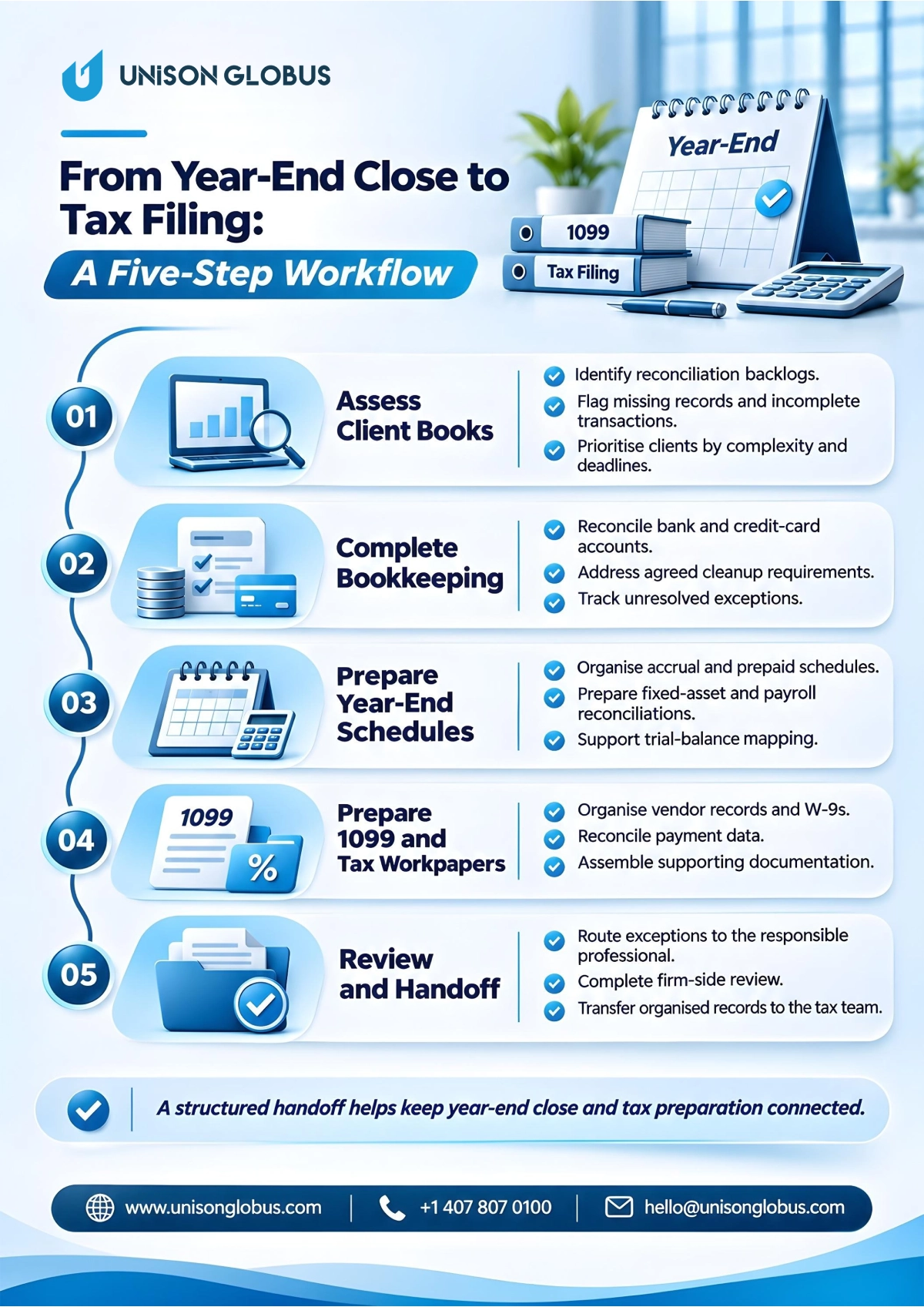
The workflow is connected:
Client records → Bookkeeping and reconciliation → Exception resolution → Year-end review → 1099 and tax-workpaper preparation → Tax-team handoff
A delay at one stage can affect subsequent work. For example, an unresolved vendor transaction may affect expense classification, year-end balances, and 1099 reporting, creating additional work across teams.
The objective is to hand over reconciled accounts, supporting schedules, documented exceptions, and a designated reviewer. Outstanding items should have clear owners and agreed resolution steps before the file moves forward.
For firms planning year-end bookkeeping preparation, the first decision is therefore which client files need routine completion, which require cleanup, and which contain issues that must remain with firm professionals.
Where Does Offshore Bookkeeping Fit Within the CPA Firm Workflow?
A typical workflow may include:
Client Records Collection → Bookkeeping Cleanup → Account Reconciliations → Year-End Close → 1099 Preparation Support → Tax Workpaper Organization → Tax Team Review → Filing
Assess Capacity and Triage Client Books Before Choosing a Support Model
Before comparing providers, identify where work is accumulating and how much review capacity is available.
Assess the workload
Review the following across the client portfolio:
- Reconciliation backlog: Identify outstanding bank, credit-card, balance-sheet, and clearing-account reconciliations.
- Cleanup requirements: Separate routine transaction corrections from historical or complex accounting issues.
- Missing records: Track incomplete statements, invoices, payroll reports, and client responses.
- 1099 workload: Estimate vendor volumes, missing W-9s, payment-data gaps, and unresolved classifications.
- Reviewer capacity: Compare expected deliverables with the hours managers and partners can allocate to review.
- Deadline exposure: Prioritize clients according to filing obligations, complexity, and the time needed to resolve exceptions.
Workforce availability also affects capacity planning. The U.S. Bureau of Labor Statistics projects 5% employment growth for accountants and auditors from 2024 to 2034, with approximately 124,200 job openings annually on average. For CPA firms, this reinforces the importance of aligning available staff and reviewer hours with seasonal demand.
Classify client books by readiness
| Readiness level | What it means | Recommended action |
|---|---|---|
| Tax-ready | Accounts are reconciled and supporting records are available | Move into the established review and tax handoff |
| Minor cleanup | A limited number of transactions or documents remain unresolved | Assign and clear specific exceptions |
| Significant cleanup | Multiple accounts, schedules, or historical records require work | Scope the project, establish milestones, and assign an owner |
| Escalation required | Material, complex, or judgment-dependent issues remain | Route the matter to the responsible firm professional |
This classification helps firms prioritize work by complexity, risk, and deadline, while identifying which files are suitable for external execution support.
Considering Offshore Bookkeeping Support for the Upcoming Filing Season?
Assess where work is accumulating, what can be standardized, and how responsibilities should be allocated before choosing a provider or support model.
Which Year-End and Pre-Filing Tasks Can Be Supported Offshore?
Repeatable activities with defined inputs, documented procedures, and clear review requirements are generally the strongest candidates for external support. Suitability depends on the engagement scope, systems, and complexity of the records.
| Work area | Potential support activities | Required firm-side checkpoint |
|---|---|---|
| Bookkeeping cleanup | Review transaction coding, reconcile accounts, identify missing activity | Resolve accounting questions and review exceptions |
| Year-end schedules | Prepare accrual, prepaid, fixed-asset, and payroll schedules | Review assumptions, adjustments, and supporting records |
| Trial balance | Organize account balances and prepare mapping | Confirm adjustments and approve the final trial balance |
| 1099 preparation support | Organize vendor data, reconcile payments, track missing W-9s | Determine reportability and approve filing |
| Tax workpapers | Index documents, assemble support, maintain open-item lists | Accept the handoff and resolve tax-related questions |
Who Prepares, Reviews, and Makes the Final Decision?
| Activity | Support Team Prepares | Firm Reviewer Reviews | Firm Decision Authority |
|---|---|---|---|
| Bank reconciliation | ✓ | ✓ | |
| Year-end schedules | ✓ | ✓ | |
| Trial balance preparation | ✓ | ✓ | |
| 1099 vendor-data reconciliation | ✓ | ✓ | |
| 1099 reportability determination | Provides supporting data | Reviews as required | ✓ |
| Adjusting entries requiring judgment | Prepares supporting detail when authorized | ✓ | ✓ |
| Tax position and planning | Provides organized records | Reviews supporting information | ✓ |
| Client advisory and interpretation | ✓ | ||
| Final filing approval and sign-off | Reviews according to firm procedure | ✓ |
Bookkeeping cleanup and reconciliation
External teams can prepare bank and credit-card reconciliations under documented procedures and maintain exception logs covering unresolved issues, required information, responsible owners, and target resolution dates.
Many firms use bookkeeping support as part of broader accounting outsourcing services designed to improve year-end efficiency and workflow consistency.
Year-end close and financial schedules
Many firms assign accrual and prepaid schedule preparation to external bookkeeping resources when procedures and review requirements are documented. The scope may also include fixed-asset support, payroll reconciliations, trial-balance mapping, and the assembly of supporting schedules for financial reporting.
The firm should define which adjustments may be prepared, which require approval, and how proposed changes must be documented.
Tax-workpaper and documentation preparation
External bookkeeping resources may organize source documents, index supporting records, map accounts to the firm’s tax workflow, and prepare an open-item list for the tax preparer. Compatibility with platforms such as QuickBooks, Xero, Drake, or CCH Axcess should be confirmed before the engagement begins.
organize the supporting records so the tax preparer can locate relevant evidence and identify outstanding items.
Preparing for 1099 Season: Data, Reconciliation, and Review
Firms with large vendor reporting obligations often establish structured 1099 preparation workflows to improve accuracy and reduce last-minute filing pressure. 1099 preparation requires a separate review of vendor information, payment records, and reporting requirements before filing.
For payments made in calendar year 2026, the federal reporting threshold for Form 1099-NEC and certain Form 1099-MISC payments increased from $600 to $2,000 under the applicable rules. Some payment categories have different requirements, and backup withholding can create reporting obligations regardless of the amount. Firms should confirm the relevant rules and exceptions using the IRS guidance on Form 1099 reporting. State requirements may differ.
For 2026 payments, Form 1099-NEC is generally due to recipients and the IRS by February 1, 2027, because January 31 falls on a Sunday. Confirm the applicable filing instructions and any exceptions before relying on a calendar date. See the IRS instructions for Forms 1099-MISC and 1099-NEC.
organize vendor records and W-9 information
Missing W-9s can be tracked through a shared exception log that identifies the outstanding information, responsible owner, and follow-up date. Vendor names and taxpayer information can be checked against available records, with discrepancies flagged for resolution before filing review.
Reconcile payment data
The preparation workflow should reconcile payment records to the general ledger and flag duplicates, missing transactions, and classification questions for review. Payment card transactions are generally reported on Form 1099-K regardless of amount. Third-party network transactions are generally reportable when payments exceed $20,000 and involve more than 200 transactions during the calendar year. Payment settlement entities report these transactions on Form 1099-K rather than duplicating them on Forms 1099-NEC or 1099-MISC. The team should flag potential misclassification for review rather than decide reportability independently.Set the filing approval process
Before preparation begins, assign responsibility for reportability decisions, client follow-ups, exception reviews, and filing authorization. The support team can prepare the data and exception report according to these instructions.Build a Year-End-to-Filing Preparation Timeline
A year-end timeline should connect bookkeeping cleanup before tax filing, close, 1099 preparation, and the tax-team handoff.
| Phase | Firm priorities | Potential support activities | Review checkpoint |
|---|---|---|---|
| Pre-season readiness | Estimate workload, assign owners, identify high-risk clients | Inventory backlogs and scope cleanup | Approve capacity and scope |
| Pre-year-end preparation | Request records and address recurring issues | Complete agreed cleanup and reconciliations | Review exceptions |
| Year-end close | Finalize balances and schedules | Prepare schedules and supporting records | Manager or controller review |
| 1099 preparation | Validate vendor and payment information | Track W-9s, reconcile data, prepare exception reports | Responsible professional reviews |
| Tax-team handoff | Confirm completeness and outstanding items | Assemble workpapers and mapped trial balance | Tax preparer accepts handoff |
| Filing season | Resolve follow-ups and manage remaining deadlines | Provide agreed documentation and bookkeeping support | Firm review and final approval |
Standardize the handoff
Define the handoff package in advance, including the trial balance, reconciled schedules, indexed supporting records, open-item list, escalation route, and acceptance criteria.
The receiving tax preparer should be able to identify completed work and outstanding items immediately. Otherwise, the handoff may simply transfer the backlog to another team.
Choose a Support Model That Matches the Workload
Firms evaluating whether to hire bookkeepers internally or add offshore capacity should compare workload consistency, reviewer availability, and operational costs. The right model depends on whether the firm needs temporary capacity, a defined cleanup project, or continuity across recurring work.
| Model | Best use case | Key consideration |
|---|---|---|
| Seasonal | A predictable peak in year-end or filing-season volume | Scope, onboarding, and end-of-season handoff must be clear |
| Project-based | A defined backlog or historical cleanup assignment | Agree on deliverables, milestones, and acceptance criteria |
| Dedicated team | Recurring bookkeeping and close activities | Requires ongoing workflow integration and supervision |
| Hybrid | Ongoing work plus additional peak-season capacity | Define how responsibilities are divided between the core and seasonal teams |
How to Evaluate an Offshore Bookkeeping Provider
- Workflow experience: How does the team handle reconciliations, year-end schedules, 1099 support, and tax handoffs?
- System compatibility: Can the team work within the firm’s approved software, templates, and access arrangements?
- Review procedures: Who checks completed work, and how are errors and rework recorded?
- Exception ownership: How are unresolved issues assigned, escalated, and tracked through closure?
- Continuity: What happens when a team member is absent or leaves?
- Peak-season capacity: How are deadlines and competing priorities managed during high-volume periods?
- Performance reporting: Which measures show timeliness, open-item aging, handoff acceptance, and rework?
- Pilot arrangements: Can the firm test a limited scope against agreed deliverables before expanding the engagement?
Security, Tax Data-Sharing, and Quality Controls
Before sharing client, information or assigning bookkeeping work to an external team, CPA firms should establish clear security, data-handling, and review requirements. These controls help protect taxpayer information and maintain accountability throughout the engagement.
Assess access and data protection
Confirm that the provider’s controls match the firm’s risk and contractual requirements. Areas to examine include multifactor authentication, role-based permissions, approved file-transfer methods, confidentiality obligations, access reviews, incident escalation, and continuity procedures. Request evidence for any certification or assurance report cited and confirm its scope and currency.
The IRS’s Publication 4557, Safeguarding Taxpayer Data, provides guidance for tax professionals on protecting taxpayer information.
CPA firms should also assess whether the FTC Safeguards Rule applies to their activities. The Rule identifies tax preparation firms among the financial institutions it may cover and requires covered firms to maintain a written information security program with appropriate safeguards. Firms should review the FTC’s Safeguards Rule guidance to understand their applicable requirements.
Review of IRC Section 7216 obligations
Section 7216 and its related regulations restrict the use and disclosure of tax-return information. Disclosure to a tax return preparer located outside the United States generally requires prior written taxpayer consent unless a specific exception applies. Additional restrictions apply to disclosing Social Security numbers for certain individual returns. The precise requirements depend on the information, parties, and circumstances involved. Review the Treasury regulations under 26 CFR §301.7216-3 and obtain appropriate professional or legal guidance before sharing information.
Establish ongoing quality control
Similar review and quality-control procedures are commonly used within audit and assurance environments to support consistency, accountability, and documentation standards. Document acceptance criteria, escalation procedures, and performance measures. Track milestone completion, unresolved-item aging, rework, and handoff acceptance to identify process improvements after each close and filing season.
When Offshore Bookkeeping Support Makes Sense
- Reconciliations and recurring bookkeeping tasks follow documented procedures.
- Cleanup work can be scoped and prioritized by client and deadline.
- The firm has an assigned reviewer and a reliable escalation route.
- System access, source records, and delivery requirements are established.
- The firm needs additional continuity during the year-end close or filing season.
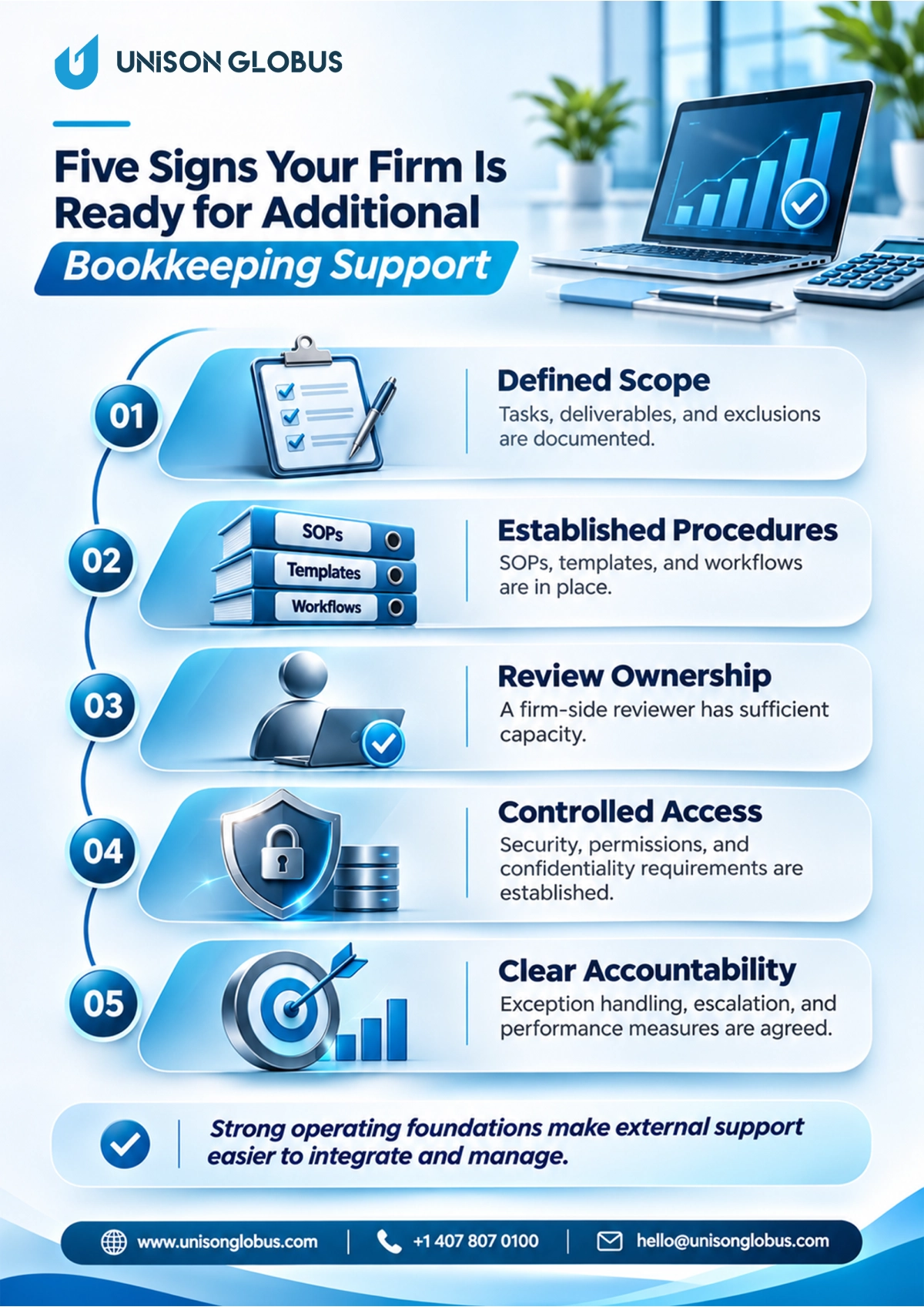
Offshore Bookkeeping Readiness Scorecard
Before selecting a provider or expanding the engagement, assess whether the operating foundations are in place. Answer Yes or No for each item.
| Readiness question | Yes | No |
|---|---|---|
| Is the scope of work clearly defined, including exclusions? | ☐ | ☐ |
| Is a firm-side reviewer assigned with sufficient review capacity? | ☐ | ☐ |
| Are SOPs, templates, and exception-handling procedures documented? | ☐ | ☐ |
| Are security, access, confidentiality, and escalation procedures established? | ☐ | ☐ |
| Is the required technology access available and approved? | ☐ | ☐ |
Interpret the result:
- 4–5 Yes: The firm may be ready to plan implementation, subject to validating scope, security, and compliance requirements.
- 2–3 Yes: Consider a limited pilot while addressing the gaps.
- 0–1 Yes: Prioritize process definition, ownership, and access arrangements before introducing external support.
* Note: This scorecard is a planning aid, not a compliance assessment. Critical gaps involving taxpayer data, access permissions, or review ownership must be addressed regardless of the score.
Year-End Pressure in the UK and Australia
The same planning principle applies in other markets, although local reporting requirements differ. In the UK, accountancy practices manage HMRC requirements for Self-Assessment, VAT, payroll, and year-end reporting. Early record collection and bookkeeping reviews help prepare client accounts ahead of key filing periods.
In Australia, practices plan around the 30 June financial year-end and ATO reporting requirements, including BAS, IAS, income tax returns, and Taxable Payments Annual Reports where applicable. Across all three markets, identifying incomplete records early and assigning preparation tasks ahead of deadlines helps firms manage workloads and reviewer capacity.
How Unison Globus Supports CPA Firms
Unison Globus US provides bookkeeping outsourcing services to CPA firms through dedicated accounting professionals aligned with the firm’s systems, procedures, and review requirements. Support can include reconciliations, bookkeeping cleanup, year-end schedules, and tax-workpaper preparation, with defined deliverables and escalation processes.
Our professionals are AI-ready and can work alongside AI-enabled tools within the firm’s established workflows. We also support year-end close outsourcing through structured workflows that help firms manage recurring bookkeeping activities while retaining control over client relationships, professional judgment, review, and final sign-off.
If your firm needs additional bookkeeping capacity ahead of year-end, contact Unison Globus to discuss your requirements.
Conclusion
Preparing for tax season starts with organized books, completed reconciliations, and supporting schedules that are ready for review. When these activities are delayed, unresolved bookkeeping issues can affect 1099 preparation and the wider tax-filing workflow.
Offshore bookkeeping support can help CPA firms manage this workload when tasks are clearly scoped, responsibilities are assigned, and review procedures are established. Assessing capacity early and planning the handoff gives firms more flexibility to manage seasonal demand.
Preparing for year-end, 1099 season, or tax filing deadlines?
Unison Globus helps CPA firms improve bookkeeping capacity, reduce reconciliation backlogs, and prepare tax-ready books through structured offshore bookkeeping support.
Frequently Asked Questions
It involves an external team completing agreed bookkeeping tasks, such as reconciliations and schedule preparation, within the CPA firm’s established workflows and review procedures.