


 [gtranslate]

This guide sets out the core company annual filing requirements every UK business must meet, the exact penalty structure for missing them, the regulatory changes already in force in 2025 and 2026, and why outsourced company secretarial services are increasingly the most effective solution for practices managing a growing client portfolio.
The Core Filing Obligations: What Every UK Company Must File
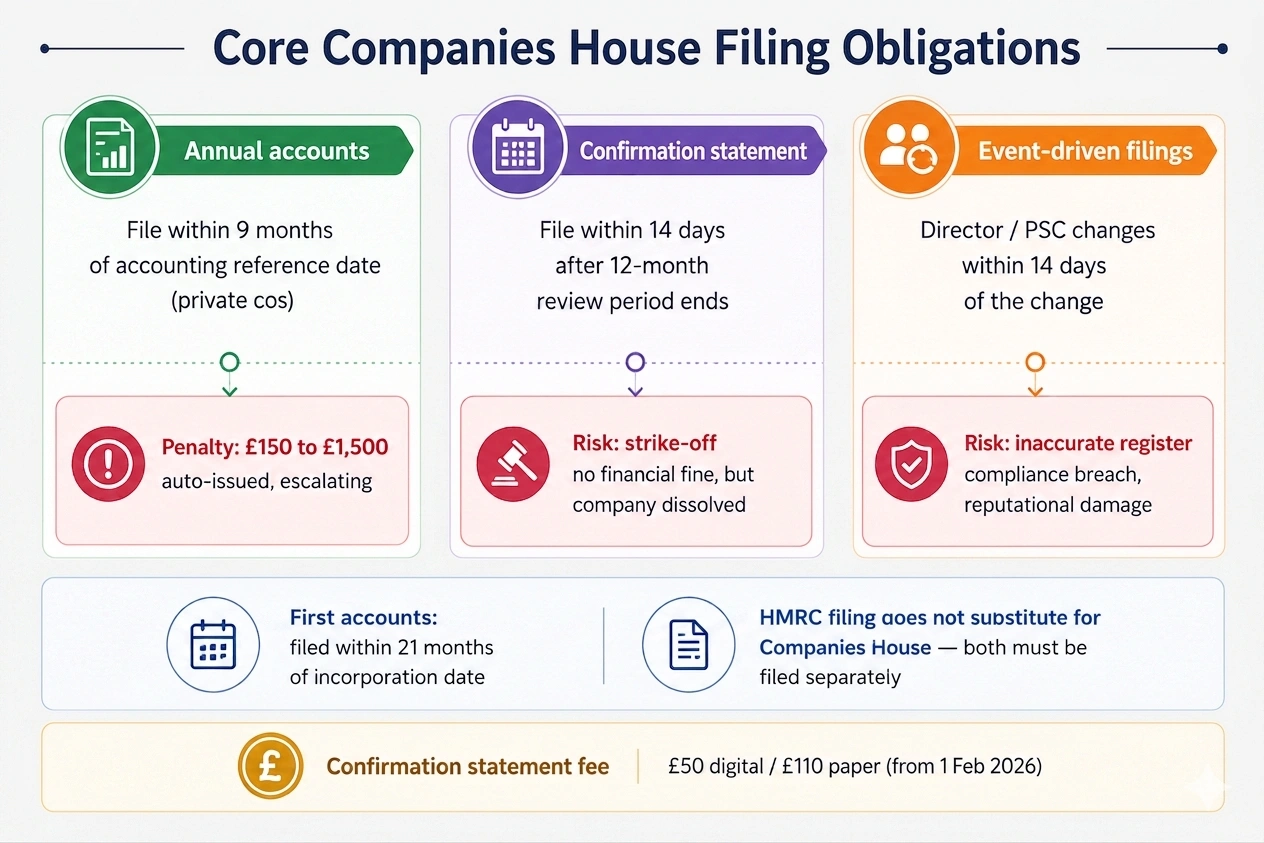
Annual Accounts Filing
Annual accounts filing Companies House requires private companies to deliver accounts within 9 months after the company’s financial year ends. First accounts must be delivered within 21 months of the incorporation date. This first-year calculation is a frequent source of errors and penalties.A critical point many clients misunderstand: as a director running a company, you must tell both Companies House and HMRC about your company and the money it has earned. These are separate obligations — filing with one does not satisfy the other. HMRC and Companies House compliance must each be managed independently.
Confirmation Statement Filing
The confirmation statement is an annual snapshot of a company’s non-financial information, covering registered office, directors, PSCs, share capital, and SIC codes. You must file your statement within 14 days of the end of your review period. Confirmation statement filing UK applies to every company, including dormant and non-trading companies. Companies House may issue a financial penalty, and your company may be struck off the register if you do not file your confirmation statement.From 1 February 2026, the digital confirmation statement filing fee increased from £34 to £50, with paper filings rising to £110.
Event-Driven Notifications
You must tell Companies House within 14 days of any changes to directors, their personal details, company secretaries, or people with significant control (PSCs). These changes must be reported when they happen, not held until the next confirmation statement.The Late Filing Penalty Structure
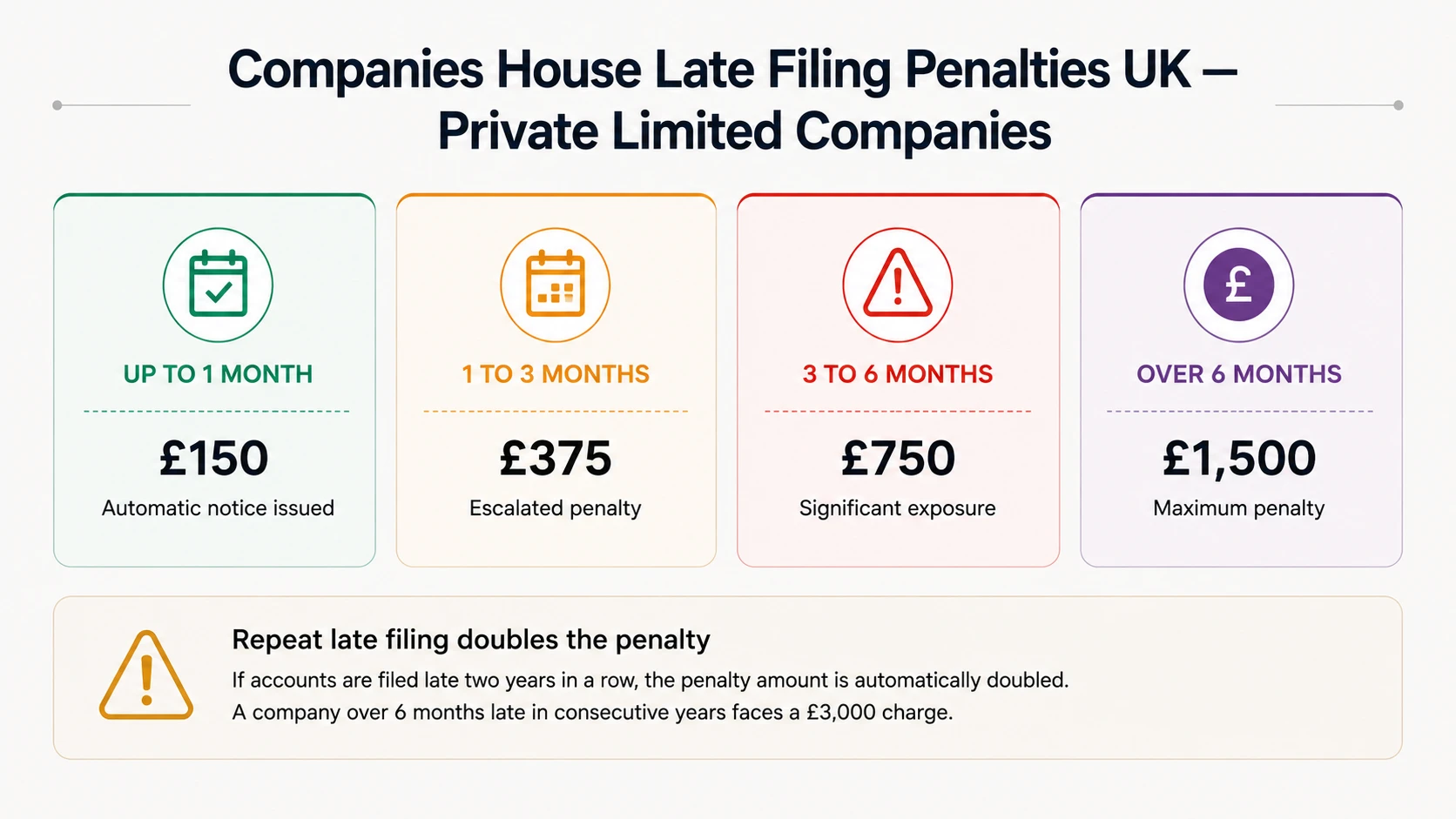
Penalty notices are issued automatically the moment accounts arrive after the deadline. The penalty is doubled if accounts are late two years in a row. A company can also be fined and struck off the register if it does not send Companies House its accounts or confirmation statement.
Companies House late filing penalties UK are triggered the moment the deadline passes. It is important to note that “delivered” means when Companies House receives the document, not when it is posted or handed to a courier. If accounts are rejected for any reason, they are not considered delivered, and the penalty clock continues to run.
Regulatory Changes in Force: What's Already Live
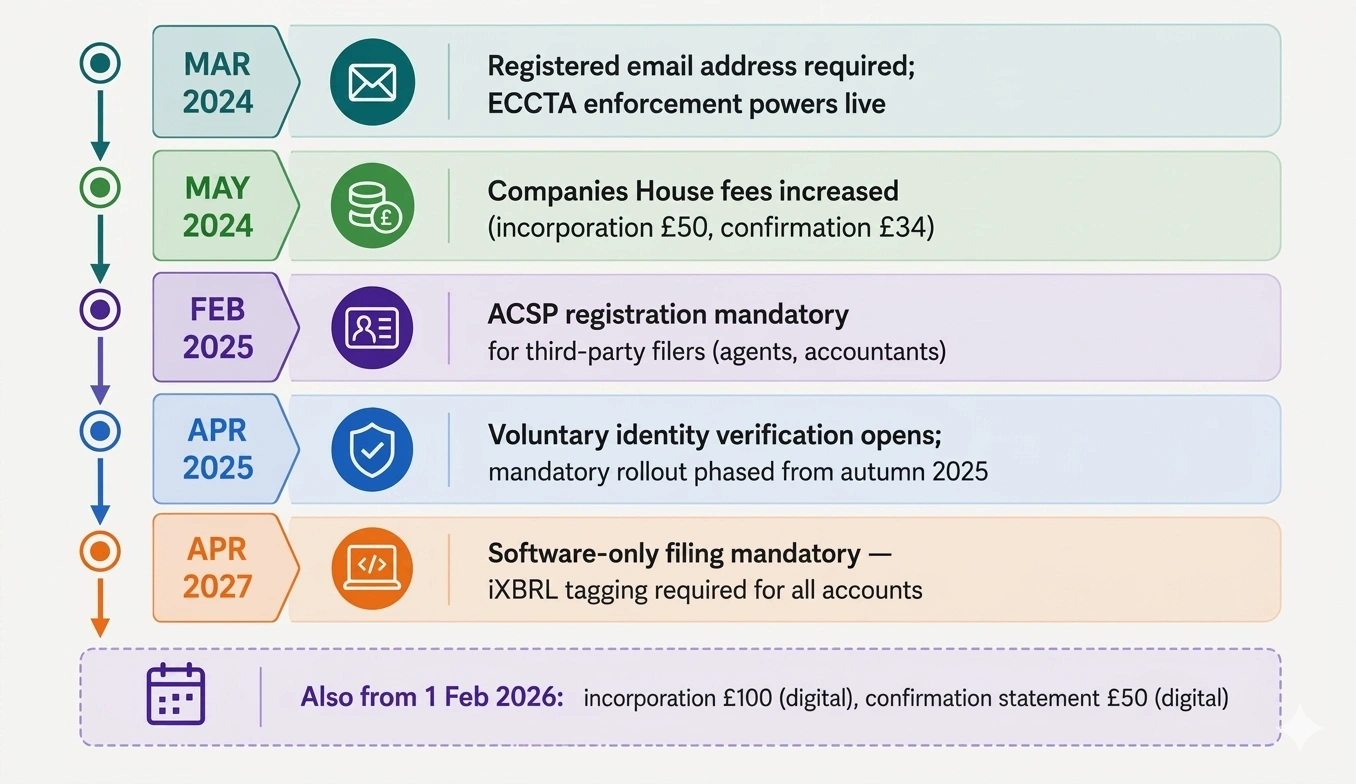
ACSP registration (February 2025): From February 2025, third-party providers conducting identity checks for Companies House, including company formation agents, solicitors, and accountants, must register as Authorised Corporate Service Providers (ACSPs). To register, businesses must be supervised by a UK Anti-Money Laundering body such as HMRC or the FCA.
Fee increases (1 February 2026): Companies House fees increased from 1 February 2026, with some fees rising by more than 50%. Incorporation filing fees rose from £50 to £100 for digital filings, and confirmation statement fees from £34 to £50 for digital submissions.
Software-only filing (from 1 April 2027): From 1 April 2027, all companies and LLPs will be required to file their accounts using commercial software, with accounts tagged using iXBRL. Companies House will close its web filing service and paper filing route for accounts from the same date.
Handling multiple filing deadlines
and statutory requirements across clients?
Common Filing Mistakes That Lead to Penalties
Companies House late filing penalties UK are rarely the result of deliberate non-compliance. They typically stem from avoidable process failures. Here are a few of them:
- First-year Deadline Miscalculation: First accounts are due within 21 months of incorporation, not 9 months. Getting this wrong is the most common reason for a penalty in year one.
- Assuming HMRC Covers Companies House: Filing corporation tax with HMRC is entirely separate from filing accounts with Companies House. Both must be done independently — one does not satisfy the other. Late officer change notifications Director appointments and resignations must be filed within 14 days. Waiting until the next confirmation statement is incorrect and creates inaccuracies on the public register.
- Missing the Registered Email Requirement: Since March 2024, a registered email address must be provided before a confirmation statement can be filed. Companies without one on record cannot complete the submission.
- Consecutive Late Filing: A single late filing is costly. A second late filing in consecutive years automatically doubles the penalty; a £1,500 charge becomes £3,000 with no discretion on the doubling.
- Delaying Identity Verification: With identity verification now required before a confirmation statement will be accepted, directors and PSCs who delay risk blocking their own filing when the deadline arrives.
How Outsourced Company Secretarial Services Protect Your Clients
For accounting practices managing multiple company clients, the cumulative burden of tracking individual filing deadlines, managing confirmation statements, updating officer records, and staying current with regulatory changes is substantial. This is where business compliance outsourcing delivers measurable value.
Outsourced company secretarial services provide your clients with a structured, proactive compliance function without the overhead of maintaining specialist in-house expertise. For your practice, it represents a scalable way to extend your service offering while reducing the risk of missed deadlines on your watch.
The scope of a well-structured company secretarial services function covers:
- Confirmation statement filing UK – ensuring annual statements are prepared, filed on time, and include all updated information, including registered email addresses and identity verification compliance.
- Annual accounts filing Companies House – tracking accounting reference dates across multiple entities, preparing accounts in the correct format for company size, and managing submission ahead of the 9-month deadline.
- Event-driven compliance – filing director and PSC changes within the 14-day window, updating registered office addresses, and maintaining accurate statutory registers.
- Regulatory change management – monitoring ECCTA reforms as they come into force, advising clients on ACSP requirements, identity verification timelines, and the 2027 transition to software-only iXBRL filing.
- HMRC and Companies House compliance – managing the two separate submission obligations so clients never mistake one for the other, ensuring corporation tax filings and annual accounts filing Companies House are coordinated without either being missed.
For practices looking to scale, statutory compliance services offer a recurring revenue model grounded in genuine client value. Every company needs these filings completed. Every director who has received a penalty notice is a client who needed this service first.
Key Deadlines vat a Glance
| Filing | Deadline | Consequence if Missed | Fee (from Feb 2026) |
|---|---|---|---|
| Annual accounts | 9 months after ARD (21 months for first accounts) | £150 to £1,500 penalty; doubled if repeated | No filing fee |
| Confirmation statement |
14 days after end of 12-month review period |
Financial penalty and risk of strike-off | £50 digital / £110 paper |
| Director / officer change | 14 days from date of change | Inaccurate register; compliance breach | No filing fee |
| Incorporation | At point of formation | N/A | £100 digital / £124 paper |
Conclusion
Accounting firms and practices that embed robust statutory compliance services into their client offering are better positioned to retain clients, reduce risk, and build a service model that delivers year-round value beyond the annual tax return. Whether through in-house processes or business compliance outsourcing, the goal is the same: no missed deadlines, no avoidable penalties, and no client whose company is at risk of being struck off.
If your practice is reviewing how it handles company secretarial services obligations, from confirmation statement filing UK requirements to annual accounts filing Companies House deadlines, Unison Globus offers a fully managed outsourced solution built specifically for UK accounting firms. From statutory register maintenance to event-driven filings and full HMRC and Companies House compliance coordination, their team handles the detail so your practice can focus on growth.
Disclaimer
Ready to take statutory compliance services off your plate?
Connect with Unison Globus