


 [gtranslate]

The operating environment for UK accountancy firms has shifted dramatically in recent years. Managing partners and senior practice leaders face escalating domestic overheads alongside a client base seeking greater commercial certainty through transparent pricing models such as Fixed Price Year-End Accounts. As SME directors navigate economic uncertainty, variable professional fees can create friction during annual compliance renewals.
Applying unpredictable hourly billing to routine statutory financial statements, Company Tax Returns (CT600), and Companies House submissions can make compliance costs harder for clients to anticipate and complicate annual renewal conversations. These pricing challenges can also have wider implications for practices considering long-term growth, succession, or a future transaction.
In the UK accountancy M&A market, prospective buyers consider factors such as recurring fees, future fee income, profitability, staff, and work in progress when assessing the value of an accountancy practice. Maintaining stable client portfolios and recurring fee income can support predictable cash flows and contribute to a more stable practice valuation and succession position.
Transitioning to fixed-fee statutory accounts can help address these challenges by reducing fee disputes, protecting fee recovery for the practice, and creating greater predictability around recurring compliance work. This can support stronger renewal confidence while contributing to a more consistent practice operating model.
This guide outlines how to design a profitable fixed-fee year-end accounts model, establish transparent scope boundaries, and align production processes to support account renewal probability and long-term practice value.
- Fixed pricing can reduce fee shock. Moving from hourly billing to fixed price year-end accounts can reduce the friction that unpredictable invoices create during annual renewal conversations, protecting both client trust and fee recovery.
- Practice valuation can benefit from stronger recurring revenue characteristics. Transparent fixed-fee models may support portfolio stability and revenue predictability, although valuation depends on multiple commercial and operational factors.
- Fee structure should follow data quality, not just turnover. Tiering clients by bookkeeping quality (clean cloud data vs. hybrid vs. unstructured records) prevents margin erosion and keeps fixed fees commercially sustainable.
- Scope boundaries protect the margin. Clear engagement letters distinguishing core statutory compliance from remediation work, tax advisory, and out-of-scope requests stop margin leakage before it starts.
- Standardised production workflows make fixed fees deliverable. Predictable turnaround depends on structured information requests, review checkpoints, and technical gates, not just a pricing decision.
- Timing matters. Practices should redesign pricing and capacity models in late spring/summer, well before busy filing periods, to avoid bottlenecks and burnout.
- Outsourced & Offshore Year-End Accounting extends delivery capacity without sacrificing control. Integrating offshore preparers into existing systems and quality frameworks (such as ISQM (UK) 1, where applicable, or ICAEW Practice Assurance) lets firms scale statutory accounts production while the engagement partner retains full professional responsibility.
- Flexible resourcing options. When peak volume pushes internal bandwidth to its limit, practices can access additional fixed-fee year-end accounts support without expanding permanent payroll costs.
- Retention is a delivery outcome, not just a pricing outcome. Even with fixed fees agreed, missed deadlines and Companies House/HMRC penalties still damage client confidence; consistent communication and on-time filing are what convert transparent pricing into long-term lifetime client value.
What Are Fixed Price Year-End Accounts?
Fixed price year-end accounts refer to a pricing model where an accounting firm agrees a predefined fee for preparing statutory accounts and related compliance work within an agreed scope, rather than charging according to time spent. The model helps improve pricing transparency, client retention, and fee predictability for UK accounting firms.
Why Transparent Pricing Has Become a Client Retention Priority for UK Accounting Firms
For practice leaders, the annual compliance cycle frequently highlights the commercial limitation of hourly billing for routine compliance work: it transfers the financial risk of internal processing inefficiencies directly onto the client. Exploring proven client retention strategies used by accounting firms reveals that transitioning to predictable fee models is key to reducing commercial tension during contract renewals.
According to official Companies House statistics, the UK companies register contained 5.48 million companies as at 31 March 2026, with 16.5 million filings accepted during the year. This scale of recurring statutory activity highlights the importance of efficient, dependable compliance processes for accountancy practices managing recurring client portfolios. Within this environment, clear pricing and defined service scopes can also make compliance costs easier for SME clients to anticipate.
Protecting Fee Recovery and Client Goodwill
Statutory compliance carries relationship risk when client expectations and invoicing diverge. Passing variable processing costs, often caused by unallocated bank feeds or missing vouchers, to the client results in billing disputes and eroded client confidence. As outlined in the ICAEW Practice Finance and Management Resources, practice profitability depends heavily on effective time and task management, pricing discipline, and maintaining strong client relationships.
This unpredictability depresses internal practice fee recovery. As staff log unbudgeted hours resolving trial balance discrepancies, WIP balances accumulate rapidly. Senior partners face a commercial tradeoff during fee sign-off:
- Invoicing accumulated WIP: Billing the full balance risks client pushback, unpaid fees, or account churn.
- Writing off WIP: Absorbing unbillable preparation hours internally degrades operating margins.
Moving to a fixed-fee compliance model, supported by defined preparation standards and structured pricing review cycles, can reduce this operational conflict. Clear engagement scope and agreed bookkeeping responsibilities also establish the operational foundation needed to deliver fixed-fee work consistently.
Struggling to manage year-end accounts volume without squeezing practice margins?
How Fixed Price Year-End Accounts Reduce Fee Friction and Improve Client Trust
The Invoicing Friction Chain
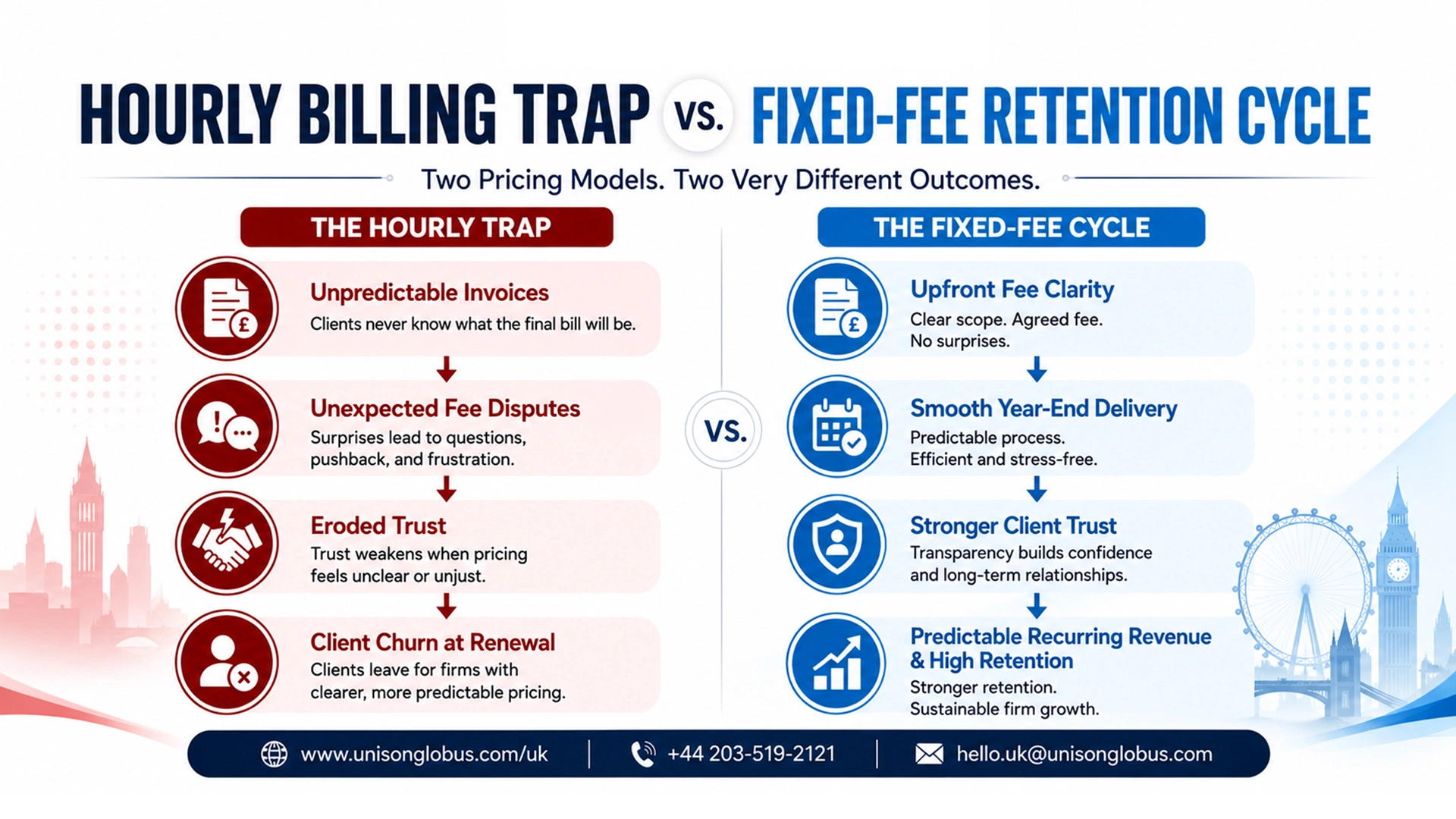
- Unpredictable Pricing: Unexpected charges create uncertainty during annual compliance discussions.
- Eroded Client Confidence: Lack of pricing clarity affects perceived service transparency.
- Renewal Risk: Weaker commercial alignment can influence long-term client retention.
By breaking this cycle, practices can better align their commercial model with client expectations. Clear upfront pricing establishes commercial clarity, allowing conversations to focus on service delivery and wider business support rather than explaining variable billable hours.
Commercial Impact: Hourly Billing vs. Fixed Pricing
| Operating Dimension | Traditional Hourly Billing | Fixed Fee Year-End Accounts Model |
|---|---|---|
| Fee Predictability | Variable; can lead to year-end fee disputes | Upfront cost certainty within the agreed scope |
| Portfolio Stability | Retention risk can increase when fee expectations are unclear | Can support more predictable client renewal conversations |
| Perceived Value | Can be affected by uncertainty around final billing | Greater transparency when scope and pricing are clearly defined |
| WIP & Realisation Risk | Potential for WIP accumulation and write-offs | Greater visibility of expected delivery costs and margins |
| Partner Workload | Time may be spent explaining or negotiating invoices | Can reduce fee-related discussions when pricing and scope are clear |
How Can UK Accounting Firms Build a Sustainable Fixed-Fee Year-End Accounts Model?
Step 1: Establish Data Quality Tiers
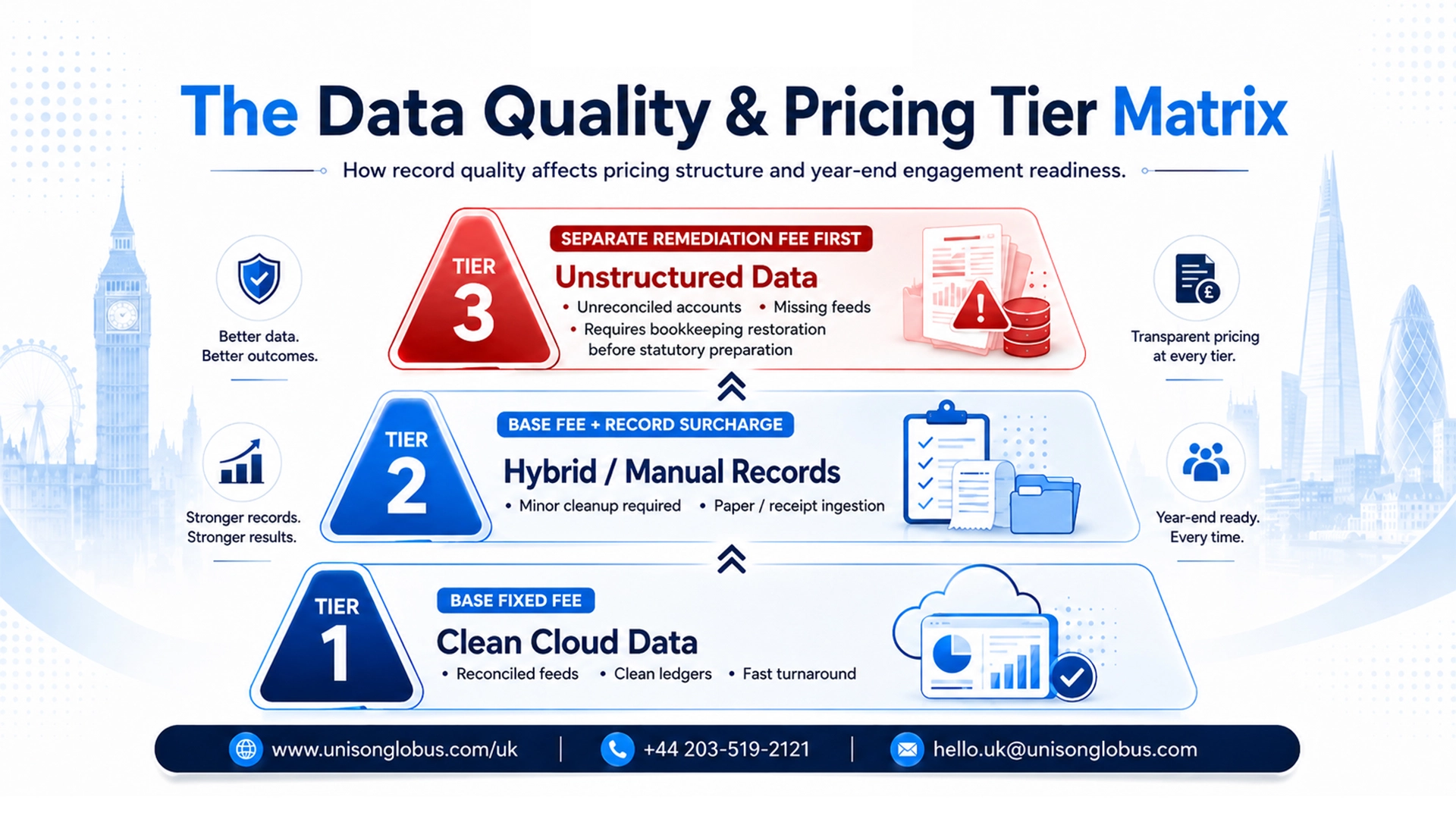
Base fixed fees on client bookkeeping quality and transaction volume rather than company turnover alone:
- Tier 1 (Clean Cloud Data): Reconciled feeds in cloud accounting software with minimal ledger queries. This forms the baseline fixed compliance fee.
- Tier 2 (Hybrid/Manual Records): Requires minor data clean-up and paper or receipt ingestion. Price this with an agreed record-processing surcharge.
- Tier 3 (Unstructured Data): Requires significant ledger reconstruction. Engagement terms should specify that bookkeeping remediation is billed separately before statutory accounts preparation begins.
Step 2: Define Explicit Scope Boundaries and Exclusions
Engagement letters must separate core statutory compliance from secondary advisory or cleanup work:- Included in Base Fixed Fee: Preparation of statutory accounts under relevant reporting standards, such as FRS 102 where applicable, including relevant small-entity requirements, or FRS 105 where the company qualifies as a micro-entity; Company Tax Return submission; standard notes assembly; and one formal partner sign-off review.
- Explicit Exclusions: Unpicking prior-period ledger errors, reconstructing lost bank feeds, handling complex HMRC enquiries, or undertaking additional work arising from historical director’s loan account adjustments.
- Remediation Thresholds: Specify that if trial balance queries exceed a pre-agreed threshold, an out-of-scope fee applies before additional processing continues.
Compliance Note: Define the Boundary Between Accounts Preparation and Tax Compliance
Transparent pricing engagements should clearly distinguish between statutory accounts preparation and wider tax compliance responsibilities. Complex tax matters, HMRC enquiries, group structures, capital allowance reviews, or research and development claims may require separate advisory arrangements.
Step 3: Implement Annual Pricing Review Cycles
Incorporate an annual fee review clause linked to client complexity, transaction volume growth, and relevant cost pressures. This review allows firms to assess whether fees remain aligned with changes in client complexity, workload, and agreed scope.
When Should Firms Introduce Fixed Pricing?
Timing is important when transitioning to a fixed-fee model. Attempting to redesign pricing structures, re-tier client portfolios, or onboard operational resources during peak compliance periods introduces unnecessary delivery risk. Practice leaders should evaluate and align their delivery models well ahead of statutory deadlines.
Reviewing practice operations during late spring or summer can provide a useful planning window ahead of peak filing periods. Deferring process and pricing decisions until later in the year can create delivery bottlenecks, increase partner workload pressure, and lead to billing disputes during busy compliance periods.
Implementation Runway ahead of Peak Periods
A practical implementation runway can be structured around three stages:
- Early Planning Phase (Portfolio & WIP Audit): Analyse realisation rates and WIP write-offs across your year-end portfolio. Identify clients with significant record clean-up requirements who may need to move to higher fixed-fee tiers.
- Scope & Capacity Alignment (Client Segmentation and Delivery Planning): Align client onboarding procedures, production capacity, and review workflows before peak periods.
- Execution & On-Time Delivery (Standardised Production and Client Communication): Execute standardised accounts production with appropriate team allocation in place, ensuring draft accounts are prepared and Company Tax Returns are filed with HMRC within agreed timelines without unexpected fee discussions.
Evaluating practice WIP recovery and portfolio retention metrics early allows partners to identify structural inefficiencies before they affect profitability, helping protect partner bandwidth and fee realisation.
Common Mistakes to Avoid When Transitioning to Fixed Pricing
While moving to fixed-fee year-end accounts supports client stability, practices frequently encounter friction when execution falls short of commercial planning. Key errors include:
- Pricing based solely on prior-year invoices: Carrying forward historical hourly totals without evaluating underlying processing inefficiencies or scope changes can perpetuate existing margin erosion.
- Ignoring bookkeeping quality: Quoting a blanket fixed fee without auditing ledger integrity forces the practice to absorb unbilled reconciliation hours.
- Missing annual fee reviews: Omitting indexed price increases or client volume reviews causes profit margins to degrade as transaction volumes grow.
- Failing to manage out-of-scope requests: Allowing work outside the initial agreement to proceed without proper notification can contribute to margin leakage.
- Treating all clients equally, regardless of complexity: Offering uniform fixed packages to businesses with vastly different reporting requirements or corporate structures risks severe underprizing.
Standardising Year-End Accounts Delivery Without Reducing Quality
A transparent pricing model protects practice margins only when accounts production workflows are standardised. Promising fixed pricing without controlling internal processing efficiency shifts financial risk back onto the practice. Implementing these structured production processes across the year-end accounts services UK practices provide can help maintain predictable turnaround times during peak compliance periods.
For example, a firm managing 300 statutory accounts engagements may standardise information requests, review checkpoints, and preparation templates to eliminate variance across the portfolio, ensuring junior staff and senior reviewers operate from the exact same playbook.
Standardised operations improve production efficiency by providing:
- Predictable Turnaround Times: Clients know when to expect draft financial statements and tax computations, removing deadline anxiety.
- Streamlined Query Management: Consolidating information requests into a single structured window prevents fragmented client interruptions.
- Consistent Deliverable Quality: Standardised working papers help ensure financial statements and CT600 return filings meet practice standards regardless of which team member prepares them.
Technical Gates for Year-End Standardisation
Practices with mature operational processes enforce technical gates before accounts production begins:
- Upfront Ledger Integrity Checks: Standardised reconciliation procedures ensure preparation begins from accurate financial data.
- Defined Remediation Rules: Applying consistent escalation procedures when data quality issues exceed agreed thresholds helps prevent delays during accounts production.
- Structured Working Paper Reviews: Applying standardised multi-tier review templates catches disclosure errors early, reducing partner review time and late adjustment friction.
By replacing ad-hoc preparation habits with disciplined, repeatable procedures, practice leaders can make fixed-fee year-end compliance more predictable for both the firm and the client.
How Outsourced Accounting Capacity Supports Fixed Fee Commitments
Many UK practices are using integrated offshore capability to support fixed-fee year-end accounts delivery. By combining internal expertise with dedicated offshore accounting support, practices can develop more scalable accounting solutions in the UK while maintaining strict control over quality, client relationships, and review standards.
To make fixed pricing sustainable, practice leaders need operational flexibility that allows them to manage fluctuating workloads without compromising review quality or client experience. Effective outsourcing models function not as standalone production arrangements, but as team extensions that integrate experienced professionals into the firm’s existing systems, procedures, communication channels, and quality-control processes.
The Fixed-Fee Delivery Framework
A successful fixed-price year-end accounts model requires alignment between commercial commitments, operational bandwidth, and client delivery outcomes. The following framework illustrates how each stage can contribute to a dependable and scalable service model.
| Delivery Stage | Strategic Objective | Operational Mechanism | Impact |
|---|---|---|---|
| 1. Commercial Commitment | Upfront Fee Certainty | Fixed pricing tied to clear scope tiers and pre-agreed review terms | Can reduce fee uncertainty and establish clearer expectations |
| 2. Production Enabler | Capacity & Delivery Velocity | Integrated capacity embedded into the practice’s workflow stack | Can help prevent internal bottlenecks and support fee realisation |
| 3. Service Outcome | On-Time Filing | Timely submission of statutory accounts to Companies House and CT600 returns to HMRC | Supports timely compliance delivery and reduces exposure to late-filing penalties |
Quality Controls and Governance
By partnering with specialised providers of offshore accounting services that UK firms trust, practices can embed dedicated preparers into their existing software stack. This allows teams to handle routine data assembly while freeing senior staff for high-value relationship management.
Offshore or co-sourced support must adhere to strict quality frameworks:
1. Quality Control Procedures
Preparation steps should follow structured review processes, including preparer checks, senior reviews, and partner sign-offs under quality management standards. For engagements within scope, this includes the FRC’s ISQM (UK) 1 framework where applicable. More broadly, firms regulated by the ICAEW should ensure their processes align with the principles-based expectations of the ICAEW Practice Assurance Regulations, supporting consistent documentation, quality monitoring, and professional compliance.
2. Information Security & Data Privacy
Operational partners should maintain information security controls, including ISO/IEC 27001 certification, where relevant, or equivalent information-security controls, secure access controls, and UK GDPR compliance. Where personal data is accessed or processed overseas, appropriate international transfer safeguards — such as Standard Contractual Clauses (SCCs) or the UK International Data Transfer Agreement (IDTA) — must be implemented to ensure legal compliance for restricted data transfers.
Important Consideration:
Outsourcing elements of year-end accounts preparation does not, by itself, transfer the UK practice's professional responsibilities under the engagement. The practice should retain appropriate oversight, review, and approval arrangements for work delivered on its behalf.
Turning Fixed Pricing Into Long-Term Client Retention
Even with transparent pricing agreements, clients evaluate professional relationships through communication consistency, delivery timelines, and overall service experience.
When internal delivery encounters friction during peak filing windows, communication slows and turnaround times stretch, creating anxiety for SME directors:
1. Late Filing Penalties:
Under Companies House filing rules applicable in 2026, private companies that file their accounts late incur penalties of £150 for filing up to one month late, £375 for more than one month but not more than three months late, £750 for more than three months but not more than six months late, and £1,500 for more than six months late.
For HMRC Corporation Tax Returns with filing dates on or after 1 April 2026, the standard late-filing penalties are £200 where the return is filed within three months of the filing date and a further £200 where it is more than three months late, resulting in a £400 fixed penalty. Higher penalties apply to repeated late filing.
These penalties can create additional friction where filing delays affect the client relationship, even where the practice manages the immediate administrative consequences.
2. Client Retention Risks:
Operational delays can contribute to client dissatisfaction and may influence retention decisions. Clients may view late filings as a reduction in service reliability and proactive account management, prompting them to reassess whether their current adviser provides the responsiveness they expect.
Establishing clear production routines helps reduce deadline pressure, supports timely delivery, and strengthens the relationship stability needed to convert transparent pricing into improved client value.
Disclaimer:
Penalty amounts are based on current Companies House and HMRC guidance at the time of writing. Actual penalties, available relief, and filing obligations may vary depending on the company's circumstances, filing history, and applicable legislative or regulatory changes. Always refer to the latest official guidance before relying on these figures.
Turn Transparent Pricing into Long-Term Practice Growth
Facing Peak-Season Capacity Pressures?
How Unison Globus UK Helps Practices Scale with Confidence
At Unison Globus UK, we help accountancy practices scale confidently through integrated accounting, bookkeeping, Corporation Tax, and year-end accounts preparation support. Our experienced professionals work within your existing systems, workflows, and quality controls, enabling your firm to manage additional delivery requirements while maintaining oversight of client relationships, compliance, and service quality.
Whether you need ongoing year-end accounts support or additional delivery capacity during busier periods, our model is designed to integrate with your existing practice operations.
Contact Unison Globus UK to discuss how our accounting outsourcing solutions can support your firm’s delivery requirements and long-term growth.