

 [gtranslate]

Improve Capacity, Reduce Costs and Deliver Excellent Client Service
Preparing year-end accounts remains one of the most resource-intensive tasks for accountants. With increasing ongoing resource challenges and growing client expectations, many firms are looking at smarter ways to manage their year-end accounts work without compromising quality.
Outsourcing year-end accounts preparation to Unison Globus UK allows accountants to increase capacity, reduce operating costs and improve turnaround times while maintaining complete control of client relationships.
This guide explains how to outsource year-end accounts services work; the benefits outsourcing can deliver and what to look for when choosing an outsourcing partner.
What Does Outsourcing Year-End Accounts Mean?
Many accountants outsource because of:
- Extreme peaks or backlogs of work
- Difficulties recruiting and retaining experienced staff
- Pressure to improve turnaround times
- Ambitious growth plans
- The need to improve profitability without increasing overheads.
Year-end accounts work is typically completed by a team based offshore using secure cloud-based accounting systems, allowing firms to benefit from highly skilled resources at a significantly lower cost than employing accountants based in the UK.
Why More UK Accountancy Firms Are Outsourcing
Increased Capacity Without Recruiting
Recruiting experienced accountants continues to be challenging and expensive. Outsourcing provides immediate access to qualified professionals who can support your team whenever workloads increase.
Rather than turning away new business or overloading existing staff, firms can scale resources up or down as demand changes.
Reduced Costs and Improved Profitability
Outsourcing can typically reduce the cost of preparing year-end accounts by up to 50% compared with employing equivalent UK-based accountants. Firms also avoid certain employment costs, including:
- Recruitment fees
- Pension contributions
- Employers National Insurance
- Holiday pay
- Training costs
- Office space and equipment.
Lower operating costs enable better profit margins while allowing firms to price services competitively.
Better Client Service
When an experienced outsourcing partner handles routine compliance work, the onshore team has more time available to support clients. Instead of spending time preparing accounts, your accountants can focus on:
- Adding value to client relationships
- Advisory services
- Practice development
- Attracting new clients.
This creates a better experience for clients while generating additional fee income.
Improved Quality and Consistency
A specialist outsourcing partner prepares year-end accounts using documented processes, experienced reviewers, and rigorous quality controls. The result is:
- Greater consistency
- Improved accuracy
- Faster turnaround
- Reduced rework
- Technical compliance.
Many firms also discover opportunities to improve their own internal workflows during implementation.
Reduced Operational Risk
Smaller firms rely heavily on a handful of experienced accountants.
If someone leaves unexpectedly, takes extended leave, or becomes unavailable during the busiest periods, service delivery can quickly be affected.
Outsourcing reduces this key person dependency by giving your firm access to a pool of talented accountants who can maintain continuity throughout the year.
Strengthened Data Security
Data security is understandably one of the key risks identified when firms consider outsourcing. A reputable outsourcing provider should demonstrate robust information security, including:
- GDPR compliance
- ISO 27001 certification
- Secure cloud-based working
- Multi-factor authentication
- Controlled system access
- Secure remote working environments
- Strict confidentiality procedures
- Physical safeguards.
Client information remains protected while work is completed efficiently and securely.
Improved Staff Development
Outsourcing is not about replacing your team. Instead, it enables qualified UK accountants to spend less time on repetitive compliance work and more time developing higher-value technical and advisory skills. This improves job satisfaction while helping firms build the next generation of specialist advisers.
When Should You Consider Outsourcing?
Many accountants begin outsourcing when they experience one or more of the following:
- Rapid practice growth
- Increasing year-end workload
- Staff shortages
- Recruitment difficulties
- Rising operating costs
- Backlogs in accounts production
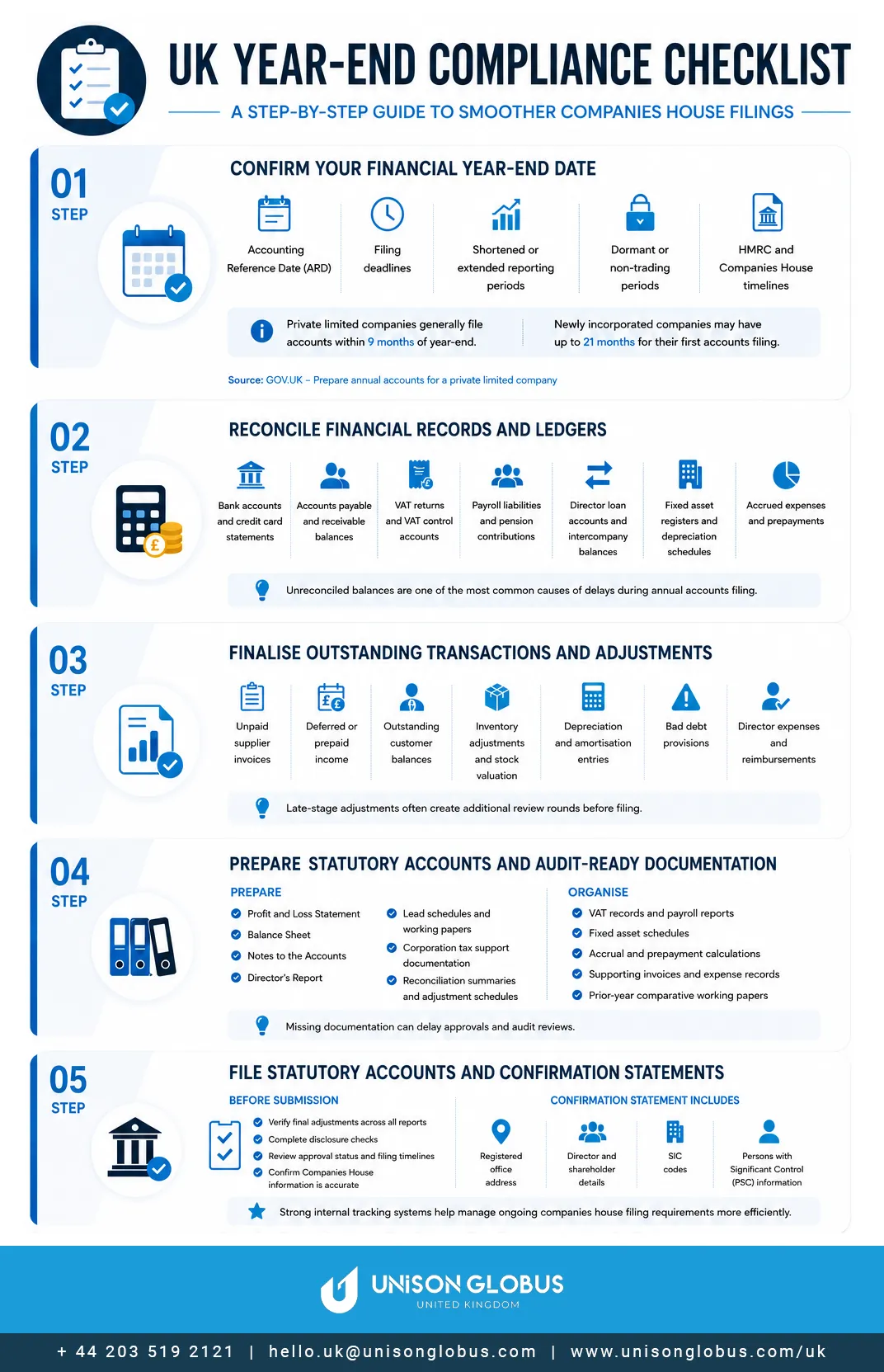
- Pressure to meet Companies House and HMRC deadlines
- Expansion into new service areas.
Introducing outsourcing before workloads become unmanageable allows firms to implement new processes gradually and achieve the greatest long-term benefits.
What Should You Look for in an Outsourcing Partner?
Choosing the right outsourcing partner is essential. Look for a provider that offers:
- Extensive experience supporting UK accountancy firms
- Qualified accountants with UK accounting and tax expertise
- Strong knowledge of Companies House and HMRC requirements
- Experience using commercial accounting software
- Dedicated account management
- Documented quality assurance processes
- GDPR compliance
- ISO 27001 certification
- Flexible pricing
- Excellent customer references.
Which Year-End Accounting Services Can Be Outsourced?
Most year-end accounting work can be outsourced successfully, including:
- Statutory accounts preparation for limited companies
- Trial balance preparation
- Balance sheet reconciliations
- Corporation tax computations
- Company tax return preparation
- VAT returns
- Monthly bank reconciliations
- Management accounts
- Professional working papers
- Statutory accounts and company tax filing support.
Many firms also outsource:
- Making Tax Digital for Income Tax
- Bookkeeping
- Payroll
- VAT compliance
- Personal tax returns
- Company secretarial services
Working with a single outsourcing partner across multiple service lines provides greater consistency and efficiency.
Why Choose Unison Globus UK?
At Unison Globus UK, we have been providing offshore services to accountants since 2006. Our customers include sole proprietors, as well as small and medium sized UK Accountancy firms. Our outsourced tax, accounting and payroll services are suitable for all client engagements – from sole traders and micro businesses to SMEs and large companies.
We provide a free trial of up to 10 hours of accountant time, with turnaround in 72 hours. If you’re looking to outsource services for the first time, increase margins, and help your clients thrive, you can book a video call with one of our expert advisors or email us at [email protected].