

 [gtranslate]

Summarize and analyze this article with:
- What Making Tax Digital Means for Accounting Firms Today
- Why Outsourcing Is Becoming Part of the MTD Answer
- MTD for VAT: The Phase Firms Have Already Absorbed
- MTD for Income Tax: The Phase That Changes the Workload
- Getting Ahead of MTD, Not Just Keeping Up With It
- Frequently Asked Questions
- What is Making Tax Digital UK for accounting firms, in simple terms?
- Can firms hire offshore accountants for MTD UK compliance work specifically?
- What do MTD IT outsourcing solutions UK actually cover?
- Is outsourced bookkeeping services UK support enough on its own, or does it need to be paired with something else?
- Does payroll outsourcing services UK support help with MTD specifically?
- Why would a firm outsource MTD compliance UK to reduce workload rather than hire in-house?
- Does tax preparation outsourcing UK cover corporation tax and year end accounts too?
VAT has been running under MTD rules since 2022, so most firms know this pattern well. Making Tax Digital for Income Tax services became mandatory this April for sole traders and landlords earning over £50,000, with more clients pulled in as the threshold drops to £30,000 in 2027 and £20,000 in 2028.Payroll, year-end accounts, and tax preparation all sit on the same real-time, digital-first expectation HMRC has built its systems around.
Source: Low Incomes Tax Reform Group
This guide breaks down what MTD actually requires across bookkeeping, VAT, payroll, and tax, and looks at how outsourcing has become a practical way for UK accounting firms to handle the added workload without growing headcount.
What Making Tax Digital Means for Accounting Firms Today
That has three concrete consequences for firms.
- First, a plain spreadsheet stops being enough on its own; it needs bridging software to connect to HMRC’s system, or the firm needs to move clients onto full accounting software like Xero, QuickBooks, or FreeAgent.
- Second, HMRC only accepts submissions from recognised software, so there is no manual online filing fallback once a client is in MTD.
- Third, filing frequency changes from once a year to several times a year, which is the part that actually drives firm workload, not the software switch itself.
Clarification: MTD for Corporation Tax (CT600) is not part of this. HMRC confirmed in July 2025 that it would not go ahead, citing complexity and resource constraints. VAT and Income Tax are the two parts of MTD that are actually live, and VAT got there first in 2022, which is why it's worth looking at next; it shows firms what the Income Tax rollout will likely feel like once it beds in.
Why Outsourcing Is Becoming Part of the MTD Answer
Reading through what MTD requires is one thing. Staying on top of it for every client, every quarter, without adding permanent headcount, is a different problem. That’s the gap accounting outsourcing UK for MTD compliance is built to close, and it’s worth understanding how it actually works before looking at each compliance area in detail.
The two common delivery models
Most outsourcing arrangements fall into one of two structures.- The first is a ticketing model, where routine work gets logged and picked up by the next available person at the provider’s end. It’s fast to set up but offers less continuity; a different person may handle a client’s bookkeeping each month.
- The second is a dedicated team model, where specific offshore staff work exclusively with one firm, learning its clients, its software setup, and its review preferences over time. For MTD work specifically, where quarterly familiarity with a client’s numbers matters, the dedicated model tends to hold up better.
How the working relationship runs
In practice, firms that hire offshore accountants for MTD UK work typically keep review and client communication in-house, while the offshore team operates inside the firm’s existing software (Xero, QuickBooks, FreeAgent, or bridging software for spreadsheet-based clients) rather than a separate system. A UK-based reviewer or manager signs off before anything goes to a client or HMRC. Data access is scoped and logged, and a data processing agreement sets out where data sits and how it’s handled, since GDPR responsibility stays with the UK firm regardless of where the work is done.What actually gets outsourced
- Digital bookkeeping for MTD compliance and outsourced bookkeeping services UK, covering transaction coding, bank reconciliation, and record maintenance kept current through the year, not rebuilt at quarter-end
- MTD IT outsourcing solutions UK, meaning the quarterly update cycle itself: data preparation, exception flagging, and draft submissions ready for in-house review and filing
- VAT compliance services UK, running the same digital-records discipline that VAT has required since 2022
- Payroll outsourcing services UK and RTI payroll services UK, keeping pay runs and HMRC submissions on schedule, independent of the ITSA workload
- Tax preparation outsourcing UK, corporation tax services UK (CT600), and year end accounts services UK, so a firm isn’t running separate providers for each compliance area
Where the value actually shows up
The workload that shifts offshore is usually the volume-heavy, repeatable part, data entry, reconciliation, first-pass preparation, not judgment calls or client relationships. That’s a deliberate split: firms keep ownership of anything requiring professional judgment or direct client contact, while routine processing runs in the background. For a practice with, say, 60 clients newly in MTD for Income Tax, that’s the difference between four in-house staff absorbing 240 extra quarterly filings a year, or an outsourced team handling the bulk of that volume while the same four staff review and sign off.Can Your Team Keep Up with Growing MTD Workloads?
MTD for VAT: The Phase Firms Have Already Absorbed
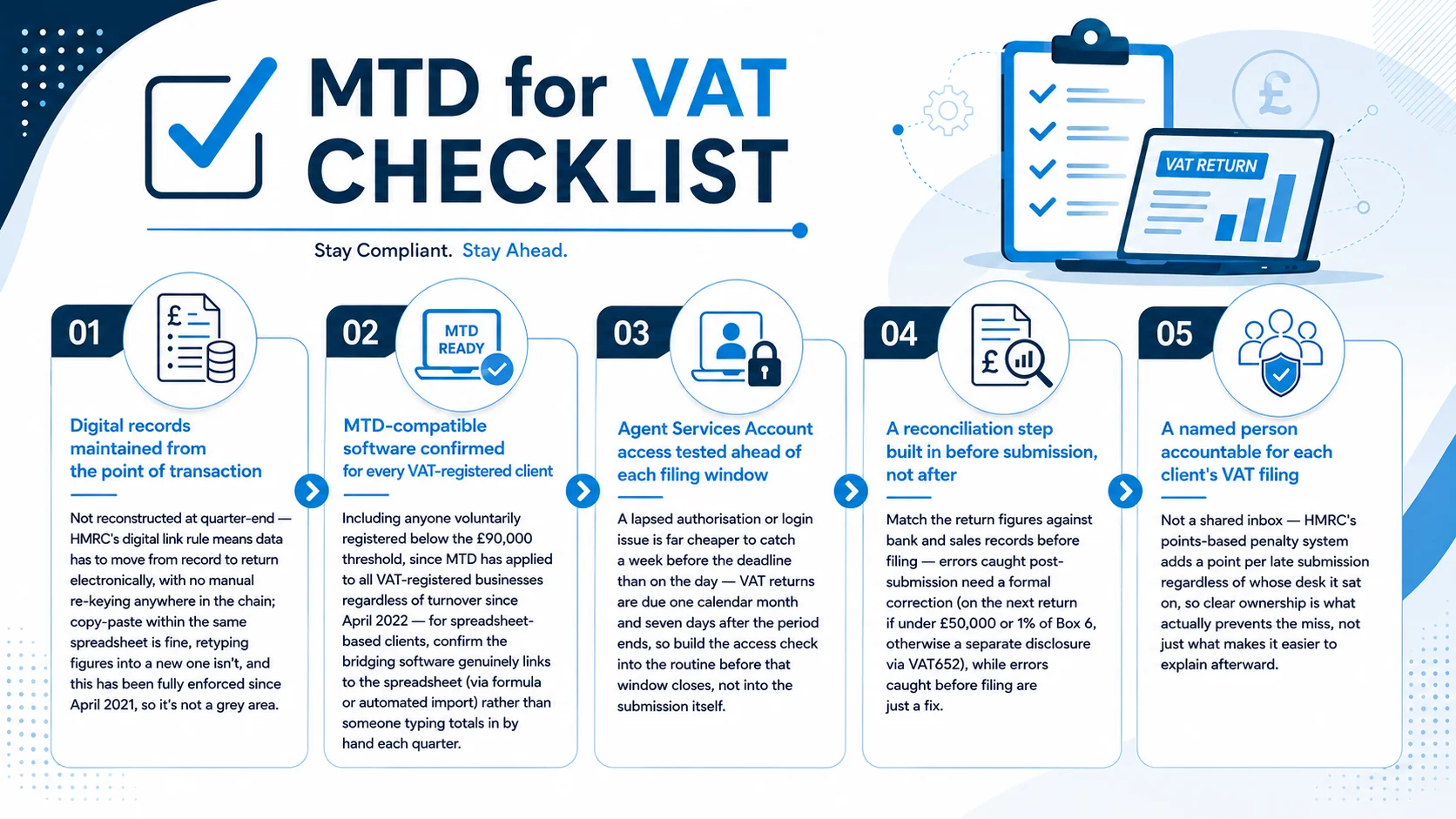
VAT compliance services UK were the first real test of Making Tax Digital, and firms have been living with it since 2022. Every VAT-registered business, regardless of size, keeps digital VAT records and files returns through MTD-compatible software. There is no paper route left.
For most firms, this transition landed better than expected. Survey data from the Chartered Institute of Taxation found that 69% of respondents said filing VAT returns under MTD was fairly or very easy. The friction that did show up wasn’t really about VAT itself; it was about the infrastructure around it: 43% found HMRC’s Agent Services Account difficult to work with, and 45% said getting help directly from HMRC was very difficult.
A good number of practitioners also said the MTD for VAT change was less than they expected. Clients who already kept digital records in Xero or QuickBooks noticed almost no difference. For firms with clients still on spreadsheets or paper, the shift was bigger, though VAT remains a comparatively simple return once the bookkeeping behind it is in order.
That’s exactly why VAT is worth understanding before looking at Income Tax. It shows what firms can expect: a manageable adjustment for clients whose bookkeeping was already solid, and a heavier lift for clients who weren’t digital to begin with. Income Tax multiplies that same pattern across a much larger and more complex group of clients, which is where the real workload pressure starts.
MTD for Income Tax: The Phase That Changes the Workload
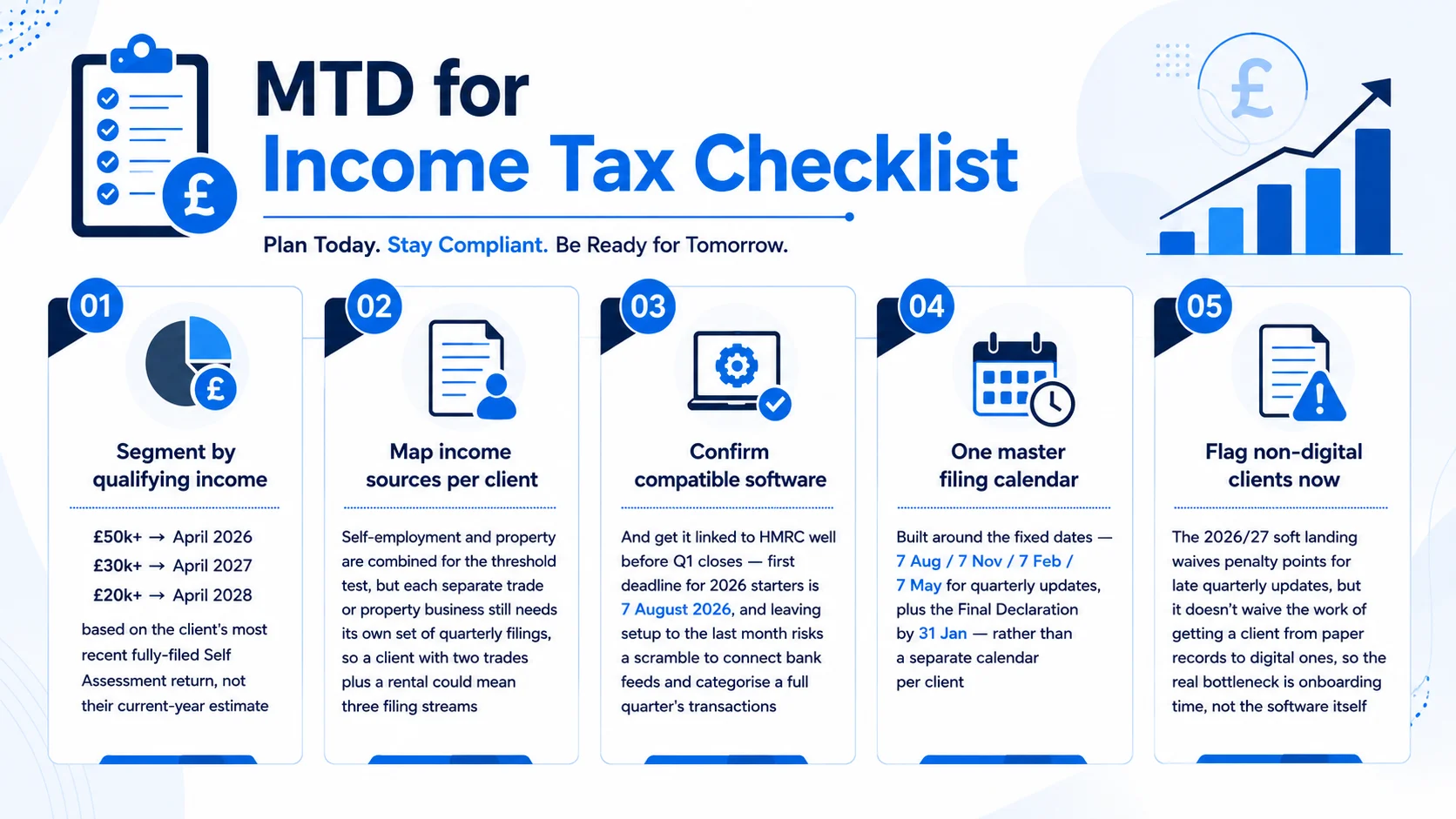
The £50,000 threshold is only the entry point. What actually changes for these clients is the filing rhythm itself. One annual Self Assessment becomes four quarterly updates plus a Final Declaration, due 7 August, 7 November, 7 February, 7 May, and 31 January respectively. A sole trader running two trades files two separate sets of updates. Property income across multiple addresses is combined into one stream.
The penalty structure has changed, too. The old flat late-filing fine is gone, replaced by a points system similar to VAT’s: one point per missed submission, £200 once four points are reached, then £200 again each time after. A soft landing applies to quarterly updates for 2026/27 only, the Final Declaration and late payments aren’t covered by that grace period.
What makes this phase harder isn’t the mechanics; it’s the gap between how accountants and clients feel about it. Research found that 68% of accountants view Making Tax Digital for Income Tax services positively for their business, yet almost as many, 42%, say more than half their clients still aren’t digital.
Client-side research tells a rougher story; one His Majesty’s Revenue & Customs advisory board survey found 68.5% saw no benefit to the scheme at all. Nobody’s arguing MTD is the wrong idea. The strain is in bringing every client along at once, which is exactly where MTD for Income Tax with digital bookkeeping kept current through the year makes the quarterly cycle manageable rather than a scramble.
Payroll, RTI, and the Rest of the Compliance Stack
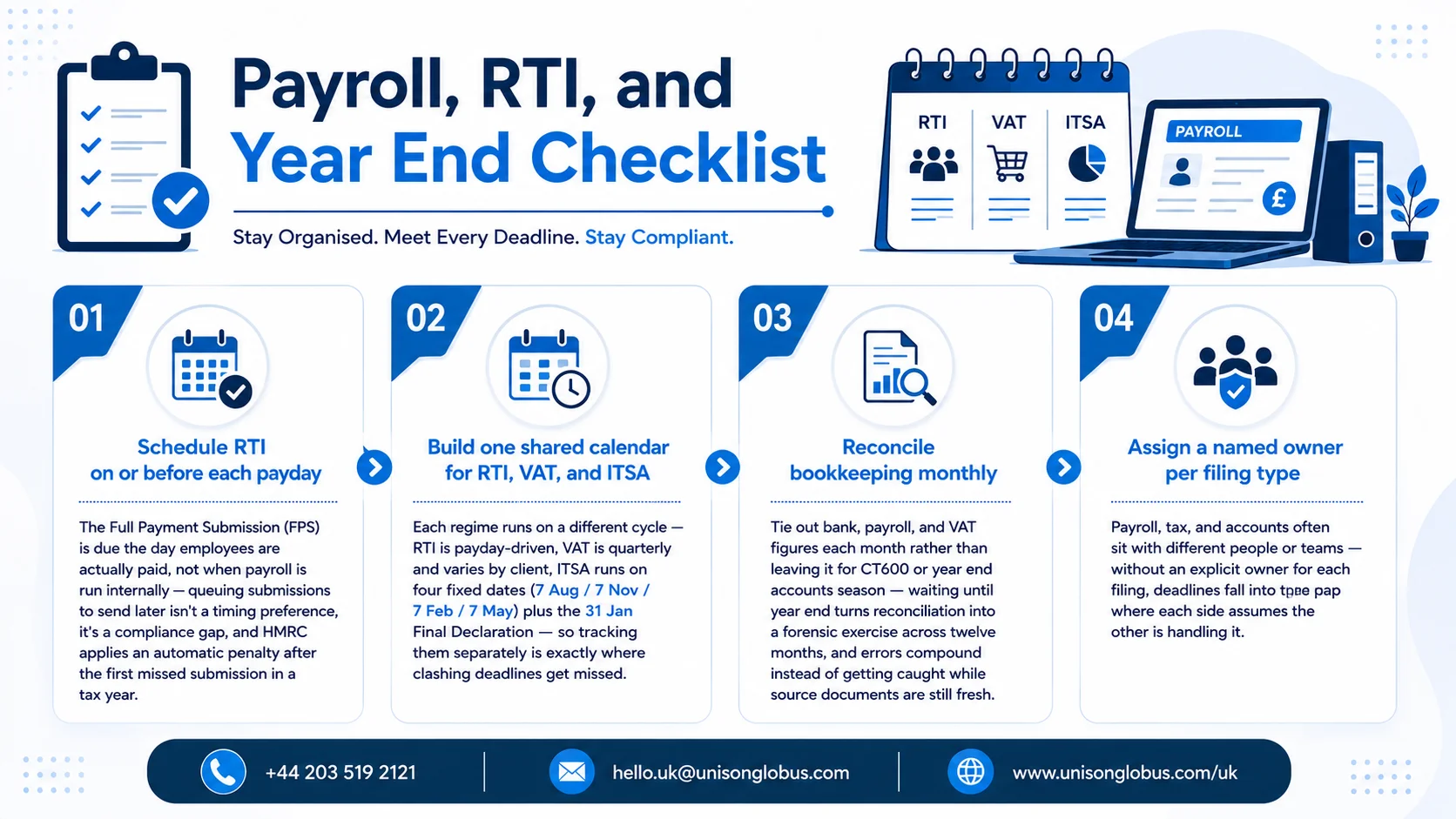
Payroll runs on its own real-time clock, separate from MTD but built on the same principle. RTI payroll services UK require payroll data to reach HMRC on or before each payday, not batched up afterwards. It’s not formally part of MTD, but it sits in the same “report as it happens” category, and firms handling it alongside quarterly ITSA updates and VAT returns are effectively juggling three overlapping submission calendars rather than one.Corporation tax stays on its existing track, since CT600 isn’t moving to MTD. But the quality of a corporation tax services UK (CT600) filing still depends entirely on what’s been fed into it. Clean digital records throughout the year make preparation straightforward; gaps in bookkeeping upstream turn into CT600 problems in January, regardless of which system is technically “MTD.”
Year end accounts services UK follow the same logic. Firms that keep digital bookkeeping current throughout the year, rather than reconstructing twelve months of records after the fact, find year end accounts preparation faster and considerably less error-prone.
Getting Ahead of MTD, Not Just Keeping Up With It
The pattern running through this guide is the same one MTD keeps producing at every phase. VAT proved firms can adapt to digital filing without much disruption. Income Tax is proving something else: that the real challenge isn’t understanding the rules, it’s delivering them consistently across a growing client base without burning out the team doing the work.
That’s really what it comes down to when firms streamline bookkeeping and tax under MTD UK: fewer disconnected point solutions, one consistent digital workflow covering bookkeeping, VAT, payroll, and tax, so nothing depends on manually stitching four separate processes together each quarter.
For firms weighing their options, the ones that outsource MTD compliance UK to reduce workload tend to make the call before a threshold forces their hand, not after a quarter gets missed. Whether that means outsourcing one service line or several, the firms handling this well are the ones treating MTD compliance with bookkeeping and VAT services as one connected system, not four separate compliance problems competing for the same hours.
This is exactly the gap Unison Globus UK works inside. Our teams plug into a firm’s existing software and review process, taking on the volume behind bookkeeping, VAT, payroll, and tax preparation so in-house staff stay focused on client work rather than quarterly submission mechanics.
If you’re weighing up whether outsourcing makes sense for your firm’s MTD workload, we’re happy to talk through what that could look like for your specific client base.
Book a consultation or start a free trial to see how it works in practice.
Looking for a Smarter Way to Manage MTD Compliance?
Frequently Asked Questions
It’s HMRC’s shift from annual paper-style filing to digital, software-driven reporting. For accounting firms, it means keeping client records digital from the point of transaction and submitting figures to HMRC directly through compatible software, rather than once a year.
Digital bookkeeping is the foundation MTD depends on, but it works best paired with VAT, payroll, and tax preparation support, since all four feed into the same quarterly and annual filings.