
Categories
Bookkeeping home uk VAT Services

Reducing VAT Errors Through Real-Time Bookkeeping: A Strategic Guide for UK Accounting Firms

It usually starts with one bank transaction. The transaction can be processed, but the supporting evidence has not arrived, so it gets left “for later”.

Then another transaction requires client confirmation before its VAT treatment can be finalised, while a bookkeeping correction is deferred rather than resolved. Across bookkeeping and VAT services in the UK, these unresolved items can remain open simply because they are not considered urgent enough to interrupt the current workflow. 

The issue for UK accounting practices is therefore not simply technical competence. It is how consistently exceptions are identified, assigned, resolved, and cleared before they reach VAT review.

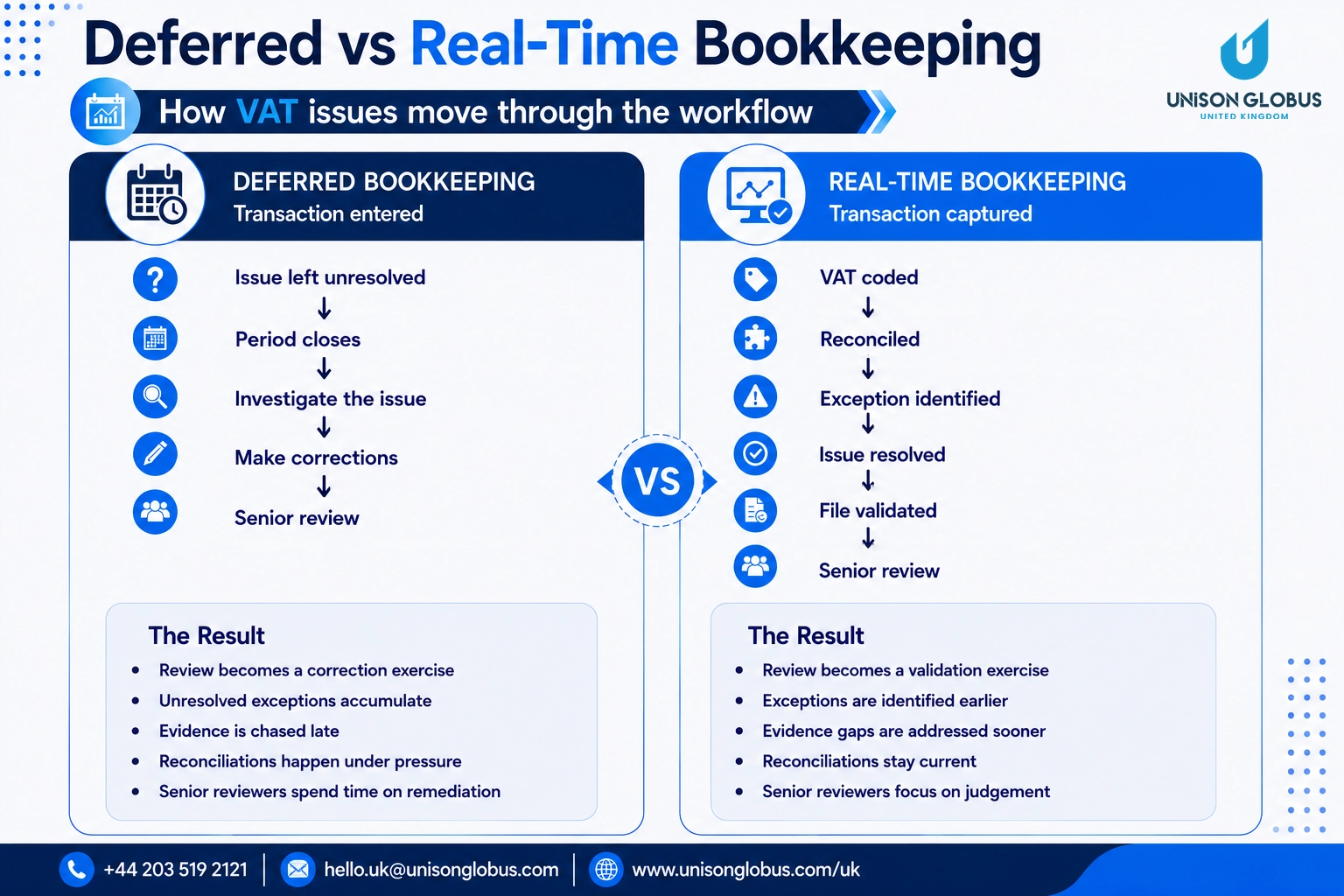
The workflow difference is straightforward:

  • Deferred: Transaction → unresolved → period closes → investigate → correct → review
  • Real-time: Transaction → identify exception → resolve → reconcile → validate → review

When these controls operate throughout the bookkeeping cycle, VAT preparation can begin with a substantially complete file rather than a queue of unresolved issues. The result is a shift in review from finding and fixing routine problems to validating the VAT position.

TL;DR

  • Deferred bookkeeping, including missing evidence, unresolved queries, and delayed corrections, can turn VAT review into a correction exercise rather than a validation step.
  • Real-time bookkeeping is a control framework that moves reconciliation, VAT coding, evidence capture, and exception resolution closer to transaction entry.
  • HMRC’s 2025 MTD evaluation found that 48% of businesses kept VAT records continuously up to date, compared with 38% before MTD. It also found that 67% identified at least one-way MTD had reduced potential mistakes.
  • MTD requires digital records, compatible software, and relevant digital links, but real-time bookkeeping itself is a firm-level workflow choice.
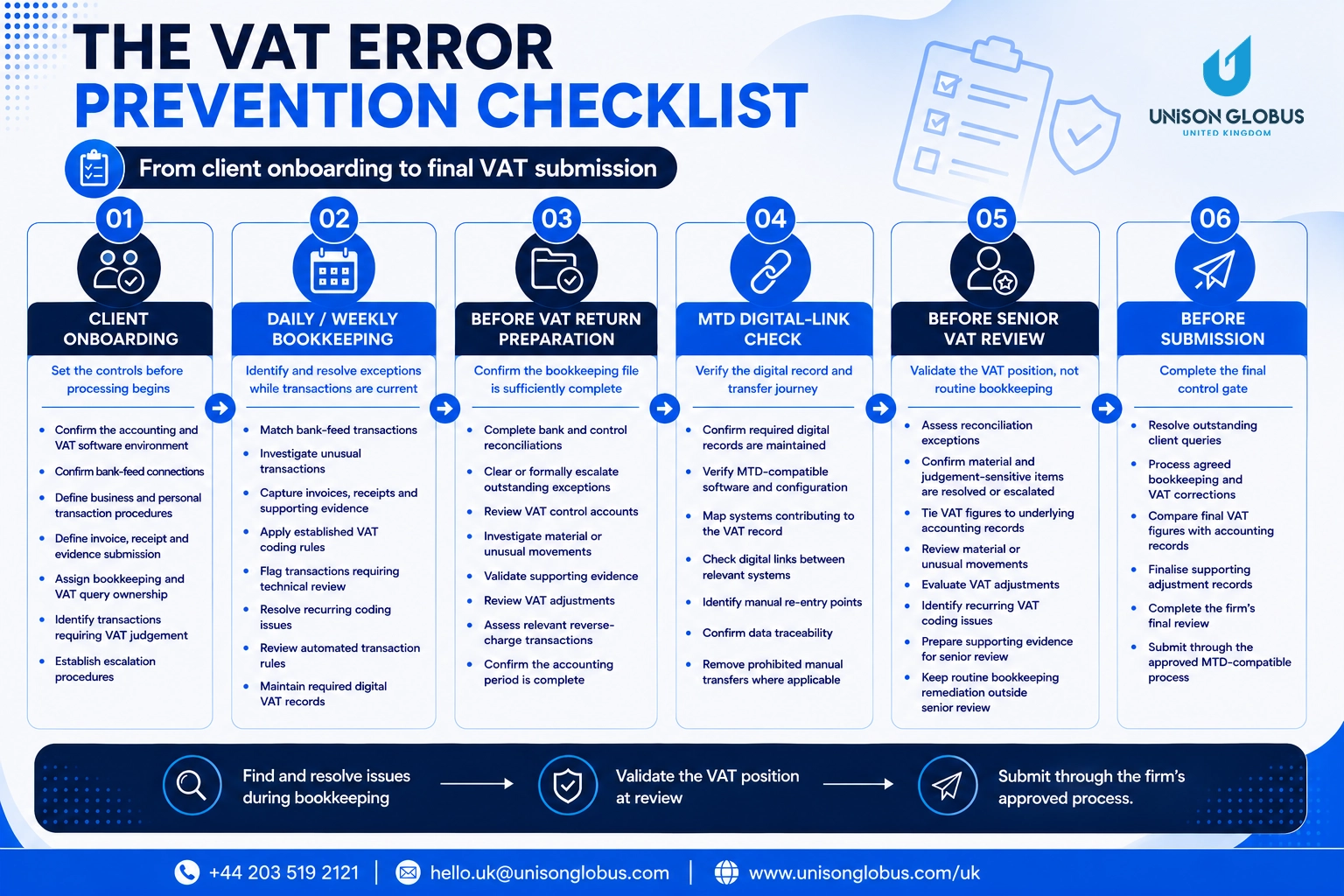
  • A practical VAT error-prevention framework covers six stages, from client onboarding and routine bookkeeping through MTD checks, senior VAT review, and pre-submission controls.
  • The objective is to resolve routine bookkeeping issues earlier so senior reviewers can focus on technical judgement, while defined external support can assist with execution where appropriate.

What Deferred Bookkeeping Actually Costs a UK Accounting Practice

For an accounting practice, the cost of deferred bookkeeping becomes most visible when routine remediation starts consuming review time and disrupting planned workflow. Incomplete records can delay VAT preparation because the file is not sufficiently complete to proceed. The issue is not the preparer’s technical capability, but whether the underlying bookkeeping has been sufficiently completed and controlled before the file reaches VAT preparation.


When basic bookkeeping issues remain unresolved, they can carry into later stages of the workflow. Senior reviewers may then spend time resolving bookkeeping matters rather than validating technical positions. At the same time, unanswered client queries can delay progress further, particularly when supporting evidence has not been requested early enough.


As these issues recur, workflow and resource planning become less predictable. Review effort starts to depend on how much remediation a file requires rather than on the technical assessment planned for that stage.


The effect can also extend to the client relationship. When evidence requests and bookkeeping queries arrive late or are repeated, clients may experience the process as reactive rather than controlled.


The operational impact becomes clearer when each deferred bookkeeping issue is traced to the work it creates downstream:

Deferred Issue Downstream Impact
Unreconciled transaction Reconciliation rework
Missing VAT evidence Client query
Incorrect VAT code Return correction
Unresolved exception Senior review time
Repeated bookkeeping error Recurring compliance risk

This is why VAT compliance UK bookkeeping should be considered an upstream control issue rather than something addressed only during VAT return preparation.

Stop VAT backlogs before review. Let Unison Globus UK keep your client files reconciled and exception-free.

What the UK Data Says About Digital Accounting and Client Expectations

HMRC’s 2025 final evaluation of Making Tax Digital for VAT supports the case for earlier issue detection.


HMRC’s 2025 evaluation, drawing on IFF Research involving 2,005 businesses mandated in 2019, found that 48% kept VAT records continuously up to date, compared with 38% before MTD. It also found that 67% identified at least one-way MTD had reduced potential mistakes.


The finding matters because more frequent digital record updates change when errors can be identified. This is particularly relevant when considering how VAT errors UK businesses encounter can arise from incomplete records, inconsistent coding, or unresolved transaction exceptions.


HMRC’s evaluation also found that 53% of businesses mandated in 2019 felt more confident about getting their VAT right after adopting MTD. Among businesses using fully functional software, that figure rose to 59%.


For a practice leader, the implication is practical. Digital record keeping is not simply a compliance requirement. It can create more frequent opportunities to identify discrepancies before they become period-end problems.


The question is whether the accounting firm’s own workflow uses those opportunities or still relies on quarterly catch-up.

Real-Time Bookkeeping Is a Control Framework, Not Just a Faster Bookkeeping Process

Real-time bookkeeping is best understood as a control framework. It moves reconciliation, evidence capture, coding checks, and exception handling closer to transaction entry.


The objective is not to process transactions simply because technology makes faster processing possible. The objective is to prevent unresolved issues from accumulating. For UK accounting firms, this connects bookkeeping controls with VAT reporting discipline, while MTD requirements govern the relevant digital records and data flows.


A controlled workflow follows:

Capture → Code → Reconcile → Exception → Resolve → Validate → Review


Each stage has a specific purpose.

  • Capture: Bring transactions and supporting evidence into the accounting environment.
  • Code: Apply the appropriate accounting and VAT treatment.
  • Reconcile: Confirm transactions agree with underlying records.
  • Exception: Identify items requiring further investigation or judgement.
  • Resolve: Assign and clear the exception before it moves downstream.
  • Validate: Confirm the file is complete and internally consistent.
  • Review: Apply professional judgement to material, unusual, or technically complex matters.

This approach supports accurate VAT reporting while also improving the quality of current-period financial information.


A reconciled file can support broader client conversations more effectively than a file that still requires basic bookkeeping reconstruction.

The Real-Time VAT Error Prevention Checklist for UK Accounting Firms

The most effective control framework follows the client file chronologically, strengthening bookkeeping first, controlling VAT error risks throughout, and verifying relevant MTD requirements before submission. For firms delivering bookkeeping services for VAT compliance, this means embedding VAT checks into routine bookkeeping rather than treating them as a separate period-end activity. 


At Client Onboarding

VAT error prevention begins before routine transaction processing. Establish the operating model and escalation routes at the start:

  • Confirm the software environment: Record the accounting and VAT platforms used by the client and practice.
  • Confirm bank-feed connections: Establish which relevant accounts are connected and how transaction data enters the ledger.
  • Define transaction boundaries: Establish procedures for identifying business and personal transactions.
  • Assign query ownership: Establish who answers bookkeeping and VAT queries and how unresolved items are escalated.
  • Identify judgement areas: Flag transaction types likely to require technical VAT consideration.
  • Set escalation procedures: Establish a clear route for uncertain VAT treatment rather than allowing items to remain unresolved.

The objective is to establish controls for VAT compliance in UK bookkeeping before transaction volume creates an exception backlog. 

During Daily or Weekly Bookkeeping

Routine processing is where many preventable exceptions should be identified. The workflow should make unresolved items visible:

  • Match bank-feed transactions: Reconcile transactions at an appropriate frequency based on transaction volume and risk.
  • Investigate unusual transactions: Flag items that do not fit established client patterns or coding rules.
  • Capture supporting evidence: Attach available invoices, receipts, and other relevant documents to transactions during processing, and raise missing items as exceptions.
  • Apply VAT codes: Apply established coding rules during processing rather than correcting large batches before review.
  • Identify technical exceptions: Route genuinely uncertain VAT treatments to the appropriate reviewer.
  • Resolve recurring issues: Correct the underlying cause when the same coding problem repeatedly appears.
  • Review recurring rules: Check automated transaction rules periodically for continued suitability.
  • Maintain digital records: Record the VAT information required in functional compatible software, while retaining invoices, receipts, and other supporting records in the form required by VAT rules.

This is where digital bookkeeping becomes a control mechanism rather than simply a method of recording transactions.


It also supports digital VAT record keeping UK practices by keeping required VAT information and supporting documentation organised within the firm’s broader bookkeeping workflow.

Before VAT Return Preparation

Before VAT return preparation for UK businesses begins, the bookkeeping file should pass a defined completion gate:

  • Complete reconciliations: Confirm relevant bank and control reconciliations are complete, with routine discrepancies resolved.
  • Clear exceptions: Resolve or formally escalate outstanding bookkeeping items that could affect VAT preparation.
  • Review VAT control accounts: Investigate balances that do not reconcile with underlying activity.
  • Investigate movements: Review material or unusual period-on-period changes before the file moves into VAT preparation.
  • Validate evidence: Confirm that supporting documentation is sufficient for material, unusual, or VAT-sensitive transactions.
  • Review adjustments: Check that relevant VAT adjustments have appropriate explanations and supporting records.
  • Review reverse charges: Where applicable, identify and assess relevant reverse-charge transactions before VAT preparation.
  • Confirm period completion: Establish that the accounting period is sufficiently complete for VAT preparation to begin.

HMRC’s VAT record-keeping guidance sets out the records VAT-registered businesses must keep and states that business records generally need to be retained for at least six years.


The result should be a VAT-ready bookkeeping file, with routine exceptions addressed, required evidence available, and the underlying records sufficiently controlled to support VAT preparation and the relevant MTD process.

MTD Digital-Link Check

MTD creates specific requirements around digital records, compatible software, and digital links. These requirements form part of the wider HMRC VAT compliance requirements for MTD reporting, while real-time bookkeeping remains a firm-level control choice.


Use this control point to assess:

  • Confirm digital records: Verify that the VAT information required for the electronic account is maintained digitally in functional, compatible software.
  • Confirm compatible software: Check the specific software and configuration being used.
  • Map software connections: Identify every system contributing to the VAT record.
  • Check digital links: Confirm that transfers within the functional, compatible software journey meet HMRC’s digital-link requirements.
  • Identify manual re-entry: Locate points where figures are manually retyped between systems.
  • Confirm traceability: Ensure figures can be followed through the relevant digital record journey.
  • Review transfer procedures: Eliminate manual transfers where HMRC requires a digital link, while documenting permitted manual inputs within the digital-record workflow.

HMRC states that digital links can include API transfers, XML, CSV imports and exports, and automated transfers. Copy-and-paste is not considered a digital link.


HMRC Guidance: Digital links and acceptable transfer methods under MTD for VAT. View HMRC VAT Notice 700/22

This makes Making Tax Digital VAT bookkeeping a practical control within the wider VAT error-prevention workflow.


The same principle applies to MTD compliance bookkeeping for UK firms operating across multiple software environments. The key issue is whether required digital records and their relevant transfers remain compliant, traceable, and connected to accurate underlying bookkeeping and VAT reporting.

Before Senior VAT Review

Senior review should validate the VAT position rather than repair basic bookkeeping. The focus should shift from file completeness to professional assessment:

  • Assess reconciliation exceptions: Focus on unusual reconciling items, unexplained balances, or exceptions requiring professional assessment rather than repeating routine reconciliation work.
  • Assess material exceptions: Confirm that material or judgement-sensitive items have a documented resolution, escalation rationale, and supporting evidence.
  • Validate VAT figures: Tie VAT figures back to the underlying accounting records and investigate material variances.
  • Assess unusual movements: Review significant or unusual changes where the explanation may affect the VAT position or require professional judgement.
  • Evaluate adjustments: Assess whether VAT adjustments are appropriate, supported, and consistent with the underlying transaction and applicable treatment.
  • Identify recurring coding issues: Determine whether recurring VAT coding patterns indicate a broader workflow, training, or client-process issue.
  • Prepare review evidence: Ensure material VAT judgements, adjustments, and technical matters are supported by the documentation or explanations required for senior review.
  • Protect reviewer time: Keep routine bookkeeping remediation outside the senior review wherever appropriate.

This is where VAT compliance support accounting firms can use defined external execution to keep routine bookkeeping work ahead of senior review. The aim is to move routine bookkeeping execution and correction earlier so senior professionals can focus on technical assessment, judgement, and review.

Before Submission

The final stage should operate as a control gate:

  • Resolve client queries: Confirm outstanding questions affecting the return have been answered.
  • Process corrections: Ensure agreed bookkeeping and VAT corrections are reflected in the file.
  • Review the return: Compare final VAT figures with the accounting records.
  • Finalise adjustment records: Confirm approved VAT adjustments are reflected in the return and supported by the required explanations and documentation.
  • Complete final review: Follow the firm’s established approval procedure.
  • Submit appropriately: Following the firm’s final approval, use its approved MTD-compatible submission process.

The strongest workflow makes submission the final validation point, not the first opportunity to discover incomplete records.

Use HMRC Error-Correction Rules as a Control Reference, Not an Error Tolerance

HMRC provides specific routes for correcting VAT errors already discovered. Those routes should never be treated as an acceptable level of bookkeeping inaccuracy.


Under Method 1, the net value of previous-return errors can generally be adjusted on the current VAT Return where the amount does not exceed £10,000. Errors between £10,000 and £50,000 can also use Method 1 where they do not exceed 1% of Box 6 for the return period in which the errors are discovered. Net errors greater than £50,000, or errors between £10,000 and £50,000 that exceed the applicable 1% Box 6 test, require Method 2 notification. The applicable correction methods and limits are set out in HMRC’s VAT error-correction rules.


HMRC also states that deliberate errors must use Method 2. Where a Method 1 correction resulted from careless conduct, separate disclosure may be required to obtain the maximum penalty reduction.


The operational distinction is important:

Regulatory Framework Operational Objective
Understand correction thresholds Detect errors early
Follow HMRC correction routes Resolve underlying bookkeeping issues
Assess material errors correctly Prevent recurring errors
Document appropriate corrections Strengthen review controls

Therefore, MTD VAT errors solutions should focus on earlier detection and root-cause correction rather than treating regulatory thresholds as acceptable error levels.

Warning:

The £10,000 figure is a regulatory correction limit. It is not an acceptable-error allowance or a bookkeeping target.

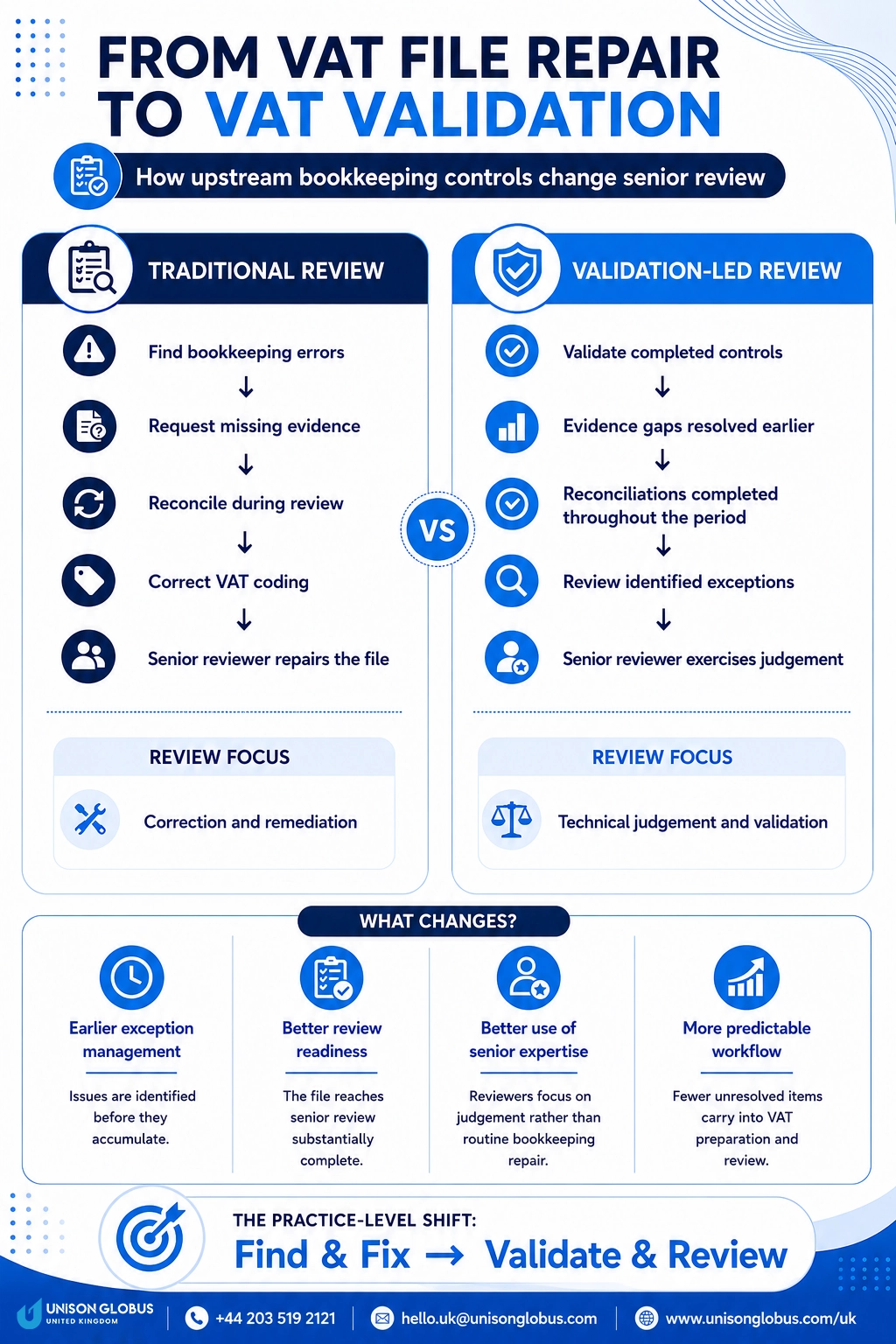
Turn the Final VAT Review into a Validation Exercise

A well-controlled bookkeeping workflow changes the purpose of senior review.


The file arrives substantially complete. Reconciliations have been performed. Exceptions have owners. Supporting evidence has been collected. The reviewer can focus on technical judgement and unusual transactions.


The distinction is straightforward:

Traditional Review Real-Time Workflow
Find bookkeeping errors Validate completed controls
Request missing evidence Resolve evidence gaps earlier
Reconcile during review Reconcile throughout the period
Correct VAT coding Review identified exceptions
Senior reviewer repairs file Senior reviewer exercises judgement

This also makes review findings more useful.


A recurring VAT coding issue should not simply be corrected and forgotten. It should feed back into the bookkeeping rule, client instruction, training point, or escalation procedure that caused the problem.


That creates a practical improvement cycle:


Exception identified → Cause assessed → Process improved → Recurrence monitored


The outcome is stronger Value Added Tax solutions because VAT control becomes part of the broader bookkeeping operating model.

The Technology Behind a Real-Time Bookkeeping Workflow

A real-time bookkeeping workflow does not depend on adopting a new technology stack. The priority is using existing systems to support earlier visibility, exception management, reconciliation, and evidence capture.


Common capabilities include:

  • Bank feeds: Bring transaction activity into the accounting system regularly, allowing unmatched or unusual items to be identified earlier.
  • Receipt and invoice capture: Connect supporting evidence to transactions while the underlying activity is still current.
  • Automated matching: Reduce routine unmatched transactions while leaving exceptions for appropriate review.
  • Cloud accounting platforms: Maintain connected accounting records and support access across the practice’s workflow.
  • Practice workflow tools: Assign bookkeeping tasks, track outstanding queries, and make unresolved exceptions visible.

Accounting platforms such as Xero, QuickBooks, and Sage can support elements of a real-time bookkeeping workflow, depending on the product, configuration, and client environment.


The important distinction is that technology enables the control framework; it does not create the control framework by itself.


For example, an automated bank feed may improve transaction visibility, but someone still needs to investigate an unusual transaction. Receipt capture may make evidence available sooner, but the supporting document still needs to be assessed. Automated matching can reduce routine work, but exceptions still require appropriate review.


The control model therefore remains:


Technology → visibility → exception identification → human assessment → resolution → review


This also explains why software capability should not be treated as equivalent to MTD compliance. Firms still need to verify their specific software configuration, digital records, digital links, and submission processes against the applicable HMRC requirements.


For practice leaders, the more useful question is: Does the current technology help the team identify, assign, resolve, and document bookkeeping exceptions before they reach senior VAT review?


If the answer is no, the underlying issue may be workflow execution rather than technology selection.

The Checklist Is Straightforward. Consistent Execution Is the Challenge.

The controls themselves are familiar. The operational challenge is maintaining them consistently across every client file. Without clear ownership, reconciliation queues, evidence requests, and unresolved exceptions can accumulate, drawing senior staff into routine remediation. The issue is therefore not whether the firm has defined bookkeeping controls, but whether those controls are executed consistently across the client portfolio.


This is where outsourced bookkeeping can have a defined operational role.


The question is not whether every bookkeeping activity should be outsourced. It is whether specific, repeatable activities can be supported externally while the accounting firm retains technical judgement and professional oversight.


For practices evaluating Outsourced Bookkeeping Services for UK Accountants, the starting point should therefore be the workflow, not the provider.

Where Outsourced Bookkeeping Can Support the Workflow

External support can help execute defined bookkeeping activities consistently within the firm’s existing systems and review framework.


Potential activities include:

  • Transaction processing: Process routine transactions according to agreed client-specific procedures.
  • Reconciliation support: Complete defined bank and account reconciliations before internal review.
  • Document follow-up: Track missing invoices, receipts, and supporting evidence.
  • Exception preparation: Identify and organise items requiring client or technical review.
  • Workflow continuity: Maintain recurring bookkeeping activities across the client portfolio.
  • Review readiness: Deliver files according to the firm’s established completion standards.

The accounting firm should retain client ownership, technical VAT judgement, client advice, approval, and submission responsibility.


For firms considering whether to outsource bookkeeping and VAT UK workflows, the same principle applies. External support should fit the firm’s control framework rather than create a separate process.


A practical evaluation should cover:

  • UK accounting expertise: Confirm the provider understands UK bookkeeping, VAT, and practice workflows.
  • Software compatibility: Ensure work can be completed within the firm’s established systems.
  • Data security: Assess controls around confidential client information.
  • Defined responsibilities: Document exactly which activities sit with each team.
  • Exception management: Establish how uncertain transactions are escalated.
  • Review controls: Define how completed bookkeeping is handed into the firm’s existing review, approval, and escalation process. 
  • Communication: Agree query routes, ownership, and escalation procedures.
  • Scalability: Confirm the model can operate consistently across the client portfolio.

For firms assessing offshore bookkeeping UK firms, these controls are more important than simply comparing delivery models.


The relevant question is whether the external team can execute defined work consistently while remaining integrated into the firm’s workflow.


Unison Globus UK provides bookkeeping support including transaction recording, reconciliations, VAT and tax preparation assistance, and integration with accounting platforms such as QuickBooks, Xero, and Sage.

Build the Control Before the Review, Not During It

The strongest VAT error controls are established before the VAT return reaches senior review.


An unresolved transaction identified during routine bookkeeping is easier to investigate than one discovered after the period closes. Missing evidence requested early is easier to obtain than evidence chased during final review.


The strategic shift is therefore:


Find and fix → Validate and review


For firms delivering Bookkeeping and VAT services in the UK, the objective is not simply to process transactions more frequently. It is to establish a repeatable control environment where reconciliation, evidence collection, VAT coding, exception management, and review readiness happen at the right point in the workflow.


That can support more reliable VAT reporting, stronger compliance controls, fewer unresolved bookkeeping issues, more predictable reviews, and better use of senior accounting expertise.


Unison Globus UK supports accounting firms with outsourced bookkeeping and accounting services, including transaction processing, bank and account reconciliations, VAT preparation support, financial reporting, and year-end accounts preparation. Our teams work within defined client procedures and existing accounting platforms, supporting consistent execution while the firm retains professional oversight, technical VAT judgement, client relationships, approval, and submission responsibility.


Contact Unison Globus UK to discuss how defined bookkeeping and VAT support can strengthen your firm’s workflow and review readiness.

Move from "find and fix" to "validate and review" with Unison Globus.

Frequently Asked Questions

No. Real-time bookkeeping is optional. MTD requires digital records, compatible software, and relevant digital links, but not continuous transaction processing.

It moves reconciliation, evidence capture, VAT coding, and exception resolution closer to transaction entry, reducing unresolved issues before VAT preparation.

Firms should verify reconciliations, VAT control accounts, supporting evidence, adjustments, unusual movements, and relevant transaction records before the return moves into preparation.

Confirm that transfers within the functional, compatible software journey use permitted digital links and that prohibited manual transfers are not used where links are required.

Method 1 generally covers errors up to £10,000, or larger errors meeting HMRC’s 1% Box 6 test, subject to the £50,000 limit.

Consider it when recurring bookkeeping creates backlogs or unresolved exceptions. Bookkeeping and VAT services UK can support defined execution while the firm retains professional oversight.
Categories
home uk Outsourcing

Use outsourcing to retain and nurture difficult clients

Accountants understand not every client needs the same level of support and attention. While the ‘low maintenance, high margin’ client is ideal, the reality is that many clients need more contact, follow-up, and detailed work than their fees may justify. Knowing what to do with difficult clients, and having the conversations needed about engagement terms, scope of work and fees, is still a challenge many accountants would prefer to avoid. However, consistently undervaluing services can lead to staff burnout, dissatisfaction, and declining profit margins. Whatever fee has been negotiated, it needs to be sustainable to deliver planned margins.

While disengaging difficult clients may seem like the obvious solution, accountants should first consider whether outsourcing can make these relationships more manageable, profitable, and sustainable.

How outsourcing can help

Difficult clients often require more support to progress even the most basic accounting tasks. Documents may arrive late, making monthly bookkeeping difficult to complete. Records may be incomplete when year-end accounts are prepared. Clients may also fail to keep their accountants informed about important developments within their business.


These clients can be full of surprises, making it difficult for an already busy practice to keep up with their accounting requirements.


Outsourcing routine accounting tasks can free accountants to focus on the work where their expertise and judgement are most valuable. Bookkeeping, monthly reconciliations, VAT returns, and year-end accounts preparation can be handled by an experienced outsourced team, creating more capacity without increasing headcount.

Use in-house resources to nurture the client relationship

When an outsourced team handles routine accounting work, onshore accountants have more time to work directly with their clients.


This creates an opportunity to understand the client’s business, identify changing requirements and ensure that tax and accounting services continue to meet their needs. It also provides the time needed to address difficult issues constructively.


If a client regularly misses deadlines, continually changes their requirements, or expects work outside the agreed scope, then clear engagement terms are essential. Evidence can be gathered to support conversations about the scope of work and fees, while the added value and benefits of the work being provided can be explained more effectively.


To achieve this, it is helpful to assign responsibility for the client relationship to a single point of contact in the practice. They understand the client’s history, expectations and specific requirements and are best placed to nurture the relationship and reinforce the positive aspects of the service, including:

  • Professional expertise and experience
  • Quality and timeliness of work
  • Customer support
  • Competitive pricing.

Meanwhile, the outsourced team can complete recurring, deadline-driven work quickly and efficiently. The onshore team retains control of communication, advice, final review, and delivery and can make a better impact with the client.

Achieve planned margins

One of the biggest benefits of outsourcing is the ability to make a demanding client commercially viable. While accountants understandably focus on achieving reasonable margins, many practices don’t regularly review how services are delivered to ensure those margins are achieved.


Before deciding what to outsource, record how much time is currently being spent servicing the client. Consider:

  • How many hours the client currently consumes
  • Which tasks take the most time
  • What those tasks cost internally
  • How much it would cost to outsource suitable work
  • Whether the client’s fees could support a revised delivery model.

Where excessive time is being spent, those tasks should be prioritized for outsourcing.


The initial aim may be to improve efficiency and reduce costs, but the longer-term benefit is often greater by creating capacity and improving profitability.


Accountants often find that a client who initially appears unprofitable is worth retaining when work is delivered more efficiently. Where outsourcing allows the onshore team to spend less time on routine processing and more time on higher-value advisory work, the overall benefit can be greater than the direct cost saving.

Which services can be outsourced?

Many recurring accounting tasks are well suited to outsourcing, including:

By outsourcing these recurring tasks, accountants can create more time to spend with difficult clients, understand their needs, and adapt services accordingly.


However, outsourcing is not a substitute for effective client management. If a client consistently sends incomplete records, misses deadlines, or requests work outside their agreed terms, those issues still need to be addressed. An outsourced team can process the work efficiently, but the relationship, expectations and commercial arrangements still need to be managed by the onshore accountant.

Retain the client while improving the relationship

Difficult clients don’t always need to be a problem forever. Sometimes, the underlying issue is that too much routine work is being performed by expensive onshore resources, leaving too little time for the client relationship. Outsourcing can change that dynamic.


By moving work to an experienced outsourced team, accountants can free up valuable onshore capacity to communicate with clients, understand their businesses, address issues, and demonstrate the value of the services being provided.


The result can be a more sustainable client relationship, improved profitability and a practice better equipped to scale.

Want to learn more?

Outsourcing can help support even the most difficult clients. It can improve profitability, make service delivery more efficient, and give practices the capacity they need to retain, nurture, and grow their client base.


Unison Globus UK’s outsourced tax, accounting and payroll services are suitable for all client engagements – from sole traders and micro businesses to large companies.


We provide a free trial of up to 10 hours of accountant time, with turnaround or work in 72 hours. If you’re looking to outsource for the first time, increase margins, and help your clients, you can book a video call with one of our expert advisors or email us at [email protected].

Categories
home uk Outsourcing

Turbo-Charge Your Practice Growth with an Effective Outsourcing Strategy

UK accountants are facing unprecedented challenges, including increasing compliance requirements, a hot recruitment market, rising employment costs, and the introduction of Making Tax Digital for Income Tax (MTD IT) affecting millions of small businesses. At the same time, clients expect more proactive service, faster turnaround times, and greater value from their accountants.

For many practices, recruiting additional staff is no longer viable. Finding experienced accountants is difficult, fewer people are entering the profession and salaries continue to rise. Peaks of work have never been more severe, with compliance deadlines now converging around a short window over the winter months.

As a result, more accountants are turning to outsourcing to support their growth plans. When implemented correctly, outsourcing can help firms boost capacity, improve profitability, enhance client service, and scale without being constrained by the local recruitment market.

Why UK Accountancy Firms Are Turning to Outsourced Accounting Support

Most accountancy firms reach a point where growth begins to inhibit effective delivery. New clients are arriving, advisory services are growing, but the resources needed to deliver work are finite. Common barriers to growth include:

  • Difficulty recruiting suitably qualified staff
  • Increasing salary expectations
  • Rising employment costs
  • Staff turnover and retention 
  • Capacity constraints during busy periods
  • Additional compliance responsibilities
  • Pressure on fees and profit margins.

Many firms find themselves trapped in a cycle where senior accountants spend more time managing workloads than focusing on growth. This is where outsourcing can transform the way a practice operates.

How Outsourced Accounting Services Help UK Firms Scale Faster

Outsourcing is no longer simply a cost-saving exercise. Leading firms now use outsourcing as a key part of their growth strategy. By partnering with a specialist outsourced accounting provider, practices gain access to experienced accountants who can support a wide range of services, including:

This additional resource allows firms to increase capacity immediately without the delays and costs associated with recruitment.

Scale Your Practice Without Increasing Overheads

One of the biggest advantages of outsourcing is scalability. Traditional recruitment involves significant costs including:

  • Recruitment fees
  • Salaries
  • Employer’s National Insurance
  • Pension contributions
  • Training costs
  • Office space and equipment
  • Employee benefits.

With outsourcing, firms can increase or decrease resources according to demand. An outsourced team provides flexible capacity without creating fixed overheads.

Improve Profitability

As employment costs continue to rise, many practices are finding that routine compliance work generates lower margins. Outsourcing improves profitability immediately by reducing employment costs and sustainably with a ready-made workforce. The result is:

  • Higher margins on recurring, compliance work
  • Improved utilisation of senior staff
  • Better margins and improved profitability.

Free Up Senior Accountants for Higher-Value Activities

Many qualified accountants spend too much time delivering routine compliance work. An effective outsourcing strategy allows firms to delegate recurring and process-driven tasks while retaining full control over client relationships and the final review of work.


This enables senior staff to focus on more productive and commercially focused work including:

  • Advisory services
  • Reactive tax services
  • Cross-selling opportunities
  • Attracting new clients.

How Offshore Accounting Teams Help During Peak Filing Seasons

Every accountancy practice experiences seasonal peaks of work. January self-assessment deadlines, quarterly VAT returns, year-end accounts preparation, payroll processing, and MTD IT reporting requirements all create significant pressure on internal teams. Outsourcing provides additional capacity when it is needed enabling accountants to:

  • Meet deadlines with confidence
  • Avoid staff burnout
  • Maintain service quality
  • Improve turnaround times
  • Reduce overtime costs.

Prepare for Making Tax Digital for Income Tax

MTD IT is one of the biggest operational challenges facing accountants. With quarterly submissions becoming mandatory for increasing numbers of taxpayers, many practices will need to deliver significantly higher volumes of work throughout the year. Developing new systems and process and recruiting additional staff to manage this increase is expensive.


Outsourcing provides a practical solution by giving firms access to dedicated bookkeeping and accounting teams that can support MTD IT needs efficiently and cost-effectively.

Read also Making Tax Digital (MTD) UK: Complete Guide for Accounting Firms to Streamline
Bookkeeping, VAT, Payroll & Tax

Maintain Quality and Control

A common misconception is that outsourcing means losing control. In reality, the most successful outsourcing relationships operate as an extension of the onshore team. Professional outsourcing providers typically offer:

  • Reactive delivery models
  • Dedicated team members
  • Structured workflows
  • Quality control processes
  • Secure data handling procedures
  • GDPR-compliant systems
  • Effective communication channels
  • Performance monitoring.

The onshore team remains responsible for client relationships and final sign-off while benefiting from additional operational capacity.

Create a More Resilient Business

Building a practice entirely around local recruitment can increase operational risk. Staff absences, resignations, and recruitment delays can all impact service delivery. An outsourced team provides additional resilience and business continuity by creating a resource pool that supports the practice throughout the year.

Building an Effective Outsourcing Strategy

To maximise the benefits of outsourcing, accountants should take a structured approach:

1
Identify Suitable Processes
Start by reviewing which tasks are recurring, process-driven, and suitable for delegation.
2
Choose the Right Partner
Select an outsourcing provider with accounting expertise, strong security controls, and experience supporting UK practices.
3
Start Small
Many firms begin with bookkeeping, payroll, or accounts preparation before expanding into additional services.
4
Establish Clear Processes
Define workflows, responsibilities, quality standards, and communication procedures from the outset.
5
Measure Performance
Track turnaround times, quality levels, efficiency gains, and financial outcomes to ensure the partnership delivers value.

Conclusion

An effective outsourcing strategy allows practices to increase capacity, improve profitability, strengthen resilience, and accelerate growth without significantly increasing overheads.


Whether your goal is to support MTD IT, improve margins, reduce recruitment challenges, or simply create more time to focus on clients, outsourcing can provide the flexibility and resources needed to achieve sustainable practice growth.

How do I find out more?

At Unison Globus, we have been providing offshore services to accountants since 2006. Our customers include sole proprietors, as well as small and medium sized UK Accountancy Practices. Our outsourced tax, accounting and payroll services are suitable for all client engagements – from sole traders and micro businesses to SMEs and large companies.


We provide a free trial of up to 10 hours of accountant time, with turnaround in 72 hours. If you’re looking to outsource services for the first time, increase margins, and help your clients thrive, you can book a video call with one of our expert advisors or email us at [email protected].

Categories
home uk Tax

Making Tax Digital (MTD) UK: Complete Guide for Accounting Firms to Streamline Bookkeeping, VAT, Payroll & Tax

Picture a mid-sized UK accounting practice with 200 self-employed and landlord clients on its books. Before this April, that practice filed one Self-Assessment return per client, per year. Now, a good chunk of those same clients’ needs four quarterly updates plus a Final Declaration instead. What used to be 200 annual filings has quietly turned into closer to 1,000 HMRC touchpoints a year, on top of VAT returns, payroll runs, and everything else already on the calendar. Nothing about the client list changed. The workload just multiplied.
That is the reality Making Tax Digital UK for accounting firms is living through right now, not preparing for. MTD is no longer a future deadline; it is an active shift in how bookkeeping, VAT, payroll, and tax compliance get delivered.

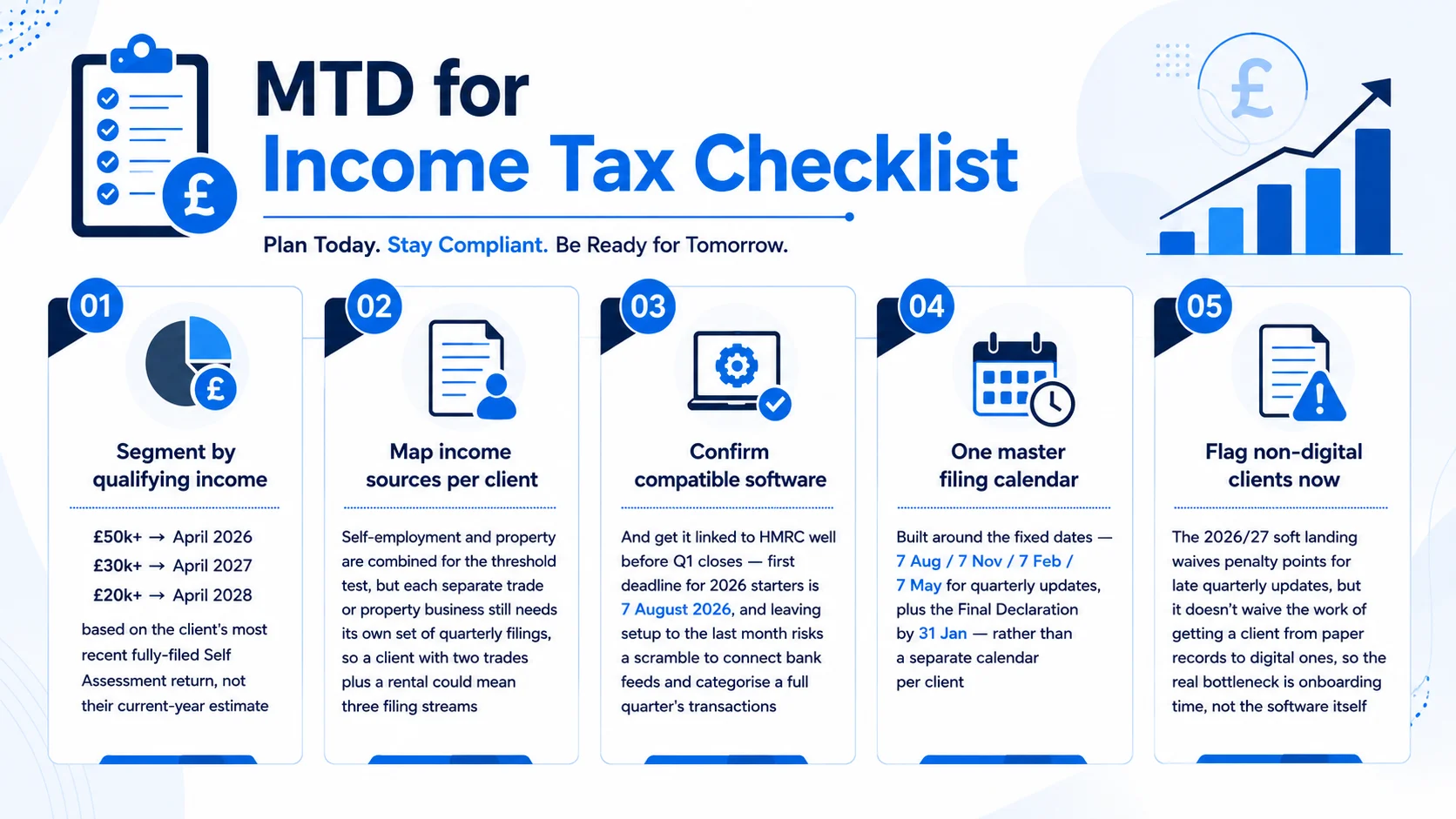
VAT has been running under MTD rules since 2022, so most firms know this pattern well. Making Tax Digital for Income Tax services became mandatory this April for sole traders and landlords earning over £50,000, with more clients pulled in as the threshold drops to £30,000 in 2027 and £20,000 in 2028.Payroll, year-end accounts, and tax preparation all sit on the same real-time, digital-first expectation HMRC has built its systems around.

Source: Low Incomes Tax Reform Group

Survey after survey shows the profession backing the principle behind MTD: cleaner records, more regular reporting, better forecasting. The doubt was never about direction. It is about capacity, whether firms can deliver this properly for every client, every quarter, without their teams burning out along the way.

This guide breaks down what MTD actually requires across bookkeeping, VAT, payroll, and tax, and looks at how outsourcing has become a practical way for UK accounting firms to handle the added workload without growing headcount.

What Making Tax Digital Means for Accounting Firms Today

Making Tax Digital UK for accounting firms requires two specific things: digital records kept from the point of transaction, and figures submitted to HMRC straight from compatible software, not typed into an online form once a year. No more posting a shoebox of receipts to the accountant every January and reconstructing a year’s numbers from scratch.


That has three concrete consequences for firms. 

  • First, a plain spreadsheet stops being enough on its own; it needs bridging software to connect to HMRC’s system, or the firm needs to move clients onto full accounting software like Xero, QuickBooks, or FreeAgent. 
  • Second, HMRC only accepts submissions from recognised software, so there is no manual online filing fallback once a client is in MTD. 
  • Third, filing frequency changes from once a year to several times a year, which is the part that actually drives firm workload, not the software switch itself.

Clarification: MTD for Corporation Tax (CT600) is not part of this. HMRC confirmed in July 2025 that it would not go ahead, citing complexity and resource constraints. VAT and Income Tax are the two parts of MTD that are actually live, and VAT got there first in 2022, which is why it's worth looking at next; it shows firms what the Income Tax rollout will likely feel like once it beds in.

Why Outsourcing Is Becoming Part of the MTD Answer

Reading through what MTD requires is one thing. Staying on top of it for every client, every quarter, without adding permanent headcount, is a different problem. That’s the gap accounting outsourcing UK for MTD compliance is built to close, and it’s worth understanding how it actually works before looking at each compliance area in detail.

The two common delivery models

Most outsourcing arrangements fall into one of two structures.
  • The first is a ticketing model, where routine work gets logged and picked up by the next available person at the provider’s end. It’s fast to set up but offers less continuity; a different person may handle a client’s bookkeeping each month.  
  • The second is a dedicated team model, where specific offshore staff work exclusively with one firm, learning its clients, its software setup, and its review preferences over time. For MTD work specifically, where quarterly familiarity with a client’s numbers matters, the dedicated model tends to hold up better.

How the working relationship runs

In practice, firms that hire offshore accountants for MTD UK work typically keep review and client communication in-house, while the offshore team operates inside the firm’s existing software (Xero, QuickBooks, FreeAgent, or bridging software for spreadsheet-based clients) rather than a separate system. A UK-based reviewer or manager signs off before anything goes to a client or HMRC. Data access is scoped and logged, and a data processing agreement sets out where data sits and how it’s handled, since GDPR responsibility stays with the UK firm regardless of where the work is done.

What actually gets outsourced

  • Digital bookkeeping for MTD compliance and outsourced bookkeeping services UK, covering transaction coding, bank reconciliation, and record maintenance kept current through the year, not rebuilt at quarter-end
  • MTD IT outsourcing solutions UK, meaning the quarterly update cycle itself: data preparation, exception flagging, and draft submissions ready for in-house review and filing
  • VAT compliance services UK, running the same digital-records discipline that VAT has required since 2022
  • Payroll outsourcing services UK and RTI payroll services UK, keeping pay runs and HMRC submissions on schedule, independent of the ITSA workload
  • Tax preparation outsourcing UK, corporation tax services UK (CT600), and year end accounts services UK, so a firm isn’t running separate providers for each compliance area

Where the value actually shows up

The workload that shifts offshore is usually the volume-heavy, repeatable part, data entry, reconciliation, first-pass preparation, not judgment calls or client relationships. That’s a deliberate split: firms keep ownership of anything requiring professional judgment or direct client contact, while routine processing runs in the background. For a practice with, say, 60 clients newly in MTD for Income Tax, that’s the difference between four in-house staff absorbing 240 extra quarterly filings a year, or an outsourced team handling the bulk of that volume while the same four staff review and sign off.

Can Your Team Keep Up with Growing MTD Workloads?

MTD for VAT: The Phase Firms Have Already Absorbed

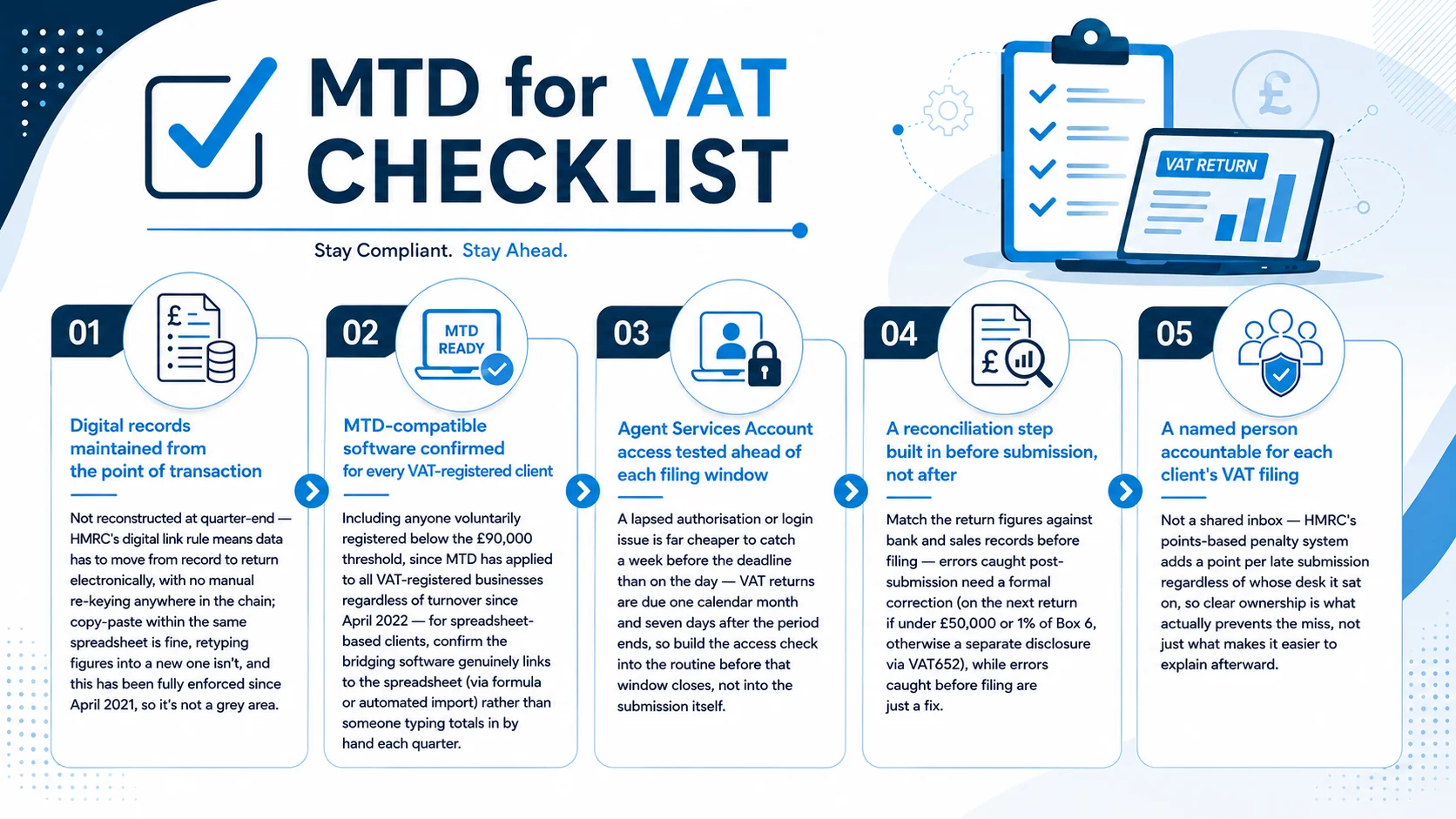
VAT compliance services UK were the first real test of Making Tax Digital, and firms have been living with it since 2022. Every VAT-registered business, regardless of size, keeps digital VAT records and files returns through MTD-compatible software. There is no paper route left.


For most firms, this transition landed better than expected. Survey data from the Chartered Institute of Taxation found that 69% of respondents said filing VAT returns under MTD was fairly or very easy. The friction that did show up wasn’t really about VAT itself; it was about the infrastructure around it: 43% found HMRC’s Agent Services Account difficult to work with, and 45% said getting help directly from HMRC was very difficult.


A good number of practitioners also said the MTD for VAT change was less than they expected. Clients who already kept digital records in Xero or QuickBooks noticed almost no difference. For firms with clients still on spreadsheets or paper, the shift was bigger, though VAT remains a comparatively simple return once the bookkeeping behind it is in order.


That’s exactly why VAT is worth understanding before looking at Income Tax. It shows what firms can expect: a manageable adjustment for clients whose bookkeeping was already solid, and a heavier lift for clients who weren’t digital to begin with. Income Tax multiplies that same pattern across a much larger and more complex group of clients, which is where the real workload pressure starts.


MTD for Income Tax: The Phase That Changes the Workload

The £50,000 threshold is only the entry point. What actually changes for these clients is the filing rhythm itself. One annual Self Assessment becomes four quarterly updates plus a Final Declaration, due 7 August, 7 November, 7 February, 7 May, and 31 January respectively. A sole trader running two trades files two separate sets of updates. Property income across multiple addresses is combined into one stream.


The penalty structure has changed, too. The old flat late-filing fine is gone, replaced by a points system similar to VAT’s: one point per missed submission, £200 once four points are reached, then £200 again each time after. A soft landing applies to quarterly updates for 2026/27 only, the Final Declaration and late payments aren’t covered by that grace period.


What makes this phase harder isn’t the mechanics; it’s the gap between how accountants and clients feel about it. Research found that 68% of accountants view Making Tax Digital for Income Tax services positively for their business, yet almost as many, 42%, say more than half their clients still aren’t digital. 


Client-side research tells a rougher story; one His Majesty’s Revenue & Customs advisory board survey found 68.5% saw no benefit to the scheme at all. Nobody’s arguing MTD is the wrong idea. The strain is in bringing every client along at once, which is exactly where MTD for Income Tax with digital bookkeeping kept current through the year makes the quarterly cycle manageable rather than a scramble.

Payroll, RTI, and the Rest of the Compliance Stack

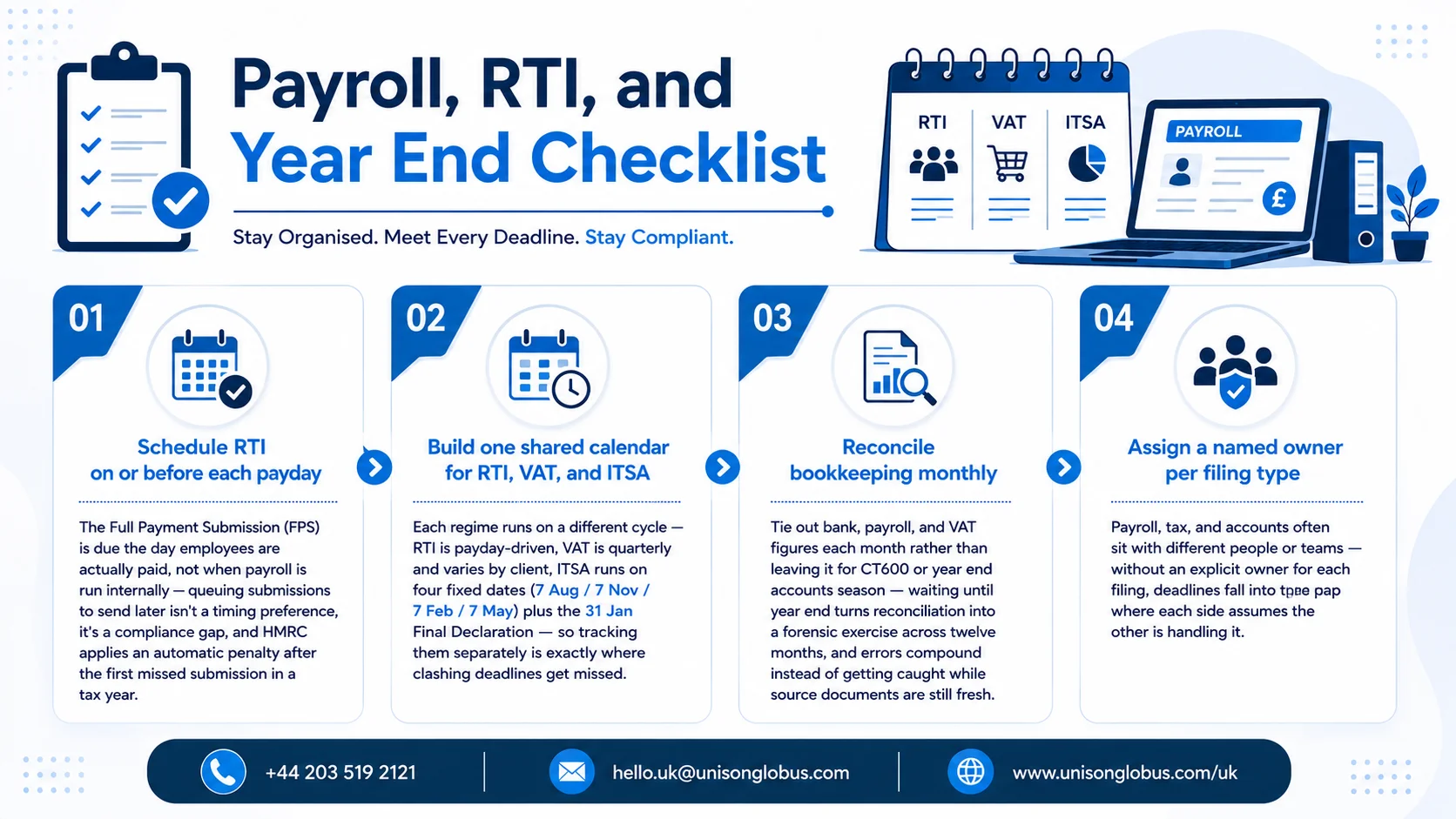
Payroll runs on its own real-time clock, separate from MTD but built on the same principle. RTI payroll services UK require payroll data to reach HMRC on or before each payday, not batched up afterwards. It’s not formally part of MTD, but it sits in the same “report as it happens” category, and firms handling it alongside quarterly ITSA updates and VAT returns are effectively juggling three overlapping submission calendars rather than one.

Corporation tax stays on its existing track, since CT600 isn’t moving to MTD. But the quality of a corporation tax services UK (CT600) filing still depends entirely on what’s been fed into it. Clean digital records throughout the year make preparation straightforward; gaps in bookkeeping upstream turn into CT600 problems in January, regardless of which system is technically “MTD.”

Year end accounts services UK follow the same logic. Firms that keep digital bookkeeping current throughout the year, rather than reconstructing twelve months of records after the fact, find year end accounts preparation faster and considerably less error-prone.

Getting Ahead of MTD, Not Just Keeping Up With It

The pattern running through this guide is the same one MTD keeps producing at every phase. VAT proved firms can adapt to digital filing without much disruption. Income Tax is proving something else: that the real challenge isn’t understanding the rules, it’s delivering them consistently across a growing client base without burning out the team doing the work.


That’s really what it comes down to when firms streamline bookkeeping and tax under MTD UK: fewer disconnected point solutions, one consistent digital workflow covering bookkeeping, VAT, payroll, and tax, so nothing depends on manually stitching four separate processes together each quarter.


For firms weighing their options, the ones that outsource MTD compliance UK to reduce workload tend to make the call before a threshold forces their hand, not after a quarter gets missed. Whether that means outsourcing one service line or several, the firms handling this well are the ones treating MTD compliance with bookkeeping and VAT services as one connected system, not four separate compliance problems competing for the same hours.


This is exactly the gap Unison Globus UK works inside. Our teams plug into a firm’s existing software and review process, taking on the volume behind bookkeeping, VAT, payroll, and tax preparation so in-house staff stay focused on client work rather than quarterly submission mechanics.


If you’re weighing up whether outsourcing makes sense for your firm’s MTD workload, we’re happy to talk through what that could look like for your specific client base.


Book a consultation or start a free trial to see how it works in practice.

Looking for a Smarter Way to Manage MTD Compliance?

Frequently Asked Questions

It’s HMRC’s shift from annual paper-style filing to digital, software-driven reporting. For accounting firms, it means keeping client records digital from the point of transaction and submitting figures to HMRC directly through compatible software, rather than once a year.

Yes. Firms increasingly hire offshore accountants for MTD UK work covering quarterly update preparation, reconciliation, and digital bookkeeping, while UK-based staff retain review, sign-off, and client communication.
Typically the quarterly update cycle itself, meaning data preparation, exception flagging, and draft submissions built inside the firm’s existing software, ready for in-house review before filing.

Digital bookkeeping is the foundation MTD depends on, but it works best paired with VAT, payroll, and tax preparation support, since all four feed into the same quarterly and annual filings.

Payroll and RTI aren’t technically part of MTD, but payroll outsourcing services UK keep pay runs and HMRC submissions on schedule independently, which matters since firms are often managing RTI, VAT, and ITSA deadlines in the same quarter.
Hiring takes time and is difficult in a UK market already short on qualified bookkeeping and accounting staff. Outsourcing adds capacity faster, without the fixed cost of a permanent hire, while UK staff keep control of review and client relationships.
Yes, most providers combine tax preparation outsourcing UK with corporation tax services UK (CT600) and year end accounts services UK, so a firm runs one workflow across all its annual filings rather than separate providers for each.