


 [gtranslate]

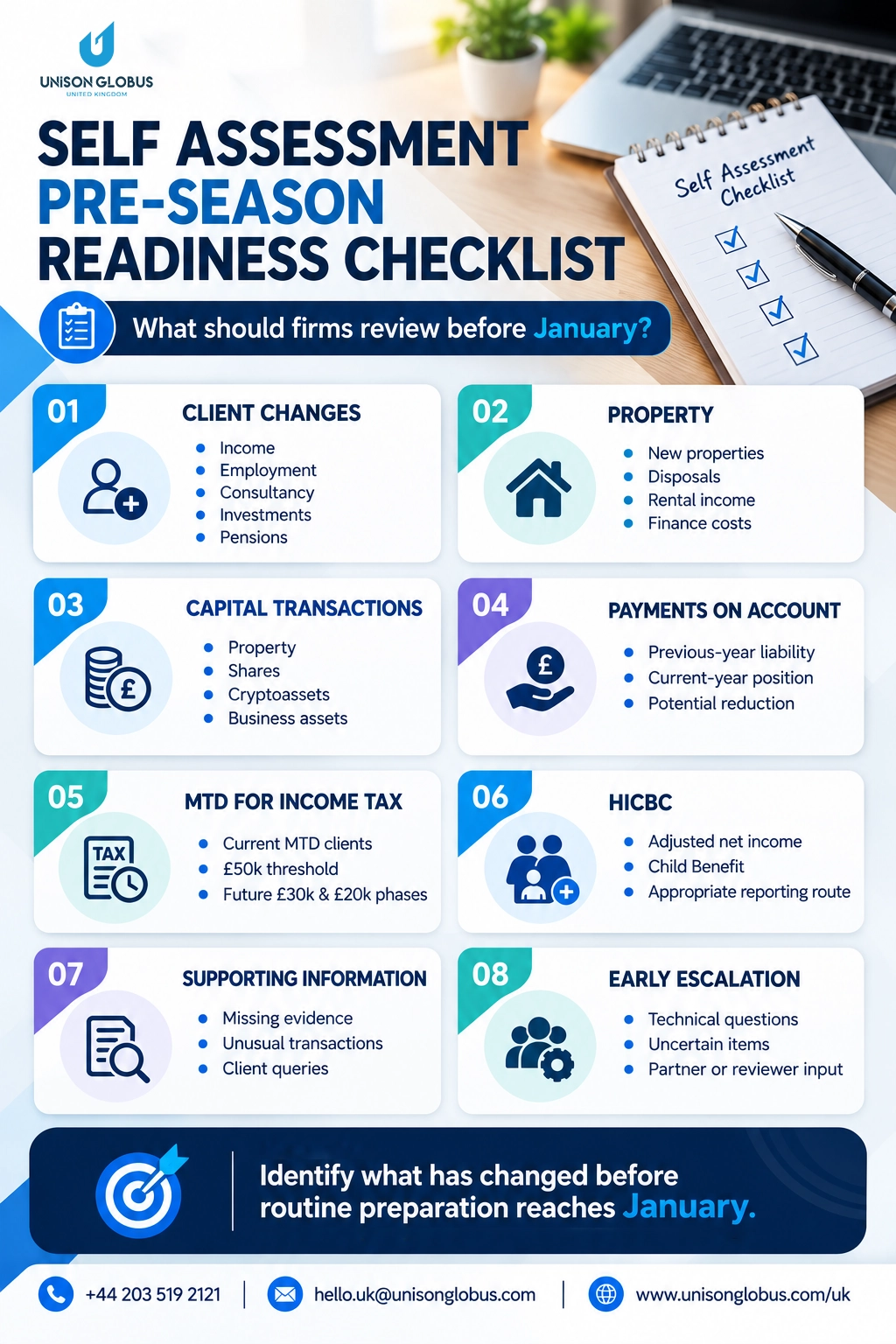
By November, a practice reviewing its Self Assessment client list can usually see which files have started to come together. However, the more important question is which clients have experienced a change in circumstances that could affect what needs to be prepared before January.
For this reason, firms managing Self-Assessment tax return preparation & filing ahead of the January cycle should focus their November review on what has changed since the previous tax year, rather than simply whether the expected records have arrived.
For example, a landlord may have disposed of a property during the year. Similarly, a sole trader may now fall within Making Tax Digital for Income Tax. Investment income may have increased. Each of these changes can affect what needs to be reviewed before the return is prepared.
With the online filing and payment deadline on 31 January 2027 approaching, this guide covers what to review now: client changes, payments on account, capital transactions, MTD for Income Tax and how to plan preparation capacity before the peak.
What is a Self Assessment tax return?
A Self Assessment tax return is the annual return used to report income and gains to HMRC where tax has not been fully collected through PAYE. It can include income from self-employment, property, investments and certain capital transactions. For accounting firms, the important point is that the return needs to reflect the client’s circumstances for the relevant tax year, not simply the documents already held on file.
Key Takeaways
- Review client circumstances first, not just missing documents, as changes in income, property, business activity, investments, or personal situations can affect reporting requirements.
- Use the previous year’s return as a reference point, not as a template for the current year’s filing.
- Review Payments on Account against the client’s current-year position to identify potential reductions or future liabilities.
- Identify capital transactions early, including property, shares, cryptoassets, and business asset disposals, before January workload pressures increase.
- Ensure landlord reviews cover ownership changes, acquisitions, disposals, refinancing arrangements, and property-related tax treatments, not just rental income.
- Assess which clients are already within, or approaching, Making Tax Digital (MTD) for Income Tax thresholds and whether digital reporting requirements are in place.
- Review clients with additional income sources, investment income, pension changes, or High Income Child Benefit Charge exposure more closely.
- Segment Self Assessment clients by preparation complexity to improve workflow planning and reviewer allocation.
- Earlier preparation creates more time for technical review, client queries, and payment planning before the January deadline.
- Where preparation capacity becomes a constraint, outsourced preparation support can help increase throughput while the firm retains review, judgement, and final sign-off.
Self-Assessment Tax Return Preparation & Filing Should Start With What Changed
The previous year’s return provides a useful reference point, but it should not become a template for the current year’s position. Changes in income, assets, business activity or personal circumstances can introduce additional reporting requirements or affect how existing information needs to be treated.
In practice, these changes tend to surface in three ways: a new reporting obligation, a need for supporting evidence the firm does not yet hold, or a different tax treatment from the previous year. Identifying which applies early determines how much preparation and review time a return needs.
This is particularly relevant when firms begin reviewing larger Self Assessment portfolios. The aim is not to investigate every client to the same depth, but to identify early which returns require additional questions, supporting evidence or professional review.
Strengthen your January readiness with a clearer view of client changes, outstanding information, and returns requiring additional review.
Review Payments on Account Before January
Payments on account are generally based on the previous year’s relevant tax liability, with two instalments normally due on 31 January and 31 July. The 31 January payment can include both the balancing payment for the previous tax year and the first payment on account for the following year. They do not apply in every case, including where the previous year’s tax owed was below £1,000 or more than 80% of the liability was collected outside Self Assessment.
Compare the Previous-Year Liability With the Current Position
Where a client’s circumstances have changed during the year, such as shifting trading levels, new consultancy work, additional rental property, or significant investment income, the previous year’s calculation may no longer be a reliable guide. If the client’s current-year tax liability is expected to be lower than the previous year’s, the firm should consider whether a reduction in payments on account is appropriate.
The assessment does not necessarily need to result in an immediate change to the client’s payments. In some cases, the outcome will simply be a clearer understanding of what the client is likely to owe and when. Where a reduction is claimed, the firm should be confident in its current-year estimate, as reducing payments too far can lead to interest on any shortfall.
Identify Capital Transactions Before the January Queue Builds
Capital transactions often require more preparation than the routine income information received from an established client. Property, shares, cryptoassets and business asset disposals may require acquisition records, disposal proceeds, transaction dates, allowable costs and consideration of relevant reliefs before the tax position can be established.
Property Disposals Carry a Separate Reporting Timetable
Residential property disposals require particular attention. Where the relevant Capital Gains Tax rules apply, a UK residential property disposal generally needs to be reported and any tax paid within 60 days of completion. This obligation operates separately from the normal Self Assessment timetable.
If a disposal only becomes apparent when the firm is reviewing January bank statements or investment records, there may be considerably less time to establish the facts and complete the necessary reporting.
Do Not Rely Entirely on Routine Records
The same principle applies to shares and cryptoassets. Clients may not always recognise a disposal, staking activity, or other transaction that needs to be raised with their accountant. For relevant clients, the annual review should establish the underlying facts and any unreported transactions before tax treatment is determined.
Review Landlord Clients Beyond Rental Income
Landlord clients warrant a broader review because property ownership and income arrangements can change without necessarily producing an obvious change in the records already held by the firm.
The firm may need to establish whether the ownership structure has changed, whether a property has been acquired, refinanced or disposed of, whether rental expenses have been categorised appropriately, and whether the tax treatment of property finance costs has been considered correctly.
For firms providing Self-Assessment Tax Return Services, this broader review helps ensure property-related changes are identified before preparation is finalised.
This is also important where a client has started receiving income from a property that was not part of the previous year’s return.
MTD for Income Tax Changes: What “Ready” Means
Making Tax Digital for Income Tax is already part of the compliance environment for the first cohort of sole traders and landlords. The phased approach means firms need to consider both clients already within MTD and those whose qualifying income could bring them into a later phase.
For MTD purposes, qualifying income is the total gross income from self-employment and property before expenses and tax. HMRC uses the relevant previous-year income to determine which clients fall within each phase. This makes the current Self Assessment review particularly relevant for sole traders and landlords whose income is approaching one of the phased thresholds.
Key MTD Thresholds
Clients with more than £50,000 of qualifying income in 2024/25 entered MTD for Income Tax from 6 April 2026. The threshold falls to more than £30,000 of qualifying income in 2025/26, with that phase beginning on 6 April 2027, and to more than £20,000 in 2026/27, with that phase beginning on 6 April 2028.
Source: GOV.UK: Find out if and when you need to use Making Tax Digital for Income Tax
Check Which Clients Are Already Within MTD
At this stage, the firm should establish whether the client’s qualifying income places them within the relevant MTD phase. It should also check whether appropriate digital records are being maintained and whether compatible software and reporting arrangements are in place. Finally, the firm should consider whether the client could enter a lower threshold in a subsequent year.
For clients already within the first phase, this is a current compliance consideration rather than something to prepare for next year. For others, the review can provide an early indication that their reporting requirements may change in a subsequent tax year.
Keep the Current Self Assessment Return Separate from MTD Obligations
Entering MTD does not remove the need to complete the current Self Assessment return. Clients entering MTD from 6 April 2026 still submit their 2025/26 Self Assessment return under the existing filing timetable, while their MTD obligations apply separately from 6 April 2026.
Identify Client Categories That Need an Earlier Review
A broad client list becomes more useful when firms identify the categories where circumstances are more likely to have changed. This does not mean treating every client in these groups as complex. It means making sure the relevant questions are asked before the return reaches final preparation.
Additional Income and Investment Income
New consultancy work, freelance income, second employment or additional property income can sit outside the records the firm already receives routinely. Dividend and savings income can also change materially from one year to the next, particularly where clients have altered their investment holdings.
Child Benefit and Pension-Related Matters
For 2024/25 onwards, the High Income Child Benefit Charge (HICBC) starts when adjusted net income exceeds £60,000 and reaches the full amount at £80,000, according to UK Government guidance on the Child Benefit tax charge.
A client who was previously outside the charge should therefore not automatically be treated as unaffected this year.
At the same time, HICBC does not automatically mean the client must file a Self Assessment return. HMRC allows the charge to be collected through PAYE only where specified conditions are met, including that the individual does not need to file a Self Assessment return for another reason. Firms should therefore establish the appropriate reporting route for each client.
Pension income, contributions and related information should also be reviewed where relevant, particularly when the client’s circumstances have changed since the previous tax year.
Segment the Client Base Before the Workload Peaks
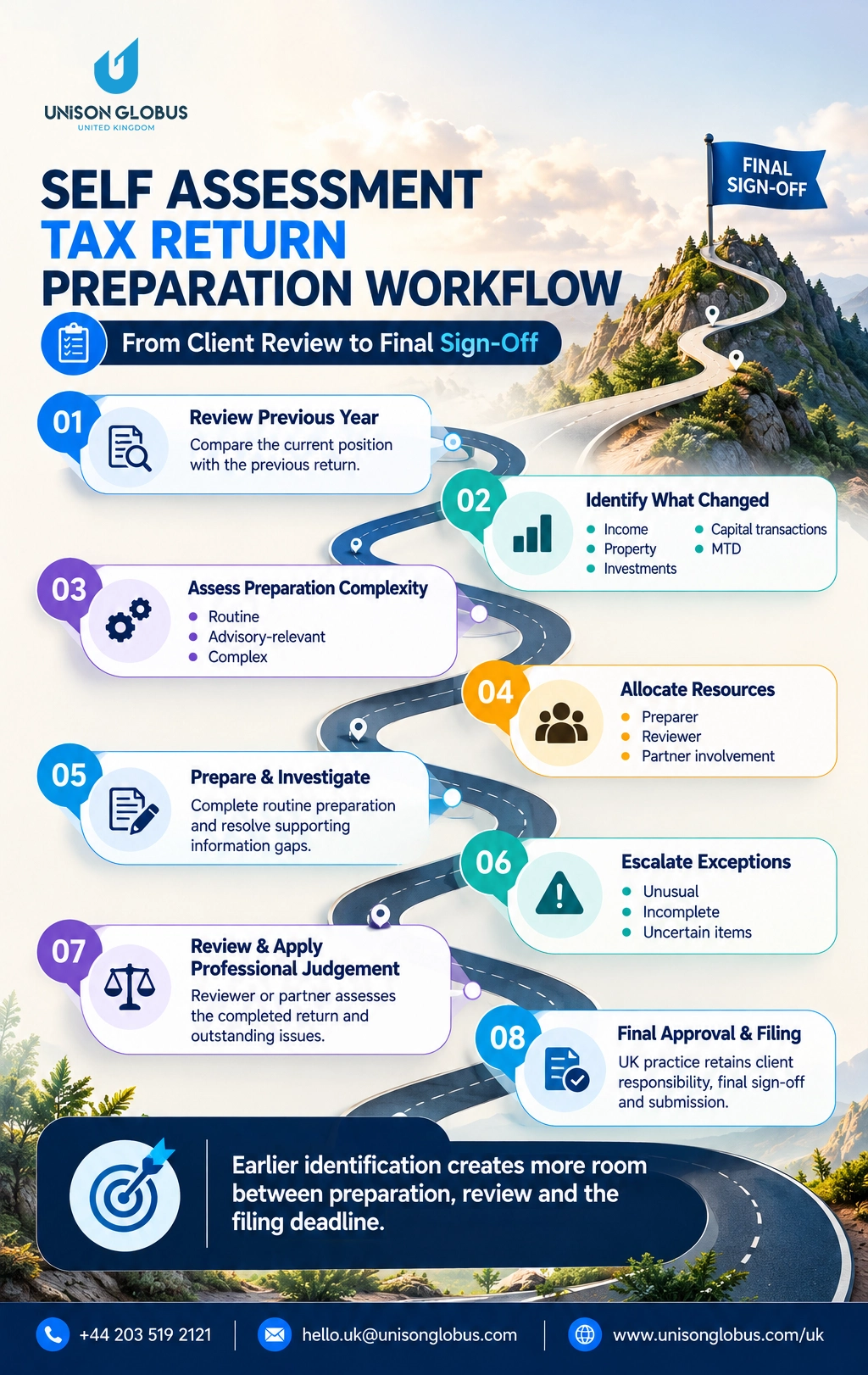
Once the initial review has identified what has changed, the client list can be segmented by the level of preparation and review each return is likely to require. In practice, this means linking the client circumstance to preparation complexity, preparer allocation, reviewer involvement and escalation:
- Straightforward returns where circumstances and supporting information remain consistent can be allocated to planned preparation runs with routine review.
- Advisory-relevant returns involving changes that require clarification can be assigned appropriate preparation time, with reviewer or partner involvement where professional judgement is required.
- Complex returns involving capital disposals, multiple income sources, MTD considerations or other issues can be allocated to more experienced preparers and scheduled for earlier reviewer or partner involvement, with unusual, incomplete or uncertain items escalated before final preparation.
Why Early Preparation Pays Off Before the Deadline Forces It
There is a useful distinction between preparing a return early and submitting it immediately. For firms managing a large Self Assessment portfolio, the value of earlier preparation is not simply meeting the filing deadline ahead of schedule. It is creating enough time between preparation and submission to deal with questions, review the completed return and give clients visibility of their final position.
The timing of that work can also affect how the practice manages its January workload. Returns that are substantially prepared before the final weeks can move through review in a more controlled sequence, while files involving unresolved matters can be identified and dealt with separately rather than competing with routine returns at the point of peak demand.
Early Preparation Creates Room for Review
Starting preparation earlier gives the firm more time to investigate client-specific issues, resolve technical questions and complete internal review without concentrating those tasks in the final weeks of January.
For practices using Self Assessment tax preparation services, the same principle applies: earlier preparation creates more room for review and resolution before January.
For clients, earlier completion can provide visibility of their tax liability and more time to plan for the January payment, particularly where a balancing payment or payment on account is likely to be significant.
The Self Assessment Deadline Remains Fixed
For the 2025/26 tax year, the online Self Assessment tax return deadline is 31 January 2027, with the tax payment also due by that date. Paper returns generally have an earlier 31 October 2026 deadline.
Early preparation also gives firms more time to check the information required for HMRC Self-Assessment Tax Return Filingbefore the statutory deadline.
The statutory deadline does not change, but the amount of work left for the final weeks can change considerably depending on how early the practice identifies client-side issues.
When Readiness Isn’t the Whole Answer
Once client information is sufficiently complete and the key issues have been identified, the remaining constraint for some firms is preparation throughput during the seasonal peak. Where that capacity is limited, some firms consider Outsourced Self-Assessment Tax Returns for defined preparation work.
Defined preparation work can be supported externally, with unusual, uncertain or incomplete items escalated to the firm’s team for resolution, while client relationships, professional judgement, review and final sign-off remain with the UK practice.
This is a separate capacity question from client readiness and is covered in more detail in our related guide to outsourced tax preparation UK during peak filing season.
A Familiar Preparation Challenge Across the UK, USA and Australia
While the UK timetable is different, other markets also have fixed filing dates and information dependencies that affect how accounting firms sequence individual tax return preparation. In the USA, CPA firms often contend with individual returns that depend on information from multiple sources, including K-1s from partnerships and S-corporations, which can affect when preparation can be completed. In Australia, tax season brings its own preparation pressures as firms manage individual returns alongside business, investment and other client tax matters across different lodgment arrangements.
Across all three markets, the specific rules and dates differ, but preparation still depends on identifying client-specific information issues early enough to keep routine work moving while preserving time for senior review and judgement.
Prepare Earlier, Review Better, Enter January With Fewer Unknowns
For the practice reviewing its client list in November, the practical advantage is knowing which files can follow the normal preparation route and which need attention before January. Starting Self-Assessment Tax Return Preparation & Filing early gives the practice more room to distinguish routine preparation from cases requiring investigation, client discussion, or additional review.
Client changes, payments on account, capital transactions, landlord reviews and MTD for Income Tax are the areas most likely to affect how much preparation and review time a return needs. Identifying them before the January queue builds means fewer surprises, more controlled review and clearer conversations with clients about what they owe and when.
The 31 January 2027 deadline will not move, but the pressure on the final weeks can be reduced by the work done now. If preparation capacity is a concern, Unison Globus offers Self Assessment tax return support to UK accounting firms, while your team keeps review and final sign-off. Contact Unison Globus to plan your support.
Extend preparation capacity during peak filing periods while keeping client relationships, professional judgement, review, and final sign-off within your practice.
Frequently Asked Questions
Review changes in income, property, capital transactions, investments, pensions, Child Benefit and MTD exposure before preparation begins, not just outstanding documents.
For 2025/26, online filing opens on 6 April 2026, and the deadline is 31 January 2027. Earlier filing is possible once the return is ready.
Payments on account are generally based on the previous year’s liability. Early review helps identify reduction claims or prepare clients for a higher balancing payment.
MTD began on 6 April 2026 for clients with 2024/25 qualifying income above £50,000. Thresholds fall to £30,000 in 2027 and £20,000 in 2028.
No. Some clients can have HICBC collected through PAYE if they meet HMRC’s conditions and do not need to file a return for another reason.
Returns involving capital disposals, property changes, multiple income sources, cryptoassets, MTD obligations or HICBC may require earlier investigation and additional review.
Yes, where preparation capacity is the constraint. Defined preparation work can be supported externally while review, judgement and final sign-off remain with the firm.
Consider scope, workflow fit, review arrangements, escalation procedures and where professional judgement, client responsibility and final approval will remain.