
Categories
Tax

How Outsourced Tax Preparation Supports Accountancy Firms During Peak Filing Season

Consider a practice with around 400 personal tax clients. By the second week of January, the filing workflow may already be running to a familiar rhythm. Client confirmations have arrived through December, review capacity has been scheduled, and the remaining returns are moving through preparation towards sign-off.

Then the pressure appears upstream of review. Client information is largely in place, and the review slots are still available, but returns are taking longer to prepare than the team has available hours. By the third week, a growing number of files are sitting between preparation and sign-off.

The frustrating part is that the firm has already planned the review resource, yet the work needed to use it is not arriving in the right shape or at the right pace.

The practical issue behind tax outsourcing for accountancy firms is where the filing-season workflow actually needs more capacity. In a concentrated peak, the constraint may be less about long-term headcount and more about having enough preparation hours available when demand is highest. What matters, then, is whether defined preparation work can be supported externally without disrupting the firm’s review, judgement and approval process.

Why Adding Headcount May Not Solve a January Problem

The instinctive response to a mid-January filing crunch is to recruit more staff. However, hiring rarely solves a concentrated filing peak quickly enough. Even after a suitable candidate is found, onboarding, training and familiarity with the firm’s software, files and review preferences take time. By then, the immediate pressure may have passed, leaving the firm with permanent capacity for a demand pattern that may be seasonal.


The volume concentrated around the Self-Assessment deadline shows why a short-term filing peak is hard to address through permanent recruitment alone. HMRC reported that 11.48 million taxpayers filed their Self Assessment returns for 2024–25 by the 31 January 2026 deadline, with 475,722 filing on deadline day alone. Permanent recruitment can leave a firm carrying additional capacity beyond the period that created immediate pressure, particularly where demand is strongly seasonal.

Is your preparation pipeline producing enough review-ready files to actually use the review capacity you’ve already planned for?

How a Preparation Backlog Shows Up Before It Reaches Review

A backlog rarely announces itself as “we have a preparation problem.” It shows up as a set of symptoms further down the workflow:


  • Preparation queues that grow while reviewers sit idle. Files are not reaching the review stage, leaving protected review capacity unused.
  • Uneven client information flow. Complete files compete with clients still supplying documents, disrupting the preparation sequence.
  • Complex returns competing with routine work. A property disposal or multi-source income return can consume disproportionate preparation hours.
  • Managers stepping into first-pass preparation. The immediate queue falls, but managers are pulled away from technical review and client work.
  • A widening gap between planned review capacity and ready files. The firm has reviewers available, but insufficient completed work reaching them on time.

For a partner looking at the queue, the distinction matters. A growing pile of unfinished returns can look like a staffing problem when the underlying constraint is further upstream.

Worth noting

This pattern isn’t confined to one practice. Advancetrack’s 2026 Accounting Talent Index Advancetrack’s 2026 Accounting Talent Index, covering accounting professionals across the UK, US, Canada and Australia, found that 73% said talent shortages were having a severe impact on their practice, while 74% were concerned that resulting workloads could contribute to staff leaving. For an individual practice, however, the important consideration is where that pressure is actually appearing: preparation, review or senior capacity.

If the bottleneck is sitting in preparation rather than review or professional judgement, the useful question is which parts of that preparation can be handled externally.

Read also Self-Assessment 2026: How UK Businesses Can Reduce Workload With Outsourced Tax Support

Preparation Versus Professional Judgement: Where External Support Fits

The focus is on which defined preparation activities can move a return from complete source information to a review-ready file within the firm’s existing review process. For example, consider a firm with 300 personal tax returns, two reviewers with protected review capacity, and a preparation team that cannot complete the return population before those review slots become available. In that situation, external preparation can support the workflow by:

  • Defined preparation capacity: Add preparation support for an agreed return population or workload period where internal preparation hours are insufficient.
  • Document and return preparation: Organise and index source documents, enter relevant data, prepare workpapers and schedules, and complete standard calculations and reconciliations within the agreed scope.
  • Exception identification: Flag missing information, inconsistencies and unusual items for clarification or escalation rather than allowing unresolved issues to move through the workflow.
  • Review-ready file assembly: Bring together the relevant computations, workpapers, supporting information and identified exceptions so the firm’s reviewer receives a defined file to assess.
  • Workflow alignment: Match allocated work to the firm’s documentation standards, preparation procedures, review requirements and agreed escalation routes.

This is often the point at which the concern shifts from capacity to control. If another team prepares part of the return, the firm needs to know exactly what comes back, what has been checked and what still requires professional judgement. External preparation supports defined execution activities, while the UK firm retains technical interpretation and professional judgement, client advice and communication, and its established review and approval process. Filing or submission responsibility remains with the firm where applicable to the engagement.


External preparation workflow UK firm
Source-document organisation and indexing Technical interpretation and professional judgement
Data entry, schedules and workpapers Complex or ambiguous tax positions
Standard calculations and reconciliations Client advice and communication
Draft computations and returns Final review and approval
Missing-information and exception flagging Sign-off and filing or submission responsibility, where applicable

The distinction matters because the value of preparation support is determined by the quality of the handoff. A file that still requires substantial first-pass preparation simply moves the bottleneck rather than resolving it. Self assessment tax return outsourcing is therefore most useful when the scope, escalation points and expected review-ready output are defined before work begins.

What Makes a Tax File Review-Ready?

A review-ready file should give the firm’s reviewer enough organised evidence to perform the professional review without having to reconstruct the preparation process first:
  • Completeness: Required source documents and relevant information have been captured and checked against the agreed preparation scope.
  • Consistency: Current-year information has been checked against prior-year records and available supporting data, with differences identified rather than assumed.
  • Exception visibility: Missing information, inconsistencies and unusual items are clearly documented and routed for resolution.
  • Review evidence: Relevant calculations, workpapers and supporting documentation are organised so the reviewer can trace the preparation.
  • Version control: The working file and return output are maintained consistently so the reviewer is assessing the current version.
  • Correction workflow: Review points and subsequent corrections can be tracked back into the file without losing the underlying preparation trail.
Tax preparation support for accountants is most effective when the handoff standard is defined before work begins, rather than when the review stage exposes missing preparation work.

What Happens to Review Capacity When Managers Absorb Preparation Work

Preparation capacity only helps when it protects the review workflow rather than simply increasing the number of files entering it. When preparation backs up, the instinctive fix of pulling a manager into first-pass work creates a second, quieter bottleneck: preparation backlog → managers pulled into preparation → review capacity falls → partner review queue grows → client turnaround slows. Where preparation is the constraint, external preparation can interrupt that chain before the backlog reaches review. That only works, though, if review capacity actually exists to receive them. If reviewers are already fully stretched, feeding them more prepared returns doesn’t solve anything; it just relocates the queue from preparation to review. Before allocating additional preparation work, confirm that the intended reviewer has protected capacity to assess the resulting files. Where the model is appropriate, it may allow managers and partners to maintain focus on technical review, complex returns, tax planning and client relationships rather than absorbing first-pass preparation.

Recruitment, Overtime or External Capacity: Weighing the Trade-Offs

Once the constraint is clear, the next step is to consider which type of capacity actually fits it. Recruitment, overtime and external preparation solve different problems, and using the wrong one for a seasonal gap is often what creates the capacity ceiling in the first place.
Option Best suited to Key consideration
Permanent recruitment Sustained, predictable workload growth Recruitment, onboarding and integration take time, so it may not address a short-term filing-season gap.
Overtime Short, exceptional spikes where internal expertise is available May help absorb immediate volume, but can compete with review work and other deadline-driven priorities.
External preparation Defined preparation work with seasonal or variable demand Requires clear scope, workflow integration, escalation routes and appropriate review controls.
For firms evaluating tax preparation services for accountancy firms, the appropriate model depends on where the workload constraint sits and whether the underlying demand is structural, temporary or seasonal. Permanent recruitment may suit sustained growth, while overtime or external preparation can be considered where the requirement is more concentrated or variable.

When External Preparation Capacity Is the Right Fit

Once a firm has identified preparation as the constraint, the next step is to test whether external support fits the existing workflow. Before allocating work externally, four conditions should be clear:
  • Preparation is the constraint: Client information is arriving at a workable pace, but completed files are accumulating before review.
  • Demand is concentrated or variable: The firm needs materially more preparation hours during peak periods than it requires throughout the year.
  • Review capacity exists: Partners or managers have protected review capacity available for completed files.
  • The work can be clearly defined: Scope, documentation standards, escalation points and review criteria can be agreed before preparation begins.
External preparation may not address the underlying bottleneck when client information is arriving late, technical review is already constrained, partner capacity is fully committed or internal processes are inconsistent. In those situations, adding preparation hours may simply move the queue elsewhere in the workflow. The same fit criteria should apply when a firm is evaluating tax return outsourcing in the UK.

When External Preparation Capacity Is the Right Fit

Once a firm has identified preparation as the constraint, the next step is to test whether external support fits the existing workflow. Before allocating work externally, four conditions should be clear:


  • Preparation is the constraint: Client information is arriving at a workable pace, but completed files are accumulating before review.
  • Demand is concentrated or variable: The firm needs materially more preparation hours during peak periods than it requires throughout the year.
  • Review capacity exists: Partners or managers have protected review capacity available for completed files.
  • The work can be clearly defined: Scope, documentation standards, escalation points and review criteria can be agreed before preparation begins.

External preparation may not address the underlying bottleneck when client information is arriving late, technical review is already constrained, partner capacity is fully committed or internal processes are inconsistent. In those situations, adding preparation hours may simply move the queue elsewhere in the workflow. The same fit criteria should apply when a firm is evaluating tax return outsourcing in the UK.

What to Evaluate Before Choosing an External Tax Preparation Partner

Once preparation has been identified as the constraint, the next concern is usually straightforward: will bringing another team into the workflow make the process easier to control or harder? Provider selection therefore becomes a question of whether the external team can operate to the firm’s required technical, workflow and control standards.


For practice leaders evaluating tax preparation services for accountancy firms, the assessment should go beyond available preparation hours. The provider also needs to operate within the firm’s technical, operational and quality-control framework.

Consider these areas:


  • Relevant UK tax experience: Confirm that the provider has experience with the return types, schedules, client profiles and complexity levels the firm intends to allocate.
  • Scope and responsibility: Establish precisely which preparation activities are included, which remain with the UK firm, and where technical questions must be escalated.
  • Software and workflow compatibility: Check compatibility with the firm’s tax software, document-management processes, naming conventions, allocation procedures and review stages.
  • Quality assurance: Understand how work is checked before it reaches the firm’s reviewer, including preparation checks, correction procedures and controls for recurring issues.
  • Exception and escalation management: Establish how incomplete information, unusual transactions and technical uncertainties are identified and escalated rather than passed downstream unresolved.
  • Data protection and information security: Establish how client information is accessed, transferred, stored and protected, including the safeguards governing international data transfers.
  • Onboarding and communication: Evaluate how the provider learns the firm’s processes, establishes working arrangements before live delivery and manages communication when work falls outside scope or requires clarification.

Once workflow fit is established, the remaining questions are whether the arrangement preserves appropriate control, protects client information and integrates with the firm’s existing responsibilities.

Compliance, Data Protection, and Control: The Questions Partners Actually Ask

01

Will external preparation just create more review work?

It can, if scope and quality controls are poorly defined. Incomplete or inconsistently documented files can create more review work than they remove. A stronger control is to agree documentation standards, escalation routes and review criteria before live work begins.

02

What about client consent and confidentiality?

Firms need clear controls over client information and, where data is transferred outside the UK, a valid international-transfer mechanism. HMRC’s Standard for Agents expects tax agents to maintain the security of client information and take reasonable steps to ensure that third-party input used in client work provides accurate results and complies with the client’s tax obligations. Where a UK firm makes a restricted transfer of personal data to a provider outside the UK, the transfer must be covered by UK adequacy regulations, appropriate safeguards or a relevant exception. Where appropriate safeguards are used, the firm must also complete the applicable data protection test. For the current requirements, see the ICO guidance on international transfers.

03

Will implementation become another project during an already busy season?

It can be rushed. A defined pilot batch with agreed turnaround standards and measured reviewer rework allows the firm to identify quality or workflow issues before meaningful volume moves across.

04

Do we lose control of client work?

A properly structured model should preserve the firm’s client relationship, technical judgement and established review and approval process. Filing or submission responsibility remains with the firm where applicable to the engagement. The external role is limited to the defined preparation activities within the agreed scope.
Build tax preparation capacity into your next filing season

Closing the Gap Before the Next January Peaks

For the 400-client practice described at the start, the issue is not simply how many returns are on the books. It is whether completed preparation work is reaching the review stage at the rate the firm has planned for. If preparation is the constraint and review capacity is available, defined external preparation can form part of the operating model without changing the firm’s existing review, judgement and approval structure.


Unison Globus UK provides outsourced tax preparation for UK accountancy firms, structured around defined preparation activities, documented handoffs, exception escalation and review-ready files within the firm’s existing operating model. This sits alongside Unison Globus’s wider outsourced bookkeeping and tax services, built to help firms keep review-ready work reaching partners and managers at the pace the filing calendar demands, without adding permanent headcount or diluting technical oversight.

Need Additional Tax Preparation Capacity Before the Next Self-Assessment Deadline?

Frequently Asked Questions

A preparation constraint exists when files are not reaching available reviewers. If files are reaching reviewers but waiting for action, the bottleneck sits within review or partner capacity.

Source-document organisation, data entry, standard calculations, reconciliations and draft computations can be suitable where information is complete and technical judgement remains with the UK firm.

Tax outsourcing for accountancy firms can fit within the existing workflow when the provider completes defined preparation work and returns review-ready files at an agreed handoff point. The UK firm retains technical review, approval, sign-off and filing responsibility.

Firms should define access controls, contractual responsibilities and appropriate UK GDPR safeguards for international transfers before sharing client information with an offshore preparation provider. This is a standard consideration wherever offshore staffing for accountancy firms is used, not just for tax preparation specifically.

A pilot should run long enough to measure turnaround, reviewer rework, query volume and exceptions, with duration determined by return volume, complexity and the results observed.

Outsourcing preparation does not, by itself, transfer the firm’s technical judgement, client advice or established review and approval process. Filing or submission responsibility remains with the firm where applicable to the engagement.
Categories
home uk Outsourcing Tax

Use Outsourcing to Deliver Making Tax Digital for Income Tax

Making Tax Digital for Income Tax (MTD IT) represents a significant change for many self-employed individuals and landlords. With further changes bringing more businesses into scope in 2027 and 2028, accountants and tax advisers find the real challenge is not understanding the new rules, it’s making sure clients are prepared and the required services and delivery processes are working effectively.

For accountants facing increasing workloads, outsourcing provides a practical way to deliver MTD IT without increasing pressure on already stretched teams.

How is Making Tax Digital for Income Tax being rolled out ?

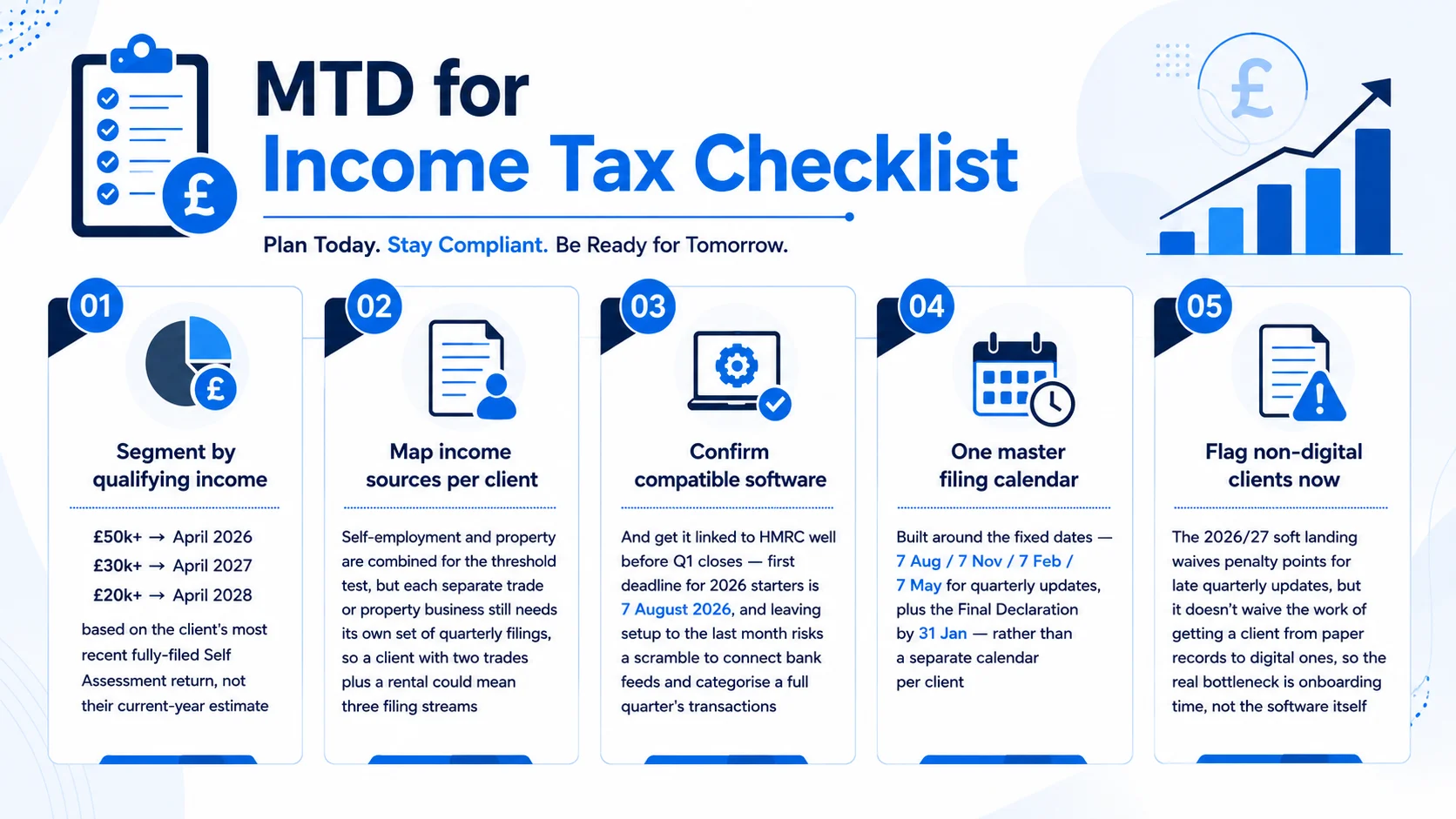
MTD IT finally landed in April 2026, with the first digital submissions being made by HMRCs deadline of 7 August 2026. More small businesses will be affected as the income threshold for entry to the regime reduces from £50,000 in 2026, to £30,000 in 2027 and finally £20,000 in April 2028.


All affected taxpayers must keep digital records and use compatible software to send a summary of income and expenses to HMRC each quarter, with a final declaration of all income and allowances sent to HMRC by 31 January after the end of the tax year.


For accountants and tax advisers, this creates additional work. Client records need to be reviewed, digital systems introduced, processes updated and clients supported as they take on new record keeping responsibilities.

The challenge for accountants

Adding MTD IT to existing compliance and advisory work puts enormous strain on already stretched people and resources. Typically, a firm preparing clients for MTD IT responsibilities must:
  • Identify those affected by MTD IT and the timing of entry to the regime
  • Arrange for clients to sign up for MTD and create an Agent Services Account to act as their representative
  • Review the way records are currently kept for completeness and accuracy
  • Move clients to digital record-keeping software supported by professional accounting and bookkeeping services.
  • Keep digital records up to date using structured digital bookkeeping solutions.
  • Prepare summaries of income and expenses each quarter and submit to HMRC
  • Contact clients throughout the tax year about their responsibilities
  • Monitor the overall tax position of affected clients to avoid any surprises at tax year-end
  • Provide ongoing support to clients in person or using digital technology.
Taken together, these tasks require significant resources to deliver, particularly where a practice has high numbers of clients affected by MTD IT.

How outsourcing can help

Outsourcing specific MTD IT tasks creates additional capacity without increasing permanent headcount. An experienced outsourcing partner can support accountants through routine, time-consuming tasks while the onshore team retains responsibility for client relationships, technical decisions, and final review of work.


Outsourced accountants can easily complete monthly bookkeeping, data collection, income and expense reconciliations, quarterly summaries, and other administrative tasks. The onshore accountant can then review the work before submission to HMRC.


This creates a model with clearly defined responsibilities that can be scaled easily as demand increases as more businesses are required to comply with MTD IT by 2028.

Reducing pressure on your existing team

One of the biggest advantages of outsourcing is capacity.


Rather than asking qualified accountants to spend time on routine data collection and processing tasks, firms can delegate tasks to an outsourced team. This allows the onshore team to concentrate on areas where their expertise adds greater value and builds the client relationship.


Starting early with an outsourced solution gives firms time to identify problem clients, improve record keeping and establish consistent processes before HMRC submission deadlines become critical.

Improving efficiency and consistency

A well-defined outsourcing process can help deliver MTD IT efficiently, with procedures and clear responsibilities assigned for:
  • Collecting client data
  • Updating software and reconciling transactions
  • Identifying errors and omissions in client data
  • Preparing digital records
  • Carrying out quality checks
  • Escalating technical or client queries
  • Completing the final review of data before submission.
At Unison Globus UK, we have worked with our customers to offer flexible delivery models for MTD IT tasks based on client needs, as shown below.
Task Completed by
Monthly data collection and bookkeeping – any software Outsourced bookkeeper
Update HMRC compatible software quarterly Outsourced bookkeeper
File summary information each quarter using HMRC compatible software Outsourced accountant
Prepare summary annual accounts and final declaration Outsourced accountant
File final declaration Onshore accountant

Our model recognises the different needs and complexity of MTD IT clients. Some clients are comfortable maintaining digital records and can self-serve. These clients may only require support at the end of the tax year to prepare accounts and a final declaration and related self-assessment tax return requirements. Others may need monthly bookkeeping, quarterly HMRC submissions, and end of year processes to ensure compliance.

Outsourcing does not mean giving up control

Some accountants are understandably cautious about outsourcing tax-related work. The key is to outsource tasks while maintaining oversight of work and progress towards agreed turnaround times. To do this, accountants should establish lines of communication with the offshore team, implement effective access controls and quality assurance procedures. Client data must also be handled securely and in accordance with applicable data protection requirements.


Using an outsource provider does not mean replacing the professional judgement of the onshore accountant. The accountant remains in control of the client relationship, determines the scope of work completed offshore and remains responsible for all professional decisions.

Choosing the right outsourcing partner

Not all outsourcing providers will be suitable for MTD IT work. Before choosing a partner, firms should consider their experience with UK accounting and tax processes, familiarity with commercial software, data security arrangements, and quality-control procedures. Accountants will also need to research the market, check industry reputations, and track records, obtain client testimonials, and understand the scope of any other services offered which may help deliver the desired offshore solution.


Accountants can test the outsourcing process with a small amount of work, such as digital bookkeeping or preparation of quarterly HMRC submissions. Outcomes can be evaluated for quality, technical accuracy, and turnaround consistent with in-house targets. Many offshore suppliers, including Unison Globus UK, offer a free-trial period, where accountants can test the service before entering into a contract. Accountants can also choose to access offshore capacity as and when they need it by using a pay as you go service. This maximises the flexibility to use an offshore option at peak periods or when an unexpected backlog of work occurs.

A proactive approach to MTD IT

MTD IT should not be treated as another compliance deadline to meet. It is an opportunity for accountants to review how they deliver services such as bookkeeping, tax, and client support throughout the year. By outsourcing recurring and deadline driven work, accountants can increase capacity, improve quality, and allow onshore teams to focus on higher-value services and client relationships.

How do I find out more about outsourcing MTD IT work?

At Unison Globus UK, we have been providing offshore services to accountants since 2006. Our customers include sole proprietors, as well as small and medium sized UK Accountancy Practices. Our outsourced tax, accounting and payroll services are suitable for all client engagements – from sole traders and micro businesses to SMEs and large companies. We have a dedicated MTD for Income Tax hub to help accountants decide the best outsourcing model for their practice.


We provide a free trial of up to 10 hours of accountant time, with turnaround in 72 hours. If you’re looking to outsource services for the first time, increase margins, and help your clients thrive, you can book a video call with one of our expert advisors or email us at [email protected].

Categories
home uk Tax

Making Tax Digital (MTD) UK: Complete Guide for Accounting Firms to Streamline Bookkeeping, VAT, Payroll & Tax

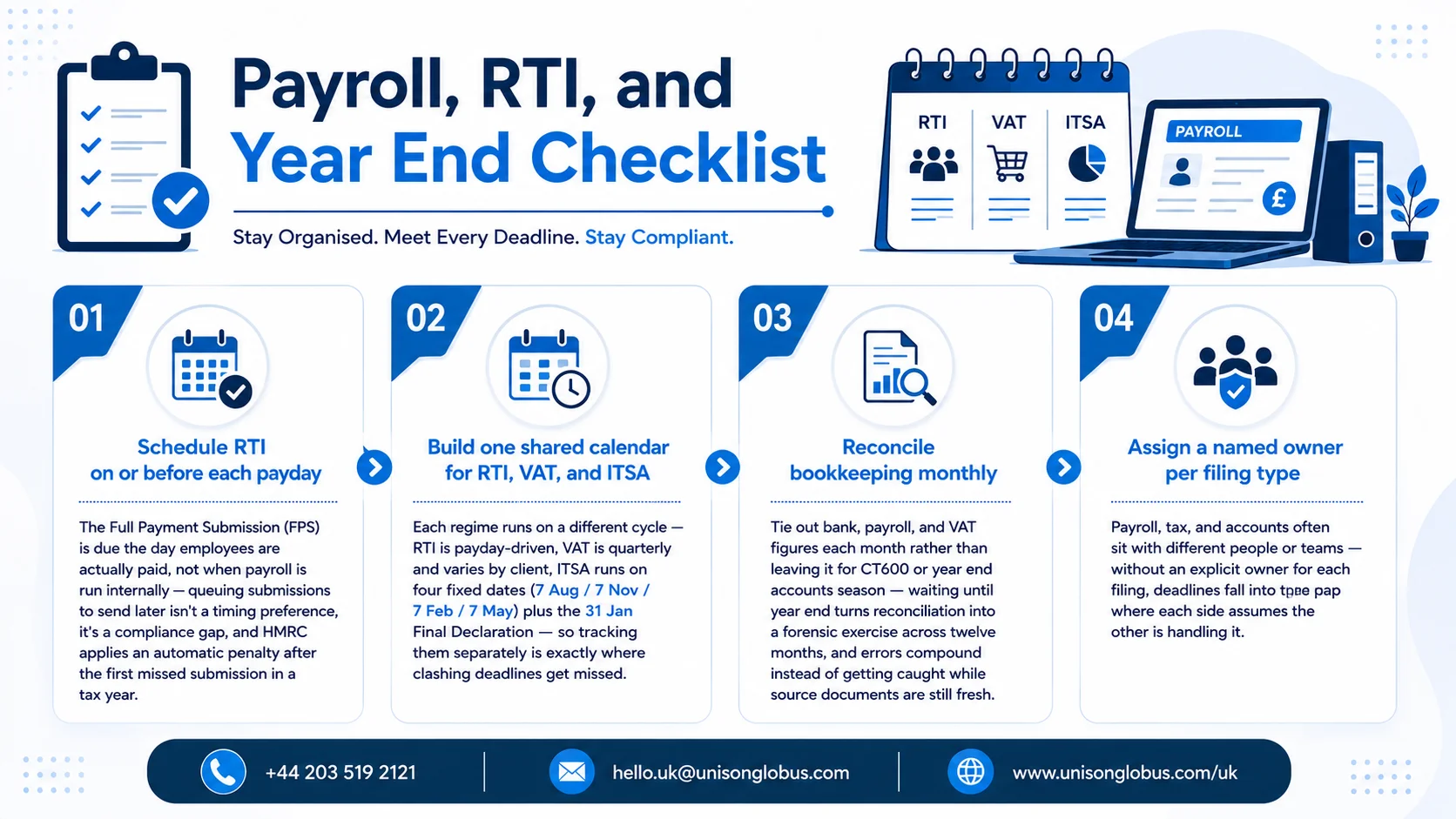
Picture a mid-sized UK accounting practice with 200 self-employed and landlord clients on its books. Before this April, that practice filed one Self-Assessment return per client, per year. Now, a good chunk of those same clients’ needs four quarterly updates plus a Final Declaration instead. What used to be 200 annual filings has quietly turned into closer to 1,000 HMRC touchpoints a year, on top of VAT returns, payroll runs, and everything else already on the calendar. Nothing about the client list changed. The workload just multiplied.
That is the reality Making Tax Digital UK for accounting firms is living through right now, not preparing for. MTD is no longer a future deadline; it is an active shift in how bookkeeping, VAT, payroll, and tax compliance get delivered.

VAT has been running under MTD rules since 2022, so most firms know this pattern well. Making Tax Digital for Income Tax services became mandatory this April for sole traders and landlords earning over £50,000, with more clients pulled in as the threshold drops to £30,000 in 2027 and £20,000 in 2028.Payroll, year-end accounts, and tax preparation all sit on the same real-time, digital-first expectation HMRC has built its systems around.

Source: Low Incomes Tax Reform Group

Survey after survey shows the profession backing the principle behind MTD: cleaner records, more regular reporting, better forecasting. The doubt was never about direction. It is about capacity, whether firms can deliver this properly for every client, every quarter, without their teams burning out along the way.

This guide breaks down what MTD actually requires across bookkeeping, VAT, payroll, and tax, and looks at how outsourcing has become a practical way for UK accounting firms to handle the added workload without growing headcount.

What Making Tax Digital Means for Accounting Firms Today

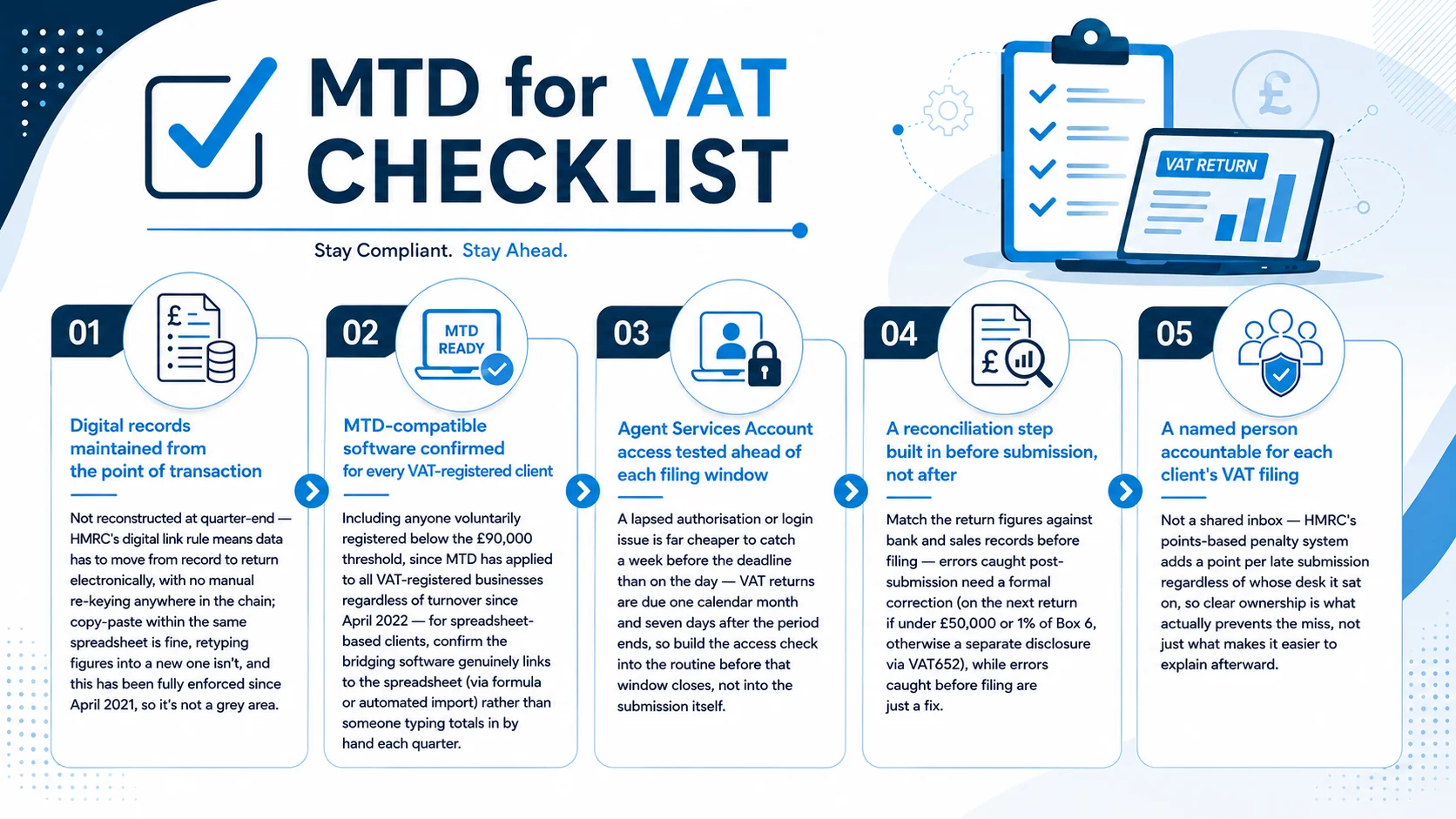
Making Tax Digital UK for accounting firms requires two specific things: digital records kept from the point of transaction, and figures submitted to HMRC straight from compatible software, not typed into an online form once a year. No more posting a shoebox of receipts to the accountant every January and reconstructing a year’s numbers from scratch.


That has three concrete consequences for firms. 

  • First, a plain spreadsheet stops being enough on its own; it needs bridging software to connect to HMRC’s system, or the firm needs to move clients onto full accounting software like Xero, QuickBooks, or FreeAgent. 
  • Second, HMRC only accepts submissions from recognised software, so there is no manual online filing fallback once a client is in MTD. 
  • Third, filing frequency changes from once a year to several times a year, which is the part that actually drives firm workload, not the software switch itself.

Clarification: MTD for Corporation Tax (CT600) is not part of this. HMRC confirmed in July 2025 that it would not go ahead, citing complexity and resource constraints. VAT and Income Tax are the two parts of MTD that are actually live, and VAT got there first in 2022, which is why it's worth looking at next; it shows firms what the Income Tax rollout will likely feel like once it beds in.

Why Outsourcing Is Becoming Part of the MTD Answer

Reading through what MTD requires is one thing. Staying on top of it for every client, every quarter, without adding permanent headcount, is a different problem. That’s the gap accounting outsourcing UK for MTD compliance is built to close, and it’s worth understanding how it actually works before looking at each compliance area in detail.

The two common delivery models

Most outsourcing arrangements fall into one of two structures.
  • The first is a ticketing model, where routine work gets logged and picked up by the next available person at the provider’s end. It’s fast to set up but offers less continuity; a different person may handle a client’s bookkeeping each month.  
  • The second is a dedicated team model, where specific offshore staff work exclusively with one firm, learning its clients, its software setup, and its review preferences over time. For MTD work specifically, where quarterly familiarity with a client’s numbers matters, the dedicated model tends to hold up better.

How the working relationship runs

In practice, firms that hire offshore accountants for MTD UK work typically keep review and client communication in-house, while the offshore team operates inside the firm’s existing software (Xero, QuickBooks, FreeAgent, or bridging software for spreadsheet-based clients) rather than a separate system. A UK-based reviewer or manager signs off before anything goes to a client or HMRC. Data access is scoped and logged, and a data processing agreement sets out where data sits and how it’s handled, since GDPR responsibility stays with the UK firm regardless of where the work is done.

What actually gets outsourced

  • Digital bookkeeping for MTD compliance and outsourced bookkeeping services UK, covering transaction coding, bank reconciliation, and record maintenance kept current through the year, not rebuilt at quarter-end
  • MTD IT outsourcing solutions UK, meaning the quarterly update cycle itself: data preparation, exception flagging, and draft submissions ready for in-house review and filing
  • VAT compliance services UK, running the same digital-records discipline that VAT has required since 2022
  • Payroll outsourcing services UK and RTI payroll services UK, keeping pay runs and HMRC submissions on schedule, independent of the ITSA workload
  • Tax preparation outsourcing UK, corporation tax services UK (CT600), and year end accounts services UK, so a firm isn’t running separate providers for each compliance area

Where the value actually shows up

The workload that shifts offshore is usually the volume-heavy, repeatable part, data entry, reconciliation, first-pass preparation, not judgment calls or client relationships. That’s a deliberate split: firms keep ownership of anything requiring professional judgment or direct client contact, while routine processing runs in the background. For a practice with, say, 60 clients newly in MTD for Income Tax, that’s the difference between four in-house staff absorbing 240 extra quarterly filings a year, or an outsourced team handling the bulk of that volume while the same four staff review and sign off.

Can Your Team Keep Up with Growing MTD Workloads?

MTD for VAT: The Phase Firms Have Already Absorbed

VAT compliance services UK were the first real test of Making Tax Digital, and firms have been living with it since 2022. Every VAT-registered business, regardless of size, keeps digital VAT records and files returns through MTD-compatible software. There is no paper route left.


For most firms, this transition landed better than expected. Survey data from the Chartered Institute of Taxation found that 69% of respondents said filing VAT returns under MTD was fairly or very easy. The friction that did show up wasn’t really about VAT itself; it was about the infrastructure around it: 43% found HMRC’s Agent Services Account difficult to work with, and 45% said getting help directly from HMRC was very difficult.


A good number of practitioners also said the MTD for VAT change was less than they expected. Clients who already kept digital records in Xero or QuickBooks noticed almost no difference. For firms with clients still on spreadsheets or paper, the shift was bigger, though VAT remains a comparatively simple return once the bookkeeping behind it is in order.


That’s exactly why VAT is worth understanding before looking at Income Tax. It shows what firms can expect: a manageable adjustment for clients whose bookkeeping was already solid, and a heavier lift for clients who weren’t digital to begin with. Income Tax multiplies that same pattern across a much larger and more complex group of clients, which is where the real workload pressure starts.


MTD for Income Tax: The Phase That Changes the Workload

The £50,000 threshold is only the entry point. What actually changes for these clients is the filing rhythm itself. One annual Self Assessment becomes four quarterly updates plus a Final Declaration, due 7 August, 7 November, 7 February, 7 May, and 31 January respectively. A sole trader running two trades files two separate sets of updates. Property income across multiple addresses is combined into one stream.


The penalty structure has changed, too. The old flat late-filing fine is gone, replaced by a points system similar to VAT’s: one point per missed submission, £200 once four points are reached, then £200 again each time after. A soft landing applies to quarterly updates for 2026/27 only, the Final Declaration and late payments aren’t covered by that grace period.


What makes this phase harder isn’t the mechanics; it’s the gap between how accountants and clients feel about it. Research found that 68% of accountants view Making Tax Digital for Income Tax services positively for their business, yet almost as many, 42%, say more than half their clients still aren’t digital. 


Client-side research tells a rougher story; one His Majesty’s Revenue & Customs advisory board survey found 68.5% saw no benefit to the scheme at all. Nobody’s arguing MTD is the wrong idea. The strain is in bringing every client along at once, which is exactly where MTD for Income Tax with digital bookkeeping kept current through the year makes the quarterly cycle manageable rather than a scramble.

Payroll, RTI, and the Rest of the Compliance Stack

Payroll runs on its own real-time clock, separate from MTD but built on the same principle. RTI payroll services UK require payroll data to reach HMRC on or before each payday, not batched up afterwards. It’s not formally part of MTD, but it sits in the same “report as it happens” category, and firms handling it alongside quarterly ITSA updates and VAT returns are effectively juggling three overlapping submission calendars rather than one.

Corporation tax stays on its existing track, since CT600 isn’t moving to MTD. But the quality of a corporation tax services UK (CT600) filing still depends entirely on what’s been fed into it. Clean digital records throughout the year make preparation straightforward; gaps in bookkeeping upstream turn into CT600 problems in January, regardless of which system is technically “MTD.”

Year end accounts services UK follow the same logic. Firms that keep digital bookkeeping current throughout the year, rather than reconstructing twelve months of records after the fact, find year end accounts preparation faster and considerably less error-prone.

Getting Ahead of MTD, Not Just Keeping Up With It

The pattern running through this guide is the same one MTD keeps producing at every phase. VAT proved firms can adapt to digital filing without much disruption. Income Tax is proving something else: that the real challenge isn’t understanding the rules, it’s delivering them consistently across a growing client base without burning out the team doing the work.


That’s really what it comes down to when firms streamline bookkeeping and tax under MTD UK: fewer disconnected point solutions, one consistent digital workflow covering bookkeeping, VAT, payroll, and tax, so nothing depends on manually stitching four separate processes together each quarter.


For firms weighing their options, the ones that outsource MTD compliance UK to reduce workload tend to make the call before a threshold forces their hand, not after a quarter gets missed. Whether that means outsourcing one service line or several, the firms handling this well are the ones treating MTD compliance with bookkeeping and VAT services as one connected system, not four separate compliance problems competing for the same hours.


This is exactly the gap Unison Globus UK works inside. Our teams plug into a firm’s existing software and review process, taking on the volume behind bookkeeping, VAT, payroll, and tax preparation so in-house staff stay focused on client work rather than quarterly submission mechanics.


If you’re weighing up whether outsourcing makes sense for your firm’s MTD workload, we’re happy to talk through what that could look like for your specific client base.


Book a consultation or start a free trial to see how it works in practice.

Looking for a Smarter Way to Manage MTD Compliance?

Frequently Asked Questions

It’s HMRC’s shift from annual paper-style filing to digital, software-driven reporting. For accounting firms, it means keeping client records digital from the point of transaction and submitting figures to HMRC directly through compatible software, rather than once a year.

Yes. Firms increasingly hire offshore accountants for MTD UK work covering quarterly update preparation, reconciliation, and digital bookkeeping, while UK-based staff retain review, sign-off, and client communication.
Typically the quarterly update cycle itself, meaning data preparation, exception flagging, and draft submissions built inside the firm’s existing software, ready for in-house review before filing.

Digital bookkeeping is the foundation MTD depends on, but it works best paired with VAT, payroll, and tax preparation support, since all four feed into the same quarterly and annual filings.

Payroll and RTI aren’t technically part of MTD, but payroll outsourcing services UK keep pay runs and HMRC submissions on schedule independently, which matters since firms are often managing RTI, VAT, and ITSA deadlines in the same quarter.
Hiring takes time and is difficult in a UK market already short on qualified bookkeeping and accounting staff. Outsourcing adds capacity faster, without the fixed cost of a permanent hire, while UK staff keep control of review and client relationships.
Yes, most providers combine tax preparation outsourcing UK with corporation tax services UK (CT600) and year end accounts services UK, so a firm runs one workflow across all its annual filings rather than separate providers for each.